Operation Pedestal orders of battle
| Operation Pedestal orders of battle | |||||||
|---|---|---|---|---|---|---|---|
| Part of the Siege of Malta in the Battle of the Mediterranean | |||||||
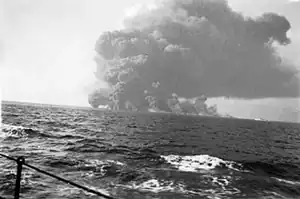 The column of smoke from Waimarama just after she exploded | |||||||
| |||||||
| Belligerents | |||||||
| Commanders and leaders | |||||||
| Strength | |||||||
|
| ||||||
| Casualties and losses | |||||||
|
| ||||||


Operation Pedestal was a British convoy operation to supply the island of Malta in August 1942, during the Second World War. This article lists the ships and aircraft involved in the convoy and those of the Axis forces that opposed it.
From 1940 to 1942, the Axis besieged Malta in what became known as the Siege of Malta (1940). The island was a crucial base for the British in the Mediterranean theatre of the war and could not produce sufficient foodstuffs for the population and the garrison without regular deliveries by ship of food, medicines, equipment and military stores. The island ceased to be an offensive base for much of 1942 and the failure of Operation Harpoon (12–15 June 1942 ) left Malta so short of supplies that its surrender was calculated in weeks. Pedestal was a maximum effort to supply Malta in which ships from the Home Fleet were dispatched to Gibraltar to reinforce Force H, for the convoy and for Operation Torch. The next scheduled Arctic convoy, Convoy PQ 19, was cancelled for lack escorts that had been diverted for Pedestal.[2]
The convoy sailed from Britain on 3 August 1942 and passed through the Strait of Gibraltar into the Mediterranean on the night of 9/10 August. Enough supplies were delivered for the population and the garrison on Malta to resume offensive operations. Fuel was carried by the US tanker Ohio, crewed by a British sailors, that reached Malta after an epic voyage, towed for much of the last leg by destroyers. Ohio sank in harbour but most of its fuel was recovered.[3] The Axis attempt to prevent the convoy reaching Malta, with bombers, German E-boats, Italian MAS and MS boats, minefields and submarine ambushes, was their last sizeable success in the Mediterranean.[4] More than 500 Merchant Navy and Royal Navy sailors and airmen were killed, nine of the thirteen merchant ships were sunk and the tanker Ohio was severely damaged.[5]
Pedestal was a costly strategic victory for the British. The arrival of Ohio justified the risks taken because its cargo of aviation fuel revitalised the Maltese air offensive against Axis shipping.[6] Submarines and torpedo-bombers returned to Malta and Spitfire fighters flown from the aircraft carrier HMS Furious enabled a maximum effort to be made against Axis ships. Italian convoys had to detour further away from the island, lengthening the journey and increasing the time during which air and naval attacks could be mounted. The Siege of Malta was broken by the Allied re-conquest of Egypt and Libya after the Second Battle of El Alamein (23 October – 11 November) and by Operation Torch (8–16 November) in the western Mediterranean, which enabled land-based aircraft to escort merchant ships to the island.[6]
Order of battle, Force F
Force P
| Ship | Year | Flag | GRT | Notes |
|---|---|---|---|---|
| SS Almeria Lykes | 1940 |  United States |
7,821 | Sunk by MAS 554, no casualties |
| MV Brisbane Star | 1936 |  United Kingdom |
11,076 | |
| MV Clan Ferguson | 1938 | United Kingdom |
7,347 | Sunk by aircraft, 18 killed |
| MV Deucalion | 1914 |  Netherlands |
1,796 | Sunk by aircraft, 1 killed |
| MV Dorset | 1934 | United Kingdom |
10,624 | Sunk by aircraft, no casualties |
| MV Empire Hope | 1941 | United Kingdom |
12,668 | Sunk by aircraft, no casualties |
| MV Glenorchy | 1939 | United Kingdom |
8,982 | Sunk by MS 31, 7 killed |
| MV Melbourne Star | 1936 | United Kingdom |
12,806 | |
| SS Ohio | 1940 | United Kingdom |
9,265 | Damaged by aircraft, 2 killed, sank in harbour |
| MV Port Chalmers | 1933 | United Kingdom |
8,535 | Convoy commodore A. G. Venables[8] |
| MV Rochester Castle | 1937 | United Kingdom |
7,795 | |
| SS Santa Elisa | 1940 | United States |
8,380 | Sunk by S 36, 4 killed |
| MV Waimarama | 1938 | United Kingdom |
12,843 | Sunk by aircraft, 83 killed |
| MV Wairangi | 1935 | United Kingdom |
10,796 | Sunk |
Ocean escort
Operation Berserk
Rendezvous for convoy and escort signalling and manoeuvre rehearsals, 6 to 9 August[10]
Force J
| Name | Flag | Type | Notes |
|---|---|---|---|
| HMS Eagle |  Royal Navy | Aircraft carrier | From Gibraltar |
| HMS Charybdis | Royal Navy | Dido-class cruiser | From Gibraltar |
| HMS Vansittart | Royal Navy | V-class destroyer | From Gibraltar |
| HMS Westcott | Royal Navy | W-class destroyer | From Gibraltar |
| HMS Wrestler | Royal Navy | W-class destroyer | From Gibraltar |
Force K
| Name | Flag | Type | Notes |
|---|---|---|---|
| HMS Indomitable | Royal Navy | Illustrious-class aircraft carrier | From Freetown |
| HMS Phoebe | Royal Navy | Dido-class cruiser | From Freetown |
| HMS Laforey | Royal Navy | L-class destroyer | From Freetown |
| HMS Lightning | Royal Navy | L-class destroyer | From Freetown |
| HMS Lookout | Royal Navy | L-class destroyer | From Freetown |
Force M
| Name | Flag | Type | Notes |
|---|---|---|---|
| HMS Argus | Royal Navy | Aircraft carrier | Flag, Rear-Admiral Lumley Lyster from Scapa Flow |
| HMS Victorious | Royal Navy | Illustrious-class aircraft carrier | Flag, Rear-Admiral Lumley Lyster from Scapa Flow |
| HMS Nelson | Royal Navy | Nelson-class battleship | Flag, Vice-Admiral Edward Syfret from Scapa Flow |
| HMS Rodney | Royal Navy | Nelson-class battleship | From Scapa Flow |
| HMS Sirius | Royal Navy | Dido-class cruiser | From Scapa Flow |
| HMS Foresight | Royal Navy | F-class destroyer | Minesweeper |
| HMS Fury | Royal Navy | F-class destroyer | Minesweeper |
| HMS Icarus | Royal Navy | I-class destroyer | Minesweeper |
| HMS Intrepid | Royal Navy | I-class destroyer | |
| HMS Sardonyx | Royal Navy | S-class destroyer | |
| HMS Buxton | Royal Navy | Town-class destroyer | From Scapa Flow |
Force W
| Name | Flag | Type | Notes |
|---|---|---|---|
| RFA Abbeydale |  Royal Navy | Dale-class oiler | |
| HMS Armeria | Royal Navy | Flower-class corvette | |
| HMS Burdock | Royal Navy | Flower-class corvette | |
Fleet Air Arm
| Squadron | Flag | Type | No. | Notes |
|---|---|---|---|---|
| 801 Naval Air Squadron | Royal Navy | Sea Hurricane | 16 | Embarked in HMS Eagle |
| 813 Naval Air Squadron | Royal Navy | Sea Hurricane | 4 | Embarked in HMS Eagle |
| 800 Naval Air Squadron | Royal Navy | Sea Hurricane | — | Embarked in HMS Indomitable |
| 806 Naval Air Squadron | Royal Navy | Martlet | 9 | Embarked in HMS Indomitable |
| 827 Naval Air Squadron | Royal Navy | Albacore | 16 | Embarked in HMS Indomitable |
| 831 Naval Air Squadron | Royal Navy | Albacore | — | Embarked in HMS Indomitable |
| 880 Naval Air Squadron | Royal Navy | Sea Hurricane | — | Embarked in HMS Indomitable |
| 809 Naval Air Squadron | Royal Navy | Fulmar | 8 | Embarked in HMS Victorious |
| 832 Naval Air Squadron | Royal Navy | Albacore | 12 | Embarked in HMS Victorious |
| 884 Naval Air Squadron | Royal Navy | Fulmar | 8 | Embarked in HMS Victorious |
| 885 Naval Air Squadron | Royal Navy | Sea Hurricane | 5 | Embarked in HMS Victorious |
| Squadron | Flag | Type | No. | Notes |
|---|---|---|---|---|
| 828 Naval Air Squadron | Royal Navy | Albacore | 27 | Based at RAF Hal Far, Malta |
| 830 Naval Air Squadron | Royal Navy | Swordfish | 1 | Based at RAF Hal Far, Malta |
Force R
| Name | Flag | Type | Notes |
|---|---|---|---|
| RFA Brown Ranger | Royal Fleet Auxiliary | Ranger-class tanker | |
| RFA Dingledale | Royal Fleet Auxiliary | Dale-class tanker | |
| HMS Coltsfoot | Royal Navy | Flower-class corvette | |
| HMS Geranium | Royal Navy | Flower-class corvette | |
| HMS Jonquil | Royal Navy | Flower-class corvette | |
| HMS Spiraea | Royal Navy | Flower-class corvette | |
| HMS Salvonia | Royal Navy | Ocean-going tug | |
Force X
| Name | Flag | Type | Notes |
|---|---|---|---|
| HMS Cairo | Royal Navy | C-class cruiser | Torpedoed 12 August, Axum, 37°40'N, 10°06'E, scuttled 13 August[16] |
| HMS Manchester | Royal Navy | Town-class cruiser | Torpedoed by MS boat, 36°50'N, 11°10'E, scuttled[16] |
| HMS Kenya | Royal Navy | Fiji-class cruiser | Damaged, 12 August, U-boats[17] |
| HMS Nigeria | Royal Navy | Fiji-class cruiser | Flag, Rear-Admiral Harold Burrough, damaged, 12 August, U-boat[17] |
| HMS Ashanti | Royal Navy | Tribal-class destroyer | 6th Destroyer Flotilla |
| HMS Foresight | Royal Navy | F-class destroyer | Torpedoed by aircraft, 12 August, 37°40'N, 10°00'E scuttled 13 August[16] |
| HMS Fury | Royal Navy | F-class destroyer | 6th Destroyer Flotilla |
| HMS Icarus | Royal Navy | I-class destroyer | 6th Destroyer Flotilla |
| HMS Intrepid | Royal Navy | I-class destroyer | 6th Destroyer Flotilla |
| HMS Pathfinder | Royal Navy | P-class destroyer | 6th Destroyer Flotilla |
| HMS Penn | Royal Navy | P-class destroyer | 6th Destroyer Flotilla |
| HMS Bicester | Royal Navy | Hunt-class destroyer | 6th Destroyer Flotilla |
| HMS Bramham | Royal Navy | Hunt-class destroyer | 6th Destroyer Flotilla |
| HMS Derwent | Royal Navy | Hunt-class destroyer | 6th Destroyer Flotilla |
| HMS Ledbury | Royal Navy | Hunt-class destroyer | 6th Destroyer Flotilla |
| HMS Jaunty | Royal Navy | Assurance-class tug | Ocean-going tug |
Force Y
Operation Ascendant
| Ship | Year | Flag | GRT | Notes |
|---|---|---|---|---|
| MV Orari | 1931 | United Kingdom |
10,350 | Reefer ship, empty since Operation Harpoon, returning from Malta to Gibraltar[18] |
| SS Troilus | 1921 | United Kingdom |
7,422 | Empty since Operation Harpoon, returning from Malta to Gibraltar[18] |
| Name | Flag | Type | Notes |
|---|---|---|---|
| HMS Matchless | Royal Navy | M-class destroyer | Escort |
| HMS Badsworth | Royal Navy | Hunt-class destroyer | Escort |
Force Z
Malta Escort Force
| Name | Flag | Type | Notes |
|---|---|---|---|
| HMS Hebe | Royal Navy | Halcyon-class minesweeper | 14th/17th Minesweeper Flotilla |
| HMS Hythe | Royal Navy | Halcyon-class minesweeper | 14th/17th Minesweeper Flotilla |
| HMS Rye | Royal Navy | Halcyon-class minesweeper | 14th/17th Minesweeper Flotilla |
| HMS Speedy | Royal Navy | Halcyon-class minesweeper | 14th/17th Minesweeper Flotilla |
| ML 121 | Royal Navy | Fairmile B motor launch | 3rd Motor Launch Flotilla |
| ML 126 | Royal Navy | Fairmile B motor launch | 3rd Motor Launch Flotilla |
| ML 134 | Royal Navy | Fairmile B motor launch | 3rd Motor Launch Flotilla |
| ML 135 | Royal Navy | Fairmile B motor launch | 3rd Motor Launch Flotilla |
| ML 168 | Royal Navy | Fairmile B motor launch | 3rd Motor Launch Flotilla |
| ML 459 | Royal Navy | Fairmile B motor launch | 3rd Motor Launch Flotilla |
| ML 462 | Royal Navy | Fairmile B motor launch | 3rd Motor Launch Flotilla |
10th Submarine Flotilla
| Name | Flag | Type | Notes |
|---|---|---|---|
| HMS P222 | Royal Navy | S-class submarine | Patrolling between Malta and Tunisia |
| HMS Safari | Royal Navy | S-class submarine | Patrolling off Milazzo |
| HMS P31 | Royal Navy | U-class submarine | Patrolling between Malta and Tunisia |
| HMS P34 | Royal Navy | U-class submarine | Patrolling between Malta and Tunisia |
| HMS Unbroken | Royal Navy | U-class submarine | Patrolling off Palermo |
| HMS United | Royal Navy | U-class submarine | Patrolling between Malta and Tunisia |
| HMS Unruffled | Royal Navy | U-class submarine | Patrolling between Malta and Tunisia |
| HMS Utmost | Royal Navy | U-class submarine | Patrolling between Malta and Tunisia |
Club Run to Malta
| Name | Flag | Type | Notes |
|---|---|---|---|
| HMS Furious | Royal Navy | Courageous-class aircraft carrier | 40 of 42 Spitfires, 38 to Malta, 2 early returns[a] |
| Squadron | Flag | Type | No. | Notes |
|---|---|---|---|---|
| — |  Royal Air Force | Spitfire VB | 42 | Embarked in HMS Furious |
| 823 Naval Air Squadron | Royal Navy | Albacore | 4 | Spare aircraft, embarked in HMS Furious |
Reserve Escort Group
| Name | Flag | Type | Notes |
|---|---|---|---|
| HMS Amazon | Royal Navy | Amazon-class destroyer | |
| HMS Keppel | Royal Navy | Shakespeare-class destroyer | |
| HMS Malcolm | Royal Navy | Scott-class destroyer | |
| HMS Venomous | Royal Navy | V-class destroyer | |
| HMS Vidette | Royal Navy | V-class destroyer | |
| HMS Westcott | Royal Navy | W-class destroyer | |
| HMS Wolverine | Royal Navy | W-class destroyer | |
| HMS Wrestler | Royal Navy | W-class destroyer | |
RAF Malta
| Squadron | Flag | Type | Role | Notes |
|---|---|---|---|---|
| 126 Squadron | Royal Air Force | Spitfire | Fighter | |
| 185 Squadron | Royal Air Force | Spitfire | Fighter | |
| 229 Squadron | Royal Air Force | Spitfire | Fighter | |
| 249 Squadron | Royal Air Force | Spitfire | Fighter | |
| 1435 Squadron | Royal Air Force | Spitfire | Fighter | |
| 235 Squadron | Royal Air Force | Beaufighter | Heavy fighter | |
| 248 Squadron | Royal Air Force | Beaufighter | Heavy fighter | |
| 252 Squadron | Royal Air Force | Beaufighter | Heavy fighter | |
| 89 Squadron | Royal Air Force | Beaufighter | Night fighter | |
| 39 Squadron | Royal Air Force | Beaufort | Torpedo-bomber | |
| 86 Squadron | Royal Air Force | Beaufort | Torpedo-bomber | |
| 217 Squadron | Royal Air Force | Beaufort | Torpedo-bomber | |
| 38 Squadron | Royal Air Force | Wellington | Night bomber | |
| 40 Squadron | Royal Air Force | Wellington | Night bomber | |
| 159 Squadron | Royal Air Force | Liberator | Night bomber | |
| 55 Squadron | Royal Air Force | Baltimore | Day bomber | |
| 69 Squadron | Royal Air Force | — | Reconnaissance | Baltimore, Wellington, PRU Spitfire |
| 203 Squadron | Royal Air Force | Maryland | Reconnaissance | RAF Middle East Command |
Operation MG 3
Convoy MW12a
| Ship | Year | Flag | GRT | Notes |
|---|---|---|---|---|
| SS City of Pretoria | 1937 | United Kingdom |
8,049 | |
| SS City of Lincoln | 1938 | United Kingdom |
8,039 | |
| MV City of Edinburgh | 1938 | United Kingdom |
8,036 | |
Escorts, Convoy MW 12a
Convoy MW 12b
| Ship | Year | Flag | GRT | Notes |
|---|---|---|---|---|
| SS Ajax | 1931 | United Kingdom |
7,540 | |
Escorts, Convoy MW 12b
Operation MG 4
| Name | Flag | Type | Notes |
|---|---|---|---|
| HMS Arethusa | Royal Navy | Arethusa-class cruiser | |
| HMS Dido | Royal Navy | Dido-class cruiser | |
| HMS Sikh | Royal Navy | Tribal-class destroyer | |
| HMS Zulu | Royal Navy | Tribal-class destroyer | |
| HMS Javelin | Royal Navy | J-class destroyer | |
| HMS Kelvin | Royal Navy | K-class destroyer | |
Axis order of battle
Axis submarines
| Name | Flag | Class | Notes |
|---|---|---|---|
| Asteria |  Kingdom of Italy |
Acciaio-class submarine | Patrol, west of Malta |
| Avorio | Kingdom of Italy |
Acciaio-class submarine | Patrol line, north of Tunisia, Cap Bon |
| Bronzo | Kingdom of Italy |
Acciaio-class submarine | Patrol line, north of Tunisia, Cap Bon |
| Cobalto | Kingdom of Italy |
Acciaio-class submarine | Patrol line, north of Tunisia, Cap Bon, rammed and sunk by Ithuriel[21] |
| Giada | Kingdom of Italy |
Acciaio-class submarine | Patrol line, Algiers to Balearics, damaged by Sunderlands, 12 August[21] |
| Granito | Kingdom of Italy |
Acciaio-class submarine | Patrol line, north of Tunisia, Cap Bon |
| Volframio | Kingdom of Italy |
Acciaio-class submarine | Patrol line, Algiers to Balearics |
| Alagi | Kingdom of Italy |
Adua-class submarine | Patrol line, north of Tunisia, Cap Bon |
| Ascianghi | Kingdom of Italy |
Adua-class submarine | Patrol line, north of Tunisia, Cap Bon |
| Axum | Kingdom of Italy |
Adua-class submarine | Patrol line, north of Tunisia, Cap Bon, torpedoed Cairo, Nigeria, Ohio[21] |
| Dagabur | Kingdom of Italy |
Adua-class submarine | Patrol line, Algiers to Balearics, sunk by Wolverine, 12 August[21] |
| Dessiè | Kingdom of Italy |
Adua-class submarine | Patrol line, north of Tunisia, Cap Bon |
| Uarsciek | Kingdom of Italy |
Adua-class submarine | Patrol line, Algiers to Balearics |
| Velella | Kingdom of Italy |
Argo-class submarine | |
| Brin | Kingdom of Italy |
Brin-class submarine | Patrol line, Algiers to Balearics |
| Otaria | Kingdom of Italy |
Glauco-class submarine | |
| Dandolo | Kingdom of Italy |
Marcello-class submarine | Patrol line, north of Tunisia, Cap Bon |
| Emo | Kingdom of Italy |
Marcello-class submarine | Patrol line, north of Tunisia, Cap Bon |
| U-73 |  Kriegsmarine |
Type VIIB submarine | Patrol line, Algiers to Balearics |
| U-205 | Kriegsmarine |
Type VIIC submarine | |
| U-333 | Kriegsmarine |
Type VIIC submarine | Patrol line, Algiers to Balearics |
Light forces
Axis air forces
| Name | Abbr. | English |
|---|---|---|
| Stormo | — | Usually two Gruppi of the same aircraft type |
| Gruppo | — | Two Squadriglie of multi-engined machines, three Squadriglie of single-engined aircraft |
| Squadra Aerea | — | Area command reporting to Comando Supremo in Rome |
| Autonomo | Aut. | Independent Gruppi and Squadriglie under Squadra command |
| Caccia Terrestre | C.T. | Land fighters |
| Caccia Marittima | C.M. | Maritime fighters |
| Bombardamento Terrestre | B.T. | Land bombers |
| Bombardamento Marittima | B.M. | Floatplanes |
| Bombardamento a Tuffo | B.a.T. | Dive bombers |
| Ricognizioni Marittima | R.M. | Reconnaissance Floatplanes |
| Ricognizione Strategica Terrestre | R.S.T. | Str R, Land Strategic Reconnaissance |
| Observazioni Aerea | O.A. | Tac R, Tactical reconnaissance |
| Aerosiluranti | A.S./Sil | Torpedo bomber |
Aeronautica Sardegna
| Gruppo | Flag | Squadriglie | Type | No. | Role | Base | Notes |
|---|---|---|---|---|---|---|---|
| 22° Gruppo | Kingdom of Italy | 359a, 362a | Re.2001 | 28 | Fighter | Elmas | |
| 24° Gruppo | Kingdom of Italy | 354a | CR.42, G.50 | 19/16 | Fighter | Elmas | |
| 51° Gruppo | Kingdom of Italy | 212a, 213a | Z.1007 | 7 | Bomber | Villacidro | |
| 65° Gruppo | Kingdom of Italy | 28a, 124a | Ro 37, Ca.314 | 24 | Torpedo-bomber | Alghero | |
| 89° Gruppo | Kingdom of Italy | 228a, 229a | SM.84sil | 13 | Torpedo-bomber | Villacidro | |
| 105° Gruppo | Kingdom of Italy | 254a, 255a | SM.79sil | 15 | Torpedo-bomber | Decimomannu | |
| 108° Gruppo | Kingdom of Italy | 256a, 257a | SM.84sil | 12 | Torpedo-bomber | Decimomannu | |
| 109° Gruppo | Kingdom of Italy | 258a, 259a | SM.84sil | 12 | Torpedo-bomber | Decimomannu | |
| 130° Gruppo | Kingdom of Italy | 280a, 283a | SM.79sil | 13 | Torpedo-bomber | Elmas | |
| 153° Gruppo | Kingdom of Italy | — | C.202 | 22 | Fighter | — | |
| 160° Gruppo | Kingdom of Italy | — | CR.42 | 16/9 | Fighter, Fighter-bomber | — | |
| Gruppo | Kingdom of Italy | 138a | Z.501, Ro.43 | 7/1 | Reconnaissance | Olbia | |
| Gruppo | Kingdom of Italy | 146a | Z.506 | 12 | Recce, ASR | Elmas | |
| Gruppo | Kingdom of Italy | 188a | Z501 | 3 | Recce, ASR | Elmas | |
| Gruppo | Kingdom of Italy | 287a | Z.506 | 7 | Recce, ASR | Elmas | |
| Gruppo | Kingdom of Italy | 613a | SM 66C, Z.506S | 5/1 | ASR | Elmas | |
| — | Kingdom of Italy | Gruppo | CR.42, G.50 | — | Night fighter | Elmas | |
Fliegerkorps II
| Unit | Flag | Type | No. | Role | Base | Notes |
|---|---|---|---|---|---|---|
| I(F) 122 |  Luftwaffe | Ju 88, Bf 109F | 7 | Long-range reconnaissance | Elmas/Catania | |
| I/JG 77 | Luftwaffe | Bf 109F | 13 | Fighter | Elmas | |
Axis air forces (Sicily)
Aeronautica Sicila
Fliegerkorps II
Aftermath
Analysis
German reports on 17 August claimed that all the tankers in the recent Mediterranean convoy had been sunk and none of the transports had reached their destination (assumed to be Egypt). The Allies had lost thirteen vessels, including nine merchantmen, one aircraft carrier (Eagle), two cruisers (Manchester and Cairo) and a destroyer (Foresight) but the Royal Navy and the Merchant Navy had saved Malta. The arrival of about 29,000 long tons (32,000 short tons) of general cargo, together with petrol, oil fuel, kerosene and diesel fuel, was enough to give the island about ten weeks' supply beyond the few weeks that the existing stocks would last. Axis propaganda broadcasts made extravagant claims but a Kriegsmarine report noted the incomplete and contradictory evidence, allowing only a provisional conclusion. The arrival of four merchant ships and a tanker was unsatisfactory, because the revival of Malta as an offensive base would affect Axis supply routes in what might be the "decisive phase of the struggle for North Africa". Supermarina reached the same conclusion and Generale Giuseppe Santoro, deputy chief of staff of the Regia Aeronautica, wrote that the British had achieved a strategic success by bringing Malta back into action "in the final phase of the struggle in Egypt".[37]
In August, with Malta still besieged, 35 per cent of Axis convoy shipping to North Africa was lost. Later that year, Admiral Eberhard Weichold summed up the Kriegsmarine view,
.... To the continental observer, the British losses seemed to represent a big victory for the Axis, but in reality the facts were quite different, since it had not been possible to prevent a British force, among which were five merchant vessels, from reaching Valetta.... Thanks to these new supplies Malta was now capable of fighting for several weeks, or, at a pinch, for several months. The main issue, the danger of air attack on the supply route to North Africa, remained. To achieve this objective no price was too high, and from this point of view the British operation, in spite of all the losses, was not a defeat, but a strategical failure of the first order by the Axis, the repercussions of which will one day be felt...
— Weichold[38]
In 1994, James Sadkovich wrote that Operation Pedestal was a tactical disaster for the British and that it was of a magnitude comparable to the German attack on Convoy PQ 17 about a month earlier.[39] In 2000, Richard Woodman called Operation Pedestal a strategic victory, raising the morale of the people and garrison of Malta, averting famine and an inevitable surrender.[40] In 2002, Giorgio Giorgerini wrote that the operation was an Italian success; Italian submarines had adopted more offensive tactics and sunk a cruiser and two merchantmen, damaged two cruisers and the tanker Ohio.[41] In 2002, Jack Greene and Alessandro Massignani called the convoy operation the last Axis victory in the Mediterranean but that it was a tactical not a strategic success. The arrival of Ohio justified the convoy despite the loss of nine of the merchant ships (one in Valletta harbour). Axis shipping had been suspended during the operation, partly because the transport Ogaden had been sunk off Derna on 12 August, by HMS Porpoise and after Ohio arrived, Axis ships had to make longer journeys. On 15 August, Lerici was also sunk by Porpoise and on 17 August, Pilo was sunk by aircraft and the tanker Pozarica was sunk on 21 August.[42]
Casualties
In 2003, Ian Malcolm listed 160 men killed on Eagle, 132 on Manchester, 52 on Nigeria, 50 on Indomitable, 24 on Cairo, five on Foresight and three men on Kenya. Merchant Navy casualties were 83 on Waimarama, eighteen on Clan Ferguson, seven on Glenorchy, five on Melbourne Star, four on Santa Elisa, one each on Deucalion, Ohio and Brisbane Star.[5] Ohio never sailed again and the British lost the carrier Eagle, the cruisers Manchester and Cairo and the destroyer Foresight. The carrier Indomitable, the cruisers Nigeria and Kenya and three destroyers were damaged and under repair for some time. On the Axis side, the Italian cruisers Bolzano and Muzio Attendolo were damaged and were not operational for the rest of the war, the Italian submarines Cobalto and Dagabur were sunk, the Italian submarine Giada and the German E-Boat S 58 were damaged.[43]
Fliegerkorps II sent 650 sorties against Pedestal from 11 to 14 August and claimed twelve aircraft shot down for eighteen losses. Total Axis losses were 62 aircraft, 42 Italian and 19 German, including losses on the ground and those shot down by their own side. Royal Navy gunners and FAA fighters claimed 74 aircraft shot down, against post-war data that they destroyed 42 Axis aircraft, 26 from the Regia Aeronautica and 16 Luftwaffe aircraft.[4] The FAA lost 13 aircraft on operations and 16 Sea Hurricanes when Eagle was sunk, the RAF lost a Beaufighter, five Spitfires and a Sunderland was shot down by Giada. The Allies could not risk such losses again and another large convoy to Malta was not attempted until November 1942, when the re-capture of airfields in Egypt and Libya after the Second Battle of El Alamein made it much easier to provide land-based air cover.[43][d]
Notes
- ↑ Furious made another Club Run. On 17 August 32 Spitfires were dispatched, 29 arriving at Malta. Furious returned to Gibraltar on 19 August.[24]
- ↑ On 10 August the RAF had 141 aircraft in Malta and on 14 August 186 were available.[17]
- ↑ Serviceable aircraft only.[35]
- ↑ In 1956, the official history gave FAA losses of 13 aircraft in action and 16 when Eagle was sunk, the RAF lost five aircraft and 35 Axis aircraft were shot down, including losses over Malta.[44]
See also
Footnotes
- ↑ Smith 1987, p. 226.
- ↑ Roskill 1956, p. 288.
- ↑ Roskill 1957, p. 298; Playfair 2004, pp. 324–325.
- 1 2 Greene & Massignani 2002, p. 261.
- 1 2 Malcolm 2013, pp. 74, 143, 146, 215, 228.
- 1 2 Roskill 1956, pp. 341–346.
- ↑ Smith 1987, p. 226; Woodman 2003, pp. 374–376; Hague 2000, pp. 192–193.
- ↑ Roskill 1956, p. 303.
- ↑ Woodman 2003, p. 499; Smith 1987, p. 229.
- 1 2 Woodman 2003, p. 499; Smith 1987, p. 227.
- 1 2 Smith 1987, p. 227; Woodman 2003, p. 499.
- ↑ Smith 1987, p. 229.
- 1 2 Smith 1987, p. 231; Woodman 2003, p. 499.
- 1 2 Woodman 2003, p. 379.
- ↑ Smith 1987, p. 228.
- 1 2 3 4 Brown 1995, p. 67.
- 1 2 3 Roskill 1956, Map 304–305.
- 1 2 Woodman 2003, pp. 379, 386; Jordan 2006, pp. 148, 166.
- ↑ Smith 1987, pp. 227, 229.
- ↑ Woodman 2003, pp. 381, 499.
- 1 2 3 4 5 6 Rohwer & Hümmelchen 2005, p. 186.
- ↑ Smith 1987, p. 230; Woodman 2003, p. 379.
- 1 2 Woodman 2003, p. 279.
- ↑ Roskill 1956, p. 308.
- ↑ Smith 1987, p. 231.
- ↑ Smith 1987, p. 232.
- ↑ Woodman 2003, p. 385; Jordan 2006, pp. 129, 130.
- 1 2 Woodman 2003, pp. 385, 500.
- ↑ Woodman 2003, pp. 221, 385; Jordan 2006, p. 148.
- ↑ Rohwer & Hümmelchen 2005, p. 187.
- ↑ Smith 1987, p. 233.
- ↑ Smith 1987, p. 234; Rohwer & Hümmelchen 2005, p. 187.
- ↑ Shores, Cull & Malizia 1987, p. xiii.
- ↑ Smith 1987, p. 236; Dunning 1998, pp. 190, 271.
- 1 2 3 Smith 1987, p. 237.
- ↑ Smith 1987, pp. 236–237; Dunning 1998, pp. 190, 271.
- ↑ Greene & Massignani 2002, pp. 261–262.
- ↑ Martienssen 1949, p. 132.
- ↑ Sadkovich 1994, p. 297.
- ↑ Woodman 2003, p. 456.
- ↑ Giorgerini 2002, pp. 333–339.
- ↑ Greene & Massignani 2002, pp. 260–261.
- 1 2 Rohwer & Hümmelchen 2005, pp. 186–187.
- ↑ Playfair 2004, pp. 321–322.
Bibliography
- Brown, David (1995) [1990]. Warship Losses of World War Two (pbk. repr. ed.). London: Arms and Armour Press. ISBN 0-85409-278-1.
- Dunning, Chris (1998). Courage Alone: The Italian Air Force 1940–1943. Aldershot: Hikoki. ISBN 1-902109-02-3.
- Giorgerini, Giorgio (2002). Uomini sul fondo: storia del sommergibilismo italiano dalle origini a oggi [Men on the Bottom: The Story of the Italian Submarine from Past to Present] (in Italian). Milano: Mondadori. ISBN 978-88-04-50537-2.
- Greene, J.; Massignani, A. (2002) [1998]. The Naval War in the Mediterranean 1940–1943 (pbk. ed.). Rochester: Chatham. ISBN 978-1-86176-190-3.
- Hague, A. (2000). The Allied Convoy System 1939–1945: Its Organization, Defence and Operation. London: Chatham. ISBN 1-86176-147-3.
- Jordan, Roger W. (2006) [1999]. The World's Merchant Fleets 1939: The Particulars and Wartime Fates of 6,000 Ships (2nd ed.). London: Chatham/Lionel Leventhal. ISBN 978-1-86176-293-1.
- Malcolm, Ian (2013). Shipping Company Losses of the Second World War. Stroud: The History Press. ISBN 978-0-7509-5371-9.
- Martienssen, A. K. (1949). Hitler and his Admirals. New York: E. P. Dutton. OCLC 562130.
- Playfair, Major-General I. S. O.; Flynn, Captain F. C. RN; Molony, Brigadier C. J. C.; Gleave, Group Captain T. P. (2004) [1960]. Butler, Sir James (ed.). The Mediterranean and Middle East: British Fortunes Reach Their Lowest Ebb (September 1941 to September 1942). History of the Second World War, United Kingdom Military Series. Vol. III (pbk. facs, repr Naval & Military Press, Uckfield ed.). London: HMSO. ISBN 978-1-84574-067-2.
- Rohwer, Jürgen; Hümmelchen, Gerhard (2005) [1972]. Chronology of the War at Sea, 1939–1945: The Naval History of World War Two (3rd rev. ed.). London: Chatham. ISBN 1-86176-257-7.
- Roskill, S. W. (1957) [1954]. Butler, J. R. M. (ed.). The Defensive. History of the Second World War United Kingdom Military Series: The War at Sea 1939–1945. Vol. I (4th impr. ed.). London: HMSO. OCLC 881709135. Archived from the original on 27 February 2022. Retrieved 21 December 2015 – via Hyperwar Foundation.
- Roskill, S. W. (1956). The Period of Balance. History of the Second World War United Kingdom Military Series: The War at Sea 1939–1945. Vol. II. London: HMSO. OCLC 174453986. Archived from the original on 6 March 2014. Retrieved 9 December 2015 – via Hyperwar Foundation.
- Sadkovich, James (1994). The Italian Navy in World War II. Westport, CN: Greenwood Press. ISBN 978-0-313-28797-8.
- Shores, Christopher; Cull, Brian; Malizia, Nicola (1987). Malta: The Hurricane Years 1940–41. London: Grub Street. ISBN 0-948817-06-2.
- Smith, Peter C. (1987). Pedestal: The Malta convoy of August 1942 (2nd rev. exp. ed.). London: William Kimber. ISBN 0-7183-0632-5.
- Woodman, Richard (2003). Malta Convoys, 1940–1943. John Murray. ISBN 978-0-7195-6408-6.
Further reading
- Crabb, Brian James (2014). Operation Pedestal: The story of Convoy WS21S in August 1942. Donington: Shaun Tyas. ISBN 978-1-907730-19-1.
- Llewellyn-Jones, M. (2007). The Royal Navy and the Mediterranean Convoys: A Naval Staff History. Naval Staff Histories. London: Routledge. ISBN 978-0-415-39095-8.

- World War II orders of battle
- Malta convoys
- 1942 in Malta
- August 1942 in Europe
- 1942 conflicts
- Aerial operations and battles of World War II involving the United Kingdom
- Italian naval victories in the battle of the Mediterranean
- Naval battles of World War II involving Italy
- Naval aviation operations and battles of World War II
- Naval battles and operations of the European theatre of World War II
- Naval battles and operations of World War II involving the United Kingdom
- WS (Winston Special) Convoys