OGLE-2005-BLG-169Lb
| Discovery | |
|---|---|
| Discovered by | MicroFUN, PLANET/RoboNet, OGLE |
| Discovery date | 10 March 2006 |
| Gravitational microlensing | |
| Orbital characteristics | |
| Star | OGLE-2005-BLG-169L |
| Physical characteristics | |
| Mass | 13.2±1.3 M🜨[1] |
| Temperature | ~70 K |
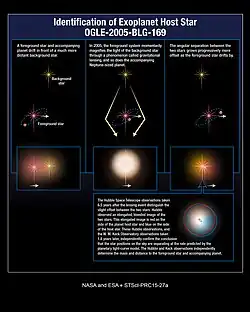
OGLE-2005-BLG-169Lb is an extrasolar planet located approximately 2,700 parsecs (8,800 light-years) away in the constellation of Sagittarius, orbiting the star OGLE-2005-BLG-169L. This planet was discovered by the OGLE project using the gravitational microlensing method. Based on a most likely mass for the host star of 0.49 solar mass (M☉), the planet has a mass of 13 times that of Earth (M🜨). Its mass and estimated temperature are close to those of Uranus. It is speculated that this planet may either be an ice giant like Uranus, or a "naked super-Earth" with a solid icy or rocky surface.[2][3]
See also
References
- ↑ Batista, V.; et al. (July 30, 2015). "CONFIRMATION OF THE OGLE-2005-BLG-169 PLANET SIGNATURE AND ITS CHARACTERISTICS WITH LENS–SOURCE PROPER MOTION DETECTION". The Astrophysical Journal. 808 (2): 170. arXiv:1507.08914. Bibcode:2015ApJ...808..170B. doi:10.1088/0004-637X/808/2/170. S2CID 119212954.
- ↑ Gould, A.; Udalski, A.; et al. (May 24, 2006). "Microlens OGLE-2005-BLG-169 Implies That Cool Neptune-like Planets Are Common". The Astrophysical Journal. 644 (1): L37. arXiv:astro-ph/0603276. Bibcode:2006ApJ...644L..37G. doi:10.1086/505421. S2CID 14270439.
- ↑ Quick, Lynnae C.; Roberge, Aki.; Mendoza, Guadalupe Tovar; Quintana, Elisa V.; Youngblood, Allison A. (4 October 2023). "Prospects for Cryovolcanic Activity on Cold Ocean Planets". The Astrophysical Journal. 956 (29): 29. Bibcode:2023ApJ...956...29Q. doi:10.3847/1538-4357/ace9b6.
- ↑ "Identifying Planets". Retrieved 3 August 2015.
External links
- "OGLE-05-169L". Exoplanets. Archived from the original on 2010-03-18. Retrieved 2008-08-22.
- "Newfound Ice World Alters Perceptions of Planetary Systems". SPACE.com. 13 March 2006. Retrieved 2008-08-22.
- "MICROLENSING EVENT OGLE-2005-blg-169". PLANET/RoboNet microlensing campaign. Archived from the original on September 30, 2007. Retrieved 2008-08-22.
