Northern Zaza
| Northern Zaza | |
|---|---|
| Pronunciation | Zaza pronunciation: [dɪmɪlki] |
| Native to | Turkey |
| Region | Parts of eastern, central and northeastern parts of Anatolia |
| Ethnicity | Zazas |
Native speakers | 0.2 million[1] (2016) |
| Dialects | Tunceli Varto |
| Latin script | |
| Language codes | |
| ISO 639-2 | kiu |
| ISO 639-3 | kiu |
| Glottolog | kirm1248 |
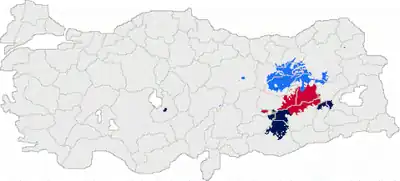 Northern Zaza, shaded in light blue | |
Northern Zaza, is one of the three primary dialects of the Zaza language, spoken by the Zaza people.[3][4][5][6][7][8][9][10][11] The dialect is also referred to as Zonê Ma, Kırmancki, So-Bê, Dımılki, Zazaki, Dersimki, Dersimce or Alevice by its speakers.[3][12]
Classification
Glottolog classifies Northern Zaza within the Adharic subgroup of the Northwestern Iranian languages branch of the Iranian languages. Northern Zaza consists of two sub-dialects, Tunceli and Varto:[13]
- Northwestern Iranian
- Adharic
- Adhari (Old Azeri)
- Zaza (Zaza)
- Southern Zaza
- Northern Zaza
- Tatic (Tati-Talysh)
- Gurani
- Adharic
History
While early linguistic investigations of Zaza primarily concentrated on the Southern dialect, it is noteworthy that the Armenian traveler Andranik, during his late 19th-century regional travels, documented vocabulary and expressions from the Dersim dialect of Northern Zaza within his work.[14]
Speakers
Northern Zaza is spoken predominantly in Erzincan, Kemah, Aşkale, Hozat, Hınıs, Kelkit, Nazimiye, Ovacık, Pülümür, Tekman, Tercan, Varto, Zara, Çayırlı and Yayladere.[11] Speakers of Northern Zaza adhere to the doctrines of Zaza Alevism.[15][16] The number of Northern Zaza speakers was estimated to be around 0.2 million people in 2016.[17]
Grammar
Northern Zaza differs from other dialects of Zaza in phonological, morphological, syntactic, and lexical aspects. The dialect exhibits significant innovations, most notably within its phonological system. Sustained centuries-long cohabitation and sociocultural contact between Zazas and Armenians in Eastern Anatolia have resulted in significant phonological restructuring of Northern Zaza, aligning it with Armenian patterns.[18] Compared to other dialects of the language, the least difference is found in its syntax, while the most significant differences are found in phonology. The phonological changes between s and š, c and g and č and k are noteworthy.[11][19] Morphologically, the feminine suffix is realized as an unstressed /-e/ in Northern Zaza, whereas it is realized as /-ı/ in Southern Zaza.[20]
References
- ↑ "Zazaki, Northern". Ethnologue. 2016. Archived from the original on 5 June 2019.
- ↑ Hammarström, Harald; Forkel, Robert; Haspelmath, Martin (eds.). "Dimli". Glottolog . Jena, Germany: Max Planck Institute for the Science of Human History.
- 1 2 "Zazaki, Northern". Ethnologue. 2025. Retrieved 20 December 2025.
- ↑ Hammarström, Harald; Forkel, Robert; Haspelmath, Martin (eds.). "Kirmanjki". Glottolog . Jena, Germany: Max Planck Institute for the Science of Human History.
- ↑ "639 Identifier Documentation: zza Zaza [zza]". SIL International. 2008. Retrieved 6 May 2024.
- ↑ Paul, Ludwig (2009). "Zazaki". In Windfuhr, Gernot (ed.). The Iranian Languages. New York: Routledge. pp. 546, 554. ISBN 978-0-7007-1131-4.
- ↑ Selcan, Zülfü (1998). Grammatik der Zaza-Sprache Nord-Dialekt (Dersim-Dialekt) [Grammar of the Zaza language, Northern dialect (Dersim dialect)] (in German). Berlin: Wissenschaft & Technik Verlag. p. 135. ISBN 3-928943-96-0.
...wurden zwei hauptdialekte der Zaza-Sprache festgestellt: ein Nord Dialekt und en Süddialekt.
- ↑ Arslan, İlyas (2016). Verbfunktionalität und Ergativität in der Zaza-Sprache (PhD thesis). Köln: Universität Düsseldorf. p. 11.
- ↑ Arslan, İlyas (2018). "Zaza Dilinde Lehçe Farklılıkları" [The Dialectological Differences Of Zaza Language]. Bingöl Üniversitesi Yaşayan Diller Enstitüsü Dergisi. 4 (4): 6–7 – via Bingöl Üniversitesi Yaşayan Diller Enstitüsü.
- ↑ Werner, Brigitte (2012). "Morphological Sketch of Southern Zazaki (spoken in the area of Çermik, Çüngüş, Siverek and Gerger)" (PDF). Zazaki.de. SIL International. p. 4. Retrieved 1 February 2026.
- 1 2 3 Keskin, Mesut (2015). "Zaza Dili (Zaza Language)". Bingöl Üniversitesi Yaşayan Diller Enstitüsü Dergisi. 1 (1): 94-95, 101-102.
- ↑ Aratemür, Yaşar (2025). Sprachatlas Der Zaza-Sprache: Lautgeographie Des Zazaki. Leiden: Brill. p. 323. ISBN 978-90-04-74621-3.
- ↑ Hammarström, Harald; Forkel, Robert; Haspelmath, Martin, eds. (2026). "Zaza". Glottolog 5.3. Jena, Germany: Max Planck Institute for the Science of Human History.
- ↑ Andranik (2023), Hakobian, Gohar G. (ed.), Dersim: Journey and Topography, Iran and the Caucasus Monographs, Leiden-Boston: Brill, ISBN 978-90-04-67775-3
- ↑ Andrews, Peter Alford (1989). Ethnic Groups in the Republic of Turkey. Wiesbaden: Reichert Verlag. p. 171.
{{cite book}}: CS1 maint: date and year (link) - ↑ Werner (2017), p. 67.
- ↑ "Zazaki, Northern". Ethnologue. 2016. Archived from the original on 5 June 2019.
- ↑ Gippert, Jost (2008). "Zur dialektalen Stellung des Zazaki". Die Sprache. 47 (1): 101–103.
- ↑ Arslan, İlyas (2018). "Zaza Dilinde Lehçe Farklılıkları" [The Dialectological Differences Of Zaza Language]. Bingöl Üniversitesi Yaşayan Diller Enstitüsü Dergisi. 4 (4): 54–55 – via Bingöl Üniversitesi Yaşayan Diller Enstitüsü.
- ↑ Hayıg, Roşan; Werner, Brigitte (2012). Zazaca-Türkçe Sözlük ; Türkçe-Zazaca Sözcük Listesi (Çermik – Çüngüş – Siverek – Gerger Bölgeleri) [Zaza-Turkish Dictionary; Turkish-Zaza Word List (Çermik - Çüngüş - Siverek - Gerger Regions)] (in Turkish). Istanbul: Tij Yayınları. p. 421.