| normal-inverse-Wishart |
|---|
| Notation |
 |
|---|
| Parameters |
 location (vector of real)
 (real)
 inverse scale matrix (pos. def.)
 (real) |
|---|
| Support |
 covariance matrix (pos. def.) |
|---|
| PDF |
 |
|---|
In probability theory and statistics, the normal-inverse-Wishart distribution (or Gaussian-inverse-Wishart distribution) is a multivariate four-parameter family of continuous probability distributions. It is the conjugate prior of a multivariate normal distribution with an unknown mean and covariance matrix (the inverse of the precision matrix).[1]
Definition
Suppose
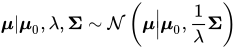
has a multivariate normal distribution with mean  and covariance matrix
 , where

has an inverse Wishart distribution. Then  has a normal-inverse-Wishart distribution, denoted as

Characterization
Probability density function

The full version of the PDF is as follows:[2]

Here  is the multivariate gamma function and
 is the Trace of the given matrix.
Posterior distribution of the parameters
Suppose the sampling density is a multivariate normal distribution

where  is an
 matrix and
 (of length
 ) is row
 of the matrix .
With the mean and covariance matrix of the sampling distribution is unknown, we can place a Normal-Inverse-Wishart prior on the mean and covariance parameters jointly
The resulting posterior distribution for the mean and covariance matrix will also be a Normal-Inverse-Wishart

where


 .
To sample from the joint posterior of , one simply draws samples from  , then draw
 . To draw from the posterior predictive of a new observation, draw
 , given the already drawn values of
 and
 .[3]
- The normal-Wishart distribution is essentially the same distribution parameterized by precision rather than variance. If then
 .
- The normal-inverse-gamma distribution is the one-dimensional equivalent.
- The multivariate normal distribution and inverse Wishart distribution are the component distributions out of which this distribution is made.
Notes
- ↑ Murphy, Kevin P. (2007). "Conjugate Bayesian analysis of the Gaussian distribution."
- ↑ Simon J.D. Prince(June 2012). Computer Vision: Models, Learning, and Inference. Cambridge University Press. 3.8: "Normal inverse Wishart distribution".
- ↑ Gelman, Andrew, et al. Bayesian data analysis. Vol. 2, p.73. Boca Raton, FL, USA: Chapman & Hall/CRC, 2014.
References
- Bishop, Christopher M. (2006). Pattern Recognition and Machine Learning. Springer Science+Business Media.
- Murphy, Kevin P. (2007). "Conjugate Bayesian analysis of the Gaussian distribution."
|
|---|
Discrete
univariate | with finite
support | |
|---|
with infinite
support | |
|---|
|
|---|
Continuous
univariate | supported on a
bounded interval | |
|---|
supported on a
semi-infinite
interval | |
|---|
supported
on the whole
real line | |
|---|
with support
whose type varies | |
|---|
|
|---|
Mixed
univariate | |
|---|
Multivariate
(joint) | |
|---|
| Directional | |
|---|
Degenerate
and singular | |
|---|
| Families | |
|---|
|


