Nannophya
| Nannophya | |
|---|---|
 | |
| Nannophya pygmaea | |
Scientific classification  | |
| Kingdom: | Animalia |
| Phylum: | Arthropoda |
| Clade: | Pancrustacea |
| Class: | Insecta |
| Order: | Odonata |
| Infraorder: | Anisoptera |
| Superfamily: | Libelluloidea |
| Family: | Libellulidae |
| Subfamily: | Brachydiplacinae |
| Genus: | Nannophya Rambur, 1842[1] |
| Synonyms[2] | |
| |
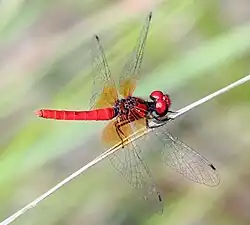
Nannophya is a genus of dragonfly in the family Libellulidae.[2] They are found in Asia and Australia.[3] They are commonly known as Pygmyflies. Species of Nannophya are small to tiny dragonflies often brightly coloured.[4] It includes Nannophya pygmaea, the scarlet dwarf, which is considered to be the world's smallest dragonfly.
Etymology
The genus name Nannophya combines the Greek νάννος (nannos, "dwarf") with φυή (phyē, "form", "stature" or "growth"). The name refers to the small size of members of the genus. Other dragonfly genera later using the root -phya include Archaeophya, Austrophya, Cordulephya and Metaphya.[1][5]
Species
The genus Nannophya includes the following species:[6]
| Male | Female | Scientific name | Common name | Distribution |
|---|---|---|---|---|
 | Nannophya australis Brauer, 1865 | Australian pygmyfly | eastern Australia | |
 | Nannophya dalei (Tillyard, 1908) | Eastern Pygmyfly[7] | south-eastern Australia | |
 | Nannophya fenshami Theischinger, 2020 | Artesian Pygmyfly[4] | Central Queensland, Australia. | |
| Nannophya katrainensis Singh, 1955 | Himalayas | |||
| Nannophya occidentalis (Tillyard, 1908) | Western Pygmyfly[8] | south-western Australia | ||
| Nannophya paulsoni Theischinger, 2003 | Scarlet Pygmyfly[4] | northern Australia | ||
 |  | Nannophya pygmaea Rambur, 1842 | Scarlet dwarf | Southeast Asia to China and Japan, south to Australia. |
References
- 1 2 Rambur, Jules (1842). Histoire naturelle des insectes. Névroptères (in French). Paris: Librairie Encyclopédique de Roret. pp. 534 [27] – via Gallica.
- 1 2 "Genus Nannophya Rambur, 1842". Australian Faunal Directory. Australian Biological Resources Study. 2012. Retrieved 25 February 2017.
- ↑ Watson, J.A.L.; Theischinger, G.; Abbey, H.M. (1991). The Australian Dragonflies: A Guide to the Identification, Distributions and Habitats of Australian Odonata. Melbourne: CSIRO. p. 278. ISBN 0-643-05136-8.
- 1 2 3 Theischinger, Günther; Hawking, John; Orr, Albert (2021). The Complete Field Guide to Dragonflies of Australia (2nd ed.). Melbourne, Victoria, Australia: CSIRO Publishing. ISBN 978-1-48631-374-7.
- ↑ Endersby, Ian; Fliedner, Heinrich (2015). The Naming of Australia's Dragonflies. Eltham, Victoria, Australia: Busybird Publishing. ISBN 9781925260625.
- ↑ Paulson, D.; Schorr, M.; Abbott, J.; Bota-Sierra, C.; Deliry, C.; Dijkstra, K.-D.; Lozano, F. "World Odonata List". OdonataCentral. University of Alabama.
- ↑ Hawking, J. (2009). "Nannophya dalei". IUCN Red List of Threatened Species. 2009 e.T163528A5611834. doi:10.2305/IUCN.UK.2009-2.RLTS.T163528A5611834.en. Retrieved 24 December 2017.
- ↑ Hawking, J. (2009). "Nannophya occidentalis". IUCN Red List of Threatened Species. 2009 e.T163540A5613560. doi:10.2305/IUCN.UK.2009-2.RLTS.T163540A5613560.en. Retrieved 24 December 2017.

Wikimedia Commons has media related to Nannophya.

Wikispecies has information related to Nannophya.