My Cousin Rachel (1952 film)
| My Cousin Rachel | |
|---|---|
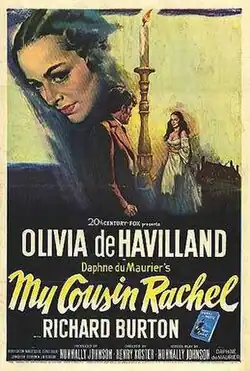 Original film poster | |
| Directed by | Henry Koster |
| Written by | Nunnally Johnson |
| Based on | |
| Produced by | Nunnally Johnson |
| Starring | Richard Burton Olivia de Havilland Audrey Dalton |
| Cinematography | Joseph LaShelle |
| Edited by | Louis R. Loeffler |
| Music by | Franz Waxman |
Production company | |
| Distributed by | Twentieth Century-Fox |
Release date |
|
Running time | 98 minutes |
| Country | United States |
| Language | English |
| Budget | $1.2 million[2] |
| Box office | $1.3 million (U.S. rentals)[3] |
My Cousin Rachel is a 1952 American romantic mystery film directed by Henry Koster and starring Olivia de Havilland, Richard Burton, Audrey Dalton, Ronald Squire, George Dolenz and John Sutton. The film is based on the 1951 novel of the same title by Daphne du Maurier.
Plot

On the coast of Cornwall, young Philip Ashley is raised by his older, wealthy cousin Ambrose on a large estate. When the weather threatens Ambrose's health, he moves to Florence, leaving Philip behind with his godfather Nick Kendall. In Florence, Ambrose decides to marry his cousin Rachel. However, back in Cornwall, Philip receives disturbing letters from Ambrose, complaining of Rachel's treatment as well as that of his physicians. Mr. Kendall believes that Ambrose is of unsound mind and may have inherited his dead father's brain tumor. Philip travels to Florence and meets Guido Rainaldi, who informs him that Ambrose has died of a brain tumor, producing a death certificate as proof, and that Ambrose's will left the Cornwall estate to Philip upon his 25th birthday. Rachel, who left Florence the day before Philip arrived, has inherited nothing and has no claim on the estate. Philip suspects Rachel of murder and vows revenge.

Months later, Rachel visits Cornwall and Philip invites her to the house. He discovers she is different from what he had imagined: beautiful, ladylike and kind. When she intends to leave, he shows her Ambrose's letters and admits that he planned to accuse her of wrongdoing, but as he no longer suspects her, he throws the letters in the fireplace to demonstrate his faith in her. He later instructs his executor, Mr. Kendall, to award Rachel a generous allowance of £5,000 per year, suggesting that the money is hers anyway. Rachel responds with gratitude and warmth and stays at the estate for an extended period, despite gossip. Yet when Mr. Kendall tells Philip that Rachel has overdrawn her accounts and she was notorious for "loose" living in Florence, Philip rejects Nick's warnings and instead cedes the entire estate to Rachel on his 25th birthday. When the day arrives, he solicits from her a vague romantic promise, which she gives, and they passionately kiss. However, the next day when Philip announces to his friends that he and Rachel are engaged to be wed, Rachel dismisses the announcement as lunacy. Rachel later tells Philip that her promise did not mean marriage, that she will never marry him and she only showed him love the because of the wealth that has given her.
Emotionally devastated, Philip succumbs to bouts of fever and delirium, but Rachel nurses him back to health. In his fever, Philip imagines a wedding with Rachel and awakens three weeks later convinced they are married and surprised to hear that she intends to return to Florence. Before she leaves, Philip becomes convinced that Rachel is attempting to poison him and that she had indeed murdered Ambrose. So great is his anger toward Rachel that he neglects to warn her about a footbridge in need of repair at the edge of the estate. Instead, Philip and his friend Louise secretly rummage through Rachel's room for a letter from Rainaldi, assuming that it will incriminate Rachel. Instead, upon discovering and reading the letter, they learn that Rainaldi merely discussed Rachel's affections for Philip and suggests that she bring Philip when visiting Florence.
Philip finds that Rachel has indeed suffered a fatal accident while crossing the unrepaired footbridge. With her last words, she asks Philip why he did not warn her of the danger. She then dies, leaving Philip to wonder for the rest of his life about his own guilt about the death of the innocent Rachel.
Cast

- Olivia de Havilland as Rachel Sangalletti Ashley
- Richard Burton as Philip Ashley
- Audrey Dalton as Louise Kendall
- Ronald Squire as Nicholas Kendall
- George Dolenz as Guido Rainaldi
- John Sutton as Ambrose Ashley
- Tudor Owen as Seecombe
- J. M. Kerrigan as Reverend Pascoe
- Margaret Brewster as Mrs. Pascoe
- Alma Lawton as Mary Pascoe
- Ola Lorraine as Pascoe Daughter
- Kathleen Mason as Pascoe Daughter
- Earl Robie as Philip at Age 5
- Argentina Brunetti as Signora
- Mario Siletti as Caretaker
Production
The story was remade My Cousin Rachel in 2017 starring Rachel Weisz and Sam Claflin.
Daphne du Maurier's agent initially attempted to sell a film adaptation her novel My Cousin Rachel for $100,000, as well as 5% of the international box office. This offer was initially rejected by every major studio, but Twentieth Century-Fox obtained the rights in September 1951 for $80,000[4] and secured George Cukor as director.[5] However, du Maurier and Cukor reviewed a screenplay draft and found it unfaithful to the novel.[6] Cukor disapproved of the comedic additions, and without achieving his desired revisions to the screenplay, withdrew in late May 1952.[7] Fox's press release explained his departure as the result of "artistic differences".[6] Fox pursued George Stevens, who was busy directing Shane, and then Carol Reed,[8] with Henry Koster named the director in June.[9]
Although she had no influence on casting, du Maurier wanted either Greta Garbo or Vivien Leigh to star as Rachel.[10] Garbo, who had not appeared on screen since Two-Faced Woman in 1941, was tempted to accept the role but was concerned that she would appear old to moviegoers and tarnish the memory of her beauty.[11] Greer Garson was rumored to be interested in the part.[12] After months of negotiation, Olivia de Havilland agreed to take the role in May 1952,[13] marking her first screen appearance since The Heiress (1949).[5] My Cousin Rachel also marked Burton's first starring role in an American film.[14] Although uninterested in the novel or screenplay, Burton accepted the role because of his respect for Cukor, and he traveled to New York for production.[15] Background shots were filmed in Cornwall, where the story is set.[4]
Before agreeing to appear in the film, Burton demanded a fee of £7,000 (equivalent to $175,362 in 2025, approximately $18,000 at the time). He was surprised when Fox offered him $50,000. Burton was disappointed with de Havilland's behavior. According to Burton, she had asked Koster to inform everyone on the set that she was to be addressed as Miss de Havilland instead of the more informal Livvie, a nickname that had been used by her previous coworkers.[16]
Reception

In a contemporary review for The New York Times, critic Bosley Crowther called the film an "excellent screen adaptation ... masterfully mounted and staged" and wrote of the film's mystery theme:
This impulse of ambiguity, which runs all the way through the film and endows it with constant fascination and uninhibited suspense, considerably obliterates the effect when it crashes against the stone wall of the author's deliberate admission of inconclusiveness. And as one searches back through the complex of personality revelations and clues, one finds that the story is little but a package of deceptions and tricks. However, so long as it is spinning—and spin it most certainly does—this nineteenth century adventure provides some delicious thrills.[1]
Critic Philip K. Scheuer of the Los Angeles Times wrote:
I hesitate to intrude so coarse and plebeian a word as 'gimmick'—but that's what it amounts to, this device of Miss du Maurier's. As such, it is likely to react to the film's disfavor, at least among the literal minded. All too quickly they may forget that if they are bothered and bewildered at the close, they have also been bewitched for an hour and a half. ... Miss de Havilland charms even as she baffles. She is like steel sheathed in silk, soft but unyielding. Like Burton, we succumb to her femininity; and around Rachel, ''succumb" is a dangerous word.[17]
Daphne du Maurier was disappointed with the finished film, feeling that de Havilland's portrayal of Rachel lost the mystery that defined the character and disliking her hairstyle, comparing it to that of Wallis Simpson.[18]
Awards
| Award | Category | Nominee(s) | Result | Ref. |
|---|---|---|---|---|
| Academy Awards | Best Supporting Actor | Richard Burton[14] | Nominated | [19] [20] |
| Best Art Direction – Black-and-White | Art Direction: Lyle R. Wheeler and John DeCuir;
Set Decoration: Walter M. Scott |
Nominated | ||
| Best Cinematography – Black-and-White | Joseph LaShelle | Nominated | ||
| Best Costume Design – Black-and-White | Charles LeMaire and Dorothy Jeakins | Nominated | ||
| Golden Globe Awards | Best Actress in a Motion Picture – Drama | Olivia de Havilland | Nominated | [21] |
| Most Promising Newcomer – Male | Richard Burton | Won |
Legacy
A 1983 BBC television version of My Cousin Rachel was directed by Brian Farnham, with Geraldine Chaplin as Rachel.[22]
The film was remade in 2017, with Roger Michell as director and Rachel Weisz as the title character.[23] The 2017 version followed a trend of contemporary adaptations of du Maurier's works.[24]
References
- 1 2 Crowther, Bosley (26 December 1952). "The Screen: 6 New Films for Christmas". The New York Times. p. 20.
- ↑ Solomon 1989, p. 248.
- ↑ "Top Grossers of 1953". Variety. 193 (6): 10–11. 13 January 1954.
- 1 2 "My Cousin Rachel (1953)". Turner Classic Movies. Archived from the original on 15 July 2012. Retrieved 12 May 2017.
- 1 2 Bubbeo 2001, p. 67.
- 1 2 Levy 1994, p. 208.
- ↑ Hopper, Hedda (28 May 1952). "Martin, Lewis to Star in 'Caddy,' Golf Story". Los Angeles Times. p. 8, Part III.
- ↑ Hopper, Hedda (6 June 1952). "Jean Simmons Named 'Murder' Femme Star". Los Angeles Times. p. 8, Part III.
- ↑ Hopper, Hedda (13 June 1952). "Jane Russell, Mature Team in 'Split Second'". Los Angeles Times. p. 8, Part III.
- ↑ Harris, Radie (23 March 1952). "Mad-hattan Diary Takes Columnist to Celebrity Row". Los Angeles Times. p. 2, Part IV.
- ↑ Hopper, Hedda (1 May 1952). "Mitchum to Interrupt Rest for Doctor Role". Los Angeles Times. p. 10, Part III.
- ↑ Schallert, Edwin (8 April 1952). "Mitchum to Get $25,000 Weekly as Rodeo Star; Lund May Write and Act". Los Angeles Times. p. 7, Part III.
- ↑ Hopper, Hedda (30 May 1952). "Olivia de Havilland to Star in 'Cousin Rachel'". Los Angeles Times. p. 4, Part III.
- 1 2 Auerbach 2002, p. 129.
- ↑ Bragg 2012.
- ↑ Burton, Richard (2012). Williams, Chris (ed.). The Richard Burton Diaries. New Haven, Connecticut: Yale University Press. ISBN 978-0-300-18010-7. LCCN 2012023966.
- ↑ Scheuer, Philip K. (26 December 1952). "'Cousin Rachel' Poses Question of Her Guilt". Los Angeles Times. p. 5, Part III.
- ↑ De Rosnay 2017, p. 216.
- ↑ "The 25th Academy Awards (1953) Nominees and Winners". Academy of Motion Picture Arts and Sciences. Archived from the original on 6 July 2011. Retrieved 20 August 2011.
- ↑ "My Cousin Rachel (1952)". Movies & TV Dept. The New York Times. 2012. Archived from the original on 15 July 2012. Retrieved 21 December 2008.
- ↑ "My Cousin Rachel". Golden Globe Awards. Retrieved 16 December 2024.
- ↑ Auerbach 2002, p. 130.
- ↑ White, Adam (25 January 2017). "My Cousin Rachel: Rachel Weisz arouses Sam Claflin's suspicions in the first trailer". The Daily Telegraph. Retrieved 12 May 2017.
- ↑ Blumsom, Amy (13 May 2016). "Exclusive: First look at Sam Claflin and Rachel Weisz in Daphne Du Maurier's My Cousin Rachel". The Daily Telegraph. Retrieved 12 May 2017.
Bibliography
- Auerbach, Nina (2002). Daphne Du Maurier, Haunted Heiress. University of Pennsylvania Press. ISBN 0812218361.
- Bragg, Melvyn (2012). "Feb. 7". Rich: The Life of Richard Burton. Hodder & Stoughton. ISBN 978-1444758467.
- Bubbeo, Daniel (2001). The Women of Warner Brothers: The Lives and Careers of 15 Leading Ladies, with Filmographies for Each. McFarland & Co. ISBN 0786462361.
- De Rosnay, Tatiana (2017). "Part IV: Cornwall, 1943". Manderley Forever: A Biography of Daphne du Maurier. Translated by Sam Taylor. New York: St. Martin's Press. ISBN 978-1250099150.
- Koster, Henry (2005). "More Lovable Than Tough". Just Making Movies: Company Directors on the Studio System. Jackson, Mississippi: University Press of Mississippi. ISBN 1617033642.
- Levy, Emanuel (1994). George Cukor: Master of Elegance: Hollywood's Legendary Director and His Stars. William Morrow and Company. ISBN 0688112463.
- Solomon, Aubrey (1989). Twentieth Century Fox: A Corporate and Financial History. Lanham, Maryland: Scarecrow Press. ISBN 978-0-8108-4244-1.
External links

- My Cousin Rachel at IMDb
- My Cousin Rachel at AllMovie
- My Cousin Rachel at the TCM Movie Database (archived)
- My Cousin Rachel at the AFI Catalog of Feature Films
- 1952 films
- 1950s historical romance films
- 1952 mystery films
- 1952 romantic drama films
- 20th Century Fox films
- Films based on works by Daphne du Maurier
- American black-and-white films
- American mystery films
- American romantic drama films
- 1952 English-language films
- Films about cousins
- Films directed by Henry Koster
- Films produced by Nunnally Johnson
- Films set in Cornwall
- Films set in the 19th century
- Films scored by Franz Waxman
- Films with screenplays by Nunnally Johnson
- Gothic films
- American historical romance films
- 1952 American films
- Psycho-biddy films
- English-language romantic drama films
- English-language historical romance films
- English-language mystery films