Definition and basic properties
An n-dimensional multi-index is an  -tuple

of non-negative integers (i.e. an element of the -dimensional set of natural numbers, denoted  ).
For multi-indices  and
 , one defines:
- Componentwise sum and difference

- Partial order

- Sum of components (absolute value)

- Factorial
- !=\alpha _{1}!\cdot \alpha _{2}!\cdots \alpha _{n}!}

- Binomial coefficient
- !}{\beta !(\alpha -\beta )!}}}

- Multinomial coefficient
- !}}}
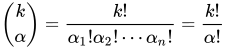 where
 .
- Power
 .
- Higher-order partial derivative
 where
 (see also 4-gradient). Sometimes the notation
 is also used.[1]
Some applications
The multi-index notation allows the extension of many formulae from elementary calculus to the corresponding multi-variable case. Below are some examples. In all the following,  (or
 ),
 , and
 (or
 ).
- Multinomial theorem
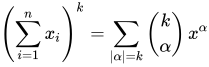
- Multi-binomial theorem
 Note that, since x + y is a vector and α is a multi-index, the expression on the left is short for (x1 + y1)α1⋯(xn + yn)αn.
- Leibniz formula
- For smooth functions
 and
 ,

- Taylor series
- For an analytic function in variables one has !}}h^{\alpha }}.}
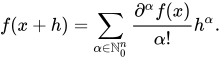 In fact, for a smooth enough function, we have the similar Taylor expansion !}}h^{\alpha }}+R_{n}(x,h),}
 where the last term (the remainder) depends on the exact version of Taylor's formula. For instance, for the Cauchy formula (with integral remainder), one gets !}}\int _{0}^{1}(1-t)^{n}\partial ^{\alpha }f(x+th)\,dt.}

- General linear partial differential operator
- A formal linear
 -th order partial differential operator in variables is written as

- Integration by parts
- For smooth functions with compact support in a bounded domain
 one has
 This formula is used for the definition of distributions and weak derivatives.
An example theorem
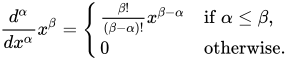
If are multi-indices and  , then
!}{(\beta -\alpha )!}}x^{\beta -\alpha }&{\text{if}}~\alpha \leq \beta ,\\0&{\text{otherwise.}}\end{cases}}}

Proof
The proof follows from the power rule for the ordinary derivative; if α and β are in  , then
!}{(\beta -\alpha )!}}x^{\beta -\alpha }&{\hbox{if}}\,\,\alpha \leq \beta ,\\0&{\hbox{otherwise.}}\end{cases}}}
 | | 1 |
Suppose  ,
 , and . Then we have that

For each  in
 , the function
 only depends on
 . In the above, each partial differentiation
 therefore reduces to the corresponding ordinary differentiation
 . Hence, from equation (1), it follows that
 vanishes if
 for at least one in . If this is not the case, i.e., if
 as multi-indices, then
 for each
 and the theorem follows. Q.E.D.
References
- ↑ Reed, M.; Simon, B. (1980). Methods of Modern Mathematical Physics: Functional Analysis I (Revised and enlarged ed.). San Diego: Academic Press. p. 319. ISBN 0-12-585050-6.
- Saint Raymond, Xavier (1991). Elementary Introduction to the Theory of Pseudodifferential Operators. Chap 1.1 . CRC Press. ISBN 0-8493-7158-9
This article incorporates material from multi-index derivative of a power on PlanetMath, which is licensed under the Creative Commons Attribution/Share-Alike License.
