Mona Bone Jakon
| Mona Bone Jakon | ||||
|---|---|---|---|---|
 | ||||
| Studio album by | ||||
| Released | 24 April 1970 | |||
| Recorded | January–February 1970 | |||
| Studios |
| |||
| Genre | Folk rock | |||
| Length | 35:15 | |||
| Labels | Island (UK/Europe) A&M (US/Canada) | |||
| Producer | Paul Samwell-Smith | |||
| Cat Stevens chronology | ||||
| ||||
Mona Bone Jakon is the third studio album by singer-songwriter Cat Stevens, released in April 1970 on the Island Records label in the United Kingdom and on A&M in the United States and Canada.
Overview
After a meteoric start to his career, surprising even his original producer at Deram Records with the hit singles "I Love My Dog", "Matthew and Son", and "I'm Gonna Get Me a Gun", Stevens' debut album, Matthew and Son, began charting. However, after the pressure for a repeat album of the same calibre, Stevens, considered a young teen sensation, was overwhelmed by a new lifestyle as well as the demands of writing, recording, performing, publicity appearances, and touring. His second album was a commercial failure and in the autumn of 1968, he was hospitalized, with a diagnosis of tuberculosis and a collapsed lung. For over a year, while recovering, Stevens virtually disappeared from the British pop scene. Mona Bone Jakon is notable not only for his return but for the emergence of a very different artist. The album sold slowly (at first) but over time has been certified Gold for sales/shipments of more than 500,000 copies in the United States.[1]
Background
During his year of doctor‑ordered bed rest, Stevens wrote a large number of new songs. After recovering, he negotiated his release from Deram Records and began working with former Yardbirds bassist Paul Samwell-Smith, who encouraged a stripped‑down sound. In contrast to his first two albums, the new material featured sparse arrangements built around acoustic guitar and keyboards, supported by a small backing group that included guitarist Alun Davies, bassist John Ryan, and drummer Harvey Burns; Peter Gabriel contributed flute to the track "Katmandu". Samwell‑Smith produced the sessions, with an emphasis on high‑fidelity clarity and a more prominent low‑end presence, reflecting the growing audiophile market of the period.[2] These recordings marked Stevens's transition from pop to a more folk rock‑oriented style at a time when the term "singer‑songwriter" was beginning to enter popular usage.[3] The songs themselves were darker in tone: the madrigal-inspired ballad "Lady D'Arbanville" elevated the tragedy of a lost lover (in this case, Stevens' former girlfriend Patti D'Arbanville) to that of a deceased one, and "Trouble" was a plea to stave off death. There were also lighter songs: "Pop Star" showcased Stevens' dramatic change in voice by satirising the triviality of celebrity.
Though "Lady D'Arbanville" would reach No. 8 on the British charts, Mona Bone Jakon was only a modest success upon its initial release. The album attracted attention, however, in the wake of the commercial breakthrough of its follow-up, Tea for the Tillerman, and with the inclusion of three of its songs ("Trouble", "I Wish, I Wish", and "I Think I See the Light") in Hal Ashby and Colin Higgins's 1971 black comedy, Harold and Maude.
Origin of title
According to a 1972 interview with Stevens, the inspiration for the title was a name he created to describe his penis: "'Mona Bone Jakon' is another name for my penis. It's the name I give it. It's not some sort of secret vocabulary, it's just something I made up."[4]
Journalist Robert Chalmers reiterated this point for a 2003 interview with Yusuf Islam for The Independent on Sunday when he wrote: "When [Stevens] re-emerged in 1969, he had more than 40 new songs and released three triumphant albums in 15 months on Chris Blackwell's Island label: Mona Bone Jakon (his pet word for penis), Tea for the Tillerman and Teaser and the Firecat."[5]
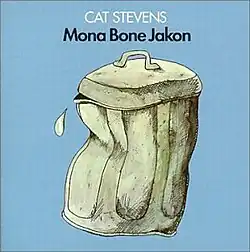
The symbolism of the cover artwork was related to Stevens' original intended title for the album, The Dustbin Cried the Day the Dustman Died.[6]
Critical reception
| Review scores | |
|---|---|
| Source | Rating |
| Christgau's Record Guide | B−[7] |
In a contemporary review for The Village Voice, music critic Robert Christgau gave the album a B+, noting that "this one has a nice post-creative trauma feel, intimate and sensitive. Recommended to singer/songwriter specialists."[8] Later, he revised his review to a B− and expressed a newfound dislike for the songs "Lady D'Arbanville", "Trouble", and "I Wish, I Wish".[7]
In a retrospective review, AllMusic's William Ruhlmann called it "a group of simple, heartfelt songs played in spare arrangements on acoustic guitars and keyboards and driven by a restrained rhythm section". He added that "Stevens' craggy voice, with its odd breaks of tone and occasional huskiness, lent these sometimes sketchy songs depth".[9]
Track listing
All tracks are written by Cat Stevens.
| No. | Title | Length |
|---|---|---|
| 1. | "Lady D'Arbanville" | 3:45 |
| 2. | "Maybe You're Right" | 3:25 |
| 3. | "Pop Star" | 4:13 |
| 4. | "I Think I See the Light" | 3:55 |
| 5. | "Trouble" | 2:49 |
| No. | Title | Length |
|---|---|---|
| 6. | "Mona Bone Jakon" | 1:42 |
| 7. | "I Wish, I Wish" | 3:50 |
| 8. | "Katmandu" | 3:22 |
| 9. | "Time" | 1:26 |
| 10. | "Fill My Eyes" | 3:00 |
| 11. | "Lilywhite" | 3:41 |
Personnel
- Cat Stevens – acoustic guitar (all tracks), keyboards (tracks 1, 2, 4, 5, 7, 8, 10), lead vocals (all tracks), congas (track 6), percussion (track 10)
- Alun Davies – acoustic guitar (tracks 1–5, 7, 10), backing vocals (tracks 3–5, 7, 10)
- John Ryan – double bass (tracks 1–3, 5, 8), bass guitar (tracks 4, 7), backing vocals (track 3)
- Harvey Burns – drums (tracks 1, 2, 4, 5, 7), percussion (track 3)
- Peter Gabriel – flute (track 8)
- Del Newman – string arrangements (tracks 1, 2, 11)
- Paul Samwell-Smith - backing vocals (tracks 1, 3–5, 7, 11), vocal sound effect (track 10)
Production
- Producer – Paul Samwell-Smith
- Engineer – Michael Bobak
- Mixing – Paul Hicks
- Supervisor – Bill Levenson
- Coordinator – Beth Stempel
- Mastering – Ted Jensen
- Design – Roland Young, Mike Diehl
- Illustrations – Cat Stevens
- Photography – Grazia Neri, Richard Stirling
Charts
| Chart (1970/71) | Peak position |
|---|---|
| Australia (Kent Music Report)[10] | 25 |
| United Kingdom (Official Charts Company) | 63 |
| United States (Billboard 200) | 164 |
Certifications and sales
| Region | Certification | Certified units/sales |
|---|---|---|
| France (SNEP)[11] | Gold | 100,000* |
| Germany (BVMI)[12] | Platinum | 500,000^ |
| United States (RIAA)[13] | Gold | 500,000^ |
|
* Sales figures based on certification alone. | ||
Notes
- ↑ "Mona Bone Jakon". Retrieved 29 April 2026.
- ↑ Charlesworth, Chris (1985). Cat Stevens: The Biography. Omnibus Press.
- ↑ Larkin, Colin (2006). The Encyclopedia of Popular Music. Oxford University Press.
- ↑ "Majicat – Cat Stevns [sic] in a French Magazine Pop Musigue [sic]", Pop Musique interview, trans. Michael Valenzuela, Majicat: Cat Stevens Scrapbook, c. 1972, retrieved 24 February 2012
{{citation}}: CS1 maint: others (link) - ↑ "The Robert Chalmers Interview: Back on the Peace Train", The Independent on Sunday, 10 December 2003, archived from the original on 24 February 2005, retrieved 2 May 2010
- ↑ Mona Bone Jakon turns 51. twitter.com. 24 April 2021. Retrieved 4 August 2023.
- 1 2 Christgau, Robert (1981). "Consumer Guide '70s: S". Christgau's Record Guide: Rock Albums of the Seventies. Ticknor & Fields. ISBN 089919026X. Retrieved 13 March 2019 – via robertchristgau.com.
- ↑ Christgau, Robert (19 November 1970). "Consumer Guide (14)". The Village Voice. New York. Retrieved 13 February 2014.
- ↑ Mona Bone Jakon at AllMusic
- ↑ Kent, David (1993). Australian Chart Book 1970–1992 (illustrated ed.). St Ives, N.S.W.: Australian Chart Book. p. 293. ISBN 0-646-11917-6.
- ↑ "French album certifications – Cat Stevens – Mona Bone Jakon" (in French). InfoDisc. Retrieved 16 November 2021. Select CAT STEVENS and click OK.
- ↑ "Gold-/Platin-Datenbank (Cat Stevens; 'Mona Bone Jakon')" (in German). Bundesverband Musikindustrie. Retrieved 11 June 2019.
- ↑ "American album certifications – Cat Stevens – Mona Bone Jakon". Recording Industry Association of America. Retrieved 11 June 2019.
| Studio pop albums |
| ||||||
|---|---|---|---|---|---|---|---|
| Live albums | |||||||
| Spiritual albums | |||||||
| Compilations | |||||||
| Singles |
| ||||||
| Other songs | |||||||
| Categories | |||||||
| Related topics |
| ||||||
