Molagoottal
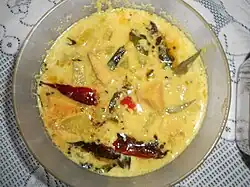 Molagoottal made with yam, ash gourd and bottle gourd | |
| Alternative names | Molagootal, molakootal |
|---|---|
| Type | Stew |
| Place of origin | India |
| Region or state | Palakkad, Kerala |
| Serving temperature | Mixed with rice |
| Main ingredients | Lentils (toor dal), coconut, cumin, vegetables |
Molagoottal (Tamil: மொளகூட்டல்; Malayalam: മൊളഗൂട്ടല്) is a mild South Indian stew of lentils and ground coconut. It is a household dish of the Palakkad Iyers, the Tamil Brahmin community of the Palakkad region of Kerala, and is thick enough to serve when a plain rasam or sambar will not do.[1] It is eaten mixed into rice with a spoon of ghee, and unlike sambar it contains no tamarind.[1]
Background
Molagoottal is believed to be the traditional food of Palakkad Iyers, who are traditionally vegetarians. Their cuisine is lentil-based, but when they settled in Kerala, they incorporated local produce such as coconut and pumpkin, and molagoottal emerged from that blend.[1] The dish is common in homes across the region and is rarely sold in restaurants.[1]
Preparation
Toor dal, with a little moong dal, is steamed with the chosen vegetables. Grated coconut is ground with cumin and dried red chillies into a paste, which is added to the dal and vegetables with enough water to make a thick stew, and the pot is finished with a tempering of mustard seeds fried in coconut oil along with curry leaves.[1] The heat comes from only a couple of chillies, so the stew is gentle rather than hot, and the absence of tamarind is what most sets it apart from sambar.[1] A related Palakkad dish, molagushayam, shares the lentil-and-vegetable base but uses moong dal, takes its heat from black pepper, and has no coconut.[1]
Varieties
Molagoottal is made in many forms that differ only in the vegetable: cheerai, with spinach or other leafy greens; noolkol, with kohlrabi; and kalandha, a mixture of assorted vegetables such as carrot, beans and potato.[1] For the spinach version, urad dal is fried with the red chillies and ground into the coconut paste.[1]
Serving
The stew is eaten mixed into rice with ghee. A Palakkad meal often pairs it with a vendakka pachadi, lady's finger in seasoned curd, and a thogayal, a dry chutney of coconut and tamarind, so that a tangy side sits against the mild stew; leftover molagoottal is also eaten with roti.[1]
