Ming'oko
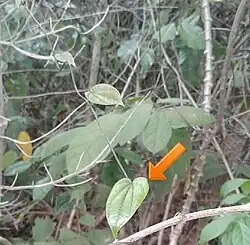
Ming'oko (ⓘ) is a wild root that grows in Makonde Plateau, Tanzania. It is widely traded on the plateau and lowlands nearby.[1] Eaten as food in the country, Ming'oko has been compared to carrot by Alexander Kesse, a German historian and scholar, who used both to analyse how people often ignore their ethnicity and culture, in this sense, calling Ming'oko as root whereas carrot is likewise.[2]
The root is considered the most important root crop in Tanzania. It is eaten after being cooked or dried.[3] It is a specie of Dioscorea hirtiflora and although it is a dry season food, it grows throughout the year but especially in August and September. It is harvested, dried, and stored until when it will be used.[4] It is also eaten in the Mtwara region of Tanzania,[5] as well as in Nanguruwe where it is not grown.[6] It is usually taken during food shortages.[7]
In a research by Marja-Liisa Swantz in 1966, the digging of Ming'oko from the soil is a labourous process and a danger to women whose work it is.[8]
See also
References
- ↑ Keese, Alexander (2010). Ethnicity and the Long-term Perspective: The African Experience. Peter Lang. p. 116. ISBN 978-3-0343-0337-8. Retrieved 31 May 2026.
- ↑ Keese, Alexander (2010). Ethnicity and the Long-term Perspective: The African Experience. Peter Lang. p. 116. ISBN 978-3-0343-0337-8. Retrieved 31 May 2026.
- ↑ Seppälä, Pekka (1998). Diversification and Accumulation in Rural Tanzania: Anthropological Perspectives on Village Economics. Nordic Africa Institute. p. 77. ISBN 978-91-7106-427-1. Retrieved 31 May 2026.
- ↑ Hassan, Mohammad Izhar; Roy, Shouraseni Sen; Chatterjee, Uday; Chakraborty, Samik; Singh, Uttara (8 July 2022). Social Morphology, Human Welfare, and Sustainability. Springer Nature. p. 498. ISBN 978-3-030-96760-4. Retrieved 31 May 2026.
- ↑ Nations, Food and Agriculture Organization of the United; Tanzania), Ministry of Natural Resources and Tourism, Dar es Salaam (United Republic of (22 February 2024). Forests for a sustainable future: education modules for primary schools: Teacher's book: Module 2 Forests, health and well-being. Food & Agriculture Org. p. 21. ISBN 978-92-5-137691-1. Retrieved 31 May 2026.
{{cite book}}: CS1 maint: multiple names: authors list (link) - ↑ Ogden, Cynthia L.; Service, Food and Agriculture Organization of the United Nations Nutrition Programmes (1996). Considering Nutrition in National Forestry Programmes. Food and Agriculture Organization of the United Nations. p. 12. Retrieved 31 May 2026.
- ↑ Agricultural Technology Development Through Participatory Research: Proceedings of the Third Collaborative Research Workshop : Held in Morogoro, 24-26 May 2004. Tanzania Agricultural Research Project Phase Two, Sokoine University of Agriculture (TARP II--SUA Project). 2004. p. 96, 98. ISBN 978-9987-9006-8-8. Retrieved 31 May 2026.
- ↑ Swantz, Marja-Liisa (1996). Sharing in Community-based Social Services in Rural Tanzania: A Case Study of Mtwara and Lindi Regions. World Institute for Development Economics Research. p. 23. Retrieved 31 May 2026.