Microsteris
| Microsteris | |
|---|---|
 | |
Scientific classification  | |
| Kingdom: | Plantae |
| Clade: | Embryophytes |
| Clade: | Tracheophytes |
| Clade: | Angiosperms |
| Clade: | Eudicots |
| Clade: | Asterids |
| Order: | Ericales |
| Family: | Polemoniaceae |
| Genus: | Microsteris Greene |
| Species: | M. gracilis |
| Binomial name | |
| Microsteris gracilis (Hook.) Greene | |
| Varieties[1] | |
| |
| Synonyms[2] | |
|
List
| |
Microsteris is a genus of flowering plants in the phlox family containing the single species Microsteris gracilis, known by the common name slender phlox.
The segregation of this species into a genus of its own is controversial, and many botanists continue to include the plant in genus Phlox.[3][4] Genetic analysis is continuing.
Description
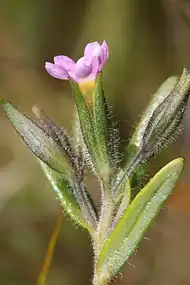
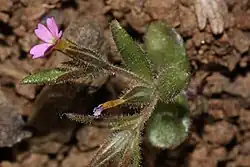
Microsteris gracilis is an annual herb which is variable in shape, taking a decumbent, branching, sometimes almost tuftlike form or growing erect and very slender. Its maximum height approaches 20 centimeters, but it may be much smaller.
The lance-shaped leaves are 1 to 3 centimeters long and oppositely arranged except for the upper ones, which are alternate. The herbage is glandular and hairy in texture. The inflorescence at the top of the stem bears one or more small flowers.
The flower has a tubular throat around a centimeter long encased in a tubular calyx of sepals. The flat corolla has five flat-tipped or notched lobes just 1 or 2 millimeters long. The flower is white to bright pink with a yellowish throat.
Taxonomy
In 1829 William Jackson Hooker named a new species in the Gilia genus, Gilia gracilis.[1] The genus Microsteris was named and described by Edward Lee Greene,[5] including Microsteris gracilis.[6] Together with its genus the species is classified in the Polemoniaceae family.[1]
Although Microsteris is monotypic genus 13 species names have been created that are a synonym another species or one of its two accepted varieties.[7]
| Name | Year | Synonym of: | Notes |
|---|---|---|---|
| Microsteris andicola Greene | 1898 | var. gracilis | = het.[8] |
| Microsteris californica Greene | 1898 | var. gracilis | = het.[8] |
| Microsteris depressa (M.E.Jones ex A.Gray) Davidson & Moxley | 1923 | L. depressum | ≡ hom.[6] |
| Microsteris diffusa A.Heller | 1899 | var. gracilis | = het.[8] |
| Microsteris gilioides (Benth.) Davidson & Moxley | 1923 | A. gilioides | ≡ hom.[9] |
| Microsteris glabella Greene | 1898 | var. humilior | = het.[10] |
| Microsteris heterophylla Brockman | 1947 | var. gracilis | = het., without a Latin descr.[8] |
| Microsteris humilis Greene | 1898 | var. humilior | = het.[10] |
| Microsteris larsenii (A.Gray) Brockman | 1947 | C. larsenii | ≡ hom.[11] |
| Microsteris macdougalii A.Heller | 1899 | var. gracilis | = het.[8] |
| Microsteris micrantha (Kellogg) Greene | 1898 | var. gracilis | = het.[8] |
| Microsteris stricta Greene | 1898 | var. gracilis | = het.[8] |
| Microsteris traskiae (Eastw. ex Milliken) Davidson & Moxley | 1923 | var. gracilis | = het.[8] |
| Notes: ≡ homotypic synonym; = heterotypic synonym | |||
The genus Myotoca with the single species Myotoca eritrichoides was created in 1907 by August Brand and attributed to August Grisebach and is synonymous with Microsteris and variety gracilis respectively.[12] In addition there are five alternate classifications for the species that are homotypic synonyms.[5]
| Name | Year |
|---|---|
| Collomia gracilis (Hook.) Douglas ex Benth. | 1834 |
| Gilia gracilis Hook. | 1829 |
| Navarretia gracilis (Hook.) Kuntze | 1891 |
| Phlox gracilis (Hook.) Greene | 1887 |
| Polemonium morenonis Kuntze | 1898 |
Names
The genus name, Microsteris, is a Botanical Latin compound meaning 'tiny star', a reference to the small, star shaped flower.[13]
Distribution
Microsteris gracilis is native to western North America from northwestern Canada to the American Midwest and West Coast, through Mexico, as well as South America from Peru to southern Chile.[1]
In Canada it does sometimes occur in the Yukon, but its has not established a recurring population.[14] It is stated to be introduced to the Yukon in the Flora of Alberta,[15] but is listed as native in Plants of the World Online.[1] In British Columbia and Alberta it is found in southern parts of the provinces.[16] In the northwestern United States it is common throughout Washington and Oregon, mostly found in southern Idaho, and widely scattered in Montana. Southward in Wyoming it is recorded in all but four counties and is found on both the western and eastern slopes of Colorado. It reaches its easternmost native distribution in a few western counties of South Dakota and Nebraska.[17]
In the southwestern US the species is native to all the diverse plant communities in California,[18] with records in almost every county.[17] It is likewise found in all but one county in Nevada and all but five counties in Utah. Plants grow in most of Arizona, but only in western counties of New Mexico.[17] South of the border it is found in just two northwestern Mexican states, Baja California and Sonora.[19]
References
Citations
- 1 2 3 4 5 POWO 2026d.
- ↑ POWO 2026a; POWO 2026d; POWO 2026e; POWO 2026f.
- ↑ Prather, Ferguson & Jansen 2000, p. 1307.
- ↑ Ferguson, C. J. and R. K. Jansen. (2002). A chloroplast DNA phylogeny of eastern Phlox (Polemoniaceae): implications of congruence and incongruence with the ITS phylogeny. American Journal of Botany 89 1324-35.
- 1 2 POWO 2026a.
- 1 2 POWO 2026b.
- ↑ POWO 2026b; POWO 2026c; POWO 2026e; POWO 2026f; POWO 2026g.
- 1 2 3 4 5 6 7 8 POWO 2026e.
- ↑ POWO 2026c.
- 1 2 POWO 2026f.
- ↑ POWO 2026g.
- ↑ POWO 2026a; POWO 2026h.
- ↑ Heil et al. 2013, p. 828.
- ↑ VASCAN 2026.
- ↑ Moss & Packer 1983, p. 463.
- ↑ Moss & Packer 1983, pp. 463, 653.
- 1 2 3 NRCS 2026.
- ↑ Patterson & Ferguson 2012.
- ↑ Hassler 2026.
Sources
Books
- Heil, Kenneth D.; O'Kane, Steve L. Jr.; Reeves, Linda Mary; Clifford, Arnold (2013). Flora of the Four Corners Region: Vascular Plants of the San Juan River Drainage, Arizona, Colorado, New Mexico, and Utah (First ed.). St. Louis, Missouri: Missouri Botanical Garden. ISBN 978-1-930723-84-9. ISSN 0161-1542. LCCN 2012949654. OCLC 859541992. Retrieved 17 July 2026.
- Moss, Ezra Henry; Packer, John G. (1983) [First edition 1959]. Flora of Alberta : A Manual of Flowering Plants, Conifers, Ferns and Fern Allies Found Growing Without Cultivation in the Province of Alberta, Canada (Second ed.). Toronto, Ontario: University of Toronto Press. ISBN 978-0-8020-2508-1. OCLC 10017484973. Retrieved 18 July 2026.
Journal articles
- Prather, L. Alan; Ferguson, Carolyn J.; Jansen, Robert K. (September 2000). "Polemoniaceae phylogeny and classification: implications of sequence data from the chloroplast gene ndhF". American Journal of Botany. 87 (9): 1300–1308. doi:10.2307/2656723. ISSN 0002-9122. JSTOR 2656723. Retrieved 18 July 2026.
Web sources
- Hassler, Michael (20 May 2026). "Phlox gracilis in Synonymic Checklist and Distribution of the World Flora. Version 26.05". World Plants. Retrieved 17 July 2026.
- NRCS (2026). "Microsteris gracilis". PLANTS Database. United States Department of Agriculture (USDA). Retrieved 18 July 2026.
- Patterson, Robert; Ferguson, Carolyn J. (2012). "Microsteris gracilis, in Jepson Flora Project". Jepson eFlora. University of California, Berkeley. Archived from the original on 2 March 2024. Retrieved 18 July 2026.
- POWO (2026a). "Microsteris Greene". Plants of the World Online. Royal Botanic Gardens, Kew. Retrieved 17 July 2026.
- POWO (2026b). "Microsteris depressa (M.E.Jones ex A.Gray) Davidson & Moxley". Plants of the World Online. Royal Botanic Gardens, Kew. Retrieved 17 July 2026.
- POWO (2026c). "Microsteris gilioides (Benth.) Davidson & Moxley". Plants of the World Online. Royal Botanic Gardens, Kew. Retrieved 17 July 2026.
- POWO (2026d). "Microsteris gracilis (Hook.) Greene". Plants of the World Online. Royal Botanic Gardens, Kew. Retrieved 17 July 2026.
- POWO (2026e). "Microsteris gracilis var. gracilis". Plants of the World Online. Royal Botanic Gardens, Kew. Retrieved 17 July 2026.
- POWO (2026f). "Microsteris gracilis var. humilior (Hook.) Cronquist". Plants of the World Online. Royal Botanic Gardens, Kew. Retrieved 17 July 2026.
- POWO (2026g). "Microsteris larsenii (A.Gray) Brockman". Plants of the World Online. Royal Botanic Gardens, Kew. Retrieved 17 July 2026.
- POWO (2026h). "Myotoca eritrichoides Griseb. ex Brand". Plants of the World Online. Royal Botanic Gardens, Kew. Retrieved 17 July 2026.
- VASCAN; Acadia University; Université de Montréal Biodiversity Centre; University of Toronto Mississauga; University of British Columbia (2026). "Microsteris gracilis - Database of Vascular Plants of Canada (VASCAN)". Canadensys. Retrieved 18 July 2026.
External links

- USDA Plants Profile for Microsteris gracilis (slender phlox)
- Microsteris gracilis — U.C. Photo gallery
- Monotypic Ericales genera
- Polemoniaceae
- Flora of Mexico
- Flora of Western Canada
- Flora of the Northwestern United States
- Flora of the Southwestern United States
- Flora of California
- Flora of Nebraska
- Flora of South Dakota
- Flora of Southern America
- Flora of the California desert regions
- Flora of the Cascade Range
- Flora of the Great Basin
- Flora of the Klamath Mountains
- Flora of the Sierra Nevada (United States)
- Natural history of the California chaparral and woodlands
- Natural history of the California Coast Ranges
- Natural history of the Peninsular Ranges
- Natural history of the Transverse Ranges
- Polemoniaceae genera
- Plants described in 1829
- Taxa named by William Jackson Hooker