Membrane glycoproteins
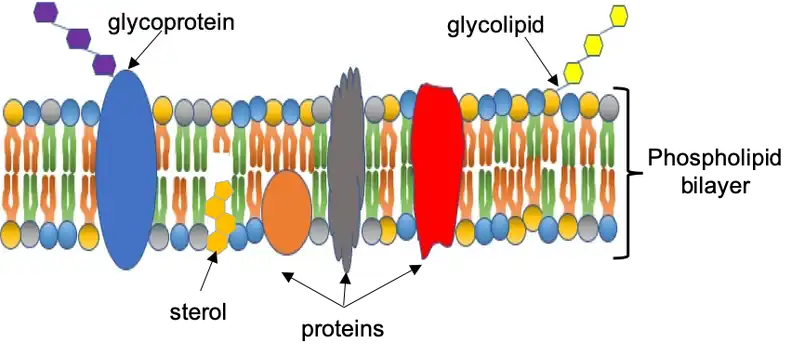
Membrane glycoproteins are membrane proteins which help in cell-cell recognition and cell-matrix recognition[1], including fibronectin, laminin and osteonectin. Glycoproteins are formed of an oligosaccharide chain that is attached covalently to a protein.[2]
See also
- Glycocalyx, a glycoprotein which surrounds the membranes of bacterial, epithelial and other cells
References
- ↑ "Science". AAAS. doi:10.1126/science.1058890?casa_token=gRPaweBc7cYAAAAA:cKgv9fq1L9KIfZd8WBJ-AODlElVufKHdyHpoAWfjLDqgXTaRy7GN3bQG-1CtKssk6IjuZ6DbJJ7pS1k. Retrieved 2026-04-20.
- ↑ "Lehninger principles of biochemistry | WorldCat.org". search.worldcat.org. Retrieved 2026-04-20.
External links
 Media related to Membrane glycoproteins at Wikimedia Commons
- Membrane+glycoproteins at the U.S. National Library of Medicine Medical Subject Headings (MeSH)
Notes and References
- Anne Dell, Howard R. Morris, Glycoprotein Structure Determination by Mass Spectrometry. Science 291, 2351-2356 (2001). DOI: https://doi.org/10.1126/science.1058890.
- Nelson DL, Cox MM, Hoskins AA, Lehninger AL (2013). Lehninger Principles of Biochemistry (Sixth ed.). Macmillan Learning. 1249676451.