Meksi family
| Meksi family | |
|---|---|
| Noble house | |
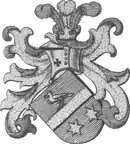 Coat of arms of the Mexa as depicted in Friedrich Heyer von Rosenfeld's "Wappenbuch des Königreichs Dalmatien", published in 1873. | |
Parent family | Bua (tribe) |
The Meksi were a noble Albanian family. Members of this family are found in Albania, Italy and Greece (especially Spetses), whose members distinguished themselves in shipping and politics.[1]
History
The Meksi family appeared around the 10th century and is believed to be the first branch of the Bua tribe.[2][3][4] According to Milan Šufflay, the region between Cape Rodon, Kruja and Lezha was inhabited by the Messi, Meksi, Mexi family.[5] The name of the Meksi clan may originate from the function, office or position of its head, who in this particular case must have been a doctor, while the suffix "si" indicates ownership of the country or from the Roman province of Moesia.[5] In this way, it turns out that Messi, Meksi, was a timar that a Byzantine emperor gave to the doctor, who apparently was the first head of the family.[6]
It appears that the province in the north of Albania, stretching from the north-east of Lezha to the shores of Shkumbin, inhabited by the Meksi, was included in a single principality at the beginning of the last millennium, with Kruja as headquarters. Then this principality was conquered by the Bulgarian kings as well as by the most powerful Albanian principalities, which were located to the south and north of it.[7] The genealogical tradition of the Meksi family, particularly as preserved in Greek historical accounts and the family's own records, asserts their presence during the pivotal events of the Fourth Crusade in 1204.[8] Misia, a coastal area from the White Drin towards the Adriatic and the village of Mes took their name from this tribe. Sebastos Petrus Messia or Misie, appears among the Albanian dynasts or barons in negotiations with the Kingdom of Naples in 1272 and 1274.[9] Shkodër Land Registry of 1416–1417 names a Pietro Mexa in 1445 and a Vucha Messi appears in 1614 as head of the village of Muriqi near Shkodër.[10] During the period of the successful struggles of the Albanian people for freedom, under the leadership of Skanderbeg, the family made an outstanding contribution, which is proven by many documents of the time.[11] Immediately after the complete conquest of Albania by the Turkish hordes, the Meksi family moved in several directions: Dalmatia, Republic of Venice, Italy, Moravia and especially towards the South.[7]
A branch of the family was established in medieval Kotor, where it appears in sources under the forms Mekša, Mexa, Mechsa and Mechxa. The family is documented in Kotor from at least 1326 and is described by Marica Malović-Đukić as a Kotor patrician family whose members were active for four generations in commerce and civic affairs. They traded in Kotor, Dubrovnik and Serbia and maintained commercial partnerships with merchants from the Zeta coast, Dubrovnik, Venice and Serbia.[12][13] The family's most prominent member was Marin Mekša, a wealthy merchant involved in the trade of silver, salt, textiles and other goods. He owned property in Kotor, Dubrovnik and Serbia and served in important civic positions in Kotor. In 1332, he acted as an envoy of King Stefan Dušan of Serbia to Venice, where he negotiated the settlement of Kotor's debts to Venetian merchants. The family remained prominent in Kotor during the 14th and early 15th centuries. Descendants participated in trade with Dubrovnik and Serbia and represented Kotor in diplomatic negotiations. The family's medieval name appears in several forms, including Mecsa, Mechsa, Mexa, Mechxa and Mexich.[12][13]
Members of the family offered military services to the Republic of Venice, especially standing out in the Ottoman–Venetian wars of 1465. Famous stradioti and member of the family, Mexa Buziqi,[3][14] aided his relative Theodore Bua and Krokodeilos Kladas in the revolt against Ottoman Empire in Morea.[15][16][17] Initially, the family bore the surname Mexis, but later it changed to De Mezzi or Mezan. The last name of the family has changed according to the language of the countries where they have lived. In Albania, ks (Meksi) or s, ss (Mesi, Messi) is used. In the provinces that were occupied by the Venetians during the Middle Ages or that were relocated to Italy ss (Messi, Da Messa),[18][19] in the Republic of Venice, according to the local dialect, z or zz (De Mezzi, Da Mezan) and in Kotor in Dalmatia x (Mexa).[20][21] The part of the family that emigrated in Greece, fought in the Greek War of Independence. In Spetses, the family was the wealthiest and most wellknown family, distinguishing themselves in shipping and politics, as well as heroes of the revolution.[22][23][24][25] The Meksi family also traces its descent from the Busichi lineage and through their shared descent from Buzici tribe,[26] the family shares a genealogical connection to the House of Wettin.[27]
Members
- Kristo Meksi, Albanian politician
- Vangjel Meksi, translator of the New Testament in Albanian
- Evangelis Zappas (through his mother Sotira Meksi),[28] Greek benefactor
- Apostol Meksi, Albanian folkorist
- Aleksandër Meksi, former Prime Minister of Albania
- Hatzigiannis Mexis, was one of the most important figures from Spetses in the Revolutionary War of 1821
- Leonidas Drosis (through his mother),[29] Greek neoclassical sculptor
- Ermelinda Meksi, Albanian politician
References
- ↑ Γαλλέτας Ηλίας, Μπουζουμπάρδη Μαρίκα, Σπέτσες, Ιστορία – Λαογραφία, Ένωση Σπετσιωτών, 2004, τόμος Α΄, σελ. 312–315
- ↑ Meksi 1995, p. 77
- 1 2 Hapwtıkn Etapaia 1984, p. 36
- ↑ "Μέξης, Χατζηγιάννης". Παγκόσμιο Βιογραφικό Λεξικό. Αθήνα: Εκδοτική Αθηνών. 1983–1988.
- 1 2 Milan Šufflay (1925). Srbi i Arbanasi (in Croatian). Seminar za arbansku filologiju. p. 26.
- ↑ Meksi, Fedhon (2010). Labova dhe Madhe dhe Labovitët: gjurmime në vite. Migjeni. p. 191. ISBN 9789995671891.
- 1 2 Meksi, Fedhon (2010). Labova dhe Madhe dhe Labovitët: gjurmime në vite. Migjeni. p. 192. ISBN 9789995671891.
- ↑ Stefanidou 1982, p. 2
- ↑ Studime Historike: Volume 4 (in Albanian). Akademia Shkencave. 1967. p. 212.
- ↑ "Bollettino – Centro di studi filologici e linguistici siciliani, Volumes 3–4". Centro di studi filologici e linguistici siciliani. 1955. p. 267.
Messa. Messi » son nominati nel Catasto scutarino del 1416–17: un Pietro Mexa di Scutari è ricordato nel 1445 e un Vucha Messi figura nel 1614 capo del villaggio di Muriqi presso Scutari...
- ↑ Akademia e Shkencave 1979
- 1 2 Marica Malović-Đukić (2008). The Mekša Kotor Family in the Middle Ages. Istorijski časopis. p. 211–239.
- 1 2 Konstantin Jireček (1902–1904). Die Romanen in den Städten Dalmatiens während des Mittelalters. Vienna: C. Gerold's Sohn. p. 42.
- ↑ Konstantinos Paparrigopoulos (1969). Ιστορία του Ελληνικού Έθνους. Vol. 7. Εκδοτικος Οικος Ελευθερουδακη-Νικα. p. 381.
- ↑ Korre 2018, pp. 524–525: "Με τους ιππείς του Κλαδά ενώθηκαν οι αρχηγοί stradioti Μέξας Μποζίκης και Θεόδωρος Μπούας Γρίβας ερχόμενοι από το Ναύπλιο."
- ↑ Irakli Koçollari (1994). Arvanitët. Albin.
- ↑ Γιώργος Ρούβαλης (2015). Το Ναύπλιο του 1500 στα βενετσιάνικα έγγραφα (in Greek). Αργολική Αρχειακή Βιβλιοθήκη Ιστορίας & Πολιτισμού. p. 66.
- ↑ "Bollettino – Centro di studi filologici e linguistici siciliani, Volumes 3–4". Centro di studi filologici e linguistici siciliani. 1955. p. 267.
- ↑ Valentini, Giuseppe (1955). Sviluppi Onomastico–Toponomastici Tribali Delle Comunità Albanesi in Sicilia (3 ed.). Palermo: G. Mori & Figli. pp. 9–10.
- ↑ Meksi, Fedhon (2010). Labova dhe Madhe dhe Labovitët: gjurmime në vite. Migjeni. p. 193. ISBN 9789995671891.
- ↑ Meksi 1995, p. 123
- ↑ Γαλλέτας Ηλίας, Μπουζουμπάρδη Μαρίκα, Σπέτσες, Ιστορία – Λαογραφία, Ένωση Σπετσιωτών, 2004, τόμος Α΄, σελ. 3110
- ↑ N. Kotzias (1858). Ἀνασκευη της του Δ. Τσαμαδου Ἀνασκευης. p. 17.
- ↑ Philologikos Syllogos Parnassos (1980). Parnassos. p. 341.
- ↑ George D. Dimacopoulos (1970). "Hē dioikētikē organosis tēs Hellēnikēs Politeias, 1828–1833: symvolē eis tēn historian tēs Hellēnikēs dioikēseōs, Volume 1". p. 130.
Κατ' ουσίαν την διοίκησιν της νήσου είχεν είτε η πλουσιωτάτη οικογένεια Μέξη , είτε η επίσης πλουσία οικογένεια
- ↑ Fedhon Meksi (2018). 10 rilindasit nga Labova e Madhe : fshati me 100 shtëpi (in Albanian). Dudaj. p. 67.
- ↑ "Kampioni absolut i 'bodybuilding' Marin Meksi, dekorohet nga Familja Mbretërore Habsburg" (in Albanian). Syri. 28 April 2023.
- ↑ Meksi, Fedhon (2010). Labova dhe Madhe dhe Labovitët: gjurmime në vite. Migjeni. p. 115. ISBN 9789995671891.
Vangjel Zhapa lindi më 23 gusht 1800. I ati quhej Vasil Zhapa, kurse e ëma Sotira Meksi, të dy nga Labova e Madhe.
- ↑ George D. Dimacopoulos (1962). Historia tēs Neoellēnikēs technēs: zōgraphikēs, glyptikēs, charaktikēs, architektonikēs kai diakosmētikēs : 1821–1941, Volume 1. To Hellēniko Vivlio.