Maybe (The Chantels song)
| "Maybe" | ||||
|---|---|---|---|---|
 | ||||
| Single by the Chantels | ||||
| from the album We Are the Chantels | ||||
| B-side | "Come My Little Baby" | |||
| Released | December 1957 | |||
| Recorded | October 16, 1957 | |||
| Venue | A Catholic church in Midtown Manhattan | |||
| Length | 2:32 | |||
| Label | End | |||
| Songwriters |
| |||
| Producer | Richard Barrett[2] | |||
| The Chantels singles chronology | ||||
| ||||
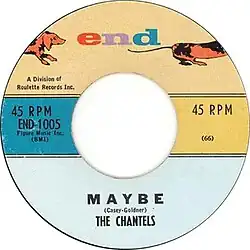
"Maybe" is a song originally credited to George Goldner and Roger "Casey" Case, though later reissues and publications have given additional credit to Richard Barrett and Arlene Smith.[2] It was recorded by American girl group the Chantels and released as their second single by End Records in December 1957.
Ranked among some of the best songs of all-time, "Maybe" is widely credited with establishing the popular girl group sound[3][4] and the place of female vocal groups in rhythm and blues music.[5]
Release
"Maybe" was released as a single in early December 1957 by End, and received immediate success in the New York City area before gaining national attention in the following months.[6] It reached its peak of #15 on Billboard's pop charts and #2 on their R&B charts by the end of that winter.[1] Following its success in the United States, it was also released internationally. It was released in the United Kingdom and Australia in February 1958 by London Recordings,[7] and in Canada by Reo Records.[8] It found major success in Canada, where it held the #1 position Canadian CHUM Chart for two weeks.[9] It went on to reportedly become the first song by a girl group to sell a million copies.[10][8]
Recording
Following the success of their previous single "He's Gone", which reached #71 on the Billboard charts, the Chantels were quick to have another recording session.[11] "Maybe" was recorded on October 16, 1957 alongside its b-side "Come My Little Baby" in a refurbished Catholic church in Midtown Manhattan, chosen for its pipe organ.[12] Piano in the session was played by Richard Barrett[1] and the orchestra was led by Buddy Lucas,[13] alongside others playing bass and drums (the drums were potentially played by Panama Francis).[12] The song took 52 takes to record due to their manager being repeatedly dissatisfied with its sound, leading to lead singer Arlene Smith being in tears by the end of the session.[14]
Critical reception
In a review from the December 2, 1957 issue of Billboard Magazine, "Maybe" is described as "organized confusion" and a song that "has to be watched - and it has to be heard to be believed."[15]
Composition
"Maybe" is a doo-wop song[2] that incorporates pop, gospel,[16] and R&B.[5] According to sheet music published by EMI Longitude Music and EMI Music Publishing, "Maybe" has a tempo of 70 beats per minute and a 12
8 time signature, set in the key of B♭ minor.[17] The song is "a powerful story of losing someone you adore and the despair of trying to win them back"[4] and "obsessive teenage lamentation."[16] Arlene Smith, who was only 16 years old at the time of recording, has said that she was "singing about the kind of love [she] didn't know," and that her performance was rather inspired by her love for her parents.[14][4]
Authorship disputes
"Maybe" has been the source of multiple conflicting claims relating to its authorship. The original single release lists George Goldner and Roger "Casey" Case as co-writers on the track, though Goldner is listed as the sole writer on its album We Are the Chantels. Some later releases would list Arlene Smith as a co-writer alongside Goldner, and starting in the mid-1960s Richard Barrett began to be credited as the sole writer on most releases.[1] Despite these claims, it is now widely cited that "Maybe" was written solely by Arlene Smith.[2]
According to Arlene Smith, the writing of the song was a collaboration between her, Goldner, and Barrett. In her account, she was sent a 78 demonstration record of the song from George Goldner, but re-wrote the lyrics of the song after being dissatisfied with the original lyrics, saying that "it just rambled on and on ... it was like a gospel song."[14] Following this, Barrett would later write the song's central piano line as well as other aspects of the instrumental.[14]
Legacy

"Maybe" has been credited with defining the girl group sound and laying the groundwork for later girl groups such as The Shirelles, The Marvelettes, and The Supremes, among countless others,[3] as well as turning the all-female group into an important part of the R&B scene.[5] Bobby Jay, a prominent New York City disc jockey of the 1950s and 60s, describes this song as "opening the floodgates", "every group that followed them wanted to be the Chantels."[14] Ronnie Spector of the Ronettes has cited "Maybe" as being one of her first inspirations for pursuing a career in music.[18] Performance-wise, it is widely considered to be a benchmark recording which "many vocalists would forever hold paramount."[11]
Rolling Stone listed "Maybe" as the 199th greatest song of all-time in 2015,[2] and Billboard listed it as the 60th greatest girl group song of all time in 2017.[16] It was also included in Robert Christgau's "Basic Record Library" of 1950s and 1960s recordings, published in Christgau's Record Guide: Rock Albums of the Seventies (1981).[19] In 2019, the Chantels' recording was inducted into the Rock and Roll Hall of Fame.[20]
Charts
|
|
The Shangri-Las version
| "Maybe" | ||||
|---|---|---|---|---|
 | ||||
| Single by the Shangri-Las | ||||
| from the album Leader of the Pack | ||||
| B-side | "Shout" | |||
| Released | December 1964 | |||
| Length | 2:35 | |||
| Label | Red Bird | |||
| Songwriter | George Goldner | |||
| Producer | Shadow Morton | |||
| The Shangri-Las singles chronology | ||||
| ||||
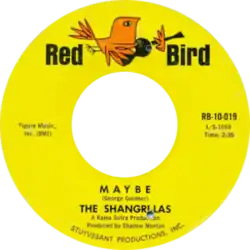
American vocal group the Shangri-Las released a version of the song in December 1964, as the fourth single from their album Leader of the Pack.
Charts
| Chart (1965) | Peak Position |
|---|---|
| US Billboard Hot 100[28] | 91 |
The Three Degrees versions
| "Maybe" | ||||
|---|---|---|---|---|
 | ||||
| Single by The Three Degrees | ||||
| from the album Maybe | ||||
| B-side | "Sugar on Sunday" | |||
| Released | 1970 | |||
| Genre | Soul | |||
| Length | 4:06 | |||
| Label | Roulette | |||
| Songwriter | Richard Barrett | |||
| Producer | Richard Barrett | |||
| The Three Degrees singles chronology | ||||
| ||||
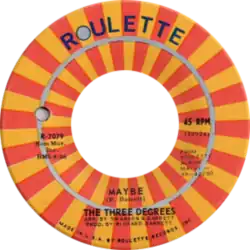
American vocal group the Three Degrees has released two versions of the song as singles. First being in 1965 which failed to chart, followed by a re-recorded version in 1970 as the lead single to their debut album of the same name, which received greater success.
Charts
| Chart (1970) | Peak Position |
|---|---|
| US Billboard Hot 100[29] | 29 |
| US Best Selling Soul Singles (Billboard)[30] | 4 |
Janis Joplin version
| "Maybe" | ||||
|---|---|---|---|---|
 | ||||
| Single by Janis Joplin | ||||
| from the album I Got Dem Ol' Kozmic Blues Again Mama! | ||||
| B-side | "Work Me, Lord" | |||
| Released | 1969 | |||
| Recorded | June 16–26, 1969 | |||
| Studio | Columbia Records Studios, New York | |||
| Genre | Blues rock | |||
| Length | 3:38 | |||
| Label | Columbia | |||
| Songwriter | Richard Barrett | |||
| Producer | Gabriel Mekler | |||
| Janis Joplin singles chronology | ||||
| ||||
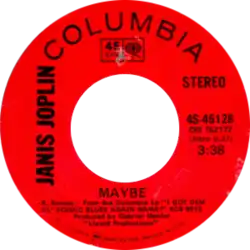
The song was released as a single by American singer-songwriter Janis Joplin in 1969 from her debut solo album I Got Dem Ol' Kozmic Blues Again Mama!
Notes
References
- 1 2 3 4 5 Warner, Jay. "The Chantels". Vocal Group Hall of Fame. Retrieved April 23, 2026.
- 1 2 3 4 5 6 "Rolling Stone's 500 Greatest Songs of All Time". Rolling Stone. April 2010.
- 1 2 Abjorensen, Norman (May 25, 2017). Historical Dictionary of Popular Music. Bloomsbury Academic. ISBN 9781538102145.
- 1 2 3 Gaines, Donna (1997). Trouble Girls: The Rolling Stone Book of Women in Rock. New York: Random House. pp. 108–9.
- 1 2 3 Meadows, Eddie S. (1983). "A Preliminary Analysis of Early Rhythm and Blues Musical Practices". The Western Journal of Black Studies. 7 (5): 172 – via ProQuest.
- ↑ "Cashbox - December 7, 1957" (PDF). Cashbox. December 7, 1957. Retrieved April 23, 2026.
- ↑ "New Musical Express - February 28, 1958" (PDF). New Musical Express. February 28, 1958. Retrieved April 25, 2026.
- 1 2 Murrells, Joseph (1978). The Book of Golden Discs. London: Barrie & Jenkins. p. 98.
- ↑ "CHART NUMBER 41 – Monday, February 24, 1958". CHUM Chart. Archived from the original on July 21, 2006.
- ↑ Scialfa, Patti (October 27, 2011). "Patti Scialfa: Girl Groups". Rolling Stone.
- 1 2 Clemente, John (June 24, 2013). Girl Groups: Fabulous Females Who Rocked the World. AuthorHouse. pp. 85–87. ISBN 9781477281284.
- 1 2 Redmond, Mike; West, Steve (1987). Arlene Smith & The Chantels (Booklet). The Chantels. Murray Hills Records. 000385.
- ↑ Flam, Steve; Newman, Ralph M.; Mondrone, Sal (1973). Bim Bam Boom, No. 9. pp. 19–20.
- 1 2 3 4 5 Flam, Laura; Liebowitz, Emily Sieu (September 5, 2023). But Will You Love Me Tomorrow?: An Oral History of the '60s Girl Groups. Grand Central Publishing. pp. 4–11. ISBN 9780306829796.
- ↑ "Billboard - December 2, 1957" (PDF). Billboard. December 2, 1957. Retrieved April 23, 2026.
- 1 2 3 "100 Greatest Girl Group Songs of All Time: Critics' Picks". Billboard. Retrieved July 11, 2017.
- ↑ "Maybe by The Chantels - Digital Sheet Music". Musicnotes.com. EMI Music Publishing. Retrieved April 23, 2026.
- ↑ Myers, Marc (August 2, 2016). "Ronnie Spector on the Chantels' 'Maybe'". The Wall Street Journal. Retrieved April 23, 2026.
- ↑ Christgau, Robert (1981). "A Basic Record Library: The Fifties and Sixties". Christgau's Record Guide: Rock Albums of the Seventies. Ticknor & Fields. ISBN 0899190251. Retrieved March 16, 2019 – via robertchristgau.com.
- ↑ Nickoloff, Annie (March 29, 2019). "Songs by The Isley Brothers, The Shangri-Las honored at Rock Hall 2019 ceremony". Cleveland.com. Retrieved April 23, 2026.
- ↑ "CHUM Hit Parade - February 24, 1958".
- 1 2 "Billboard - February 10, 1958" (PDF). Billboard. February 10, 1958. Retrieved April 22, 2026.
- ↑ "Billboard - March 24, 1958" (PDF). Billboard. March 24, 1958. Retrieved April 22, 2026.
- ↑ "Cashbox - February 15, 1958" (PDF). Cashbox. February 15, 1958. Retrieved April 22, 2026.
- ↑ "Cashbox - March 1, 1958" (PDF). Cashbox. March 1, 1958. Retrieved April 22, 2026.
- ↑ "Billboard - December 15, 1958" (PDF). Billboard. December 15, 1958. Retrieved April 22, 2026.
- ↑ "Cashbox - December 27, 1958" (PDF). Cashbox. February 15, 1958. Retrieved April 22, 2026.
- ↑ "Billboard - January 2, 1965" (PDF). Billboard. January 2, 1965. Retrieved April 25, 2026.
- ↑ "Billboard - August 8, 1970" (PDF). Billboard. August 8, 1970. Retrieved April 25, 2026.
- ↑ "Billboard - July 18, 1970" (PDF). Billboard. July 18, 1970. Retrieved April 25, 2026.
