Marat/Sade (film)
| Marat/Sade | |
|---|---|
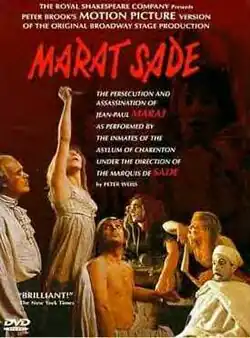 DVD cover | |
| Directed by | Peter Brook |
| Written by | Adrian Mitchell Geoffrey Skelton |
| Based on | |
| Produced by | Michael Birkett |
| Starring | Patrick Magee Ian Richardson Michael Williams Clifford Rose Glenda Jackson Freddie Jones |
| Cinematography | David Watkin |
| Edited by | Tom Priestley |
| Music by | Richard Peaslee Patrick Gowers |
Production company |
|
| Distributed by | United Artists |
Release dates |
|
Running time | 116 minutes[1] |
| Country | United Kingdom |
| Language | English |
The Persecution and Assassination of Jean-Paul Marat as Performed by the Inmates of the Asylum of Charenton Under the Direction of the Marquis de Sade, usually shortened to Marat/Sade (pronounced [ma.ʁa.sad])[a], is a 1967 British film adaptation of Peter Weiss's 1964 play. It is directed by Peter Brook, and originated in his stage production for the Royal Shakespeare Company, which later transferred to Broadway. The film stars Ian Richardson, Patrick Magee, Glenda Jackson, Clifford Rose, and Freddie Jones, reprising their roles from the stage version.
The film premiered on 22 February 1967, and received widespread positive reviews from critics.[2]
Plot
In the Charenton Asylum in 1808, the Marquis de Sade stages a play about the murder of Jean-Paul Marat by Charlotte Corday, using his fellow inmates as actors. The director of the hospital, Monsieur Coulmier, supervises the performance, accompanied by his wife and daughter. Coulmier, who supports Napoleon's government, believes that the play will support his bourgeois and reactionary ideas, and denounce those of the more radical stages of the French Revolution that Marat helped lead. His patients, however, have other ideas, and they make a habit of speaking lines he had attempted to suppress, or deviating entirely into personal opinion. The Marquis himself, meanwhile, subtly manipulates both the players and the audience to create an atmosphere of chaos and nihilism that ultimately brings on an orgy of destruction.
Cast
- Patrick Magee as Marquis de Sade
- Ian Richardson as Jean-Paul Marat
- Michael Williams as Herald
- Clifford Rose as Monsieur Coulmier
- Glenda Jackson as Charlotte Corday
- Freddie Jones as Cucurucu
- Hugh Sullivan as Kokol
- John Hussey as Newly Rich Lady
- W. Morgan Sheppard as A Mad Animal
- Jonathan Burn as Polpoch
- Jeanette Landis as Rossignol
- Robert Langdon Lloyd as Jacques Roux
- John Steiner as Monsieur Dupere
- James Mellor as Schoolmaster
- Henry Woolf as Father
- Mark Jones as Mother
- John Harwood as Voltaire
- Leon Lissek as Lavoisier
- Susan Williamson as Simonne Évrard
- Brenda Kempner as Madame Coulmier
- Ruth Baker as Mademoiselle Coulmier
- Ian Hogg as Military Representative
Production
Filming took place at Pinewood Studios in Buckinghamshire. David Watkin was the cinematographer.[3]
Release
The film held its world premiere in New York City on 22 February 1967, and had its UK premiere in London on 8 March.
Reception
Critical response
Roger Ebert gave the film a positive review, "The actors are superb. When we first see the Marquis (Patrick Magee), he looks steadily into the camera for half a minute and the full terror of his perversion becomes clearer than any dialog can make it. Glenda Jackson, as Marat's assassin Charlotte Corday, weaves back and forth between the melancholy of her mental illness and the fire of the role she plays. Ian Richardson, as Marat, still advocates violence and revolution even though thousands have died and nothing has been accomplished."[4]
Film critic Leonard Maltin awarded the film 4 out of a possible 4 stars, calling the film "chilling", and praising the film's atmosphere as being "so vivid that it seems actors are breathing down your neck".[5]
Film review aggregator Rotten Tomatoes reported an approval rating of 94%, based on 14 reviews, with an average rating of 8/10.[2]
Accolades
| Institution | Year | Category | Nominee | Result |
|---|---|---|---|---|
| Kinema Junpo | 1969 | Best Foreign-Language Film | Peter Brook | 4th place |
| Locarno International Film Festival[6] | 1967 | Youth Jury Mention (Feature Films) | Won | |
| Nastro d'Argento[7] | 1969 | Best Foreign Director | Won[b] |
Notes
- ↑ The film uses the full title in the opening credits, though most of the publicity materials use the shortened form.
- ↑ Tied with Robert Bresson for Mouchette.
References
- ↑ "THE PERSECUTION AND ASSASSINATION OF JEAN-PAUL MARAT AS PERFORMED BY THE INMATES OF THE ASYLUM OF CHARENTON UNDER THE DIRECTION OF THE MARQUIS DE SADE (X)". British Board of Film Classification. 30 November 1966. Archived from the original on 19 March 2014. Retrieved 19 March 2014.
- 1 2 "Marat/Sade (1966)". Rotten Tomatoes. Retrieved 19 December 2022.
- ↑ Watkin, David (7 January 2009). "Filmography". The David Watkin Archive. Retrieved 12 August 2015.
- ↑ Ebert, Roger (2 May 1967). "Marat/Sade Movie Review & Film Summary (1967)". Chicago Sun-Times – via Rogerebert.com.
- ↑ Maltin, Leonard (2 September 2014). Leonard Maltin's 2015 Movie Guide. New York City: Penguin Publishing Group. p. 896. ISBN 9780698183612.
- ↑ "20th Locarno Film Festival". Locarno Film Festival. Retrieved 9 May 2024.
- ↑ "1969 awards". Nastri d'Argento. Retrieved 9 May 2024.
External links
- Marat/Sade at IMDb
- Marat/Sade at Rotten Tomatoes
- Marat/Sade at the TCM Movie Database (archived)

- 1967 films
- 1960s political drama films
- British political drama films
- Films directed by Peter Brook
- Films about the Marquis de Sade
- British films based on plays
- Films set in Paris
- Films set in the 1790s
- Films set in 1808
- French Revolution films
- Films about theatre
- Films set in psychiatric hospitals
- Films shot at Pinewood Studios
- United Artists films
- Cultural depictions of Jean-Paul Marat
- Cultural depictions of Charlotte Corday
- 1966 historical drama films
- British historical drama films
- 1967 English-language films
- 1967 British films
- English-language historical drama films