Macquarie University Faculty of Science and Engineering
 | |
| Type | Public |
|---|---|
| Established | 2009 - Amalgamation of various departments |
| Affiliations | Macquarie University |
| Students | 4,153[1] |
| Location | , , |
| Campus | |
| Website | science.mq.edu.au |
 | |
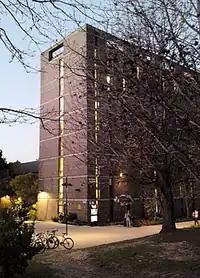
The Faculty of Science and Engineering is a constituent body of Macquarie University. The Faculty offers undergraduate and postgraduate coursework and research degree programs and is home to a number of internationally recognised research centres and also distinguished research staff. The Science Faculty is based on the Eastern half of the Academic Core at Macquarie University and is located near to the Macquarie University Research Park and the Macquarie University Hospital, thus allowing practical links with industry and research. The Faculty is renowned for its research in such areas as chiropractic science, proteomic analysis,[2] climate risk research, environmental science and ecological studies.[3]
Undergraduate Study
The Faculty offers bachelor degrees and undergraduate diplomas as part of their undergraduate programs. The Bachelor of Science offered by the faculty is a flexible program that students can tailor to suit their needs; with 25 majors available for study.[4]
Postgraduate Study
The Faculty offers postgraduate awards in the form of master's degrees, as coursework and research degrees, doctoral studies and postgraduate diplomas or certificates. Research degrees offered to students are designed to assist students to investigate and contribute to knowledge in their chosen discipline and to develop proficiency in conducting research.[5]
Faculty Departments and Centres
The Faculty of Science is divided into separate Departments which focus on specific fields of science for research and education purposes. The Excellence in Research for Australia initiative, as part of the Australian Research Council, has recognised several departments in the Faculty for "outstanding performance well above world standard" in the fields of Earth Sciences, Physical Sciences, Environmental Sciences, Biological Sciences, and Psychology and Cognitive Sciences.[6] Centres, also referred as Research Centres, under the Faculty of Science are at the forefront of research in the university and focus on significant and emerging fields in science.
The Faculty encompasses four schools, 2 research departments[7], and thirteen research centres[8].
Schools & Departments
- School of Computing
- School of Engineering
- School of Mathematical and Physical Sciences
- School of Natural Sciences
- Applied BioSciences
- Australian Astronomical Optics (AAO) - Macquarie
Centres
National research centres:
- ARC Centre of Excellence for Synthetic Biology (SynBio)
- Facilitated Advancement of Australia's Bioactives (FAAB)
- Risk Frontiers ("The birthplace of" [8])
University research centres:
- Astrophysics and Space Technologies
- Data Horizons
- Smart Green Cities
- Future Communications
Faculty research centres:
- Advanced Drone Systems
- Applied Artificial Intelligence
- Future Ecosystems Research Network
- Frontier AI
- Multi-omics
- Pollinator Futures
References
- ↑ "Macquarie at a Glance". Macquarie University. Archived from the original on 3 September 2011. Retrieved 29 September 2011.
- ↑ "System for identifying proteins to drive new direction in medical research". Macquarie University. Retrieved 29 September 2011.
- ↑ "Top institutions in Australia and New Zealand for research in environmental sciences and ecology". Times Higher Education. 26 May 2011. Retrieved 29 September 2011.
- ↑ "Undergraduate Courses". Macquarie University. Archived from the original on 3 December 2011. Retrieved 23 November 2011.
- ↑ "PhD & Research Degrees". Macquarie University. Archived from the original on 8 October 2011. Retrieved 29 September 2011.
- ↑ "Top Marks for Science". Macquarie University. Archived from the original on 8 October 2011. Retrieved 29 September 2011.
- ↑ "Schools and departments". Macquarie University. Retrieved 17 July 2026.
- 1 2 "Our research". Macquarie University. Retrieved 17 July 2026.