MDL (drug)
 | |
| Clinical data | |
|---|---|
| Other names | 10-methoxydihydrolysergol; 10-α-methoxy-9,10-dihydrolysergol |
| ATC code |
|
| Identifiers | |
| |
| CAS Number | |
| PubChem CID | |
| ChemSpider | |
| CompTox Dashboard (EPA) | |
| Chemical and physical data | |
| Formula | C17H22N2O2 |
| Molar mass | 286.375 g·mol−1 |
| 3D model (JSmol) | |
| |
| |
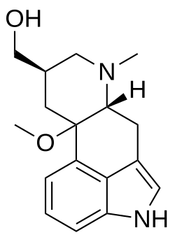
MDL (short for Methoxy Dihydro Lysergol) is a metabolite of the drug nicergoline.[1][2][3]
It is member of the ergoline family and is a dehydrogenated and methoxylated lysergol (a lysergol in which the double bond between carbon atoms 9 and 10 has been hydrogenated and a methoxy group is attached to the 10th carbon atom in the α-configuration).
MDL is formed as a result of the N-demethylation of the metabolite MMDL; the enzyme CYP2D6 plays a key role in this chemical reaction, and its individual functional activity determines the efficiency with which this drug is metabolised in the body.[4]
Pharmacology
Pharmacodynamics
Little is known about the serotonergic activity of MDL; however, there is a study evaluating the antioxidant activity of nicergoline metabolites, in which MDL and MMDL protect tissues from oxidation, prevent a drop in glutathione levels and halt lipid peroxidation.[5] In combination with nicergoline, it stimulates astrocytes, causing them to release protective growth factors (TGF-beta and GDNF); however, the metabolite MMDL did not exhibit this effect.[6] It mildly stimulates the synthesis of noradrenaline in the brain and has a weak (low) affinity for alpha-1-adrenoceptors.[7]
See also
References
- ↑ Sioufi, A.; Sandrenan, N.; Godbillon, J. (1992). "Determination of 10 alpha-methoxy-9,10-dihydrolysergol, a nicergoline metabolite, in human urine by high performance liquid chromatography". Biomedical Chromatography: BMC. 6 (1): 9–11. doi:10.1002/bmc.1130060104. ISSN 0269-3879. PMID 1600376.
- ↑ Chen, P.; Tian, Z.; Digenis, G. A.; Tai, H. H. (1996). "Enzyme immunoassay of two nicergoline metabolites, 10 alpha-methoxy-9, 10-dihydrolysergol (MDL) and 1-methyl-10 alpha-methoxy-9, 10-dihydrolysergol (MMDL)". Research Communications in Molecular Pathology and Pharmacology. 92 (3): 315–328. ISSN 1078-0297. PMID 8827829.
- ↑ Zheng, Rong; Wu, Yi-Hong; Jiang, De-Xi; Zhang, Dan (2012). "Determination of metabolite of nicergoline in human plasma by high-performance liquid chromatography and its application in pharmacokinetic studies". Journal of Pharmaceutical Analysis. 2 (1): 62–66. doi:10.1016/j.jpha.2011.09.005. ISSN 2095-1779. PMC 5760819. PMID 29403722.
- ↑ Böttiger, Y.; Dostert, P.; Benedetti, M. S.; Bani, M.; Fiorentini, F.; Casati, M.; Poggesti, I.; Alm, C.; Alvan, G.; Bertilsson, L. (1996). "Involvement of CYP2D6 but not CYP2C19 in nicergoline metabolism in humans". British Journal of Clinical Pharmacology. 42 (6): 707–711. doi:10.1046/j.1365-2125.1996.00471.x. ISSN 0306-5251. PMC 2042720. PMID 8971425.
- ↑ Vairetti, Mariapia; Battaglia, Angelo; Carfagna, Nicola; Luigi Canonico, Pier; Bertè, Francantonio; Richelmi, Plinio (2002-10-18). "Antioxidant properties of MDL and MMDL, two nicergoline metabolites, during chronic administration of haloperidol". European Journal of Pharmacology. 453 (1): 69–73. doi:10.1016/s0014-2999(02)02386-5. ISSN 0014-2999. PMID 12393061.
- ↑ Caraci, Filippo; Chisari, Mariangela; Frasca, Giuseppina; Canonico, Pier Luigi; Battaglia, Angelo; Calafiore, Marco; Battaglia, Giuseppe; Bosco, Paolo; Nicoletti, Ferdinando; Copani, Agata; Sortino, Maria Angela (2005-06-14). "Nicergoline, a drug used for age-dependent cognitive impairment, protects cultured neurons against beta-amyloid toxicity". Brain Research. 1047 (1): 30–37. doi:10.1016/j.brainres.2005.04.004. ISSN 0006-8993. PMID 15882840.
- ↑ Moretti, A.; Carfagna, N.; Caccia, C.; Carpentieri, M. (1988). "Effect of ergolines on neurotransmitter systems in the rat brain". Archives Internationales de Pharmacodynamie et de Therapie. 294: 33–45. ISSN 0003-9780. PMID 2906797.