Lynching of Richard Dickerson
| Date | March 7, 1904 |
|---|---|
| Location | |
| Participants | Mob |
| Deaths | 2 |
| Injuries | 1 |
Property damage | 7 buildings including the jail |
| Displaced | 150 |
| Coroner | Mr. Thomas |
| Arrests | Albert Loback and George Hill |
| Charges | Malicious destruction of property |
The lynching of Richard Dickerson (Dixon) took place in Springfield, Ohio, on March 7, 1904. Dickerson was an African American man arrested for the fatal shooting of a white police officer, Charles B. Collis. A mob broke into the jail and seized and lynched Dickerson. Riots and attacks on Black-owned businesses followed.
Background
Between 1902 and 1904 eleven African Americans were lynched in Springfield, Ohio. Most of those charged in the crimes received light sentences.[1]
Dickerson, also known as Richard Dixon, came to Springfield in 1902 from Cynthiana, Kentucky, after leaving town following an altercation that led to him cutting a man during an argument. He and Ms. Corbin were not married but shared a son. In Springfield, Dickerson was arrested numerous times for drinking and fighting, but there is no record of arrests for other types of serious crime. The 1904 city directory indicated that he was operating a "lunchroom."[2] On March 4, 1904, Dickerson was arrested after domestic dispute he caused while intoxicated. He was ordered to avoid Mamie Corbin, the mother of his 6 year old child unless accompanied by an officer. On March 6, sergeant Charles B. Collis was approached by Dickerson who he had been familiar with due to the many arrests Dickerson had accumulated while intoxicated. Dickerson asked if Collis would help him retrieve some blankets and books from the Jones Hotel where Ms. Corbin was living. Upon arrival Ms. Corbin declined to let Dickerson inside to retrieve his belongings but promise to drop them off at a later time. In response Dickerson angrily pulled out a .38 caliber revolver and shot Ms. Corbin in the chest. Sergeant Collis quickly went for his weapon but was struck twice before collapsing. Dickerson would then walk to the jail and turn himself in moments later. When word spread, there was already talk of lynching Dickerson.[3][4][5]
Following the shooting, Collis remained in critical condition while Richard Dixon was transferred from police headquarters to the county jail for security. Dixon's attorney, Sully Jaymes, advised him not to discuss the case, while contemporary reports speculated that he might claim insanity. As Collis's condition worsened, he made a will and gave an official statement about the shooting. Collis died at noon on Monday March 7, becoming the first Springfield policeman killed in the line of duty.[6] special grand jury was planned to indict Dixon, but before judicial proceedings could begin, threats to lynch him spread throughout Springfield. Local newspapers intensified the controversy, with the Press-Republic describing the shooting as evidence of the city's broader crime problem and criticizing the courts for failing to punish criminals. The next day, Collis died from his wounds, and the mob resolved to lynch Dickerson. Members of the Anti-Mob and Lynch-Law Association implored the sheriff to ask for help, but the sheriff said he could protect the prisoner.[4][6][7]
Escalation
On Monday, Springfield city leaders called an emergency meeting following criticisms that they were failing to aggressively combat local crime. This group included Mayor Charles Bowlus, Police Chief Richard O'Brien, Police Court Judge Joseph J. Miller, Police Prosecutor John Cole, and County Prosecutor John McGrew. They blamed the city's recent crime surge over the prior two years on sex workers and illegal brothels, deciding that the local court system needed to shut down these operations. Sheriff Floyd Routzahn, who was responsible for guarding Dixon, skipped the meeting. Instead, he spent the day hearing warnings from both white and Black residents about a growing plot to lynch the prisoner. While Routzahn spoke about these threats with the mayor, police chief, and military officials, he decided not to increase security at the jail, believing based on past events that he could manage the crowd without extra defense measures.[8]
Despite the ongoing discussions among city leaders, local residents began making quiet preparations to murder Dixon. Hardware stores experienced a sudden surge in handgun and ammunition sales. Additionally, a telephone pole was secretly moved into the prison yard to be used later to break down the doors. By nightfall, onlookers gathered in the downtown area to watch the situation unfold. A crowd quickly formed around the county jail. Around 6:00 p.m., a group of loud newspaper delivery boys gathered outside, and they were soon joined by families and groups of local citizens. Routzahn realized he had underestimated the danger and phoned the mayor at 8:00 p.m. for assistance, reporting that a hostile mob of a few hundred people had surrounded the building and were shouting racial slurs. Mayor Bowlus and a small group of city workers tried to intervene and de-escalate the mob, but they were unable to calm the crowd. After speaking with the mayor, Routzahn talked to Major Thomas Kirkpatrick, the top Ohio National Guard officer in the city. The sheriff had previously asked local military captains to stay on standby. In this evening phone call, Routzahn assured Kirkpatrick that civil police could still manage the mob, but he inquired about the process for calling in military support if the situation worsened. Kirkpatrick responded that he would not deploy National Guard units unless local law enforcement completely ran out of options and fulfilled a complex series of administrative steps. The sheriff viewed this response as a rejection of aid and informed the mayor. Bowlus called Kirkpatrick directly to confirm, and the military commander repeated that troops would remain stationary until all legal protocols were met.[8]
Meanwhile, the situation at the county jail escalated as the crowd grew to roughly 1,200 people. The mob became increasingly agitated upon spotting Black citizens and began vocalizing fears that Richard Dixon would evade punishment. Sheriff Routzahn attempted to pacify the gathering by announcing plans for a special grand jury and an expedited trial for Dixon, emphasizing his legal obligation to defend the prisoner. The crowd rejected the announcement, shouting back threats of violence and demands to access the inmate. Despite the escalating tension, the gathering did not believe law enforcement would use lethal force against them. [9]
Lynching of Richard Dickerson
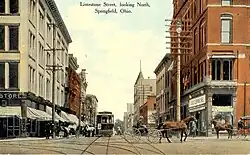
At 9:00 pm on March 7, 1904, the mob demanded that Sheriff Routzahn turn over Dickerson. The Sheriff told the crowd to disperse and said he would defend Dickerson. He said he would "do his duty at whatever cost." The mob had been trying to knock down one of the jail's doors and they stopped after the Sheriff's statement. The Sheriff thought the trouble had passed, but an the mob returned.[10] A small group from the crowd used a telephone pool as a battering ram and rushed the front doors of the jail. Officers successfully arrested two organizers of the charge, causing the remaining attackers to fall back, and police cleared the immediate courtyard. Believing the crowd was manageable and compliant, authorities did not implement further defensive measures. This assessment remained unchanged despite reports that a determined group of men from Lagonda, where Officer Charles Collis had been employed at the International Harvester facility, was marching downtown to join the crowd, and despite the fact that electrical power to the facility had been severed. Reporters, municipal leaders, and local citizens moved freely through the jail compound during this period, with journalists describing the scene as orderly and comparing it to an election night gathering. Onlookers included families with baby carriages, and observers noted very few intoxicated individuals. Aside from occasional gunshots fired into the air or stones thrown at windows, law enforcement maintained control over the compound, and by 10:30 p.m., the crowd began to diminish and scatter.
The temporary calm ended fifteen minutes later when a new group of 50 to 70 men arrived at the facility carrying a railroad tie, using it to smash through the iron-reinforced eastern entrance. Once the doors breached, a group of approximately 250 individuals forced their way into the building. Police Inspector William Warner led a squad of officers to confront the invaders with clubs and unholstered handguns, but he ordered his men not to open fire. Other responding officers and sheriff's deputies refrained from unholstering their weapons out of fear of being shot by the heavily armed crowd. Aware that Dixon was being held on the second level, members of the mob attempted to use the railroad tie against the iron cell block doors. When guards informed them the log would be ineffective, the attackers retrieved chisels and sledgehammers to breach the cell block. The crowd then held the jail's Black turnkey, Sherman Gregory, at gunpoint, forcing him to unlock the cell and surrender the prisoner. Upon entering the cell block, members of the mob immediately assaulted Dixon before dragging him down the front steps of the jail and out of the facility. The attackers shot Dixon six to nine times, killing him.
The mob initially attempted to suspend his corpse from a light pole within the jail courtyard, but when that failed, they secured a rope around his neck and dragged his body through the streets of Springfield to the intersection of Fountain and Main Streets. Members of the crowd scaled an electrical pole, hoisting Dixon's body approximately eighteen feet into the air to loud cheers from the onlookers.
Mutilation of Richard Dickerson
Around 11:30 pm on March 7, 1904, the freshly Murdered body of Richard Dickerson was finish being strung from a utility pole. A celebratory atmosphere followed as the crowd began shooting dozens of bullets into the hanging corpse. Onlookers cheered and waved handkerchiefs, while others exchanged jokes and congratulated one another, expressing relief that the community would see a peaceful period following the event. Individuals without firearms borrowed weapons from neighbors so they could participate in the shooting. After roughly thirty minutes, the gathering began slicing off pieces of the hanging rope to keep as personal souvenirs. The crowd also tore off Dixon's clothing to distribute the fabric as tokens. During the scramble for souvenirs, the body was accidentally cut down, but the crowd immediately stripped the remaining clothing from the corpse and suspended it back up on the pole. City officials did not arrive at the scene until 2:30 a.m., three and a half hours after Dixon was initially taken from his cell. The local coroner, accompanied by six police officers, lowered the body into a coffin while a final group of onlookers rushed the transport wagon to claim more pieces of the rope. A subsequent medical examination at the Gross Funeral Parlor revealed that Dixon's face had been severely beaten beyond recognition. The coroner reported no bruising on the torso, but identified fifteen total bullet entry wounds: two in the left arm, six in the left side, one in the right thigh, one in the left thigh, four in the chest, and one in the forehead.[11] [12] [13][14][15]
Riots
On March 8, 1904, a day after the lynching, a mob of more than 1,000 people gathered at the rail yards. An attack on the "Levee" was planned. The Levee was an African American section of town filled with saloons. The mob gathered up flammable items and separated into three groups. Each group was responsible for burning down a different saloon. Before the night was over, seven buildings were destroyed. The fire department showed up and stood by watching the buildings burn.[16] During the rioting no effort was made by the Company A Ninth Battalion since it was composed of many African Americans.[17]
City officials asked the governor for five more companies of soldiers to help restore order. The Governor complied bringing the total to 15 companies of soldiers. On March 9, African American residents were ordered to stay indoors. In one reported incident five shots were fired at one Black man in town. Colonel Mead was in charge of the troops, and he restored order.[1]
Aftermath

The coroner gave his ruling after an autopsy. He stated, "I am unable to determine the direct cause of death..."[1]
Albert Lobeck and George Hill were later arrested for leading the mob. They were each charged with malicious destruction of property.[13]
By March 16, Anna Corbin (the woman who was shot by Dickerson) filed a $5000 lawsuit against the city for Dickerson's lynching.[18]
In the summer of 1904, several Ohio National Guard officers faced court-martial for failing to act on their own initiative to mobilize their units in response to the rioting.[19] Judge advocate Edward Vollrath, an attorney and regimental commander, prosecuted the case. However, the plaintiffs successfully argued that in the absence of activation orders from the governor, they were under no obligation to order their soldiers to act.[19]
See also
References
- 1 2 3 "Mob May Clash with the Blacks". The Cairo Bulletin. 10 March 1904. Archived from the original on 12 January 2022. Retrieved 11 January 2022.
- ↑ "Lynching". Springfield Program in Inter-Cultural Education. August 1972. p. 33. Retrieved 14 August 2026.
{{cite news}}:|archive-url=is malformed: timestamp (help);|first=missing|last=(help)CS1 maint: url-status (link) - ↑ "175 Years of Struggle - Page 15". cdm17329.contentdm.oclc.org. Retrieved 14 August 2026.
- 1 2 Huffman, S.E (2 April 1904). "The Lynching of Richard Dickerson at Springfield, Ohio, March 7th, 1904". Black Virginia. Archived from the original on 11 January 2022. Retrieved 11 January 2022.
- ↑ "Patrolman Charles B. Collis, Springfield Police Department, Ohio". The Officer Down Memorial Page, Inc. Archived from the original on 16 January 2022. Retrieved 16 January 2022.
- 1 2 "175 Years of Struggle - Page 16". cdm17329.contentdm.oclc.org. Retrieved 14 August 2026.
- ↑ "A Negro is Lynched in Ohio". Newark Advocate. Newark, Ohio. 8 March 1904. Archived from the original on 11 January 2022. Retrieved 16 January 2022.
- 1 2 "175 Years of Struggle - Page 17". cdm17329.contentdm.oclc.org. Retrieved 14 August 2026.
- ↑ "175 Years of Struggle - Page 17". cdm17329.contentdm.oclc.org. Retrieved 14 August 2026.
- ↑ "Negro Murdered Lynched at Springfield". Sandusky Evening Star. 8 March 1904. Archived from the original on 11 January 2022. Retrieved 11 January 2022.
- ↑ "175 Years of Struggle - Page 19". cdm17329.contentdm.oclc.org. Retrieved 14 August 2026.
- ↑ "A Negro Lynched". People's Voice. 10 March 1904. Archived from the original on 11 January 2022. Retrieved 11 January 2022 – via Newspapers.com.
- 1 2 "Lynching". Springfield Program in Inter-Cultural Education. August 1972. p. 33. Retrieved 14 August 2026.
{{cite news}}:|archive-url=is malformed: timestamp (help);|first=missing|last=(help)CS1 maint: url-status (link) - ↑ "Negro Lynched". Lead Daily Call. 8 March 1904. Archived from the original on 11 January 2022. Retrieved 11 January 2022 – via Newspapers.com.
- ↑ Without Sanctuary Gallery picture # 78
- ↑ Blocker, Jr, Jack S. (2006). "Ohio Valley History" (PDF). Filson Historical. p. 27. Archived (PDF) from the original on 11 January 2022. Retrieved 11 January 2022.
- ↑ Ginzburg, Ralph (1988). 100 years of lynchings. Baltimore, MD: Black Classic Press. pp. 65–67. ISBN 9780933121188. Archived from the original on 26 February 2022. Retrieved 11 January 2022 – via Google Books.
- ↑ "Sues City Because Mob Avenged Her". Logansport Journal. 16 March 1904. Archived from the original on 11 January 2022. Retrieved 11 January 2022.
- 1 2 "Different Are the Views Taken by the Governor and Court-Martial". The Cincinnati Post. Cincinnati, OH. 28 July 1904. p. 6 – via Newspapers.com.
- "War on Dives in Springfield". Washington Times. 9 March 1904. Archived from the original on 11 January 2022. Retrieved 11 January 2022.
- 1904 deaths
- 1904 in Ohio
- 1904 murders in the United States
- Deaths by person in Ohio
- Lynching deaths in Ohio
- March 1904 in the United States
- People murdered in Ohio
- Springfield, Ohio
- Murdered African-American people
- Events that led to courts-martial
- Attacks on bars in the United States
- Attacks on prisons and jails in the United States
- 1904 riots
- Attacks on buildings and structures in the 1900s
- Racially motivated violence against African Americans in Ohio
- African-American lynching victims