Lucky Strike, Alberta
Lucky Strike | |
|---|---|
Locality | |
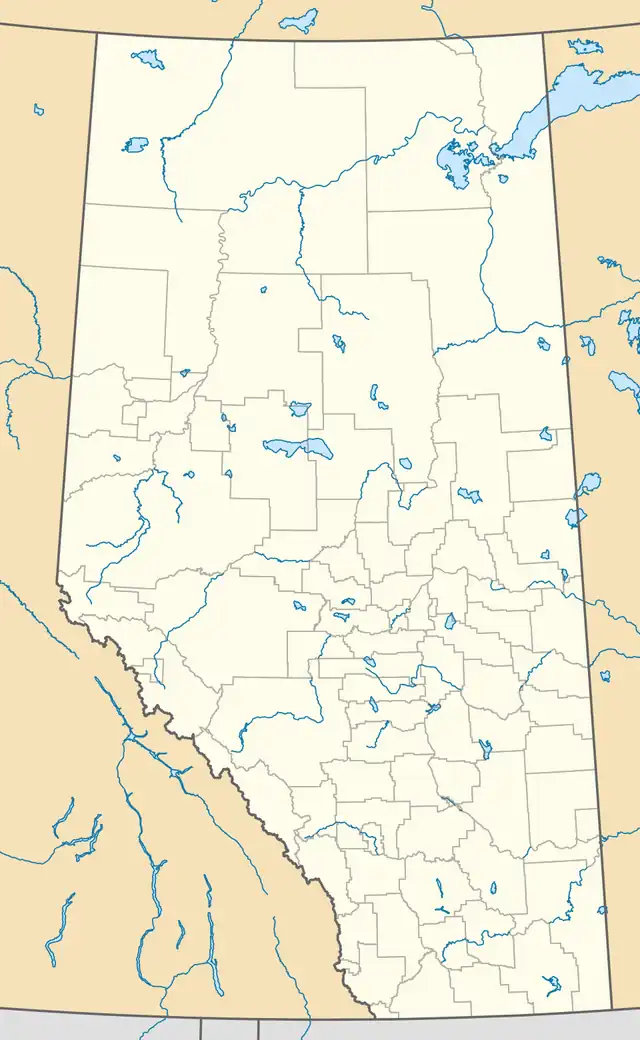  Location of Lucky Strike in Alberta | |
| Coordinates: 49°12′12″N 111°29′21″W / 49.2034°N 111.4892°W | |
| Country | Canada |
| Province | Alberta |
| Region | Southern Alberta |
| Census division | 2 |
| Municipal district | County of Warner No. 5 |
| Government | |
| • Governing body | County of Warner No. 5 Council |
| Time zone | UTC−06:00 (Alberta Time) |
| Postal code span | |
| Area code | +1-403 |
| Highways | Highway 501 |
| Waterways | Smith Coulee |
Lucky Strike was a locality in the County of Warner No. 5, Alberta, Canada located on Highway 501.[1] As of the 21st century, the toponym is used to refer geographically to the original site.[2] It is approximately 26 km (16 mi) east of Milk River, 20 km (12 mi) northeast of Writing-on-Stone Provincial Park,[3] and 18 km (11 mi) south of Foremost.
Toponymy
Researchers have recorded at least two explanations for Lucky Strike's name.[4] A version accepted by the Geographical Names Board of Canada holds that early settlers named the locality because "those who obtained land [there] were considered to be fortunate".[4][5][6] Geographer Frank Jankunis categorizes Lucky Strike as one of several early localities in southern Alberta with names that "reflect the aspirations of the pioneers [for] their communities"; other examples include Faith and Success.[7]
Another common version provides that Lucky Strike was named when a prospective homesteader, who was surveying the area's available land on a rainy and windy day, successfully lit a pipe with the only match he had.[4] Other members of the group he was travelling with agreed he had enjoyed a "lucky strike".[4]
Topography
Lucky Strike falls within both the Verdigris Plain and the Lucky Strike Upland, areas of gently rolling terrain formed by ancient glacial activity.[8][9] The landscape contains some hummocks, and scattered outcrops of rock.[9] Soils are generally well-suited to agriculture, though some are highly saline.[8][9]
Flora and fauna
As of 2024, the invasive caragana plant grows in Lucky Strike's vicinity.[10] The area also hosts populations of badgers and Richardson's ground squirrels.[10]
History
Founding: 1908–1910

Lucky Strike and surrounding areas officially opened for settlement on January 10, 1910, but some settlers had already established homesteads as squatters.[11][12] One such couple was Emma and Nathaniel Kingsbury, who first settled in the area that would become known as Lucky Strike in 1908.[11] Lucky Strike formally became the community's name in January 1910, when Emma Kingsbury opened a post office by that title.[13][2]
The Kingsburys also ran a hostel and general store, the Lucky Strike Sleeping and Eating Emporium; the latter contained a dance hall.[11][2][14] Because many early immigrants to Lucky Strike were from the United States, the hall hosted annual events to celebrate both July 4 (American Independence Day) and July 1 (Canada Day) for some decades.[6][11] Emma Kingsbury additionally served as the district's returning officer during elections; in this role, she helped illiterate locals to fill out their ballots.[15]
The community was established enough by 1910 that a local carpenter built a schoolhouse, Prairie Round School, located 4.8 km (3.0 mi) west of the Lucky Strike Emporium.[6][11] The building doubled as a place of worship for various congregations in the area until its closure in 1929.[11][14]
Discovery of coal and development: 1911–1945
Coal was discovered in coulees within 20 km (12 mi) of Lucky Strike in 1911.[3][15] According to the Government of Alberta, the Lucky Strike coal field proved to be "the most productive coal field in the southern part" of the Taber-Manyberries area over the next four decades.[16] Mines brought employment opportunities for farmers in the area, and made Lucky Strike a commercial hub for the district while mining was underway.[15]
While the coal industry developed, the number of homesteaders arriving in the region started to slow down.[2] A period of mild weather since the start of the century gave way to dry and volatile conditions, making farms harder to sustain.[2][17] Nonetheless, Lucky Strike residents established a series of services throughout the year 1913, including a community well, Lucky Strike School,[11] and Prairie Round Cemetery, established beside the existing Prairie Round School.[18][10] Lucky Strike School served as a venue for various religious services,[19] and railway services reached nearby Foremost that same year.[17]
Alberta Government Telephones brought telephone services to Lucky Strike in 1918.[19] Members of the Lucky Strike Women's Institute (itself established in 1936) voted to dissolve and become the Lucky Strike Community Club in 1939.[11] Volunteers who joined the club tended to Prairie Round Cemetery, held raffles, organized dances, and, during the Second World War, hosted "welcome home" parties for returning veterans.[11]
Decline and withdrawal of provincial recognition: 1946–2000
Coal production began to decline in Alberta during the late 1940s, as major railways switched from using coal to diesel.[20] Mining communities similarly declined, as miners moved elsewhere for work or social support.[20]
The Kingsbury family sold Lucky Strike's post office in 1948 to Maurine and Morrison Look, who moved the attached general store from the Kingsbury's farm to a new location half a mile away.[11] Meanwhile, the vacant Prairie Round School building was moved into Lucky Strike to become Lucky Strike Community Hall.[11] The facility began to host Sunday school gatherings, as well as religious services by visiting pastors, including United Church of Canada ministers from nearby Foremost.[11]
1948 also saw the closure of Lucky Strike School, owing to a shortage of students and difficulty finding teachers who would move to the rural locality.[11][21] Lucky Strike Mine closed the following year,[22] and most of the area's original mining operations ceased by 1954.[15][16] A local family bought Lucky Strike School in 1956 for $251 ($2,882 in constant dollars) and moved it to their farm.[11][21]
Lucky Strike's final postmistress, Olive Fitzpatrick, assumed the role in June 1964, only to step down in late 1965.[13][2] No suitable replacement could be found, owing to the locality's small population, and the post office closed permanently in December.[2][13] Prairie Round Cemetery received its final interment in 1969.[10]
On April 28, 1970, the Government of Alberta rescinded recognition of Lucky Strike as a named locality,[1] and religious services in Lucky Strike Community Hall ended two years later due to poor attendance.[11] The Lucky Strike Community Association remained active, in particular by maintaining Prairie Round Cemetery, until it folded sometime after 1999.[10][23]
21st century: 2001–present
Lucky Strike was one of several farming communities in the Writing-on-Stone region, including Masinasin and Clarinda, that did not survive into the 21st century.[2][9] The dormant Lucky Strike Community Hall was held by a local organization until 2023, when Warner County demolished the facility at their request.[24][25]
Places of interest
Prairie Round Cemetery, which received interments between 1913 and 1969, remains accessible to the public as of 2026.[18] Warner County installed a sign for the cemetery in 2023,[26] and maintained it until 2024.[10] The graveyard has since been deemed inactive and abandoned by the county.[18]
Notable residents
- Leonard Halmrast – resident of Lucky Strike[27] and member of the Legislative Assembly of Alberta from 1945 to 1967; held positions in Premier Ernest Manning's cabinet from 1953 to 1967[28][29]
See also
References
- 1 2 Government of Canada, Natural Resources Canada. "Place names - Lucky Strike". Canadian Geographical Names Database. Retrieved July 5, 2026.
- 1 2 3 4 5 6 7 8 Speirs, Dale (March 2023). "Postal History of the Writing-on-Stone District, Alberta" (PDF). Journal of Alberta Postal History. 1 (27): 3–16.
- 1 2 Government of Canada, Natural Resources Canada. "Geographical names near Lucky Strike". Canadian Geographical Names Database. Retrieved July 5, 2026.
- 1 2 3 4 Karamitsanis, Aphrodite (1992). "Place names of Alberta. 2: Southern Alberta". University of Calgary Press. p. 74. ISBN 978-0-919813-95-3.
{{cite web}}: CS1 maint: periodical has ISBN (link) - ↑ Canadian Board on Geographical Names (1928). Place-names of Alberta. Ottawa: F. A. Acland, printer. p. 80.
- 1 2 3 Campbell, Alice A. (1959). Milk River Country (1 ed.). Lethbridge: Lethbridge Herald. pp. 204–205, 320, 342.
- ↑ Jankunis, Frank J. (1972). Southern Alberta: A Regional Perspective; F. Jankunis, Editor. With Illus. by G.S. Young. Lethbridge: University of Lethbridge. p. 93.
- 1 2 Terrain Sciences Department (1988). "Peatland Distribution in Alberta" (PDF). Alberta Geological Survey. Alberta Research Council. Map.
- 1 2 3 4 Agriculture and Forestry (July 23, 2019). General land systems descriptions for the agricultural region of Alberta. Government of Alberta. p. 7.
- 1 2 3 4 5 6 Warner County (March 5, 2024). COUNTY COUNCIL March 5, 2024 9:00 a.m. Council Chambers AGENDA. County of Warner. p. 83.
- 1 2 3 4 5 6 7 8 9 10 11 12 13 14 15 Short Grass Historical Society (1974). Long Shadows - A History of Shortgrass Country. Commentator Publishing Company. pp. 12–22, 55–63, 83–112, 124–126, 139–140.
- ↑ Glenbow Archives (1910). "Lucky Strike, Alberta". University of Calgary Digital Collections. Retrieved July 5, 2026.
Lucky Strike was opened for homesteading on January 10, 1910.
- 1 2 3 Canada, Library and Archives (November 25, 2016). "Lucky Strike Archives / Post Offices and Postmasters". recherche-collection-search.bac-lac.gc.ca. Retrieved July 5, 2026.
- 1 2 Finstad, Helen, ed. (1970). Prairie Footprints: A History of the Community in Southern Alberta Known as Pendant d'Oreille. Pendant d'Oreille Lutheran Church Women. pp. 126, 208.
- 1 2 3 4 Brower, Warren, ed. (2003). The Hills of Home (2 ed.). Altona: Hills of Home History Committee. pp. 228, 292.
- 1 2 Campbell, J. D. (January 1, 1974). "Coal Resources, Taber-Manyberries Area, Alberta". Alberta Geological Survey. Earth Sciences Report 1974-03. pp. 10–11. Retrieved July 5, 2026.
- 1 2 Warner Old Timers' Association (1962). Warner Pioneers. Lethbridge: Lethbridge Herald. pp. 102, 119–120.
- 1 2 3 Alberta, County of Warner. "Cemeteries". warnercounty.ca. Retrieved July 5, 2026.
- 1 2 Butterwick, Alyce, ed. (1975). Shortgrass Country: A History of Foremost and Nemiskam (1 ed.). Foremost: Foremost Historical Society. pp. 118, 548.
- 1 2 Finkel, Alvin. "Coal Mining in Alberta". Alberta Labour History Institute (ALHI): Workers' History / Workers' Stories. Retrieved July 5, 2026.
- 1 2 "School Committee Report". Raymond Recorder. February 24, 1956. p. 4.
- ↑ Campbell, J. D. (January 1, 1964). "Catalogue of Coal Mines of the Alberta Plains". Alberta Geological Survey. p. 7. Retrieved July 5, 2026.
- ↑ Government of Alberta (1999). Alberta Gaming and Liquor Commission annual report 1998-99 (1 ed.). Edmonton: Alberta Gaming and Liquor Commission. p. 65.
- ↑ County of Warner (July 19, 2022). "COUNTY COUNCIL July 19, 2022 AGENDA". Warner County No. 5. p. 4.
- ↑ Liebelt, Larry (May 16, 2023). "PUBLIC WORKS SUPERINTENDENT'S REPORT – May 16, 2023". County of Warner. p. 7.
- ↑ Liebelt, Larry (May 16, 2023). "PUBLIC WORKS SUPERINTENDENT'S REPORT". COUNTY COUNCIL May 16, 2023 AGENDA. p. 7 – via Warner County.
- ↑ "Pioneer Days Revived At Milk River When Border Lions Hold Celebration". Lethbridge Herald. September 26, 1946. p. 5.
- ↑ Canadian Parliamentary Guide / Guide Parlementaire Canadien (in English and French). P.G. Normandin. 1951. p. 428.
- ↑ Langford, Tom (2011). Alberta's Daycare Controversy: From 1908 to 2009-- and Beyond. Athabasca University Press. pp. 49–60. ISBN 978-1-926836-02-7.
External links
- Ghost Towns in Canada. Lucky Strike
Places adjacent to Lucky Strike, Alberta | |
|---|---|


Subdivisions of Alberta | |
|---|---|
| Subdivisions | |
| Communities | |
| Cities and urban service areas | |

