Love After War
| Love After War | ||||
|---|---|---|---|---|
 | ||||
| Studio album by | ||||
| Released | December 6, 2011 | |||
| Recorded | 2010–11 | |||
| Genres | ||||
| Length | 61:40 | |||
| Labels | ||||
| Producers |
| |||
| Robin Thicke chronology | ||||
| ||||
| Singles from Love After War | ||||
| ||||
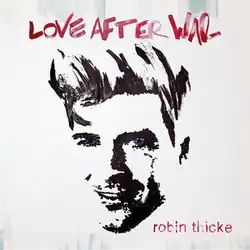
Love After War is the fifth studio album by American R&B recording artist Robin Thicke. It was released on December 6, 2011, by Star Trak Entertainment in the United States. Drawing on Thicke's experiences of becoming a father and his relationship with Paula Patton, the album explores the "inner wars" of relationships and personal struggles, emphasizing love, compassion, patience, and understanding. Thicke wrote and produced the album himself, with Lil Wayne as its sole guest collaborator.[2]
The album received generally mixed-to-positive reviews, with critics praising Thicke's vocals, romantic songwriting, and polished blend of soul, funk, and bossa nova influences, while some found the 17-track album repetitive or overly superficial. Commercially, the underperformed. It debuted at number 22 on the US Billboard 200 and number 6 on the Top R&B/Hip-Hop Albums, becoming his fourth consecutive top-ten album on the latter chart but his first since A Beautiful World (2002) to miss the Billboard 200 top ten. The album's title track became Thicke's second number one hit on the US Adult R&B Songs chart.
Background
For his fifth studio album, Love After War, Thicke drew heavily on the experience of becoming a father and the changes it brought to his relationship with his wife, Paula Patton.[3] Many of the album's songs were inspired by Patton and their relationship, while Thicke described the project more broadly as an exploration of the "inner wars" people face in relationships and within themselves.[3] He wrote and produced the album himself, with Lil Wayne as its only guest collaborator, and sought to move beyond conflict, fear, and emotional turmoil toward love, compassion, patience, and understanding[4] Thicke also connected the album’s emotional vulnerability to his identity as a soul singer, emphasizing the importance of personal relationships and vulnerability in his music.[3]
Singles
The album's lead single and title track, "Love After War", was released on October 11, 2011, and officially impacted U.S. Urban radio on October 18, 2011. The music video was released on November 21, 2011.[5] The single also impacted Smooth Jazz radio on November 22, 2011.[6] The album's second single, "Pretty Lil' Heart", featuring Lil Wayne, was released on November 8, 2011, and impacted Urban and Urban Mainstream radio on November 21 and November 22, respectively. The music video, in which Thicke adopted a James Dean-inspired look, was released on March 2, 2012.[7] "All Tied Up" was subsequently released as the album's third single and impacted Urban Adult Contemporary radio on April 10, 2012. Its music video was released on June 7, 2012.[8]
Critical reception
| Review scores | |
|---|---|
| Source | Rating |
| About.com |   [9] |
| AllMusic | [10] |
| Entertainment Weekly | B+[11] |
| Rolling Stone | [12] |
| Slant Magazine | [13] |
| USA Today | [14] |
Love After War received generally mixed to positive reviews from music critics. Mark Edward Nero of About.com called it a "tender and romantic" album and described Thicke as one of contemporary R&B's most "sensitive yet sexual" singers, praising his growth as a vocalist and songwriter and its more personal approach.[9] Kyle Anderson of Entertainment Weekly similarly praised Thicke's "creamy voice", although he felt that the 17-track album became somewhat exhausting in its latter stages.[11] Elysa Gardner of USA Today praised Thicke's "dextrous singing", noting echoes of Marvin Gaye and Michael McDonald and his ability to give old-school R&B textures a fresh, understated finish.[14] Writing for Fact, Alex Macpherson praised the album's predominantly smooth, bossa nova-influenced soul and its "understated but irresistible melodic touches", while highlighting Thicke's ability to balance his suave loverman image with an awkward, humorous side that made him more endearing. He described the album as an effective blend of polished romanticism and Thicke's playful personality.[15]
Allison Stewart of The Washington Post viewed Love After War as a more assured follow-up to Sex Therapy, praising its blend of falsetto-led ballads and funk-oriented tracks. She characterized the album as drawing on the "Marvin Gaye School of Socially Conscious Babymaking", highlighting the Prince-influenced "I'm an Animal" and "An Angel on Each Arm" while finding the socially conscious "The New Generation" weighed down by its earnestness.[16] Less impressed, AllMusic editor Andy Kellman described Thicke's sound as "suave, and even more swashbuckling", but felt that the album's second half offered little development from his earlier work.[10] Slant Magazine's Matthew Cole was more critical, arguing that Thicke's full-voice performances produced "mixed results" and that the album's 17-track "seduction routine" caused its weaker material to accumulate.[13] Nate Chinen of The New York Times likewise found the album too superficial, writing that Thicke "ask[s] you to admire his tasteful slickness without delving much deeper than the surface."[1] Rolling Stone writer Jody Rosen was more favorable toward Thicke's romantic material, highlighting his acoustic guitar work and "feathery upper register" as particularly effective expressions of his strengths as a singer.[12]
Commercial performance
The album debuted at number 22 on the Billboard 200 and number six on the Top R&B/Hip-Hop Albums, with first-week sales of 41,000 copies in the United States.[17] Although it became his fourth consecutive album to reach the top ten on the latter chart, it was his first to miss the top ten on the Billboard 200 since his debut album, A Beautiful World (2002), and ultimately sold approximately 206,000 copies in the United States, according to Nielsen SoundScan.[18] Reflecting on the album's commercial performance, Thicke later expressed disappointment, questioning whether continuing to invest so heavily in his music was worthwhile after the comparatively weak sales.[18]
Track listing
All tracks are written by Robin Thicke, except where noted.
| No. | Title | Writer(s) | Length |
|---|---|---|---|
| 1. | "An Angel on Each Arm" | 4:12 | |
| 2. | "I'm an Animal" | 4:05 | |
| 3. | "Never Give Up" | Thicke, M. Garcia | 2:37 |
| 4. | "The New Generation" | 3:59 | |
| 5. | "Love After War" | 3:16 | |
| 6. | "All Tied Up" | 3:53 | |
| 7. | "Pretty Lil' Heart" (featuring Lil Wayne) | 3:35 | |
| 8. | "Mission" | 2:46 | |
| 9. | "Tears on My Tuxedo" | 5:14 | |
| 10. | "Boring" | 3:28 | |
| 11. | "Lovely Lady" | 2:05 | |
| 12. | "Dangerous" | 3:42 | |
| 13. | "Full Time Believer" | Thicke, Bobby Keyes | 4:03 |
| 14. | "I Don't Know How It Feels to Be U" | 5:30 | |
| 15. | "Cloud 9" | Thicke, Bobby Keyes | 2:57 |
| 16. | "The Lil' Things" | 2:47 | |
| 17. | "What Would I Be?" | 3:23 |
| No. | Title | Length |
|---|---|---|
| 18. | "Stupid Things" | 4:54 |
| 19. | "Compass or Map" | 3:55 |
| 20. | "We a Family" | 3:35 |
- Sample credits
- "Never Give Up" contained a sample of José Pablo Moncayo's 1941 piece Huapango.[10]
Personnel
Credits for Love After War adapted from AllMusic.[19]
|
|
Charts
Weekly charts
|
Year-end charts
|
References
- 1 2 Chinen, Nate (December 6, 2011). "New Music - Amy Winehouse, Robin Thicke and T-Pain". The New York Times. Retrieved December 6, 2011.
- ↑ Daw, Robbie. "Robin Thicke’s ‘Love After War’ Album Cover, Tracklist Revealed." Idolator. [link removed] (accessed November 17, 2011).
- 1 2 3 Dawson, Will (May 17, 2025). "A Conversation with Singer/Songwriter ROBIN THICKE". medium.com. Retrieved August 1, 2026.
- ↑ Dawson, Will (November 22, 2011). "Robin Thicke At The AMA's, Globalgrind.com Interview". Globalgrind.com. Retrieved August 1, 2026.
- ↑ "Video: Robin Thicke – 'Love After War'". Rap-Up.com. November 21, 2011. Retrieved February 29, 2012.
- ↑ "®R&R :: Going For Adds™ :: Smooth Jazz ®". Gfa.radioandrecords.com. November 22, 2011. Archived from the original on September 12, 2014. Retrieved February 29, 2012.
- ↑ "Robin Thicke Channels James Dean in 'Pretty Lil' Heart' Video". Rap-Up.com. March 2, 2012. Retrieved March 2, 2012.
- ↑ "Video: Robin Thicke – 'All Tied Up'". Rap-Up.com. Retrieved March 1, 2014.
- 1 2 Nero, Mark Edward. "Tender & Romantic". About.com. Archived from the original on July 10, 2014. Retrieved July 31, 2026.
- 1 2 3 Kellman, Andy (December 4, 2011). "Love After War - Robin Thicke". AllMusic. Review. Retrieved August 1, 2026.
- 1 2 Anderson, Kyle (November 30, 2011). "Love After War review - Robin Thicke Review". Entertainment Weekly. Time Inc. Archived from the original on December 3, 2011. Retrieved December 4, 2011.
- 1 2 Rosen, Jody (December 6, 2011). "Love After War". Rolling Stone. Wenner Media. Retrieved December 6, 2011.
- 1 2 Cole, Matthew (December 6, 2011). "Robin Thicke: Love After War". Slant Magazine. Retrieved December 6, 2011.
- 1 2 Gardner, Elysa (December 5, 2011). "Listen Up: Robin Thicke, The Roots, T-Pain, Nils Lofgren album reviews". USA Today. Gannett Company. Retrieved December 6, 2011.
- ↑ Macpherson, Alex (January 16, 2012). "Robin Thicke: Love After War". Fact Magazine. Retrieved August 1, 2026.
- ↑ Stewart, Allison (December 9, 2011). "Music review: Robin Thicke's 'Love After War'". The Washington Post. Retrieved August 1, 2026.
- ↑ Jacobs, Allen (December 14, 2011). "Hip Hop Album Sales: The Week Ending 12/11/2011 | Get The Latest Hip Hop News, Rap News & Hip Hop Album Sales". HipHop DX. Archived from the original on April 15, 2012. Retrieved February 29, 2012.
- 1 2 Gardner, Elysa (July 30, 2013). "On 'Blurred Lines,' Robin Thicke's vision is clear". USA Today. Retrieved January 3, 2014.
- ↑ "Love After War - Robin Thicke". AllMusic. Rovi Corporation. Credits. Retrieved December 4, 2011.
- ↑ "Robin Thicke Chart History (Billboard 200)". Billboard. Retrieved May 30, 2020.
- ↑ "Robin Thicke Chart History (Top R&B/Hip-Hop Albums)". Billboard. Retrieved May 30, 2020.
- ↑ "Top Billboard 200 Albums – Year-End 2012". Billboard. Retrieved May 30, 2020.
- ↑ "Top R&B/Hip-Hop Albums – Year-End 2012". Billboard. Retrieved May 30, 2020.