Litti (dish)
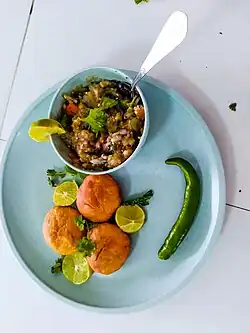 Chokha surrounded by ghee-dipped litti | |
| Alternative names | Baati, Bhauri, Phutahari |
|---|---|
| Course | Snack, main course |
| Place of origin | India |
| Region or state | Bhojpuri region |
| Associated cuisine | Bhojpuri cuisine |
| Serving temperature | Any |
| Main ingredients | Wheat flour, brinjal, onion, peppers, cilantro, mustard oil, gram flour, ghee |
| Variations | Baati |

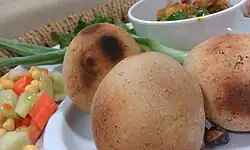
Litti (Bhojpuri: 𑂪𑂲𑂗𑂲 romanized: leetee, IPA: [lɪʈːiː, liːʈiː]) is a wholewheat flour dough ball stuffed with a spiced mixture of satui (roasted black chickpea flour).[1] Litti, along with chokha, is a complete meal that is popular in the Bhojpuri region of eastern Uttar Pradesh, Bihar, Jharkhand and Madhesh.[2][3] It is also a popular street food in small towns and cities. Over the years it has gained international recognition.[4][5][6]
It consists of a wheat dough ball filled with a mixture of roasted gram flour, Lemon, spices, and herbs, which is then roasted on hot charcoal or fire. They can also be baked in an oven, roasted on a tava or fried.[1]
Historical background
The history of Litti is deeply rooted in the Bhojpuri region of the Indian subcontinent, particularly in the cities of Buxar and Banaras. Both the Panchkosi Jatra and the Lota-Bhanta Mela are significant cultural and religious events in these regions, highlighting the ritualistic importance of Litti.
The Panchkosi Jatra, an annual pilgrimage held in Buxar, involves the circumambulation of five sacred sites. It starts every year on the fifth day of the dark fortnight of Agrahayana and lasts for five days. According to a legend from the Ramayana, Lord Ram consumed Litti-Chokha during his visit to Charitravan in Buxar while staying at the ashram of Maharishi Vishwamitra. As part of the Panchkosi Jatra, Litti is prepared and offered to Lord Ram as prasad at Charitravan on the final day of the journey, symbolizing devotion and preserving the dish’s ritualistic significance in the area's long-standing traditions.[7][8]
The Lota-Bhanta Mela, held annually in Varanasi, on the sixth day of the dark fortnight of Agrahayana is another major festival linked to Litti (also called Baati). According to legend, Lord Ram is believed to have visited Kashi twice, performing the sacred Panchkosi Jatra—first to absolve King Dasharatha of a curse and later to atone for Brahmahatya after slaying Ravana. During his second pilgrimage, Lord Ram made a Shivling from sand, performed jalabhishek, and then prepared Litti-Chokha, offering it to Lord Shiva as bhog and later consuming it as prasad, completing his penance. This site is now known as Rameshwar Mahadev. As part of the Lota-Bhanta Mela, devotees bathe in the Varuna River, prepare Litti-Chokha, and offer it to Lord Shiva, continuing this sacred tradition of devotion.[9]
Description
Litti is a dough ball made from whole wheat flour, stuffed with sattu (roasted gram flour) mixed with garlic, ginger, onions, coriander leaves, lime juice, carom seeds, nigella seeds, and mustard oil. Traditionally, it is cooked over a coal fire, giving it a distinct smoky flavour.[10]
Flavors and variations
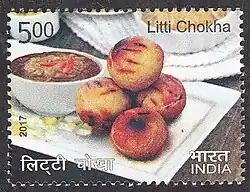
Herbs and spices used to flavour the litti include onion, garlic, ginger, coriander leaves, lime juice, carom seeds, nigella seeds and salt.[11] In Madhesh Province of Nepal, Litti is served with Momo Achar. In western Bihar and eastern Uttar Pradesh, litti is served with murgh korma (a creamy chicken curry) or chokha (a vegetable preparation of roasted and mashed eggplant, tomato, and potato).[12]
Popularity
Litti-chokha was selected to represent the country under the banner of the National Association of Street food Vendors of India (NASVI) at the five-day event in the Philippines capital, Manila.[13][14]
See also
References
- 1 2 Amit, Dassana (2 February 2023). "Litti Chokha Recipe | Litti Recipe". Dassana's Veg Recipes. Retrieved 28 December 2023.
- ↑ Ojhā, Satyadeva (2006). भोजपुरी कहावतें: एक सांस्कृतिक अध्ययन (in Hindi). Vaṇī Prakāśana. ISBN 978-81-8143-562-0.
- ↑ Ghosh, Avijit (22 May 2010). CINEMA BHOJPURI. Penguin UK. ISBN 978-81-8475-256-4.
- ↑ Singh, Siddhivi (19 November 2023). "Halls of fame at international trade fair team india is the crowdpuller". Times Of India.
- ↑ "Development and Standardization of Naturally Fortified Litti – Chokha" (PDF). Journal of Food Technology & Nutrition Sciences. 3 (4). 25 November 2021.
- ↑ Sharma, Sanjeev Kumar. "A signature dish of Bihar: Litti and Chokha". Researchgate.
- ↑ "Bihar's Panchkosi Fair: A Grand Celebration Of Tradition With Litti-Chokha". News18. Retrieved 30 November 2024.
- ↑ "Litti Chokha: बक्सर में भगवान श्रीराम ने खाया था लिट्टी-चोखा, जानिए क्या है पंचकोशी यात्रा की पौराणिक कथा - Litti Chokha Shriram had eaten Litti Chokha in Buxar know what is the legend of Panchkoshi Yatra". Jagran (in Hindi). Retrieved 30 November 2024.
- ↑ "लोटा-भंटा मेला : मेला जहां वरुणा में स्नान के बाद लगता है भोले को बाटी- चोखा का भोग - Lota Bhanta Mela A symbol of faith fair where after bathing in Varuna bati chokha bhog to shiva in Varanasi Jagran Special". Jagran (in Hindi). Retrieved 30 November 2024.
- ↑ bhat, kkulvas (10 June 2021). "Litti Chokha". KitchenCultures. Retrieved 22 August 2024.
- ↑ Bihar (India); Pranab Chandra Roy Choudhury (1966). Bihar district gazetteers. Printed by the Superintendent, Secretariat Press, Bihar. p. 807. Retrieved 28 September 2012.
- ↑ Caroline Trefler (21 June 2011). Fodor's Essential India: With Delhi, Rajasthan, the Taj Mahal & Mumbai. Random House Digital, Inc. pp. 157–. ISBN 978-1-4000-0529-1. Retrieved 28 September 2012.
- ↑ "Bihar's Famous Cuisine Litti-Chokha Set To Compete At The Manila International Food Festival On May 31". india.com.
- ↑ "Bihari delicacy litti-chokha to compete with American, Thai cuisines at Manila food fest". Hindustan Times. 24 May 2017.

| Dishes by origin |
| ||||||||||||||||||||
|---|---|---|---|---|---|---|---|---|---|---|---|---|---|---|---|---|---|---|---|---|---|
| By type and origin |
| ||||||||||||||||||||
| By type |
| ||||||||||||||||||||

