List of reptiles of Angola

Angola is home to a rich and diverse reptile fauna, with at least 324 species documented according to the Reptile Database (as of 2025). This list includes lizards, snakes, turtles, crocodilians, and amphisbaenians, reflecting the country's varied ecosystems from savannas to rainforests and deserts.[1]
The following is a representative selection of reptile species recorded in Angola. Ratings for global conservation statuses and trends are given by IUCN Red List unless stated otherwise.
Agamidae (dragons)
| Common name | Binomial name | Length | Global status | Global trend | Distribution | Image |
|---|---|---|---|---|---|---|
| Ceríaco's tree agama | Acanthocercus ceriacoi | ~25 cm (9.8 in) | Data deficient | ? | Angola; endemic species, typically inhabiting rocky or arid regions. | |
| Falk's blue-headed tree agama | Acanthocercus cyanocephalus | ~30 cm (12 in) | Least Concern |  | Found in East and Central Africa, including Angola; prefers trees and rocky outcrops in savannahs. |  |
| (No common name) Acanthocercus margaritae | Acanthocercus margaritae | ~25 cm (9.8 in) | Data deficient | ? | Angola and neighboring regions; inhabits semi-arid environments and rocky outcroppings. | |
| Ground agama | Agama aculeata | ~30 cm (12 in) | Least Concern | | Distributed across southern Africa, including Angola; prefers arid and semi-arid grasslands and rocky terrains. |  |
| Common agama | Agama agama | ~30 cm (12 in) | Least Concern | | Widespread across sub-Saharan Africa, including Angola; found near human settlements, savannahs, and rocky regions. | 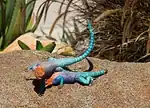 |
| Anchieta's agama | Agama anchietae | ~26 cm (10 in) | Least Concern | | Endemic to Angola; inhabits savannahs and rocky outcrops. | 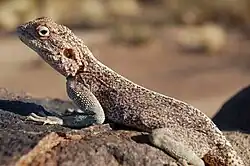 |
| Mucoso agama | Agama mucosoensis | ~25 cm (9.8 in) | Least Concern |  | Angola; poorly known species, likely inhabiting arid or semi-arid environments. | |
| Namib rock agama | Agama planiceps | ~35 cm (14 in) | Least Concern | | Found in southern Africa, including Angola; often seen on rocky outcrops and in arid regions. |  |
Amphisbaenidae (worm lizards)
| Common name | Binomial name | Length | Global status | Global trend | Distribution | Image |
|---|---|---|---|---|---|---|
| (No common name) Dalophia angolensis | Dalophia angolensis | ~20 cm (7.9 in) | Least Concern | | Endemic to Angola; fossorial, inhabiting sandy or loose soil habitats in savannahs and dry grasslands. | |
| (No common name) Dalophia ellenbergeri | Dalophia ellenbergeri | ~30 cm (12 in) | Least Concern | | Found in Central Africa, including Angola and Democratic Republic of Congo; inhabits tropical and subtropical dry regions. | |
| Pestle-tailed worm lizard | Dalophia pistillum | ~15 cm (5.9 in) | Least Concern | | Found in Angola and neighboring areas; poorly known species, likely fossorial, inhabiting loose soil or dry habitats. |  |
| (No common name) Dalophia welwitschii | Dalophia welwitschii | ~25 cm (9.8 in) | Data deficient | ? | Found across southern Africa, including Angola; prefers sandy or loose soils in savannahs and woodlands. | |
| Anchieta's worm lizard | Monopeltis anchietae | ~40 cm (16 in) | Least Concern | | Endemic to Southern Angola; fossorial species found in sandy or arid environments. | |
| Dusky worm lizard | Monopeltis infuscata | ~30 cm (12 in) | Least Concern | | Found in southern and central Angola; fossorial, prefers soft soils in savannah areas. |  |
| (No common name) Monopeltis luandae | Monopeltis luandae | ~25 cm (9.8 in) | Least Concern | ? | Endemic to Angola; fossorial species likely inhabiting the Luanda region in sandy soils. | |
| (No common name) Monopeltis perplexus | Monopeltis perplexus | ~35 cm (14 in) | Data deficient | ? | Restricted to Angola and Zambia; fossorial, prefers loose soils in semi-arid climates. | |
| Vanderyst worm lizard | Monopeltis vanderysti | ~30 cm (12 in) | Least Concern | | Found in Central Africa, including the DRC and northern Angola; fossorial, inhabits savannah and forest edge regions. |
Chamaeleonidae (chameleons)
| Common name | Binomial name | Length | Global status | Global trend | Distribution | Image |
|---|---|---|---|---|---|---|
| Double-scaled chameleon | Chamaeleo anchietae | ~25 cm (9.8 in) | Least Concern | ? | Endemic to Angola; inhabits savannahs, woodlands, and transitional areas. Likely restricted to fragmented habitats. |  |
| Flap-necked chameleon | Chamaeleo dilepis | ~35 cm (14 in) | Least Concern | | Widespread across sub-Saharan Africa, including Angola; prefers woodlands, savannahs, and areas with some vegetation cover. |  |
| Graceful chameleon | Chamaeleo gracilis | ~40 cm (16 in) | Least Concern | | Found throughout West, Central, and East Africa, with occurrences in Angola. Found in savannahs, forests, and disturbed habitats such as gardens. |  |
| Namaqua chameleon | Chamaeleo namaquensis | ~25 cm (9.8 in) | Least Concern | | Found in arid regions of southwestern Africa, including Namibia and Angola; a desert specialist that prefers open sandy or rocky habitats. |  |
| Owen's chameleon | Trioceros oweni | ~30 cm (12 in) | Least Concern | ? | Occurs in Central and West Africa, including Northern Angola; inhabits forests, dense vegetation, and tropical lowlands. |  |
Cordylidae (girdled lizards)
| Common name | Binomial name | Length | Global status | Global trend | Distribution | Image |
|---|---|---|---|---|---|---|
| Angolan girdled lizard | Cordylus angolensis | ~15 cm (5.9 in) | Data deficient | ? | Endemic to Angola; found in rocky outcrops in savannah and grassland habitats. |  |
| Machadoe's girdled lizard | Cordylus machadoi | ~15 cm (5.9 in) | Near Threatened | ? | Endemic to Angola, specifically highland areas; inhabits rocky and mountainous regions. | |
| Mombolo girdled lizard | Cordylus momboloensis | ~15 cm (5.9 in) | Data deficient | ? | Endemic to Angola; known from the Mombolo region. | |
| Kaokoveld girdled lizard | Cordylus namakuiyus | ~16 cm (6.3 in) | Least concern | | Restricted to Angola; inhabits rocky areas in the Namakuiyus region. | |
| N'Dolondolo girdled lizard | Cordylus phonolithos | ~15 cm (5.9 in) | Data deficient | ? | Endemic to Angola; primarily found on phonolite rock formations. |
Gekkonidae (geckos)
- Afroedura bogerti
- Afroedura donveae
- Afroedura praedicta
- Afroedura pundomontana
- Afroedura vazpintorum
- Afroedura wulfhaackei
- Hemidactylus bayonii
- Hemidactylus benguellensis
- Hemidactylus carivoensis
- Hemidactylus cinganji
- Hemidactylus faustus
- Hemidactylus longicephalus
- Hemidactylus mabouia
- Hemidactylus nzingae
- Hemidactylus paivae
- Hemidactylus pfindaensis
- Hemidactylus vernayi
- Kolekanos plumicaudus
- Kolekanos spinicaudus
- Lygodactylus angolensis
- Lygodactylus baptistai
- Lygodactylus bradfieldi
- Lygodactylus capensis
- Lygodactylus chobiensis
- Lygodactylus lawrencei
- Lygodactylus nyaneka
- Lygodactylus tchokwe
- Pachydactylus angolensis
- Pachydactylus caraculicus
- Pachydactylus maiatoi
- Pachydactylus oreophilus
- Pachydactylus punctatus
- Pachydactylus rangei
- Pachydactylus rugosus
- Pachydactylus scherzi
- Pachydactylus scutatus
- Pachydactylus vanzyli
- Pachydactylus wahlbergii
Lacertidae (true lizards)
| Common name | Binomial name | Length | Global status | Global trend | Distribution | Image |
|---|---|---|---|---|---|---|
| Bivar's bushveld lizard | Heliobolus bivari | ~15 cm (5.9 in) | Data deficient | ? | Endemic to Angola; found in sandy, arid areas of savannahs and grasslands. | |
| Crawford-Cabral's bushveld lizard | Heliobolus crawfordi | ~15 cm (5.9 in) | Data deficient | ? | Endemic to Angola; inhabits sandy and semi-arid environments. | |
| Bushveld lizard | Heliobolus lugubris | ~20 cm (7.9 in) | Least Concern | | Found in southern Africa, including Angola, Namibia, Botswana, southwestern Zimbabwe, southern Mozambique, and South Africa; prefers sandy, open savannahs and dry habitats. | 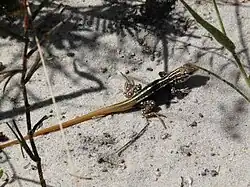 |
| Angolan rough-scaled lizard | Ichnotropis bivittata | ~18 cm (7.1 in) | Least Concern | | Found in Angola, Tanzania, Democratic Republic of the Congo, Zambia, Malawi, and Gabon; inhabits forests, savannahs, grasslands, and areas with loose soil. | |
| Cape rough-scaled lizard | Ichnotropis capensis | ~20 cm (7.9 in) | Least Concern | | Found in southern Africa, including Angola, Namibia, Botswana, and South Africa; prefers arid and semi-arid grasslands. |  |
| Marx's rough-scaled lizard | Ichnotropis microlepidota | ~18 cm (7.1 in) | Data deficient | ? | Endemic to central Angola; associated with grasslands. | |
| Angolan sandveld lizard | Nucras broadleyi | ~20 cm (7.9 in) | Least Concern | | Endemic to southwestern Angola; inhabits arid savannahs and rocky areas. | |
| Scaled sandveld lizard | Nucras scalaris | ~18 cm (7.1 in) | Least concern | ? | Endemic to Angola; found in transitional zones between forests, grasslands, and rocky areas. |
Scincidae (skinks)
- Acontias jappi
- Acontias kgalagadi
- Acontias mukwando
- Acontias occidentalis
- Eumecia anchietae
- Feylinia currori
- Feylinia elegans
- Feylinia grandisquamis
- Leptosiaphos dewittei
- Melanoseps occidentalis
- Mochlus hinkeli
- Mochlus sundevallii
- Panaspis breviceps
- Panaspis cabindae
- Panaspis ericae
- Panaspis maculicollis
- Panaspis mocamedensis
- Panaspis mundavambo
- Panaspis wahlbergii
- Sepsina angolensis
- Sepsina bayonii
- Sepsina copei
- Trachylepis albilabris
- Trachylepis albopunctata
- Trachylepis ansorgii
- Trachylepis attenboroughi
- Trachylepis bayonii
- Trachylepis binotata
- Trachylepis bocagii
- Trachylepis bouri
- Trachylepis chimbana
- Trachylepis damarana
- Trachylepis hilariae
- Trachylepis hoeschi
- Trachylepis huilensis
- Trachylepis laevis
- Trachylepis maculilabris
- Trachylepis notabilis
- Trachylepis occidentalis
- Trachylepis ovahelelo
- Trachylepis punctulata
- Trachylepis raymondlaurenti
- Trachylepis sulcata
- Trachylepis suzanae
- Trachylepis vunongue
- Trachylepis wahlbergii
- Trachylepis wilsoni
Varanidae (monitor lizards)
| Common name | Binomial name | Length | Global status | Global trend | Distribution | Image |
|---|---|---|---|---|---|---|
| Rock monitor | Varanus albigularis | ~200 cm (79 in) | Least Concern | | Found in southern, central, and eastern Africa, including Angola; inhabits savannahs, woodlands, and scrubland. Terrestrial and often found near termite mounds. |  |
| Nile monitor | Varanus niloticus | ~250 cm (98 in) | Least Concern | | Widely distributed across sub-Saharan Africa, including Angola; inhabits rivers, wetlands, savannahs, and forests. Highly aquatic and opportunistic predator. |  |
Testudines (turtles and tortoises)
| Common name | Binomial name | Carapace length | Global status | Global trend | Distribution | Image |
|---|---|---|---|---|---|---|
| Loggerhead turtle | Caretta caretta | 100 cm (39 in) | Vulnerable |  | Found in temperate, subtropical, and tropical oceans worldwide; adults prefer coastal waters with rocky or muddy substrates, nest on steeply sloped, high-energy beaches. | 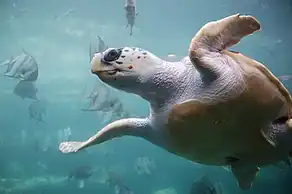 |
| Green turtle | Chelonia mydas | 150 cm (59 in) | Endangered | | Primarily aquatic. May be found at coasts or islands where it comes to nest. |  |
| Leatherback turtle | Dermochelys coriacea | 270 cm (110 in) | Vulnerable | | Found in all tropical and temperate oceans; nests on sandy beaches, highly pelagic, tolerates cold waters. |  |
| Hawksbill turtle | Eretmochelys imbricata | 100 cm (39 in) | Critically endangered | | Primarily aquatic. |  |
| Bell's hinge-back tortoise | Kinixys belliana | 220 mm (8.7 in) | Least Concern | | Inhabits savannahs and woodlands across sub-Saharan Africa; terrestrial, often shelters in burrows or under vegetation. |  |
| Forest hinge-back tortoise | Kinixys erosa | 400 mm (16 in) | Data deficient | ? | Inhabits lowland evergreen forests, marshes, and riverine galleries in West and Central Africa. |  |
| Speke's hinge-back tortoise | Kinixys spekii | 210 mm (8.3 in) | Vulnerable* | | Found in savannahs and woodlands of southern and eastern Africa. |  |
| Olive ridley turtle | Lepidochelys olivacea | 75 cm (30 in) | Vulnerable | | Found in tropical oceans worldwide; nests in mass arribadas on sandy beaches. |  |
| African helmeted turtle | Pelomedusa subrufa | 25 cm (9.8 in) | Least Concern | | Common in slow-moving freshwater bodies across sub-Saharan Africa. |  |
| Okavango mud turtle | Pelusios bechuanicus | 22 cm (8.7 in) | Least Concern | | Inhabits rivers, swamps, and marshes in southern Africa; aquatic, prefers clear water with vegetation. |  |
| West African mud turtle | Pelusios castaneus | 30 cm (12 in) | Least Concern | | Found in a variety of freshwater habitats in West and Central Africa; tolerates disturbed environments. |  |
| Central African mud turtle | Pelusios chapini | 18 cm (7.1 in) | Least Concern | | Native to Central Africa; inhabits slow-moving freshwater habitats with abundant vegetation. | |
| African forest turtle | Pelusios gabonensis | 23 cm (9.1 in) | Least Concern | | Occurs in rivers, swamps, and marshes in Central and West Africa; aquatic. | 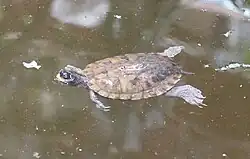 |
| African dwarf mud turtle | Pelusios nanus | 10 cm (3.9 in) | Data deficient | ? | Found in shallow freshwater habitats in Angola, DRC, Zambia. | |
| Rhodesian mud turtle | Pelusios rhodesianus | 17 cm (6.7 in) | Least Concern | ? | Inhabits rivers and marshes in southern Africa; aquatic. | |
| Leopard tortoise | Stigmochelys pardalis | 700 mm (28 in) | Least Concern | ? | Found in savannahs and grasslands across eastern and southern Africa. |  |
| African softshell turtle | Trionyx triunguis | 95 cm (37 in) | Vulnerable | | Inhabits rivers, lakes, and estuaries in Africa and the Middle East; aquatic. |  |
*Not evaluated by IUCN Red List, but given a Vulnerable status by the TFTSG Provisional Red List in 2013.[2]
Crocodylidae (crocodiles)
| Common name | Binomial name | Length | Global status | Global trend | Distribution | Image |
|---|---|---|---|---|---|---|
| Nile crocodile | Crocodylus niloticus | ~500 cm (200 in) (max ~600 cm) | Least Concern | | Found throughout sub-Saharan Africa, including Angola; inhabits rivers, lakes, mangroves, and freshwater wetlands, occasionally found in brackish waters. |  |
| Dwarf crocodile | Osteolaemus tetraspis | ~150 cm (59 in) | Vulnerable | | Found in swamps, slow-moving rivers, and forested wetlands in West and Central Africa, including parts of Northern Angola. |  |
Typhlopidae (blind snakes)
| Common name | Binomial name | Length | Global status | Global trend | Distribution | Image |
|---|---|---|---|---|---|---|
| Angolan blind snake | Afrotyphlops angolensis | ~30 cm (12 in) | Least Concern | ? | Angola; fossorial, found in sandy or loose soil habitats. | |
| Angolan giant blind snake | Afrotyphlops anomalus | ~30 cm (12 in) | Least Concern | | Angola, Democratic Republic of Congo; fossorial, inhabits loose soil and leaf litter. | |
| Blotched blind snake | Afrotyphlops congestus | ~50 cm (20 in) | Least Concern | | Sub-Saharan Africa, including Angola and Congo Basin; prefers tropical forests. | |
| African giant blind snake | Afrotyphlops dinga | ~20 cm (7.9 in) | Data deficient | ? | Angola, Democratic Republic of Congo; fossorial, poorly known species. |  |
| Lined blind snake | Afrotyphlops lineolatus | ~45 cm (18 in) | Least Concern | ? | Found in savannahs and woodlands of southern and central Africa, including Angola. | |
| Spotted blind snake | Afrotyphlops punctatus | ~40 cm (16 in) | Least Concern | ? | Widely distributed across sub-Saharan Africa, including Angola; fossorial. | |
| Schlegel's beaked blind snake | Afrotyphlops schlegelii | ~90 cm (35 in) | Least Concern | | Found in savannahs and forests across sub-Saharan Africa, including Angola. |  |
| Schmidt's blind snake | Afrotyphlops schmidti | ~35 cm (14 in) | Data deficient | ? | Angola; fossorial, poorly studied species, likely inhabits sandy soils. | |
| Léopoldville beaked snake | Letheobia praeocularis | ~13 cm (5.1 in) | Least Concern | | Angola; fossorial snake likely inhabiting tropical habitats. | |
| Western threadsnake | Namibiana labialis | ~15 cm (5.9 in) | Least Concern | | Found in southwestern Africa, including Angola and Namibia; fossorial. | |
| Benguela worm snake | Namibiana latifrons | ~10 cm (3.9 in) | Least Concern | | Southwestern Africa, including Angola; sandy and arid regions. | |
| Bocage's blind snake | Namibiana rostrata | ~9 cm (3.5 in) | Least Concern | ? | Angola, Namibia; fossorial, sandy or loose soil habitat. | |
| Shaba thread snake | Leptotyphlops kafubi | ~12 cm (4.7 in) | Least Concern | | Angola, Democratic Republic of Congo; fossorial snake found in savannas and urban areas. | |
| Peters's threadsnake | Leptotyphlops scutifrons | ~15 cm (5.9 in) | Least Concern | ? | Sub-Saharan Africa, widespread including Angola; fossorial. |  |
Colubridae (colubrids)
- Boaedon angolensis
- Boaedon bocagei
- Boaedon branchi
- Boaedon fradei
- Boaedon lineatus
- Boaedon mentalis
- Boaedon olivaceus
- Boaedon variegatus
- Bothrophthalmus lineatus
- Crotaphopeltis barotseensis
- Crotaphopeltis hotamboeia
- Dasypeltis confusa
- Dasypeltis congolensis
- Dasypeltis palmarum
- Dasypeltis scabra
- Dipsadoboa shrevei
- Dispholidus punctatus
- Dispholidus typus
- Grayia caesar
- Grayia ornata
- Grayia smithii
- Grayia tholloni
- Hapsidophrys smaragdina
- Hemirhagerrhis viperina
- Hormonotus modestus
- Limaformosa capensis
- Limaformosa savorgnani
- Limaformosa vernayi
- Limnophis bangweolicus
- Limnophis bicolor
- Limnophis branchi
- Lycodonomorphus subtaeniatus
- Lycophidion hellmichi
- Lycophidion laterale
- Lycophidion meleagre
- Lycophidion multimaculatum
- Lycophidion namibianum
- Lycophidion ornatum
- Psammophis mossambicus
- Panaspis breviceps
- Philothamnus angolensis
- Philothamnus carinatus
- Philothamnus dorsalis
- Philothamnus heterodermus
- Philothamnus heterolepidotus
- Philothamnus hoplogaster
- Philothamnus nitidus
- Philothamnus ornatus
- Philothamnus semivariegatus
- Polemon collaris
- Polemon gabonensis
- Prosymna ambigua
- Prosymna angolensis
- Prosymna confusa
- Prosymna frontalis
- Prosymna lisima
- Prosymna visseri
- Psammophis angolensis
- Psammophis ansorgii
- Psammophis jallae
- Psammophis leightoni
- Psammophis leopardinus
- Psammophis lineatus
- Psammophis mossambicus
- Psammophis notostictus
- Psammophis subtaeniatus
- Psammophis trigrammus
- Psammophis zambiensis
- Psammophylax ocellatus
- Psammophylax rhombeatus
- Psammophylax tritaeniatus
- Pseudaspis cana
- Pythonodipsas carinata
- Rhamnophis aethiopissa
- Scaphiophis albopunctatus
- Thrasops flavigularis
- Thrasops jacksonii
- Toxicodryas blandingii
- Toxicodryas pulverulenta
Elapidae (elapids)
| Common name | Binomial name | Length | Global status | Global trend | Distribution | Image |
|---|---|---|---|---|---|---|
| Jameson's mamba | Dendroaspis jamesoni | ~250 cm (98 in) | Least Concern | | Found in Central and West Africa, including parts of northern Angola; inhabits forested and woodland areas, often arboreal but also active on the ground. |  |
| Black mamba | Dendroaspis polylepis | ~450 cm (180 in) | Least Concern | | Widely distributed across sub-Saharan Africa, including Angola; prefers savannahs, open woodlands, and rocky areas. |  |
| Günther's garter snake | Elapsoidea guentherii | ~50 cm (20 in) | Least concern | ? | Found in Angola, southern DRC, and Zambia; fossorial and inhabits dry savannahs. | |
| Angolan garter snake | Elapsoidea semiannulata | ~60 cm (24 in) | Least concern | ? | Found in Angola, Congo, DRC, and parts of Gabon; found in forests and savannas. | |
| Anchieta's cobra | Naja anchietae | ~200 cm (79 in) | Least Concern | | Found in Angola, Botswana, Namibia, and Zambia; inhabits dry savannahs. | |
| Banded water cobra | Naja annulata | ~275 cm (108 in) | Least Concern | ? | Found in Central and East Africa, including the Congo River basin; highly aquatic and inhabits rivers, lakes, and swamps. |  |
| Forest cobra | Naja melanoleuca | ~300 cm (120 in) | Least Concern | | Widely distributed across sub-Saharan forests, including Angola; found in forests, woodlands, and sometimes human settlements. |  |
| Mozambique spitting cobra | Naja mossambica | ~150 cm (59 in) | Least Concern | ? | Found in southern Africa, including Angola; inhabits forests, savannahs, scrubland, and artificial terrain. |  |
| Many-banded snake | Naja multifasciata | ~200 cm (79 in) | Least Concern | | Found in tropical rainforests of Central Africa, including very northern parts of Angola. | |
| Western barred spitting cobra | Naja nigricincta | ~200 cm (79 in) | Least Concern | | Found in southwestern Angola and Namibia; inhabits dry savannahs, shrubland, and rocky areas. |  |
| Black-necked spitting cobra | Naja nigricollis | ~200 cm (79 in) | Least Concern | ? | Found throughout sub-Saharan Africa, including Angola; inhabits savannahs, woodlands, and urban areas. |  |
| Brown forest cobra | Naja subfulva | ~300 cm (120 in) | Least Concern | | Found in forests and woodland savannahs of Central and East Africa, including Angola; found in forests, savannas, wetlands, and urban areas. |  |
| Goldie's tree cobra | Pseudohaje goldii | ~250 cm (98 in) | Least Concern | ? | Found in forests of Central and West Africa, including Angola; found in forests. |  |
Viperidae (vipers)
| Common name | Binomial name | Length | Global status | Global trend | Distribution | Image |
|---|---|---|---|---|---|---|
| Variable bush viper | Atheris squamigera | ~60 cm (24 in) | Least Concern | | Found in Central and West Africa, inhabiting dense rainforests and often arboreal. |  |
| Puff adder | Bitis arietans | ~100 cm (39 in) | Least Concern | | Widespread across Sub-Saharan Africa and parts of Arabia. Found in forests, savannahs, grasslands, wetlands, and rocky areas. |  |
| Horned adder | Bitis caudalis | ~40 cm (16 in) | Least Concern | | Found in southern Africa, in arid regions such as deserts and semi-deserts. | 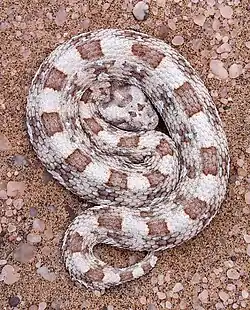 |
| Gaboon viper | Bitis gabonica | ~180 cm (71 in) | Vulnerable | | Found in Central and West African including parts of northern Angola. Inhabits rainforests, savannah, shrublands, grass lands, and urban areas. |  |
| Angolan adder | Bitis heraldica | ~30 cm (12 in) | Vulnerable | | Endemic to Angola, found in forests and rocky areas. | |
| Rhinoceros viper | Bitis nasicornis | ~120 cm (47 in) | Vulnerable | | Found in Central African rainforests and sometimes in urban areas. |  |
| Peringuey's desert adder | Bitis peringueyi | ~25 cm (9.8 in) | Least Concern | | Found in the Namib Desert of Namibia and southern Angola. |  |
| Two-striped night adder | Causus bilineatus | ~60 cm (24 in) | Least Concern | | Found in Central and East Africa, in moist savannahs and wetlands. | |
| Forest night adder | Causus lichtensteinii | ~60 cm (24 in) | Least Concern | | Found in West and Central Africa, in forests and urban areas. | |
| Spotted night adder | Causus maculatus | ~50 cm (20 in) | Least Concern | | Found across Sub-Saharan Africa, often in drier habitats like savannahs and urban areas. | |
| Rasmussen's night adder | Causus rasmusseni | ~50 cm (20 in) | Data deficient | ? | Found in parts of West Africa, primarily in grasslands and forests. | |
| Green night adder | Causus resimus | ~60 cm (24 in) | Least Concern | | Found in Rwanda, Burundi, and other East African regions. Prefers savannas, grasslands, wetlands, and urban areas. | |
| Rhombic night adder | Causus rhombeatus | ~90 cm (35 in) | Least Concern | | Found in southern Africa, in various habitats including grasslands, and savannahs. |  |
| West African carpet viper | Echis ocellatus | ~75 cm (30 in) | Least Concern | | Found in West Africa, predominantly in arid regions like savannahs and grasslands. |
Pythonidae (pythons)
| Common name | Binomial name | Length | Global status | Global trend | Distribution | Image |
|---|---|---|---|---|---|---|
| Angolan python | Python anchietae | ~200 cm (79 in) (max ~430 cm) | Least Concern | | Endemic to southern Africa, including Angola and Namibia; inhabits rocky outcrops, arid grasslands, and savannahs. | 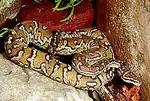 |
| Southern African python | Python natalensis | ~500 cm (200 in) (max ~600 cm) | Least Concern | | Found in southern and southeastern Africa, including Angola; inhabits savannahs, forests, wetlands, and rocky areas. | 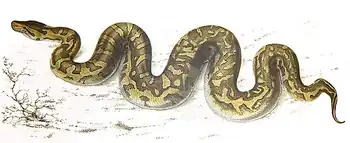 |
| African rock python | Python sebae | ~600 cm (240 in) (max ~700 cm) | Near threatened | | Widely distributed across sub-Saharan Africa; includes its range in Angola, occupying forests, savannahs, wetlands, and rocky habitats. |  |
See also
External links
References
- ↑ "The Reptile Database: Angola". Retrieved 29 April 2025.
- ↑ "Tortoise and Freshwater Turtle Specialist Group". Retrieved 30 April 2025.