List of mammals of Missouri

77 species of wild mammals can be found the U.S. state of Missouri. Of these, 30 species are rodents, 16 are bats, 15 are carnivorans, 7 are eulipotyphlans, 3 are artiodactyls, another 3 are lagomorphs, and the armadillos, opposums, primates each have one species in the state. Most species have established populations, but some, such as the grey wolf, are not native to the state but are still spotted on rare occasions. Two species, the eastern small-footed myotis and little brown bat are classified as endangered species by the IUCN. Other species, such as feral or domesticated mammals, are not included on this list.
Most species listed in this article are derived from the work The Wild Mammals of Missouri, a 2001 catalogue of all known wild mammal species in the state.[1]: v–vi Three species in the book, the red wolf (Canis rufus),[2] Townsend's big-eared bat (Corynorhinus townsendii),[3] and white-tailed jackrabbit (Lepus townsendii)[4] are not included as there are no longer any individuals present in Missouri. Unless otherwise noted, range information is provided by the Missouri Department of Conservation's Field Guide.[5]
Artiodactyla
| Common name and image | Scientific name | Range | Status |
|---|---|---|---|
| Family Bovidae — one species | |||
American bison |
Bison bison Linnaeus, 1758 |
Small populations in Barton and Harrison counties. Others live on some private ranches. | Near Threatened[6] |
| Family Cervidae (deer) — two species | |||
Elk |
Cervus canadensis Erxleben, 1777 |
Carter, Reynolds, and Shannon counties. Occasional sightings in other areas. | Least Concern[7] |
White-tailed deer |
Odocoileus virginianus Zimmermann, 1780 |
Statewide. | Least Concern[8] |
Carnivora
| Common name and image | Scientific name | Range | Status |
|---|---|---|---|
| Family Canidae (dogs) — four species | |||
Coyote |
Canis latrans Say, 1823 |
Statewide, most common in northern and western grasslands. | Least Concern[9] |
Gray wolf |
Canis lupus Linnaeus, 1758 |
No permanent populations. Sometimes spotted while travelling between states. | Least Concern[10] |
Red fox |
Vulpes vulpes Linnaeus, 1758 |
Statewide, most common in the north and west. | Least Concern[11] |
Gray fox |
Urocyon cinereoargenteus Schreber, 1775 |
Statewide, most common in the Ozarks. | Least Concern[12] |
| Family Felidae (cats) — two species | |||
Bobcat |
Lynx rufus Schreber, 1777 |
Statewide. | Least Concern[13] |
Cougar |
Puma concolor Linnaeus, 1771 |
No known permanent populations, but there have been numerous sightings statewide. | Least Concern[14] |
| Family Mephitidae — two species | |||
Striped skunk |
Mephitis mephitis Schreber, 1776 |
Statewide. | Least Concern[15] |
Eastern spotted skunk |
Spilogale putorius Linnaeus, 1758 |
Statewide. | Vulnerable[16] |
| Family Mustelidae — five species | |||
North American river otter |
Lontra canadensis Schreber, 1777 |
Statewide. | Least Concern[17] |
Least weasel |
Mustela nivalis Linnaeus, 1766 |
Most areas in the north. | Least Concern[18] |
Long-tailed weasel |
Neogale frenata Lichtenstein, 1831 |
Statewide, most common in the south. | Least Concern[19] |
American mink |
Neogale vison Schreber, 1777 |
Statewide, most common in the Mississippi lowlands. | Least Concern[20] |
American badger |
Taxidea taxus Schreber, 1777 |
Statewide, most common in the Osage and Dissected Till Plains. | Least Concern[21] |
| Family Procyonidae — one species | |||
Common raccoon |
Procyon lotor Linnaeus, 1758 |
Statewide. | Least Concern[22] |
| Family Ursidae (bears) — one species | |||
American black bear |
Ursus americanus Pallas, 1780 |
Statewide, most concentrated in the south. | Least Concern[23] |
Chiroptera
| Common name and image | Scientific name | Range | Status |
|---|---|---|---|
| Family Molossidae (free-tailed bats) — two species | |||
Big free-tailed bat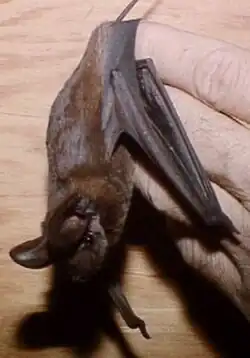 |
Nyctinomops macrotis Gray, 1839 |
Native to South America, Central America, Mexico, and the Southeastern US. Occasional wanderers have been recorded in the state.[24] | Least Concern[25] |
Mexican free-tailed bat |
Tadarida brasiliensis Geoffroy, 1824 |
Individuals from the Southwestern US wander into the state on rare occasions. | Least Concern[26] |
| Family Vespertilionidae — fourteen species | |||
Rafinesque's big-eared bat |
Corynorhinus rafinesquii Lesson, 1827 |
Southeastern corner. | Least Concern[27] |
Big brown bat |
Eptesicus fuscus Beauvois, 1796 |
Statewide. | Least Concern[28] |
Silver-haired bat |
Lasionycteris noctivagans Le Conte, 1831 |
Statewide; most common during spring and fall. | Least Concern[29] |
Eastern red bat |
Lasurius borealis Müller, 1776 |
Statewide; most common in May–September, generally rare in winter, especially in the north. | Least Concern[30] |
Hoary bat |
Lasurius cinereus Beauvois, 1796 |
Statewide. | Least Concern[31] |
Seminole bat |
Lasiurus seminolus Rhoads, 1895 |
The northern limits of its summer migration have been expanding, likely because of climate change.[32] Can now be found in the far south, with some reaching as far north as Pulaski county. | Least Concern[33] |
Southeastern myotis |
Myotis austroriparius Rhoads, 1897 |
Southeastern corner.[34] | Least Concern[34] |
Gray bat |
Myotis grisescens Howell, 1909 |
Most common in the Ozarks, but can be found in some areas north of the Missouri river. | Vulnerable[35] |
| Eastern small-footed myotis |
Myotis leibii Audubon & Bachman, 1842 |
Southwestern areas; has been identified in Washington, Iron,[36] Madison counties.[37] | Endangered[38] |
Little brown bat |
Myotis lucifugus Le Conte, 1831 |
Statewide. | Endangered[39] |
Northern long-eared bat |
Myotis septentrionalis Trouessart, 1897 |
Statewide except for southwestern corner.[40] | Near Threatened[40] |
Indiana bat |
Myotis sodalis Miller & Allen, 1928 |
Most areas in the summer, found in the north during winter. | Near Threatened[41] |
Evening bat |
Nycticeius humeralis Rafinesque, 1818 |
Statewide. | Least Concern[42] |
Tricolored bat |
Perimyotis subflavus F. Cuvier, 1832 |
Statewide. | Vulnerable[43] |

Cingulata
| Common name and image | Scientific name | Range | Status |
|---|---|---|---|
| Family Dasypodidae — one species | |||
Nine-banded armadillo |
Dasypus novemcinctus Linnaeus, 1758 |
Statewide except for the far north. | Least Concern[44] |
Didelphimorphia
| Common name and image | Scientific name | Range | Status |
|---|---|---|---|
| Family Didelphidae (opossums) — one species | |||
Virginia opossum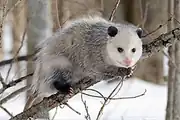 |
Didelphis virginiana Kerr, 1792 |
Statewide, less common in the northwest and southeast. | Least Concern[45] |
Eulipotyphla
| Common name and image | Scientific name | Range | Status |
|---|---|---|---|
| Family Soricidae (shrews) — six species | |||
Northern short-tailed shrew |
Blarina brevicauda Say, 1823 |
Together, the short-tailed shrews are found statewide. However, the range of individual Blarina species is somewhat unknown. | Least Concern[46] |
Southern short-tailed shrew |
Blarina carolinensis Bachman, 1837 |
Least Concern[47] | |
| Elliot's short-tailed shrew | Blarina hylophaga Elliot, 1899 |
Least Concern[48] | |
North American least shrew |
Cryptotis parva Say, 1823 |
Statewide. | Least Concern[49] |
Cinereus shrew |
Sorex cinereus Kerr, 1792 |
Northern half of the state, most common near streams and in floodplains | Least Concern[50] |
Southeastern shrew |
Sorex longirostris Bachman, 1837 |
Statewide except for the far northwest. | Least Concern[51] |
| Family Talpidae — one species | |||
Eastern mole |
Scalopus aquaticus Linnaeus, 1758 |
Statewide. | Least Concern[52] |
Lagomorpha
| Common name and image | Scientific name | Range | Status |
|---|---|---|---|
| Family Leporidae — three species | |||
Black-tailed jackrabbit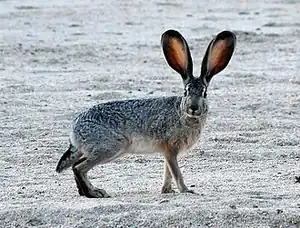 |
Lepus californicus Gray, 1837 |
Eastern areas.[53] | Least Concern[53] |
Swamp rabbit |
Sylvilagus aquaticus Bachman, 1837 |
Southeastern Mississippi lowlands. | Least Concern[54] |
Eastern cottontail |
Sylvilagus floridanus J. A. Allen, 1890 |
Statewide. | Least Concern[55] |
Primates
| Common name and image | Scientific name | Range | Status |
|---|---|---|---|
| Family Hominidae (great apes) — one species | |||
Human Mike Kehoe, current governor of Missouri |
Homo sapiens Linnaeus, 1758 |
Statewide, largest settlements are Kansas City and St. Louis.[56] | Not Evaluated |
Rodentia
| Common name and image | Scientific name | Range | Status |
|---|---|---|---|
| Family Castoridae (beavers) — one species | |||
North American beaver |
Castor canadensis Kuhl, 1820 |
Statewide near rivers and streams. | Least Concern[57] |
| Family Cricetidae — sixteen species | |||
Eastern meadow vole |
Microtus pennsylvanicus Ord, 1815 |
Northern areas, most common in stream valleys and floodplains. | Least Concern[58] |
Woodland vole |
Microtus pinetorum Le Conte, 1830 |
Statewide. | Least Concern[59] |
Prairie vole |
Microtus ochrogaster Wagner, 1842 |
Statewide. | Least Concern[60] |
Eastern woodrat |
Neotoma floridana Ord, 1818 |
Known occurrences in the southern half of the state, potentially present in the north.[61] | Least Concern[62] |
Golden mouse |
Ochrotomys nuttalli Harlan, 1832 |
Southeastern areas.[63] | Least Concern[63] |
Muskrat |
Ondatra zibethicus Linnaeus, 1766 |
Statewide. | Least Concern[64] |
Marsh rice rat |
Oryzomys palustris Harlan, 1837 |
Extreme southeast.[65] | Least Concern[66] |
| Texas mouse |
Peromyscus attwateri Allen, 1895 |
Southwestern areas.[67] | Least Concern[68] |
Cotton mouse |
Peromyscus gossypinus Le Conte, 1853 |
Southeastern areas.[69] | Least Concern[70] |
Eastern deer mouse |
Peromyscus maniculatus Wagner, 1845 |
Statewide. | Least Concern[71] |
White-footed mouse |
Peromyscus leucopus Rafinesque, 1818 |
Statewide.[72] | Least Concern[72] |
Fulvous harvest mouse |
Reithrodontomys fulvescens J.A.Allen, 1894 |
Southwestern areas.[73] | Least Concern[73] |
Western harvest mouse |
Reithrodontomys megalotis Baird, 1857 |
Statewide.[74] | Least Concern[75] |
| Plains harvest mouse |
Reithrodontomys montanus Baird, 1855 |
Western areas.[76] | Least Concern[77] |
Hispid cotton rat |
Sigmodon hispidus Say and Ord, 1825 |
Statewide except for northeast.[78] | Least Concern[79] |
Southern bog lemming |
Synaptomys cooperi Baird, 1857 |
Statewide except for southwestern corner.[80] | Least Concern[80] |
| Family Echimyidae — one species | |||
Nutria |
Myocastor coypus Molina, 1782 |
Introduced,[81] now statewide and is most common in the southeast. | Least Concern[81] |
| Family Geomyidae (gophers) — one species | |||
Plains pocket gopher |
Geomys bursarius Shaw, 1800 |
North and eastern areas.[82] | Least Concern[83] |
| Family Heteromyidae — one species | |||
Plains pocket mouse |
Perognathus flavescens Merriam, 1889 |
Northwestern corner;[84] has been found in Atchison county.[85] | Least Concern[86] |
| Family Muridae — three species | |||
House mouse |
Mus musculus Linnaeus, 1758 |
Introduced, now statewide.[87] | Least Concern[87] |
Brown rat |
Rattus norvegicus Berkenhout, 1769 |
Introduced, now statewide.[88] | Least Concern[88] |
Black rat |
Rattus rattus Linnaeus, 1758 |
Introduced, now in St. Louis; potentially in Kansas City.[1]: 252 | Least Concern[89] |
| Family Scuiridae (squirrels) — six species | |||
Southern flying squirrel |
Glaucomys volans Linnaeus, 1758 |
Statewide. | Least Concern[90] |
Thirteen-lined ground squirrel |
Ictidomys tridecemlineatus Mitchill, 1821 |
Mostly in northwestern areas. | Least Concern[91] |
Groundhog |
Marmota monax Linnaeus, 1758 |
Statewide, less common in the Mississippi lowlands. | Least Concern[92] |
Franklin's Ground Squirrel |
Poliocitellus franklinii Howell, 1938 |
Northern quarter. | Least Concern[93] |
Eastern gray squirrel |
Scuirus carolinensis Gmelin, 1788 |
Statewide, most common in the Ozarks and Mississippi lowlands. | Least Concern[94] |
Fox squirrel |
Sciurus niger Linnaeus, 1758 |
Statewide, more common in the north and western plains. | Least Concern[95] |
| Family Zapodidae (jumping mice) — one species | |||
Meadow jumping mouse |
Zapus hudsonius Zimmermann, 1780 |
Statewide.[96] | Least Concern[97] |


References
- 1 2 Schwartz, Elizabeth Reeder; Schwartz, Charles Walsh (2001). The Wild Mammals of Missouri (2 ed.). University of Missouri Press. ISBN 9780826213594.
- ↑ "Ask MDC". Missouri Department of Conservation. March 2023.
Native to the southeastern United States, red wolves were nearly driven to extinction by the mid-1900s. In 1950, a small female taken in Taney County became the last red wolf on record in Missouri.
- ↑ "Big-Eared Bats". Missouri Department of Conservation.
Townsend's big-eared bat (Corynorhinus townsendii) is mostly found in western North America; one of its subspecies, the Ozark big-eared bat (C. townsendii ingens), is a federally endangered subspecies that used to occur in Missouri, but there have been no official sightings here since the early 1970s. It is currently considered extirpated from the state but is still found in Arkansas and Oklahoma.
- ↑ Brown, David E.; Smith, Andrew T.; Frey, Jennifer K.; Schweiger, Brittany J. (November 25, 2019). "A Review of the Ongoing Decline of the White-Tailed Jackrabbit". Journal of Fish and Wildlife Management. 11 (1): 341–352. doi:10.3996/042019-JFWM-026.
The distribution and abundance of the white-tailed jackrabbit Lepus townsendii have declined significantly since 1950... We note its extirpation in Missouri, Kansas and Oklahoma, and potential extirpation in British Columbia, Oregon, Illinois, and Wisconsin.
- ↑ "Field Guide". Missouri Department of Conservation.
- ↑ Aune, K.; Jørgensen, D. & Gates, C. (2018) [errata version of 2017 assessment]. "Bison bison". IUCN Red List of Threatened Species. 2017 e.T2815A123789863. doi:10.2305/IUCN.UK.2017-3.RLTS.T2815A45156541.en.
- ↑ Brook, S.M.; Pluháček, J.; Lorenzini, R.; Lovari, S.; Masseti, M.; Pereladova, O.; Mattioli, S. (2019) [errata version of 2018 assessment]. "Cervus canadensis". IUCN Red List of Threatened Species. 2018 e.T55997823A142396828. doi:10.2305/IUCN.UK.2018-2.RLTS.T55997823A142396828.en.
- ↑ Gallina, S.; Lopez Arevalo, H. (2016). "Odocoileus virginianus". IUCN Red List of Threatened Species. 2016 e.T42394A22162580. doi:10.2305/IUCN.UK.2016-2.RLTS.T42394A22162580.en.
- ↑ Kays, R. (2020) [errata version of 2018 assessment]. "Canis latrans". IUCN Red List of Threatened Species. 2018 e.T3745A163508579. doi:10.2305/IUCN.UK.2018-2.RLTS.T3745A163508579.en.
- ↑ Boitani, L.; Werhahn, G.; Smith, D.W. (2026). "Canis lupus". IUCN Red List of Threatened Species. 2026 e.T3746A226161232. doi:10.2305/IUCN.UK.2026-1.RLTS.T3746A226161232.en.
- ↑ Hoffmann, M.; Sillero-Zubiri, C. (2021) [amended version of 2016 assessment]. "Vulpes vulpes". IUCN Red List of Threatened Species. 2021 e.T23062A193903628. doi:10.2305/IUCN.UK.2021-1.RLTS.T23062A193903628.en. Retrieved February 17, 2022.
- ↑ Roemer, G.; Cypher, B.; List, R. (2016). "Urocyon cinereoargenteus". IUCN Red List of Threatened Species. 2016 e.T22780A46178068. doi:10.2305/IUCN.UK.2016-1.RLTS.T22780A46178068.en.
- ↑ Kelly, M.; Morin, D. & Lopez-Gonzalez, C.A. (2016). "Lynx rufus". IUCN Red List of Threatened Species. 2016 e.T12521A50655874. doi:10.2305/IUCN.UK.2016-1.RLTS.T12521A50655874.en.
- ↑ Nielsen, C.; Thompson, D.; Kelly, M. & Lopez-Gonzalez, C. A. (2016) [errata version of 2015 assessment]. "Puma concolor". IUCN Red List of Threatened Species. 2015 e.T18868A97216466. doi:10.2305/IUCN.UK.2015-4.RLTS.T18868A50663436.en.
- ↑ Helgen, K. & Reid, F. (2016). "Mephitis mephitis". IUCN Red List of Threatened Species. 2016 e.T41635A45211301. doi:10.2305/IUCN.UK.2016-1.RLTS.T41635A45211301.en.
- ↑ Gompper, M.; Jachowski, D. (2016). "Spilogale putorius". IUCN Red List of Threatened Species. 2016 e.T41636A45211474. doi:10.2305/IUCN.UK.2016-1.RLTS.T41636A45211474.en.
- ↑ Serfass, T. (2021). "Lontra canadensis". IUCN Red List of Threatened Species. 2021 e.T12302A164577078. doi:10.2305/IUCN.UK.2021-3.RLTS.T12302A164577078.en.
- ↑ McDonald, R.A.; Abramov, A.V.; Stubbe, M.; Herrero, J.; Maran, T.; Tikhonov, A.; Cavallini, P.; Kranz, A.; Giannatos, G.; Kryštufek, B.; Reid, F. (2019) [amended version of 2016 assessment]. "Mustela nivalis". IUCN Red List of Threatened Species. 2019 e.T70207409A147993366. doi:10.2305/IUCN.UK.2016-1.RLTS.T70207409A147993366.en.
- ↑ Reid, F. & Helgen, K. (2016). "Mustela frenata". IUCN Red List of Threatened Species. 2016 e.T41654A45213820. doi:10.2305/IUCN.UK.2016-1.RLTS.T41654A45213820.en. Retrieved February 18, 2022.
- ↑ Reid, F.; Schiaffini, M. & Schipper, J. (2016). "Neogale vison". IUCN Red List of Threatened Species. 2016 e.T41661A45214988. doi:10.2305/IUCN.UK.2016-1.RLTS.T41661A45214988.en.
- ↑ Helgen, K.; Reid, F. (2016). "Taxidea taxus". IUCN Red List of Threatened Species. 2016 e.T41663A45215410. doi:10.2305/IUCN.UK.2016-1.RLTS.T41663A45215410.en.
- ↑ Timm, R.; Cuarón, A.D.; Reid, F.; Helgen, K. & González-Maya, J.F. (2016). "Procyon lotor". IUCN Red List of Threatened Species. 2016 e.T41686A45216638. doi:10.2305/IUCN.UK.2016-1.RLTS.T41686A45216638.en.
- ↑ Garshelis, D. L.; Scheick, B. K.; Doan-Crider, D. L.; Beecham, J. J. & Obbard, M. E. (2017) [errata version of 2016 assessment]. "Ursus americanus". IUCN Red List of Threatened Species. 2016 e.T41687A114251609. doi:10.2305/IUCN.UK.2016-3.RLTS.T41687A45034604.en.
- ↑ Schmidt, C. J.; Peek, G. A. M.; Kaufman, D. W.; Kaufman, E. J.; Flinck, L.; Patrick, Hope A.; Timm, R. (2017). "BIG FREE-TAILED BAT". Kansas Mammal Atlas.
- ↑ Barquez, R.; Diaz, M. & Arroyo-Cabrales, J. (2016) [errata version of 2015 assessment]. "Nyctinomops macrotis". IUCN Red List of Threatened Species. 2015 e.T14996A97207443. doi:10.2305/IUCN.UK.2015-4.RLTS.T14996A22010988.en.
- ↑ Barquez, R.; Diaz, M.; Gonzalez, E.; Rodriguez, A.; Incháustegui, S.; Arroyo-Cabrales, J. (2015). "Tadarida brasiliensis". IUCN Red List of Threatened Species. 2015 e.T21314A22121621. doi:10.2305/IUCN.UK.2015-4.RLTS.T21314A22121621.en.
- ↑ Arroyo-Cabrales, J.; Álvarez-Castañeda, S.T. (2017). "Corynorhinus rafinesquii". IUCN Red List of Threatened Species. 2017 e.T17600A21976905. doi:10.2305/IUCN.UK.2017-2.RLTS.T17600A21976905.en.
- ↑ Miller, B.; Reid, F.; Arroyo-Cabrales, J.; Cuarón, A.D.; de Grammont, P.C. (2016). "Eptesicus fuscus". IUCN Red List of Threatened Species. 2016 e.T7928A22118197. doi:10.2305/IUCN.UK.2016-3.RLTS.T7928A22118197.en.
- ↑ Solari, S. (2019). "Lasionycteris noctivagans". IUCN Red List of Threatened Species. 2019 e.T11339A22122128. doi:10.2305/IUCN.UK.2019-1.RLTS.T11339A22122128.en.
- ↑ Arroyo-Cabrales, J.; Miller, B.; Reid, F.; Cuarón, A.D.; de Grammont, P.C. (2016). "Lasiurus borealis". IUCN Red List of Threatened Species. 2016 e.T11347A22121017. doi:10.2305/IUCN.UK.2016-1.RLTS.T11347A22121017.en.
- ↑ Gonzalez, E.; Barquez, R.; Arroyo-Cabrales, J. (2016). "Lasiurus cinereus". IUCN Red List of Threatened Species. 2016 e.T11345A22120305. doi:10.2305/IUCN.UK.2016-1.RLTS.T11345A22120305.en.
- ↑ Perry, Roger W. (October 22, 2018). "Migration and recent range expansion of Seminole bats (Lasiurus seminolus) in the United States". Journal of Mammology. 99 (6): 1478–1485. doi:10.1093/jmammal/gyy135.
- ↑ Solari, S. (2019). "Lasiurus seminolus". IUCN Red List of Threatened Species. 2019 e.T11353A22119113. doi:10.2305/IUCN.UK.2019-1.RLTS.T11353A22119113.en.
- 1 2 Arroyo-Cabrales, J.; Álvarez-Castañeda, S.T. (2017). "Myotis austroriparius". IUCN Red List of Threatened Species. 2017 e.T14147A22059907. doi:10.2305/IUCN.UK.2017-2.RLTS.T14147A22059907.en.
- ↑ Solari, S. (2018). "Myotis grisescens". IUCN Red List of Threatened Species. 2018 e.T14132A22051652. doi:10.2305/IUCN.UK.2018-2.RLTS.T14132A22051652.en.
- ↑ LaVal, Richard K.; LaVal, Margaret K. (January 1980). "Ecological studies and management of Missouri bats Ecological studies and management of Missouri bats, with emphasis on cave-dwelling species". Conservation Commission of the State of Missouri. 8: 17.
- ↑ McDaniel, V. Rick; Harvey, Michael J.; Tumilson, Renn; Paige, Ken N. (1982). "Status of the Small-Footed Bat, Myotis leibii leibii, in the Southern Ozarks". Journal of the Arkansas Academy of Science. 36: 93.
- ↑ Solari, S. (2018). "Myotis leibii". IUCN Red List of Threatened Species. 2018 e.T14172A22055716. doi:10.2305/IUCN.UK.2018-2.RLTS.T14172A22055716.en.
- ↑ Solari, S. (2021) [amended version of 2018 assessment]. "Myotis lucifugus". IUCN Red List of Threatened Species. 2021 e.T14176A208031565. doi:10.2305/IUCN.UK.2021-3.RLTS.T14176A208031565.en.
- 1 2 Solari, S. (2018). "Myotis septentrionalis". IUCN Red List of Threatened Species. 2018 e.T14201A22064312. doi:10.2305/IUCN.UK.2018-2.RLTS.T14201A22064312.en.
- ↑ Arroyo-Cabrales, J.; Ospina-Garces, S. (2016). "Myotis sodalis". IUCN Red List of Threatened Species. 2016 e.T14136A22053184. doi:10.2305/IUCN.UK.2016-1.RLTS.T14136A22053184.en.
- ↑ Solari, S. (2019). "Nycticeius humeralis". IUCN Red List of Threatened Species. 2019 e.T14944A22015223. doi:10.2305/IUCN.UK.2019-1.RLTS.T14944A22015223.en.
- ↑ Solari, S. (2018). "Perimyotis subflavus". IUCN Red List of Threatened Species. 2018 e.T17366A22123514. doi:10.2305/IUCN.UK.2018-2.RLTS.T17366A22123514.en.
- ↑ Loughry, J.; McDonough, C.; Abba, A.M. (2014). "Dasypus novemcinctus". IUCN Red List of Threatened Species. 2014 e.T6290A47440785. doi:10.2305/IUCN.UK.2014-1.RLTS.T6290A47440785.en.
- ↑ Pérez-Hernandez, R.; Lew, D.; Solari, S. (2016). "Didelphis virginiana". IUCN Red List of Threatened Species. 2016 e.T40502A22176259. doi:10.2305/IUCN.UK.2016-1.RLTS.T40502A22176259.en.
- ↑ Cassola, F. (2017) [errata version of 2016 assessment]. "Blarina brevicauda". IUCN Red List of Threatened Species. 2016 e.T41451A115187102. doi:10.2305/IUCN.UK.2016-3.RLTS.T41451A22292945.en.
- ↑ Cassola, F. (2017) [errata version of 2016 assessment]. "Blarina carolinensis". IUCN Red List of Threatened Species. 2016 e.T41452A115187223. doi:10.2305/IUCN.UK.2016-3.RLTS.T41452A22293016.en.
- ↑ Cassola, F. (2017) [errata version of 2016 assessment]. "Blarina hylophaga". IUCN Red List of Threatened Species. 2016 e.T41453A115187348. doi:10.2305/IUCN.UK.2016-3.RLTS.T41453A22292879.en.
- ↑ Woodman, N.; Matson, J.; Cuarón, A.D.; de Grammont, P.C. (2017) [errata version of 2016 assessment]. "Cryptotis parva". IUCN Red List of Threatened Species. 2016 e.T41377A115182514. doi:10.2305/IUCN.UK.2016-3.RLTS.T41377A22284502.en.
- ↑ Cassola, F. (2017) [errata version of 2016 assessment]. "Sorex cinereus". IUCN Red List of Threatened Species. 2016 e.T41392A115183208. doi:10.2305/IUCN.UK.2016-3.RLTS.T41392A22314055.en.
- ↑ Cassola, F. (2017) [errata version of 2016 assessment]. "Sorex longirostris". IUCN Red List of Threatened Species. 2016 e.T41401A115184004. doi:10.2305/IUCN.UK.2016-3.RLTS.T41401A22313322.en.
- ↑ Matson, J.; Woodman, N.; Castro-Arellano, I.; de Grammont, P.C. (2017) [errata version of 2016 assessment]. "Scalopus aquaticus". IUCN Red List of Threatened Species. 2016 e.T41471A115188304. doi:10.2305/IUCN.UK.2016-3.RLTS.T41471A22319923.en.
- 1 2 Brown, D.E.; Lorenzo, C.; Álvarez-Castañeda, S.T. (2019). "Lepus californicus". IUCN Red List of Threatened Species. 2019 e.T41276A45186309. doi:10.2305/IUCN.UK.2019-1.RLTS.T41276A45186309.en.
- ↑ Lanier, H.C.; Nielsen, C. (2019). "Sylvilagus aquaticus". IUCN Red List of Threatened Species. 2019 e.T41296A45190578. doi:10.2305/IUCN.UK.2019-1.RLTS.T41296A45190578.en.
- ↑ Nielsen, C.; Lanier, H.C. (2019). "Sylvilagus floridanus". IUCN Red List of Threatened Species. 2019 e.T41299A45191626. doi:10.2305/IUCN.UK.2019-1.RLTS.T41299A45191626.en.
- ↑ "Metropolitan and Micropolitan Statistical Areas Population Totals: 2020-2022". Census.gov. Archived from the original on June 29, 2022.
- ↑ Cassola, F. (2016). "Castor canadensis". IUCN Red List of Threatened Species. 2016 e.T4003A22187946. doi:10.2305/IUCN.UK.2016-3.RLTS.T4003A22187946.en.
- ↑ Cassola, F. (2017) [errata version of 2016 assessment]. "Microtus pennsylvanicus". IUCN Red List of Threatened Species. 2016 e.T13452A115114123. doi:10.2305/IUCN.UK.2016-3.RLTS.T13452A22347596.en.
- ↑ Cassola, F. (2017) [errata version of 2016 assessment]. "Microtus pinetorum". IUCN Red List of Threatened Species. 2016 e.T42633A115197344. doi:10.2305/IUCN.UK.2016-3.RLTS.T42633A22346051.en.
- ↑ Cassola, F. (2017) [errata version of 2016 assessment]. "Microtus ochrogaster". IUCN Red List of Threatened Species. 2016 e.T42631A115196932. doi:10.2305/IUCN.UK.2016-3.RLTS.T42631A22347375.en.
- ↑ Britzke, Eric R.; Robbins, Lynn W. (March 2002). "Distribution of the Eastern Woodrat, Neotoma floridana, in Missouri". The Southwestern Naturalist. 47 (1): 125–127. doi:10.2307/3672815.
- ↑ Cassola, F. (2017) [errata version of 2016 assessment]. "Neotoma floridana". IUCN Red List of Threatened Species. 2016 e.T42650A115199202. doi:10.2305/IUCN.UK.2016-3.RLTS.T42650A22371112.en.
- 1 2 Cassola, F. (2017) [errata version of 2016 assessment]. "Ochrotomys nuttalli". IUCN Red List of Threatened Species. 2016 e.T42674A115200634. doi:10.2305/IUCN.UK.2016-3.RLTS.T42674A22352024.en.
- ↑ Cassola, F. (2016). "Ondatra zibethicus". IUCN Red List of Threatened Species. 2016 e.T15324A22344525. doi:10.2305/IUCN.UK.2016-3.RLTS.T15324A22344525.en.
- ↑ Genoways, Hugh H. (2023). Holocene Rice Rats (Genus Oryzomys) from the Upper Mississippi River Drainage Basin. Lincoln, Nebraska: Zea Books. p. 12. ISBN 978-1-60962-296-1. This book deems the species present in Missouri as O. texensis, the Texas rice rat, which according to genetic evidence may be a distinct species. This does not affect the species count, however.
- ↑ Cassola, F. (2017) [errata version of 2016 assessment]. "Oryzomys palustris". IUCN Red List of Threatened Species. 2016.
- ↑ Schnake-Greene, Janice E.; Robbins, Lynn W.; Tolliver, Deanna K. (March 1990). "A Comparison of Genetic Differentiation among Populations of Two Species of Mice (Peromyscus)". The Southwestern Naturalist. 35 (1): 54–60. doi:10.2307/3671985.
- ↑ Cassola, F. (2017) [errata version of 2016 assessment]. "Peromyscus attwateri". IUCN Red List of Threatened Species. 2016 e.T42652A115199528. doi:10.2305/IUCN.UK.2016-3.RLTS.T42652A22359663.en.
- ↑ Kath, Joseph A.; Feldhamer, George (April 3, 2001), Identification, current distribution, and relative abundance of the cotton mouse in Illinois (PDF), p. 17
- ↑ Cassola, F. (2017) [errata version of 2016 assessment]. "Peromyscus gossypinus". IUCN Red List of Threatened Species. 2016 e.T42653A115199668. doi:10.2305/IUCN.UK.2016-3.RLTS.T42653A22359397.en. Retrieved September 16, 2024.
- ↑ Cassola, F. (2016). "Peromyscus maniculatus". IUCN Red List of Threatened Species. 2016 e.T16672A22360898. doi:10.2305/IUCN.UK.2016-2.RLTS.T16672A22360898.en.
- 1 2 Cassola, F. (2017) [errata version of 2016 assessment]. "Peromyscus leucopus". IUCN Red List of Threatened Species. 2016 e.T16669A115136270. doi:10.2305/IUCN.UK.2016-3.RLTS.T16669A22360579.en.
- 1 2 Cassola, F. (2017) [errata version of 2016 assessment]. "Reithrodontomys fulvescens". IUCN Red List of Threatened Species. 2016 e.T19407A115150749. doi:10.2305/IUCN.UK.2016-3.RLTS.T19407A22385132.en.
- ↑ Howell, Arthur H. (June 5, 1914). "Revision of the American Harvest Mice (Genus Reithrodontomys)". North American Fauna. 36: 1–97.
- ↑ Cassola, F. (2017) [errata version of 2016 assessment]. "Reithrodontomys megalotis". IUCN Red List of Threatened Species. 2016 e.T19410A115151098. doi:10.2305/IUCN.UK.2016-3.RLTS.T19410A22386423.en.
- ↑ Geluso, Keith; Wright, Greg D. (March 27, 2019). "Status of the Plains Harvest Mouse (Reithrodontomys montanus griseus) in eastern Nebraska". Transactions of the Nebraska Academy of Sciences and Affiliated Societies. 39: 10–16. doi:10.32873/unl.dc.tnas.39.10.
- ↑ Lacher, T.; Timm, R.; Álvarez-Castañeda, S.T. (2017) [errata version of 2016 assessment]. "Reithrodontomys montanus". IUCN Red List of Threatened Species. 2016 e.T19413A115151509. doi:10.2305/IUCN.UK.2016-3.RLTS.T19413A22385976.en. Retrieved February 15, 2023.
- ↑ Thompson, Cody W.; Finck, Elmer J. (December 2013). "A Northward Range Extension of the Hispid Cotton Rat (Sigmodon hispidus) in Missouri". The Prairie Naturalist: 96–99.
- ↑ Cassola, F. (2017) [errata version of 2016 assessment]. "Sigmodon hispidus". IUCN Red List of Threatened Species. 2016 e.T20213A115157685. doi:10.2305/IUCN.UK.2016-3.RLTS.T20213A22356086.en.
- 1 2 Cassola, F. (2017) [errata version of 2016 assessment]. "Synaptomys cooperi". IUCN Red List of Threatened Species. 2016 e.T42639A115198182. doi:10.2305/IUCN.UK.2016-3.RLTS.T42639A22377358.en.
- 1 2 Ojeda, R.; Bidau, C.; Emmons, L. (2017) [errata version of 2016 assessment]. "Myocastor coypus". IUCN Red List of Threatened Species. 2016 e.T14085A121734257.
- ↑ Connior, Matthew B. (July 28, 2011). "Geomys bursarius (Rodentia: Geomyidae)". Mammalian Species. 43 (879): 104–117. doi:10.1644/879.1.
- ↑ Cassola, F. (2017) [errata version of 2016 assessment]. "Geomys bursarius". IUCN Red List of Threatened Species. 2016 e.T42588A115192675. doi:10.2305/IUCN.UK.2016-3.RLTS.T42588A22217794.en.
- ↑ Monk, R. Richard; Jones Jr., J. Knox (May 17, 1996). "Perognathus flavescens". Mammalian Species (525): 1–4. doi:10.2307/3504180.
- ↑ Easterla, David A. (August 21, 1967). "First Specimens of Plains Pocket Mouse From Missouri". Journal of Mammology. 48 (3): 479–480. doi:10.2307/1377789.
- ↑ Lacher, T.; Timm, R.; Álvarez-Castañeda, S.T. (2017) [errata version of 2016 assessment]. "Perognathus flavescens". IUCN Red List of Threatened Species. 2016 e.T16634A115134864. doi:10.2305/IUCN.UK.2016-3.RLTS.T16634A22224757.en.
- 1 2 Musser, G.; Hutterer, R.; Kryštufek, B.; Yigit, N.; Mitsainas, G. (2021) [amended version of 2016 assessment]. "Mus musculus". IUCN Red List of Threatened Species. 2021 e.T13972A197519724. doi:10.2305/IUCN.UK.2021-1.RLTS.T13972A197519724.en.
- 1 2 Biancolini, D.; Johnson, I.B.W. (2026). "Rattus norvegicus". IUCN Red List of Threatened Species. 2026 e.T19353A286459858. doi:10.2305/IUCN.UK.2026-1.RLTS.T19353A286459858.en.
- ↑ Kryštufek, B.; Palomo, L.; Hutterer, R.; Mitsainas, G.; Yigit, N. (2021). "Rattus rattus". IUCN Red List of Threatened Species. 2021 e.T19360A192565917. doi:10.2305/IUCN.UK.2021-1.RLTS.T19360A192565917.en.
- ↑ Cassola, F. (2017) [errata version of 2016 assessment]. "Glaucomys volans". IUCN Red List of Threatened Species. 2016 e.T9240A115091392. doi:10.2305/IUCN.UK.2016-3.RLTS.T9240A22257175.en.
- ↑ Cassola, F. (2016). "Ictidomys tridecemlineatus". IUCN Red List of Threatened Species. 2016 e.T42564A22263122. doi:10.2305/IUCN.UK.2016-3.RLTS.T42564A22263122.en.
- ↑ Cassola, F. (2017) [errata version of 2016 assessment]. "Marmota monax". IUCN Red List of Threatened Species. 2016 e.T42458A115189992. doi:10.2305/IUCN.UK.2016-3.RLTS.T42458A22257685.en.
- ↑ Cassola, F. (2016). "Poliocitellus franklinii". IUCN Red List of Threatened Species. 2016 e.T41787A22265037. doi:10.2305/IUCN.UK.2016-2.RLTS.T41787A22265037.en.
- ↑ Cassola, F. (2016). "Sciurus carolinensis". IUCN Red List of Threatened Species. 2016 e.T42462A22245728. doi:10.2305/IUCN.UK.2016-2.RLTS.T42462A22245728.en.
- ↑ Linzey, A.V.; Timm, R.; Emmons, L.; Reid, F. (2017) [errata version of 2016 assessment]. "Sciurus niger". IUCN Red List of Threatened Species. 2016 e.T20016A115155257. doi:10.2305/IUCN.UK.2016-3.RLTS.T20016A22247226.en.
- ↑ Krutzsch, Philip H. (April 21, 1954). North American Jumping Mice (Genus Zapus). Lawrence Kansas: University of Kansas Publications.
- ↑ Cassola, F. (2017) [errata version of 2016 assessment]. "Zapus hudsonius". IUCN Red List of Threatened Species. 2016 e.T42613A115194664. doi:10.2305/IUCN.UK.2016-3.RLTS.T42613A22203109.en.