List of mammals of Ireland
There are 53 mammal species native to Ireland or naturalised in both the Republic of Ireland and Northern Ireland before 1500, of which 27[1] are terrestrial mammals and 26[2] are marine mammals. According to the Ireland Red List of terrestrial mammals in 2019, locally, the black rat is listed as vulnerable, the grey wolf is extinct, and the remaining 25 terrestrial mammals are least concern. Not assessed were nine mammal species that were introduced after 1500. The following tags are used to highlight each species' conservation status as assessed on the IUCN Red List:
| CR | Critically endangered | The species is in imminent risk of extinction in the wild. |
| EN | Endangered | The species is facing an extremely high risk of extinction in the wild. |
| VU | Vulnerable | The species is facing a high risk of extinction in the wild. |
| NT | Near threatened | The species does not meet any of the criteria that would categorise it as risking extinction but it is likely to do so in the future. |
| LC | Least concern | There are no current identifiable risks to the species. |
| DD | Data deficient | There is inadequate information to make an assessment of the risks to this species. |
This article is based on the Ireland Red List No. 12: Terrestrial Mammals[1] for terrestrial mammals, and the Irish Whale and Dolphin Group list[2] for marine mammals, unless otherwise referenced. This article refers to species' global IUCN conservation status (as opposed to local status). "Introduced" means a species is not native to Ireland and was introduced after 1500 CE. "Naturalised" means a species is not native to Ireland, but was introduced before 1500 CE, and thus is not invasive. "Vagrant" means a marine species which doesn't have an established population in Ireland, but occasionally appears there.
Diprotodontia (kangaroos and wallabies)
Although marsupials are only native to Australasia and the Americas, the red-necked wallaby has been introduced to Ireland: a population has been breeding on Lambay island since the 1950s.[3]
Family: Macropodidae (kangaroos, wallabies, etc)
- Genus: Notamacropus
- Red-necked wallaby – Notamacropus rufogriseus EN (introduced)
Rodentia (rodents)

Ireland has 9 species of rodent: 3 native, 1 naturalised, and 5 introduced. Rodents are the largest order of mammals, making up over 40% of mammal species globally. They have two incisors in the upper and lower jaw which grow continually and must be kept short by gnawing.
Suborder: Sciurognathi
Family: Sciuridae (squirrels)
- Subfamily: Sciurinae
- Genus: Sciurus
- Eastern grey squirrel – Sciurus carolinensis LC (introduced)
- Red squirrel – Sciurus vulgaris LC
Family: Cricetidae (voles)
- Subfamily: Arvicolinae
- Genus: Clethrionomys
- Bank vole – Clethrionomys glareolus LC (introduced)
- Genus: Microtus
- Field vole – Microtus agrestis LC (introduced)[5]
Family: Muridae (mice, rats, etc)
- Subfamily: Murinae
- Genus: Apodemus
- Wood mouse – Apodemus sylvaticus LC
- Genus: Mus
- House mouse – Mus musculus LC
- Genus: Rattus
Family: Gliridae (dormice)
- Subfamily: Leithiinae
- Genus: Muscardinus
- Hazel dormouse – Muscardinus avellanarius LC (introduced)
Lagomorpha (lagomorphs)

Ireland has 3 species of lagomorph: 1 native, 1 naturalised, and 1 introduced. Although lagomorphs can resemble rodents, and were classified as a superfamily in that order until the early 20th century, they have since been considered a separate order. They differ from rodents in a number of physical characteristics, such as having four incisors in the upper jaw rather than two.
Family: Leporidae (rabbits, hares)
- Genus: Lepus
- European hare – Lepus europaeus LC (introduced)
- Irish hare – Lepus timidus hibernicus LC
- Genus: Oryctolagus
- European rabbit – Oryctolagus cuniculus EN (naturalised)
Artiodactyla (even-toed ungulates)

Ireland has 6 species of even-toed ungulate: 1 native, 1 naturalised, and 4 introduced. The even-toed ungulates are ungulates whose weight is borne about equally by the third and fourth toes, rather than mostly or entirely by the third as in perissodactyls. There are about 220 artiodactyl species globally, including many that are of great economic importance to humans.
Family: Cervidae (deer)
- Subfamily: Cervinae
- Genus: Cervus
- Genus: Dama
- European fallow deer – Dama dama LC (naturalised)
- Subfamily: Capreolinae
- Genus: Capreolus
- Roe deer – Capreolus capreolus LC (introduced)
- Genus: Muntiacus
- Reeves's muntjac – Muntiacus reevesi LC (introduced)
Family: Bovidae (bovids)
- Subfamily: Caprinae
- Genus: Capra
- Feral goat (including Irish goat) – Capra hircus (introduced)
Eulipotyphla (hedgehogs, shrews and moles)


Ireland has 3 species of Eulipotyphla: 2 native, and 1 introduced. The order Eulipotyphla contains the hedgehogs, shrews, and moles. Hedgehogs are easily recognised by their spines, shrews closely resemble mice, while moles (which are absent from Ireland)[6] are stout-bodied burrowers.
Family: Erinaceidae (hedgehogs)
- Subfamily: Erinaceinae
- Genus: Erinaceus
- European hedgehog – Erinaceus europaeus NT
Family: Soricidae (shrews)
- Subfamily: Soricinae
- Genus: Crocidura
- Greater white-toothed shrew – Crocidura russula LC (introduced)
- Genus: Sorex
- Eurasian pygmy shrew – Sorex minutus LC
Chiroptera (bats)


Ireland has 9 species of bat: all are native. The bats' most distinguishing feature is that their forelimbs are developed as wings, making them the only mammals capable of flight. Bat species account for about 20% of all mammal species globally.
Family: Vespertilionidae (vesper bats)
- Subfamily: Myotinae
- Genus: Myotis
- Daubenton's bat – Myotis daubentonii LC
- Whiskered bat – Myotis mystacinus LC
- Natterer's bat – Myotis nattereri LC
- Subfamily: Vespertilioninae
- Genus: Nyctalus
- Lesser noctule – Nyctalus leisleri LC
- Genus: Pipistrellus
- Nathusius' pipistrelle – Pipistrellus nathusii LC
- Common pipistrelle – Pipistrellus pipistrellus LC
- Soprano pipistrelle – Pipistrellus pygmaeus LC
- Genus: Plecotus
- Brown long-eared bat – Plecotus auritus LC
Family: Rhinolophidae (horseshoe bats)
- Subfamily: Rhinolophinae
- Genus: Rhinolophus
- Lesser horseshoe bat – Rhinolophus hipposideros LC
Carnivora (carnivorans)


Ireland has 14 species of carnivoran: 12 native, and 2 introduced. Carnivorans include over 260 species globally, the majority of which eat meat as their primary dietary item. They have a characteristic skull shape and dentition.
Suborder: Caniformia
Family: Canidae (dogs, foxes)
Family: Mustelidae (mustelids)
- Genus: Lutra
- European otter – Lutra lutra NT
- Genus: Martes
- European pine marten – Martes martes LC
- Genus: Meles
- European badger – Meles meles LC
- Genus: Mustela
- Irish stoat – Mustela erminea hibernica LC
- Feral ferret – Mustela furo (introduced)
- Genus: Neogale
- American mink – Neogale vison LC (introduced)
Family: Phocidae (earless seals)
- Genus: Halichoerus
- Grey seal – Halichoerus grypus LC
- Genus: Phoca
- Harbour seal – Phoca vitulina LC
- Genus: Cystophora
- Hooded seal – Cystophora cristatus EN (vagrant)
- Genus: Erignathus
- Bearded seal – Erignathus barbatus NT (vagrant)
- Genus: Pagophilus
- Harp seal – Pagophilus groenlandicus NT (vagrant)
- Genus: Pusa
- Ringed seal – Pusa hispida LC (vagrant)
Family: Odobenidae (walruses)
Cetacea (whales)

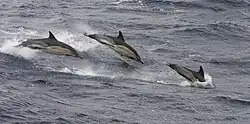


Ireland has 25 cetaceans: all are native. The order Cetacea includes whales, dolphins, and porpoises. They are the mammals most fully adapted to aquatic life with a spindle-shaped, nearly hairless body protected by a thick layer of blubber, and forelimbs and tail modified to provide propulsion underwater.
Suborder: Mysticeti (baleen whales)
Family: Balaenidae
- Genus: Balaena
- Bowhead whale – Balaena mysticetus LC (vagrant)
- Genus: Eubalaena
- North Atlantic right whale – Eubalaena glacialis CR (vagrant)
Family: Balaenopteridae (rorquals)
- Genus: Balaenoptera
- Common minke whale – Balaenoptera acutorostrata LC
- Sei whale – Balaenoptera borealis EN
- Blue whale – Balaenoptera musculus EN
- Fin whale – Balaenoptera physalus VU
- Genus: Megaptera
- Humpback whale – Megaptera novaeangliae LC
Suborder: Odontoceti (toothed whales)
Superfamily: Delphinoidea
Family: Delphinidae (marine dolphins)
- Genus: Delphinus
- Common dolphin – Delphinus delphis LC
- Genus: Globicephala
- Long-finned pilot whale – Globicephala melas LC
- Genus: Grampus
- Risso's dolphin – Grampus griseus LC
- Genus: Lagenorhynchus
- White-beaked dolphin – Lagenorhynchus albirostris LC
- Genus: Leucopleurus
- Atlantic white-sided dolphin – Leucopleurus acutus LC
- Genus: Orcinus
- Orca – Orcinus orca DD
- Genus: Pseudorca
- False killer whale – Pseudorca crassidens NT
- Genus: Stenella
- Striped dolphin – Stenella coeruleoalba LC
- Genus: Tursiops
- Common bottlenose dolphin – Tursiops truncatus LC
Family: Monodontidae
- Genus: Delphinapterus
- Beluga – Delphinapterus leucas LC (vagrant)
Family: Phocoenidae (porpoises)
- Genus: Phocoena
- Harbour porpoise – Phocoena phocoena LC
Superfamily: Physeteroidea
Family: Physeteridae
- Genus: Physeter
- Sperm whale – Physeter macrocephalus VU
Family: Kogiidae
- Genus: Kogia
- Pygmy sperm whale – Kogia breviceps LC
Superfamily: Ziphioidea
Family: Ziphidae (beaked whales)
- Genus: Ziphius
- Cuvier's beaked whale – Ziphius cavirostris LC
- Subfamily: Hyperoodontinae
- Genus: Hyperoodon
- Northern bottlenose whale – Hyperoodon ampullatus NT
- Genus: Mesoplodon
- Sowerby's beaked whale – Mesoplodon bidens LC
- Gervais' beaked whale – Mesoplodon europaeus LC
- True's beaked whale – Mesoplodon mirus LC
Locally extinct

The following species are locally extinct in the country:[8]
- Wolf – Canis lupus, see Wolves in Ireland
- Eurasian lynx – Lynx lynx
- Reindeer – Rangifer tarandus
- Wild boar – Sus scrofa
- Brown bear – Ursus arctos, see Bears in Ireland
Globally extinct
The following species were present in Ireland, and are now extinct globally:[9]
- Irish elk – Megaloceros giganteus
- Woolly mammoth – Mammuthus primigenius
- Cave hyena – Crocuta spelaea
See also
References
- 1 2 Marnell, F.; Looney, D.; Lawton, C. (2019), "Ireland Red List No. 12: Terrestrial Mammals" (PDF), National Parks and Wildlife Service, Department of the Culture, Heritage and the Gaeltacht, Dublin, Ireland
- 1 2 "Species". Irish Whale and Dolphin Group. Retrieved 27 February 2026.
- ↑ Glynn, Niall (2 October 2022). "Lambay Island is home to Ireland's wallabies". BBC Northern Ireland. Retrieved 5 March 2026.
Rupert Baring introduced the first wallabies to the island in the 1950s
- ↑ Finnegan, Laura A.; Poole, Alan; Lawton, Colin; Rochford, John M. (April 2009). "Morphological diversity of the red squirrel, Sciurus vulgaris, in Ireland". European Journal of Wildlife Research. 55 (2). University of Galway: 145–151. doi:10.1007/s10344-008-0228-1.
- ↑ Moynagh, J.; Viscardi, P. (2022). "Vouchered record of Field Vole (Microtus agrestis) in Ireland from Co. Monaghan". Irish Naturalists' Journal. 39: 104–106.
- ↑ "Mole". Ulster Wildlife. Retrieved 28 February 2026.
- ↑ Whooley, Pádraig. "Kerry Walrus March 14th re-sighted in Wales March 20th: Update 29th March". Irish Whale and Dolphin Group. Retrieved 28 February 2026.
- ↑ Lysaght, L.; Marnell, F. (2016). Atlas of Mammals in Ireland 2010-2015 (PDF). Waterford: National Biodiversity Data Centre. ISBN 978-1-911172-04-8.
- ↑ "Ice Age Ireland Cool Fossils!" (PDF). National Museum of Ireland. January 2025. Retrieved 5 March 2026.
External links

- Ireland Red List No. 12: Terrestrial Mammals
- Irish Whale and Dolphin Group
- Biodiversity Ireland Biodiversity Maps
- Atlas of Mammals in Ireland (2016, outdated but still mostly accurate)