List of mammals of Brazil
Brazil has the largest mammal diversity in the world, with around 751 described species[1] and more likely to be discovered. According to the International Union for Conservation of Nature, 66 of these species are endangered, and 40% of the threatened taxa belong to the primate group.[2]
The following tags are used to highlight each species' conservation status as assessed by the International Union for Conservation of Nature:
| EX | Extinct | No reasonable doubt that the last individual has died. |
| EW | Extinct in the wild | Known only to survive in captivity or as a naturalized populations well outside its previous range. |
| CR | Critically endangered | The species is in imminent risk of extinction in the wild. |
| EN | Endangered | The species is facing an extremely high risk of extinction in the wild. |
| VU | Vulnerable | The species is facing a high risk of extinction in the wild. |
| NT | Near threatened | The species does not meet any of the criteria that would categorise it as risking extinction but it is likely to do so in the future. |
| LC | Least concern | There are no current identifiable risks to the species. |
| DD | Data deficient | There is inadequate information to make an assessment of the risks to this species. |
Some species were assessed using an earlier set of criteria. Species assessed using this system have the following instead of least concern categories:
| LR/lc | Lower risk/least concern | Species for which there are no identifiable risks. |
Infraclass: Metatheria
Order: Didelphimorphia


- Family: Caluromyidae
- Genus: Caluromys
- Brown-eared woolly opossum, C. lanatus LC
- Bare-tailed woolly opossum, C. philander LC
- Genus: Caluromys
- Family: Didelphidae
- Genus: Caluromysiops
- Black-shouldered opossum, Caluromysiops irrupta LC
- Genus: Glironia
- Bushy-tailed opossum, Glironia venusta LC
- Genus: Chironectes
- Water opossum, Chironectes minimus LC
- Genus: Didelphis
- White-eared opossum, Didelphis albiventris LC
- Big-eared opossum, Didelphis aurita LC
- Guianan white-eared opossum, Didelphis imperfecta LC
- Genus: Lutreolina
- Big lutrine opossum, Lutreolina crassicaudata LC
- Genus: Philander
- Anderson's four-eyed opossum, Philander andersoni LC
- Southeastern four-eyed opossum, Philander frenatus LC
- McIlhenny's four-eyed opossum, Philander mcilhennyi LC
- Gray four-eyed opossum, Philander opossum LC
- Genus: Gracilinanus
- Agile gracile opossum, Gracilinanus agilis LC
- Emilia's gracile opossum, Gracilinanus emiliae DD
- Brazilian gracile opossum, Gracilinanus microtarsus LC
- Genus: Marmosa
- White-bellied woolly mouse opossum, Marmosa constantiae LC
- Woolly mouse opossum, Marmosa demerarae LC
- Rufous mouse opossum, Marmosa lepida LC
- Linnaeus's mouse opossum, Marmosa murina LC
- Tate's woolly mouse opossum, Marmosa paraguayana LC
- Bare-tailed woolly mouse opossum, Marmosa regina LC
- Genus: Marmosops
- Tschudi's slender opossum, Marmosops impavidus LC
- Gray slender opossum, Marmosops incanus LC
- Neblina slender opossum, Marmosops neblina LC
- White-bellied slender mouse opossum, Marmosops noctivagus LC
- Delicate slender opossum, Marmosops parvidens LC
- Brazilian slender opossum, Marmosops paulensis LC
- Pinheiro's slender opossum, Marmosops pinheiroi LC
- Genus: Metachirus
- Brown four-eyed opossum, Metachirus nudicaudatus LC
- Genus: Monodelphis
- Northern three-striped opossum, Monodelphis americana LC
- Northern red-sided opossum, Monodelphis brevicaudata LC
- Yellow-sided opossum, Monodelphis dimidiata LC
- Gray short-tailed opossum, Monodelphis domestica LC

Gray short-tailed opossum - Emilia's short-tailed opossum, Monodelphis emiliae LC
- Ihering's three-striped opossum, Monodelphis iheringi DD
- Pygmy short-tailed opossum, Monodelphis kunsi LC
- Marajó short-tailed opossum, Monodelphis maraxina DD
- Chestnut-striped opossum, Monodelphis rubida DD
- Long-nosed short-tailed opossum, Monodelphis scalops LC
- Southern red-sided opossum, Monodelphis sorex LC
- Southern three-striped opossum, Monodelphis theresa DD
- Red three-striped opossum, Monodelphis umbristriata VU
- One-striped opossum, Monodelphis unistriata CR
- Genus: Thylamys
- Dwarf fat-tailed mouse opossum, Thylamys velutinus LC
- Genus: Caluromysiops
Infraclass: Eutheria
Order: Pilosa


- Family: Bradypodidae
- Genus: Bradypus
- Maned sloth, Bradypus torquatus VU
- Pale-throated sloth, Bradypus tridactylus LC
- Brown-throated sloth, Bradypus variegatus LC
- Genus: Bradypus
- Family: Choloepodidae
- Genus: Choloepus
- Linnaeus's two-toed sloth, Choloepus didactylus LC
- Hoffmann's two-toed sloth, Choloepus hoffmanni LC
- Genus: Choloepus


- Family Cyclopedidae
- Genus: Cyclopes
- Silky anteater, Cyclopes didactylus LC
- Genus: Cyclopes
- Family: Myrmecophagidae
- Genus: Myrmecophaga
- Giant anteater, Myrmecophaga tridactyla VU
- Genus: Tamandua
- Southern tamandua, Tamandua tetradactyla LC
- Genus: Myrmecophaga
Order: Cingulata


- Family: Dasypodidae
- Genus: Cabassous
- Greater naked-tailed armadillo, Cabassous tatouay LC
- Southern naked-tailed armadillo, Cabassous unicinctus LC
- Genus: Dasypus
- Southern long-nosed armadillo, Dasypus hybridus NT
- Great long-nosed armadillo, Dasypus kappleri LC
- Nine-banded armadillo, Dasypus novemcinctus LC
- Seven-banded armadillo, Dasypus septemcinctus LC
- Genus: Euphractus
- Six-banded armadillo, Euphractus sexcinctus LC
- Genus: Priodontes
- Giant armadillo, Priodontes maximus VU
- Genus: Tolypeutes
- Southern three-banded armadillo, Tolypeutes matacus NT
- Brazilian three-banded armadillo, Tolypeutes tricinctus VU
- Genus: Cabassous
Order: Chiroptera
- Family: Emballonuridae
- Genus: Centronycteris
- Shaggy bat, Centronycteris maximiliani LR/lc
- Genus: Cormura
- Chestnut sac-winged bat, Cormura brevirostris LC
- Genus: Cyttarops
- Short-eared bat, Cyttarops alecto LC
- Genus: Diclidurus
- Northern ghost bat, Diclidurus albus LR/lc
- Greater ghost bat, Diclidurus ingens DD
- Isabelle's ghost bat, Diclidurus isabella LC
- Lesser ghost bat, Diclidurus scutatus LC
- Genus: Peropteryx
- Greater dog-like bat, Peropteryx kappleri LR/lc
- White-winged dog-like bat, Peropteryx leucoptera LC
- Lesser dog-like bat, Peropteryx macrotis LR/lc
- Pale-winged dog-like bat, Peropteryx pallidoptera
- Genus: Rhynchonycteris
- Proboscis bat, Rhynchonycteris naso LR/lc
- Genus: Saccopteryx
- Greater sac-winged bat, Saccopteryx bilineata LC
- Frosted sac-winged bat, Saccopteryx canescens LC
- Amazonian sac-winged bat, Saccopteryx gymnura DD
- Lesser sac-winged bat, Saccopteryx leptura LC
- Genus: Centronycteris
- Family: Phyllostomidae
- Subfamily: Desmodontinae
- Genus: Desmodus
- Common vampire bat, Desmodus rotundus LC

Vampire bat
- Common vampire bat, Desmodus rotundus LC
- Genus: Diaemus
- White-winged vampire bat, Diaemus youngii LC
- Genus: Diphylla
- Hairy-legged vampire bat, Diphylla ecaudata LC
- Genus: Desmodus
- Subfamily: Glossophaginae
- Genus: Anoura
- Tailed tailless bat, Anoura caudifer LC
- Geoffroy's tailless bat, Anoura geoffroyi LC
- Genus: Choeroniscus
- Minor long-nosed long-tongued bat, Choeroniscus minor LC
- Genus: Glossophaga
- Commissaris's long-tongued bat, Glossophaga commissarisi LR/lc
- Miller's long-tongued bat, Glossophaga longirostris DD
- Pallas's long-tongued bat, Glossophaga soricina LR/lc
- Genus: Hsunycteris
- Thomas's nectar bat, Hsunycteris thomasi LC
- Genus: Lichonycteris
- Dark long-tongued bat, Lichonycteris degener LR/lc
- Genus: Lionycteris
- Chestnut long-tongued bat, Lionycteris spurrelli LC
- Genus: Lonchophylla
- Bokermann's nectar bat, Lonchophylla bokermanni DD
- Dekeyser's nectar bat, Lonchophylla dekeyseri NT
- Lonchophylla inexpectata, Lonchophylla inexpectata
- Godman's nectar bat, Lonchophylla mordax LC
- Peracchi's nectar bat, Lonchophylla peracchii
- Genus: Scleronycteris
- Ega long-tongued bat, Scleronycteris ega LC
- Genus: Anoura
- Subfamily: Carolliinae
- Genus: Rhinophylla
- Fischer's little fruit bat, Rhinophylla fischerae LC
- Dwarf little fruit bat, Rhinophylla pumilio LC
- Genus: Carollia
- Benkeith's short-tailed bat, Carollia benkeithi
- Silky short-tailed bat, Carollia brevicauda LR/lc
- Seba's short-tailed bat, Carollia perspicillata LR/lc
- Little white-shouldered bat, Ametrida centurio LC
- Subfamily: Phyllostominae
- Genus: Chrotopterus
- Big-eared woolly bat, Chrotopterus auritus LR/lc
- Genus: Garnderycteris
- Striped hairy-nosed bat, Gardnerycteris crenulatum LR/lc
- Genus: Glyphonycteris
- Davies's big-eared bat, Glyphonycteris daviesi DD
- Tricolored big-eared bat, Glyphonycteris sylvestris LC
- Genus: Lampronycteris
- Yellow-throated big-eared bat, Lampronycteris brachyotis LC
- Genus: Lonchorhina
- Tomes's sword-nosed bat, Lonchorhina aurita LR/lc
- Northern sword-nosed bat, Lonchorhina inusitata DD
- Genus: Lophostoma
- Pygmy round-eared bat, Lophostoma brasiliense LR/lc
- Carriker's round-eared bat, Lophostoma carrikeri LC
- Schultz's round-eared bat, Lophostoma schulzi LC
- White-throated round-eared bat, Lophostoma silvicola LC
- Genus: Macrophyllum
- Long-legged bat, Macrophyllum macrophyllum LC
- Genus: Micronycteris
- Brosset's big-eared bat, Micronycteris brosseti DD
- Hairy big-eared bat, Micronycteris hirsuta LC
- Little big-eared bat, Micronycteris megalotis LC
- Common big-eared bat, Micronycteris microtis LC
- White-bellied big-eared bat, Micronycteris minuta LC
- Sanborn's big-eared bat, Micronycteris sanborni DD
- Schmidts's big-eared bat, Micronycteris schmidtorum LR/lc
- Genus: Mimon
- Golden bat, Mimon bennettii LC
- Genus: Neonycteris
- Least big-eared bat, Neonycteris pusilla VU
- Genus: Phylloderma
- Pale-faced bat, Phylloderma stenops LR/lc
- Genus: Phyllostomus
- Pale spear-nosed bat, Phyllostomus discolor LC
- Lesser spear-nosed bat, Phyllostomus elongatus LC
- Greater spear-nosed bat, Phyllostomus hastatus LC
- Guianan spear-nosed bat, Phyllostomus latifolius LC
- Genus: Tonatia
- Greater round-eared bat, Tonatia bidens DD
- Stripe-headed round-eared bat, Tonatia saurophila LR/lc
- Genus: Trachops
- Fringe-lipped bat, Trachops cirrhosus LC
- Genus: Trinycteris
- Niceforo's big-eared bat, Trinycteris nicefori LC
- Genus: Vampyrum
- Spectral bat, Vampyrum spectrum NT[3]
- Genus: Chrotopterus
- Subfamily: Stenodermatinae
- Genus: Artibeus
- Brown fruit-eating bat, Artibeus concolor LC
- Fringed fruit-eating bat, Artibeus fimbriatus LC
- Great fruit-eating bat, Artibeus lituratus LC
- Dark fruit-eating bat, Artibeus obscurus LC
- Flat-faced fruit-eating bat, Artibeus planirostris LR/lc
- Genus: Chiroderma
- Brazilian big-eyed bat, Chiroderma doriae LC
- Salvin's big-eyed bat, Chiroderma salvini LR/lc
- Little big-eyed bat, Chiroderma trinitatum LC
- Hairy big-eyed bat, Chiroderma villosum LR/lc
- Vizotto's big-eyed bat, Chiroderma vizottoi LR/lc
- Genus: Dermanura
- Andersen's fruit-eating bat, Dermanura anderseni LC
- Bogota fruit-eating bat, Dermanura bogotensis
- Gervais's fruit-eating bat, Dermanura cinerea LC
- Gnome fruit-eating bat, Artibeus gnoma LC
- Genus: Mesophylla
- MacConnell's bat, Mesophylla macconnelli LC
- Genus: Platyrrhinus
- Slender broad-nosed bat, Platyrrhinus angustirostris
- Eldorado broad-nosed bat, Platyrrhinus aurarius
- Short-headed broad-nosed bat, Platyrrhinus brachycephalus LC
- Brown-bellied broad-nosed bat, Platyrrhinus fusciventris LC
- Heller's broad-nosed bat, Platyrrhinus helleri LC
- Incan broad-nosed bat, Platyrrhinus incarum LC
- Buffy broad-nosed bat, Platyrrhinus infuscus LC
- White-lined broad-nosed bat, Platyrrhinus lineatus LC
- Recife broad-nosed bat, Platyrrhinus recifinus LC
- Genus: Pygoderma
- Ipanema bat, Pygoderma bilabiatum LC
- Genus: Sphaeronycteris
- Visored bat, Sphaeronycteris toxophyllum DD
- Genus: Sturnira
- Little yellow-shouldered bat, Sturnira lilium LR/lc
- Greater yellow-shouldered bat, Sturnira magna
- Tilda's yellow-shouldered bat, Sturnira tildae LC
- Genus: Uroderma
- Tent-making bat, Uroderma bilobatum LR/lc
- Brown tent-making bat, Uroderma magnirostrum LR/lc
- Genus: Vampyressa
- Southern little yellow-eared bat, Vampyressa pusilla DD
- Northern little yellow-eared bat, Vampyressa thyone LC
- Genus: Vampyriscus
- Bidentate yellow-eared bat, Vampyriscus bidens LC
- Brock's yellow-eared bat, Vampyriscus brocki LC
- Genus: Vampyrodes
- Great stripe-faced bat, Vampyrodes caraccioli LC
- Genus: Artibeus
- Subfamily: Desmodontinae
- Family: Mormoopidae
- Genus: Pteronotus
- Big naked-backed bat, Pteronotus gymnonotus LR/lc
- Parnell's mustached bat, Pteronotus parnellii LR/lc
- Wagner's mustached bat, Pteronotus personatus LC
- Genus: Pteronotus
- Family: Noctilionidae
- Genus: Noctilio
- Lesser bulldog bat, Noctilio albiventris LC
- Greater bulldog bat, Noctilio leporinus LC
- Genus: Noctilio
- Family: Furipteridae
- Genus: Furipterus
- Thumbless bat, Furipterus horrens LC
- Genus: Furipterus
- Family: Thyropteridae
- Genus: Thyroptera
- De Vivo's disk-winged bat, Thyroptera devivoi DD
- Peters's disk-winged bat, Thyroptera discifera LC
- LaVal's disk-winged bat, Thyroptera lavali
- Spix's disk-winged bat, Thyroptera tricolor LC
- Patricia's disk-winged bat, Thyroptera wynneae
- Genus: Thyroptera
- Family: Natalidae
- Genus: Natalus
- Brazilian funnel-eared bat, Natalus macrourus LC
- Genus: Natalus
- Family: Molossidae

Brazilian free-tailed bat - Genus: Cynomops
- Cinnamon dog-faced bat, Cynomops abrasus DD
- Greenhall's dog-faced bat, Cynomops greenhalli
- Miller's dog-faced bat, Cynomops milleri
- Para dog-faced bat, Cynomops paranus DD
- Southern dog-faced bat, Cynomops planirostris LC
- Genus: Eumops
- Black bonneted bat, Eumops auripendulus LC
- Dwarf bonneted bat, Eumops bonariensis LC
- Eumops delticus
- Wagner's bonneted bat, Eumops glaucinus LC
- Sanborn's bonneted bat, Eumops hansae LC
- Guianan bonneted bat, Eumops maurus LC
- Patagonian bonneted bat, Eumops patagonicus LC
- Western bonneted bat, Eumops perotis LC
- Colombian bonneted bat, Eumops trumbulli LC
- Genus: Molossops
- Rufous dog-faced bat, Molossops neglectus DD
- Dwarf dog-faced bat, Molossops temminckii LC
- Genus: Molossus
- Aztec mastiff bat, Molossus aztecus
- Coiba mastiff bat, Molossus coibensis
- Bonda mastiff bat, Molossus currentium
- Velvety free-tailed bat, Molossus molossus LC
- Miller's mastiff bat, Molossus pretiosus
- Black mastiff bat, Molossus rufus LC
- Genus: Neoplatymops
- Mato Grosso dog-faced bat, Neoplatymops mattogrossensis LC
- Genus: Nyctinomops
- Peale's free-tailed bat, Nyctinomops aurispinosus LC
- Broad-eared bat, Nyctinomops laticaudatus LC
- Big free-tailed bat, Nyctinomops macrotis LC
- Genus: Promops
- Big crested mastiff bat, Promops centralis LC
- Brown mastiff bat, Promops nasutus LC
- Genus: Tadarida
- Brazilian free-tailed bat, Tadarida brasiliensis LC
- Genus: Cynomops

- Family: Vespertilionidae
- Genus: Eptesicus
- Little black serotine, Eptesicu andinus
- Brazilian brown bat, Eptesicus brasiliensis LC
- Chiriquinan serotine, Eptesicus chiriquinus
- Diminutive serotine, Eptesicus diminutus DD
- Argentine brown bat, Eptesicus furinalis LC
- Taddei serotine, Eptesicus taddeii
- Genus: Histiotus
- Strange big-eared brown bat, Histiotus alienus DD
- Thomas's big-eared brown bat, Histiotus laephotis DD
- Small big-eared brown bat, Histiotus montanus DD
- Tropical big-eared brown bat, Histiotus velatus DD
- Genus: Lasiurus
- Desert red bat, Lasiurus blossevillii LC
- Tacarcuna bat, Lasiurus castaneus DD
- Hoary bat, Lasiurus cinereus LC
- Hairy-tailed bat, Lasiurus ebenus DD
- Southern yellow bat, Lasiurus ega LC
- Big red bat, Lasiurus egregius DD
- Saline red bat, Lasiurus salinae
- Genus: Rhogeessa
- Husson's yellow bat, Rhogeessa hussoni LC
- Thomas's yellow bat, Rhogeessa io LC
- Genus: Myotis
- Silver-tipped myotis, Myotis albescens LC
- Myotis dinellii
- Izecksohn's myotis, Myotis izecksohni
- LaVal's myotis, Myotis lavali
- Yellowish myotis, Myotis levis LC
- Black myotis, Myotis nigricans LR/lc
- Riparian myotis, Myotis riparius LC
- Red myotis, Myotis ruber NT
- Velvety myotis, Myotis simus DD
- Genus: Eptesicus
Order: Primates
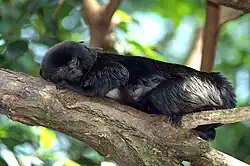
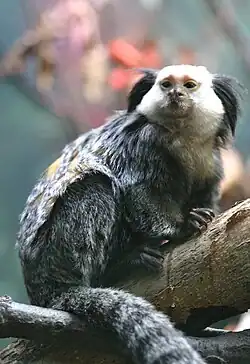

- Family: Callitrichidae
- Genus: Callimico
- Goeldi's marmoset, Callimico goeldii VU
- Genus: Callithrix
- Buffy-tufted marmoset, Callithrix aurita VU
- Buffy-headed marmoset, Callithrix flaviceps EN
- White-headed marmoset, Callithrix geoffroyi LC
- Common marmoset, Callithrix jacchus LC
- Wied's marmoset, Callithrix kuhlii NT
- Black-tufted marmoset, Callithrix penicillata LC
- Genus: Cebuella
- Pygmy marmoset, Cebuella pygmaea LC
- Genus: Leontocebus
- Cruz Lima's saddle-back tamarin, Leontocebus cruzlimai LC
- Lesson's saddle-back tamarin, Leontocebus fuscus LC
- Brown-mantled tamarin, Leontocebus fuscicollis LC
- Black-mantled tamarin, Leontocebus nigricollis LC
- Weddell's saddle-back tamarin, Leontocebus weddelli LC
- Genus: Leontopithecus
- Superagui lion tamarin, Leontopithecus caissara CR
- Golden-headed lion tamarin, Leontopithecus chrysomelas EN
- Black lion tamarin, Leontopithecus chrysopygus EN
- Golden lion tamarin, Leontopithecus rosalia EN
- Genus: Mico
- Rio Acari marmoset, Mico acariensis DD
- Gold-and-white marmoset, Mico chrysoleucus DD
- Emilia's marmoset, Mico emiliae DD
- Santarem marmoset, Mico humeralifer DD
- Roosmalens' dwarf marmoset, Mico humilis VU
- Hershkovitz's marmoset, Mico intermedia LC
- White marmoset, Mico leucippe VU
- Manicore marmoset, Mico manicorensis LC
- Marca's marmoset, Mico marcai DD
- Maués marmoset, Mico mauesi LC
- Munduruku marmoset, Mico munduruku VU
- Black-tailed marmoset, Mico melanurus LC
- Black-headed marmoset, Mico nigriceps DD
- Sateré marmoset, Mico saterei LC
- Genus: Saguinus
- Pied tamarin, Saguinus bicolor EN
- Emperor tamarin, Saguinus imperator LC
- Mottle-faced tamarin, Saguinus inustus LC
- White-lipped tamarin, Saguinus labiatus LC
- Martins's tamarin, Saguinus martinsi LC
- Red-handed tamarin, Saguinus midas LC
- Moustached tamarin, Saguinus mystax LC
- Black tamarin, Saguinus niger VU
- Genus: Callimico
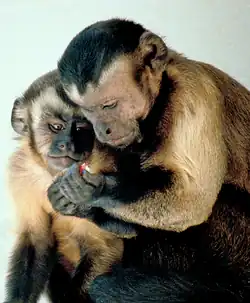
- Family: Cebidae
- Genus: Cebus
- Humboldt's white-fronted capuchin, Cebus albifrons LC
- Kaapori capuchin, Cebus kaapori CR
- Spix's white-fronted capuchin, Cebus unicolor
- Wedge-capped capuchin, Cebus olivaceus LC
- Marañón white-fronted capuchin, Cebus yuracus
- Genus: Sapajus
- Tufted capuchin, Sapajus apella LC
- Black-striped capuchin, Sapajus libidinosus LC
- Large-headed capuchin, Sapajus macrocephalus LC
- Black capuchin, Sapajus nigritus NT
- Crested capuchin, Sapajus robustus EN
- Golden-bellied capuchin, Sapajus xanthosternos CR
- Genus: Saimiri
- Black-capped squirrel monkey, Saimiri boliviensis LC
- Collins' squirrel monkey, Saimiri collinsi
- Humboldt's squirrel monkey, Saimiri cassiquiarensis
- Guianan squirrel monkey, Saimiri sciureus LC
- Bare-eared squirrel monkey, Saimiri ustus NT
- Black squirrel monkey, Saimiri vanzolinii VU
- Genus: Cebus
- Family: Aotidae
- Genus: Aotus
- Feline night monkey, Aotus azarae LC
- Nancy Ma's night monkey, Aotus nancymaae LC
- Black-headed night monkey, Aotus nigriceps LC
- Three-striped night monkey, Aotus trivirgatus LC
- Spix's night monkey, Aotus vociferans LC
- Genus: Aotus


- Family: Pitheciidae
- Genus: Cacajao
- Bald uakari, Cacajao calvus VU
- Black-headed uakari, Cacajao melanocephalus LC
- Aracá uakari, Cacajao ayresi VU
- Neblina uakari, Cacajao hosomi VU
- Genus: Callicebus
- Baptista Lake titi, Callicebus baptista LC
- Barbara Brown's titi, Callicebus barbarabrownae CR
- Prince Bernhard's titi, Callicebus bernhardi LC
- Brown titi, Callicebus brunneus LC
- Chestnut-bellied titi, Callicebus brunneus LC
- Ashy black titi, Callicebus cinerascens LC
- Coimbra Filho's titi, Callicebus coimbrai EN
- Coppery titi, Callicebus cupreus LC
- White-eared titi, Callicebus donacophilus LC
- Hershkovitz's titi, Callicebus dubius LC
- Hoffmanns's titi, Callicebus hoffmannsi LC
- Lucifer titi, Callicebus lucifer LC
- Black titi, Callicebus lugens LC
- Coastal black-handed titi, Callicebus melanochir VU
- Red-bellied titi, Callicebus moloch LC
- Black-fronted titi, Callicebus nigrifrons NT
- White-coated titi, Callicebus pallescens LC
- Atlantic titi, Callicebus personatus VU
- Rio Purus titi, Callicebus purinus LC
- Red-headed titi, Callicebus regulus LC
- Stephen Nash's titi, Callicebus stephennashi DD
- Collared titi, Callicebus torquatus LC
- Genus: Chiropotes
- White-nosed saki, Chiropotes albinasus EN
- Red-backed bearded saki, Chiropotes chiropotes LC
- Brown-backed bearded saki, Chiropotes israelita
- Black bearded saki, Chiropotes satanas CR
- Uta Hick's bearded saki, Chiropotes utahicki EN
- Genus: Pithecia
- White-footed saki, Pithecia albicans VU
- Rio Tapajós saki, Pithecia irrorata LC
- Monk saki, Pithecia monachus LC
- White-faced saki, Pithecia pithecia
- Genus: Cacajao

- Family: Atelidae
- Genus: Alouatta
- Red-handed howler, Alouatta belzebul VU
- Black howler, Alouatta caraya LC
- Brown howler, Alouatta guariba LC
- Amazon black howler, Alouatta nigerrima LC
- Venezuelan red howler, Alouatta seniculus LC
- Maranhão red-handed howler, Alouatta ululata EN
- Genus: Ateles
- White-fronted spider monkey, Ateles belzebuth EN
- Peruvian spider monkey, Ateles chamek EN
- White-cheeked spider monkey, Ateles marginatus EN
- Red-faced spider monkey, Ateles paniscus VU
- Genus: Brachyteles
- Southern muriqui, Brachyteles arachnoides EN
- Northern muriqui, Brachyteles hypoxanthus CR
- Genus: Lagothrix
- Gray woolly monkey, Lagothrix cana EN
- Brown woolly monkey, Lagothrix lagothricha VU
- Silvery woolly monkey, Lagothrix poeppigii VU
- Genus: Alouatta
Order: Carnivora


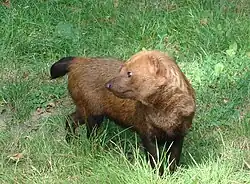

Canidae - dogs, foxes, wolves
- Genus: Atelocynus
- Short-eared dog, A. microtis NT
- Genus: Cerdocyon
- Crab-eating fox, C. thousLC
- Genus: Chrysocyon
- Maned wolf, C. brachyurus NT
- Genus: Dusicyon
- Genus: Lycalopex
- Pampas fox, L. gymnocercus LC
- Hoary fox, L. vetulus NT
- Genus: Speothos
- Bush dog, S. venaticus NT
Felidae - cats


- Genus: Leopardus
- Pampas cat L. colocolo NT[4]
- Geoffroy's cat L. geoffroyi LC[5]
- Ocelot L. pardalis LC[6]
- Oncilla L. tigrinus VU[7]
- Margay L. wiedii NT[8]
- Genus: Herpailurus
- Jaguarundi, H. yagouaroundi LC[9]
- Genus: Puma
- Genus: Panthera
Mustelidae - otters, weasels and allies


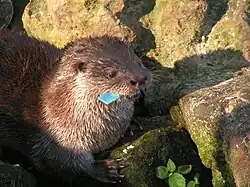
- Tayra, Eira barbara
- Lesser grison, Galictis cuja
- Greater grison, Galictis vittata
- Neotropical river otter, Lontra longicaudis
- Amazon weasel, Neogale africana
- Long-tailed weasel, Neogale frenata
- Giant otter, Pteronura brasiliensis
- Molina's hog-nosed skunk, Conepatus chinga
- Striped hog-nosed skunk, Conepatus semistriatus
- South American fur seal, Arctocephalus australis LC[12]
- Subantarctic fur seal, Arctocephalus tropicalis (vagrant) LC[13]
- South American sea lion, Otaria flavescens LC[14]
- Southern elephant seal, Mirounga leonina (vagrant) LC[15]
Procyonidae - raccoons, coatis, olingos and allies

- Eastern lowland olingo, Bassaricyon beddardi
- South American coati, Nasua nasua
- Kinkajou, Potos flavus
- Crab-eating raccoon, Procyon cancrivorus



- Southern right whale, Eubalaena australis
- Common minke whale, Balaenoptera acutorostrata
- Antarctic minke whale, Balaenoptera bonaerensis
- Sei whale, Balaenoptera borealis
- Bryde's whale, Balaenoptera brydei
- Omura's whale, Balaenoptera omurai (the second case found in Atlantic oceans)[16]
- Blue whale, Balaenoptera musculus
- Fin whale, Balaenoptera physalus
- Humpback whale, Megaptera novaeangliae
- Long-beaked common dolphin, Delphinus capensis
- Pygmy killer whale, Feresa attenuata
- Short-finned pilot whale, Globicephala macrorhynchus
- Long-finned pilot whale, Globicephala melas
- Risso's dolphin, Grampus griseus
- Fraser's dolphin, Lagenodelphis hosei
- Southern right whale dolphin, Lissodelphis peronii
- Killer whale, Orcinus orca
- Melon-headed whale, Peponocephala electra
- False killer whale, Pseudorca crassidens
- Costero, Sotalia guianensis
- Tucuxi, Sotalia fluviatilis
- Pantropical spotted dolphin, Stenella attenuata
- Clymene dolphin, Stenella clymene
- Striped dolphin, Stenella coeruleoalba
- Spinner dolphin, Stenella longirostris
- Rough-toothed dolphin, Steno bredanensis
- Common bottlenose dolphin, Tursiops truncatus
- Burmeister's porpoise, Phocoena spinipinnis
- Spectacled porpoise, Phocoena dioptrica
- Sperm whale, Physeter macrocephalus VU[17]
Iniidae - South American river dolphins
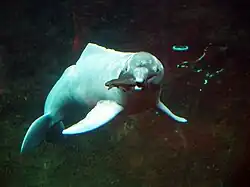
- Amazon river dolphin, Inia geoffrensis
- Araguaian river dolphin, Inia araguaiaensis
Pontoporiidae - La Plata dolphin
- La Plata dolphin, Pontoporia blainvillei
- Arnoux's beaked whale, Berardius arnuxii
- Southern bottlenose whale, Hyperoodon planifrons
- Blainville's beaked whale, Mesoplodon densirostris
- Hector's beaked whale, Mesoplodon hectori
- Cuvier's beaked whale, Ziphius cavirostris

- Amazonian manatee, Trichechus inunguis VU[18]
- West Indian manatee, Trichechus manatus VU[19]
- Dwarf manatee, Trichechus pygmaeus[20] (disputed species status)[1]

- Brazilian tapir, Tapirus terrestris
- Kabomani tapir, Tapirus kabomani
- Feral hog, Sus scrofa (introduced species)

- Collared peccary, Dicotyles tajacu
- Giant peccary, Pecari maximus
- White-lipped peccary, Tayassu pecari


- Chital or axis deer, Axis axis (introduced species)
- Marsh deer, Blastocerus dichotomus
- Red brocket, Mazama americana
- Gray brocket, Mazama gouazoubira
- Pygmy brocket, Mazama nana
- White-tailed deer, Odocoileus virginianus
- Pampas deer, Ozotoceros bezoarticus

- Amazon dwarf squirrel, Microsciurus flaviventer
- Neotropical pygmy squirrel, Sciurillus pusillus
- Brazilian squirrel, Sciurus aestuans
- Yellow-throated squirrel, Sciurus gilvigularis
- Bolivian squirrel, Sciurus ignitus
- Northern Amazon red squirrel, Sciurus igniventris
- Southern Amazon red squirrel, Sciurus spadiceus

- Nutria, Myocastor coypus
Muridae - Old World rats and allies
- Norway rat, Rattus norvegicus (introduced species)
- Black rat, Rattus rattus (introduced species)
- House mouse, Mus musculus (introduced species)
Cricetidae - New World rats and allies

- Abrawayaomys chebezi
- Ruschi's rat, Abrawayaomys ruschii
- Azara's grass mouse, Akodon azarae
- Cursor grass mouse, Akodon cursor
- Lindbergh's grass mouse, Akodon lindberghi
- Montane grass mouse, Akodon montensis
- Caparaó grass mouse, Akodon mystax
- Paraná grass mouse, Akodon paranaensis
- Reig's grass mouse, Akodon reigi
- Sao Paulo grass mouse, Akodon sanctipaulensis
- Serra do Mar grass mouse, Akodon serrensis
- Large-lipped crimson-nosed rat, Bibimys labiosus
- Brazilian shrew mouse, Blarinomys breviceps
- Gray-bellied brucie, Brucepattersonius griserufescens
- Red-bellied brucie, Brucepattersonius igniventris
- Ihering's hocicudo, Brucepattersonius iheringi
- Soricine brucie, Brucepattersonius soricinus
- Large vesper mouse, Calomys callosus
- Calomys cerqueirai
- Small vesper mouse, Calomys laucha
- Delicate vesper mouse, Calomys tener
- Tocantins vesper mouse, Calomys tocantinsi
- Cerradomys langguthi
- Cerradomys maracajuensis
- Marinho's oryzomys, Cerradomys marinhus
- Lindbergh's oryzomys, Cerradomys scotti
- Terraced rice rat, Cerradomys subflavus
- Cerradomys vivoi
- Montane Atlantic Forest rat, Delomys collinus
- Striped Atlantic Forest rat, Delomys dorsalis
- Pallid Atlantic Forest rat, Delomys sublineatus
- Drymoreomys albimaculatus
- Emmons's rice rat, Euryoryzomys emmonsae
- Buffy-sided oryzomys, Euryoryzomys lamia
- MacConnell's rice rat, Euryoryzomys macconnelli
- Elegant rice rat, Euryoryzomys nitidus
- Russet rice rat, Euryoryzomys russatus
- Gray leaf-eared mouse, Graomys griseoflavus
- Web-footed marsh rat, Holochilus brasiliensis
- Amazonian marsh rat, Holochilus sciureus
- Atlantic Forest oryzomys, Hylaeamys laticeps
- Azara's broad-headed oryzomys, Hylaeamys megacephalus
- Sowbug rice rat, Hylaeamys oniscus
- Western Amazonian oryzomys, Hylaeamys perenensis
- Yungas rice rat, Hylaeamys yunganus
- Juliomys anoblepas (extinct)
- Juliomys ossitenuis
- Lesser Wilfred's mouse, Juliomys pictipes
- Cleft-headed juliomys, Juliomys rimofrons
- Aracuaria Forest tree mouse, Juliomys ximenezi
- Juscelinomys candango (extinct)
- Juscelinomys talpinus
- Molelike mouse, Juscelinomys vulpinus
- Woolly giant rat, Kunsia tomentosus
- Lund's amphibious rat, Lundomys molitor
- Transitional colilargo, Microakodontomys transitorius
- Dubost's bristly mouse, Neacomys dubosti
- Guiana bristly mouse, Neacomys guianae
- Jurua bristly mouse, Neacomys minutus
- Musser's neacomys, Neacomys musseri
- Paracou neacomys, Neacomys paracou
- Common neacomys, Neacomys spinosus
- Narrow-footed bristly mouse, Neacomys tenuipes
- Hairy-tailed bolo mouse, Necromys lasiurus
- Small-footed bristly mouse, Nectomys rattus
- Scaly-footed water rat, Nectomys squamipes
- Guianan arboreal rice rat, Oecomys auyantepui
- Bicolored arboreal rice rat, Oecomys bicolor
- Cleber's arboreal rice rat, Oecomys cleberi
- Unicolored arboreal rice rat, Oecomys concolor
- Mamore arboreal rice rat, Oecomys mamorae
- Brazilian arboreal rice rat, Oecomys paricola
- King arboreal rice rat, Oecomys rex
- Robert's arboreal rice rat, Oecomys roberti
- Trinidad arboreal rice rat, Oecomys trinitatis
- Chacoan pygmy rice rat, Oligoryzomys chacoensis
- Yellow pygmy rice rat, Oligoryzomys flavescens
- Fulvous pygmy rice rat, Oligoryzomys fulvescens
- Small-eared pygmy rice rat, Oligoryzomys microtis
- Oligoryzomys moojeni
- Black-footed pygmy rice rat, Oligoryzomys nigripes
- Oligoryzomys rupestris
- Straw-colored pygmy rice rat, Oligoryzomys stramineus
- Amazonian hocicudo, Oxymycterus amazonicus
- Angular hocicudo, Oxymycterus angularis
- Caparaó hocicudo, Oxymycterus caparaoe
- Hispid hocicudo, Oxymycterus hispidus
- Long-nosed hocicudo, Oxymycterus nasutus
- Robert's hocicudo, Oxymycterus roberti
- Red hocicudo, Oxymycterus rufus
- Rio de Janeiro arboreal rat, Phaenomys ferrugineus
- Brazilian false rice rat, Pseudoryzomys simplex
- Brazilian arboreal mouse, Rhagomys rufescens
- Gardner's climbing mouse, Rhipidomys gardneri
- White-footed climbing mouse, Rhipidomys leucodactylus
- MacConnell's climbing mouse, Rhipidomys macconnelli
- Atlantic Forest climbing mouse, Rhipidomys mastacalis
- Splendid climbing mouse, Rhipidomys nitela
- Waterhouse's swamp rat, Scapteromys tumidus
- Ucayali spiny mouse, Scolomys ucayalensis
- Alston's cotton rat, Sigmodon alstoni
- Paraguayan rice rat, Sooretamys angouya
- Cerrado mouse, Thalpomys cerradensis
- Hairy-eared cerrado mouse, Thalpomys lasiotis
- Blackish grass mouse, Thaptomys nigrita
- Cerrado red-nosed mouse, Wiedomys cerradensis
- Red-nosed mouse, Wiedomys pyrrhorhinos
- Greater Wilfred's mouse, Wilfredomys oenax
- Short-tailed cane rat, Zygodontomys brevicauda
- Bristle-spined porcupine, Chaetomys subspinosus
- Bahia porcupine, Coendou insidiosus
- Black-tailed hairy dwarf porcupine, Coendou melanurus
- Black dwarf porcupine, Coendou nycthemera
- Brazilian porcupine, Coendou prehensilis
- Roosmalen's dwarf porcupine, Coendou roosmalenorum
- Paraguaian hairy dwarf porcupine, Coendou spinosus
- Pacarana, Dinomys branickii
Caviidae - guinea pigs and cavies


- Brazilian guinea pig, Cavia aperea
- Shiny guinea pig, Cavia fulgida
- Santa Catarina's guinea pig, Cavia intermedia
- Greater guinea pig, Cavia magna
- Guinea pig, Cavia porcellus
- Yellow-toothed cavy, Galea flavidens
- Spix's yellow-toothed cavy, Galea spixii
- Acrobatic cavy, Kerodon acrobata
- Rock cavy, Kerodon rupestris
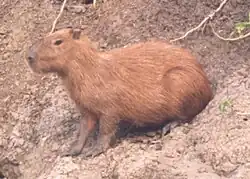
- Capybara, Hydrochoerus hydrochaeris LC[21]
Dasyproctidae - agoutis and acouchis
- Azara's agouti, Dasyprocta azarae
- Black agouti, Dasyprocta fuliginosa
- Red-rumped agouti, Dasyprocta leporina
- Black-rumped agouti, Dasyprocta prymnolopha
- Central American agouti, Dasyprocta punctata
- Red acouchi, Myoprocta acouchy
- Green acouchi, Myoprocta pratti
- Lowland paca, Cuniculus paca
- Brazilian tuco-tuco, Ctenomys brasiliensis
- Flamarion's tuco-tuco, Ctenomys flammarioni
- Tiny tuco-tuco, Ctenomys minutus
- Natterer's tuco-tuco, Ctenomys nattereri
- Rondon's tuco-tuco, Ctenomys rondoni
- Collared tuco-tuco, Ctenomys torquatus
Echimyidae - spiny rats and allies
- Painted tree-rat, Callistomys pictus
- Owl's spiny rat, Carterodon sulcidens
- Bishop's fossorial spiny rat, Clyomys bishopi
- Broad-headed spiny rat, Clyomys laticeps
- Bolivian bamboo rat, Dactylomys boliviensis
- Amazon bamboo rat, Dactylomys dactylinus
- White-faced spiny tree-rat, Echimys chrysurus
- Giant tree-rat, Toromys grandis
- Brandt's guiara, Euryzygomatomys guiara
- Fischer's guiara, Euryzygomatomys spinosus
- Yellow-crowned brush-tailed rat, Isothrix bistriata
- Rio Negro brush-tailed rat, Isothrix negrensis
- Plain brush-tailed rat, Isothrix pagurus
- Atlantic bamboo rat, Kannabateomys amblyonyx
- Tuft-tailed spiny tree-rat, Lonchothrix emiliae
- Long-tailed armored tree-rat, Makalata macrura
- Ferreira's spiny tree-rat, Mesomys hispidus
- Tufted-tailed spiny tree-rat, Mesomys occultus
- Pará spiny tree-rat, Mesomys stimulax
- Golden Atlantic tree-rat, Phyllomys blainvilii
- Orange-brown Atlantic tree-rat, Phyllomys brasiliensis
- Drab Atlantic tree-rat, Phyllomys dasythrix
- Kerr's Atlantic tree-rat, Phyllomys kerri
- Pallid Atlantic tree-rat, Phyllomys lamarum
- Lund's Atlantic tree-rat, Phyllomys lundi
- Mantiqueira Atlantic tree-rat, Phyllomys mantiqueirensis
- Long-furred Atlantic tree-rat, Phyllomys medius
- Black-spined Atlantic tree-rat, Phyllomys nigrispinus
- Rusty-sided Atlantic tree-rat, Phyllomys pattoni
- Giant Atlantic tree-rat, Phyllomys thomasi
- Short-furred Atlantic tree-rat, Phyllomys unicolor
- Napo spiny rat, Proechimys quadruplicatus
- Short-tailed spiny rat, Proechimys brevicauda
- Guyenne spiny rat, Proechimys guyannensis
- Cuvier's spiny rat, Proechimys cuvieri
- Stiff-spine spiny rat, Proechimys echinothrix
- Gardner's spiny rat, Proechimys gardneri
- Goeldi's spiny rat, Proechimys goeldii
- Guyanan spiny rat, Proechimys hoplomyoides
- Kulina spiny rat, Proechimys kulinae
- Long-tailed spiny rat, Proechimys longicaudatus
- Mouse-tailed Atlantic spiny rat, Proechimys myosuros
- Roberto's spiny rat, Proechimys roberti
- Patton's spiny rat, Proechimys pattoni
- Napo spiny rat, Proechimys quadruplicatus
- Simon's spiny rat, Proechimys simonsi
- Steere's spiny rat, Proechimys steerei
- Common punaré, Thrichomys apereoides
- White-spined Atlantic spiny rat, Trinomys albispinus
- Soft-spined Atlantic spiny rat, Trinomys dimidiatus
- Elias's Atlantic spiny rat, Trinomys eliasi
- Gracile Atlantic spiny rat, Trinomys gratiosus
- Ihering's Atlantic spiny rat, Trinomys iheringi
- Dark-caped Atlantic spiny rat, Trinomys mirapitanga
- Moojen's Atlantic spiny rat, Trinomys moojeni
- Spiked Atlantic spiny rat, Trinomys paratus
- Hairy Atlantic spiny rat, Trinomys setosus
- Yonenaga's Atlantic spiny rat, Trinomys yonenagae
- Common tapetí, Sylvilagus brasiliensis EN
- Coastal tapetí, Sylvilagus tapetillus VU
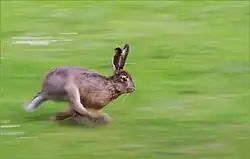
- European hare, Lepus europaeus (introduced species) LC
See also
References
- 1 2 Quintela, Fernando M.; da Rosa, Clarissa A.; Feijó, Anderson (2020). "Updated and annotated checklist of recent mammals from Brazil". Anais da Academia Brasileira de Ciências. 92. doi:10.1590/0001-3765202020191004.
- ↑ MicoLeao. "Mapping the Diversity of Mammals in Brazil". BiodiversityMapping.org. Retrieved 2025-02-24.
- ↑ Solari, S. (2018). "Vampyrum spectrum". IUCN Red List of Threatened Species. 2018 e.T22843A22059426. doi:10.2305/IUCN.UK.2018-2.RLTS.T22843A22059426.en. Retrieved 7 July 2024.
- ↑ Lucherini, M.; Eizirik, E.; de Oliveira, T.; Pereira, J.; Williams, R.S.R. (2016). "Leopardus colocolo". IUCN Red List of Threatened Species. 2016 e.T15309A97204446. doi:10.2305/IUCN.UK.2016-1.RLTS.T15309A97204446.en. Retrieved 7 July 2024.
- ↑ Pereira, J.; Lucherini, M.; Trigo, T. (2015). "Leopardus geoffroyi". IUCN Red List of Threatened Species. 2015 e.T15310A50657011. doi:10.2305/IUCN.UK.2015-2.RLTS.T15310A50657011.en. Retrieved 7 July 2024.
- ↑ Paviolo, A.; Crawshaw, P.; Caso, A.; de Oliveira, T.; Lopez-Gonzalez, C.A.; Kelly, M.; De Angelo, C.; Payan, E. (2016) [errata version of 2015 assessment]. "Leopardus pardalis". IUCN Red List of Threatened Species. 2015 e.T11509A97212355. doi:10.2305/IUCN.UK.2015-4.RLTS.T11509A50653476.en. Retrieved 7 July 2024.
- ↑ Payan, E.; de Oliveira, T. (2016). "Leopardus tigrinus". IUCN Red List of Threatened Species. 2016 e.T54012637A50653881. doi:10.2305/IUCN.UK.2016-2.RLTS.T54012637A50653881.en. Retrieved 7 July 2024.
- ↑ de Oliveira, T.; Paviolo, A.; Schipper, J.; Bianchi, R.; Payan, E.; Carvajal, S.V. (2015). "Leopardus wiedii". IUCN Red List of Threatened Species. 2015 e.T11511A50654216. doi:10.2305/IUCN.UK.2015-4.RLTS.T11511A50654216.en. Retrieved 7 July 2024.
- ↑ Caso, A.; de Oliveira, T.; Carvajal, S.V. (2015). "Herpailurus yagouaroundi". IUCN Red List of Threatened Species. 2015 e.T9948A50653167. doi:10.2305/IUCN.UK.2015-2.RLTS.T9948A50653167.en. Retrieved 7 July 2024.
- ↑ Nielsen, C.; Thompson, D.; Kelly, M.; Lopez-Gonzalez, C.A. (2016) [errata version of 2015 assessment]. "Puma concolor". IUCN Red List of Threatened Species. 2015 e.T18868A97216466. doi:10.2305/IUCN.UK.2015-4.RLTS.T18868A50663436.en. Retrieved 7 July 2024.
- ↑ Quigley, H.; Foster, R.; Petracca, L.; Payan, E.; Salom, R.; Harmsen, B. (2018) [errata version of 2017 assessment]. "Panthera onca". IUCN Red List of Threatened Species. 2017 e.T15953A123791436. doi:10.2305/IUCN.UK.2017-3.RLTS.T15953A50658693.en. Retrieved 7 July 2024.
- ↑ Cárdenas-Alayza, S.; Oliveira, L.; Crespo, E. (2016). "Arctocephalus australis". IUCN Red List of Threatened Species. 2016 e.T2055A45223529. doi:10.2305/IUCN.UK.2016-1.RLTS.T2055A45223529.en.
- ↑ Hofmeyr, G.J.G (2015). "Arctocephalus tropicalis". IUCN Red List of Threatened Species. 2015 e.T2062A45224547. doi:10.2305/IUCN.UK.2015-4.RLTS.T2062A45224547.en.
- ↑ Cárdenas-Alayza, S.; Crespo, E.; Oliveira, L. (2016). "Otaria byronia". IUCN Red List of Threatened Species. 2016 e.T41665A61948292. doi:10.2305/IUCN.UK.2016-1.RLTS.T41665A61948292.en.
- ↑ Hofmeyr, G.J.G (2015). "Mirounga leonina". IUCN Red List of Threatened Species. 2015 e.T13583A45227247. doi:10.2305/IUCN.UK.2015-4.RLTS.T13583A45227247.en.
- ↑ Cypriano-Souza, Ana Lúcia; De Meirelles, Ana Carolina Oliveira; Carvalho, Vitor Luz; Bonatto, Sandro Luis (2017). "Rare or cryptic? The first report of an Omura's whale (Balaenoptera omurai) in the South Atlantic Ocean". Marine Mammal Science. 33 (1): 80–95. Bibcode:2017MMamS..33...80C. doi:10.1111/mms.12348.
- ↑ Taylor, B.L.; Baird, R.; Barlow, J.; Dawson, S.M.; Ford, J.; Mead, J.G.; Notarbartolo di Sciara, G.; Wade, P.; Pitman, R.L. (2019) [amended version of 2008 assessment]. "Physeter macrocephalus". IUCN Red List of Threatened Species. 2019 e.T41755A160983555. doi:10.2305/IUCN.UK.2008.RLTS.T41755A160983555.en. Retrieved 7 July 2024.
- ↑ Marmontel, M.; de Souza, D.; Kendall, S. (2016). "Trichechus inunguis". IUCN Red List of Threatened Species. 2016 e.T22102A43793736. doi:10.2305/IUCN.UK.2016-2.RLTS.T22102A43793736.en.
- ↑ Deutsch, C.J.; Morales-Vela, B. (2024). "Trichechus manatus". IUCN Red List of Threatened Species. 2024 e.T22103A43792740. doi:10.2305/IUCN.UK.2024-2.RLTS.T22103A43792740.en.
- ↑ van Roosmalen, Marc G.M. (2015). "Hotspot of new megafauna found in the Central Amazon (Brazil): the lower Rio Aripuanã Basin" (PDF). Biodiversity Journal. 6 (1): 219–244.
- ↑ Reid, F. (2016). "Hydrochoerus hydrochaeris". IUCN Red List of Threatened Species. 2016 e.T10300A22190005. doi:10.2305/IUCN.UK.2016-2.RLTS.T10300A22190005.en. Retrieved 7 July 2024.
- Costa, L.P. et al. 2005. Mammal Conservation in Brazil. Conservation Biology 19 (3), pp. 672–679.
- Moratelli, R., Dias, D. 2015. A new species of nectar-feeding bat, genus Lonchophylla, from the Caatinga of Brazil (Chiroptera, Phyllostomidae). ZooKeys 514, pp. 73–91.
- Nogueira, M.R. et al. 2014. Checklist of Brazilian bats, with comments on original records. Check List 10 (4), pp. 808–821.
- Rocha, P.A. et al. 2015. First record of Salvin's big-eyed bat Chiroderma salvini Dobson, 1878 for Brazil. Mammalia (in press).
- natureserve.org
Category: