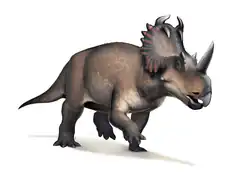
Liaoceratops
| Liaoceratops Temporal range: Early Cretaceous, | |
|---|---|
 | |
| Skull at the Baoding Natural History Museum | |
Scientific classification  | |
| Kingdom: | Animalia |
| Phylum: | Chordata |
| Class: | Reptilia |
| Clade: | Dinosauria |
| Clade: | †Ornithischia |
| Clade: | †Ceratopsia |
| Clade: | †Neoceratopsia |
| Genus: | †Liaoceratops Xu et al., 2002 |
| Type species | |
| Liaoceratops yanzigouensis Xu et al., 2002 | |
Liaoceratops, meaning "Liaoning horned face", is a ceratopsian dinosaur believed to be an early relative of the horned ceratopsids. It lived in the Early Cretaceous, 126 million years ago.[1] It was discovered in China by a team of American and Chinese scientists. Liaoceratops was much smaller than its later relatives, but offers a glimpse into the early evolution of this group of dinosaurs.
Discoveries and naming

Liaoceratops was discovered in the famous Liaoning Province of China, where several fossils of feathered dinosaurs have also been collected. The type species Liaoceratops yanzigouensis was in 2002 named and described by Xu Xing, Peter Makovicky, Wang Xiaolin, Mark Norell and You Hailu.[2] The generic name is derived from Liaoning and the Greek keras, "horn" and ops, "face". The specific name refers to the town Yanzigou.
The holotype IVPP V12738 has been found in the Yixian Formation dating from the Barremian. These beds have also yielded fossil insects, fossils of ginkgo trees, and many other dinosaurs, including the early troodontid Sinovenator, also described by Makovicky later in 2002.[3]
"This area is yielding extremely important information on the evolution of dinosaurs, mammals, insects, and flowering plants. I hope to find even more primitive specimens than Liaoceratops," Peter Makovicky said.
The holotype consists of an almost complete skull. As paratype specimen IVPP V12633 has been referred, the skull of a juvenile. In 2007 another skull, CAGS-IG-VD-002, of an even younger individual was referred. This lacked the skull roof, which has been explained as the result of a predator opening the braincase to eat the contents.[4]
Description and classification

Liaoceratops was a relatively small dinosaur, reaching 50 cm (1.6 ft) in length and 2 kg (4.4 lb) in body mass.[5] The holotype skull measures of 154 millimetres in length, weighing an estimated seven pounds and possessing only jugal horns and a small skull frill, lacking the orbital horns and true neck shield that characterized later ceratopsians.

Palaeobiology
Behavior
As a species of neoceratopsian, Liaoceratops fed on low-growing plants,such as ferns and cycads.[6] Its small frill and jugal horns are hypothesized to possess function for species recognition and visual display rather than active defense.[7]
Liaoceratops inhabited the forest and wetland environments of the Jehol Biota during the Early Cretaceous. Its body coloration is hypothesized to provide camouflage in dense forest habitats, similar to modern herbivores live in forest.

Senses
Because Liaoceratops had large olfactory bulbs for its size, it possessed an excellent sense of smell. Its long semicircular canals and clearly distinguishable floccular lobes suggest that it had an almost horizontal head posture and that it was bipedal. Its short cochlear ducts suggest that Liaoceratops individuals communicated with each other through high frequency vocalisations.[9]
See also
Notes
- ↑ Chang, S.-C.; Gao, K.-Q.; Zhou, Z.-F.; Jourdan, F. (2017). "New chronostratigraphic constraints on the Yixian Formation with implications for the Jehol Biota". Palaeogeography, Palaeoclimatology, Palaeoecology. 487: 399–406. Bibcode:2017PPP...487..399C. doi:10.1016/j.palaeo.2017.09.026.
- ↑ Xu, Xing; Makovicky, Peter J.; Wang, X.; Norell, Mark A. & You, H. (2002). "A ceratopsian dinosaur from China and the early evolution of Ceratopsia". Nature. 416 (6878): 314–317. Bibcode:2002Natur.416..314X. doi:10.1038/416314a. PMID 11907575. S2CID 4322101.
- ↑ Xu, Xing; Norell, Mark A.; Wang, X.-L.; Makovicky, Peter J.; Wu, X.-C. (2002). "A basal troodontid from the Early Cretaceous of China". Nature. 415 (6873): 780–784. Bibcode:2002Natur.415..780X. doi:10.1038/415780a. PMID 11845206. S2CID 4417515.
- ↑ You, H., Tanoue, K., and Dodson, P., 2007, "A new specimen of Liaoceratops yanzigouensis (Dinosauria: Neoceratopsia) from the Early Cretaceous of Liaoning Province, China", Acta Geologica Sinica 81(6): 898-904
- ↑ Paul, Gregory S. (2016). The Princeton Field Guide to Dinosaurs. Princeton University Press. p. 277. ISBN 978-1-78684-190-2. OCLC 985402380.
- ↑ Xu, X., Makovicky, P. J., Wang, X., Xu, X., & You, H. (2002). A ceratopsian dinosaur from China and the early evolution of Ceratopsia. Nature, 415(6872), 652-655.
- ↑ You, H., & Dodson, P. (2004). Basal Ceratopsia. In The Dinosauria (2nd ed.).
- ↑ Xu, X., Makovicky, P. J., Wang, X., Xu, X., & You, H. (2002). A ceratopsian dinosaur from China and the early evolution of Ceratopsia. Nature, 415(6872), 652-655.
- ↑ Yang, Yuqing; Gong, Enpu; Zhao, Cuilin; Wu, Wenhao; Godefroit, Pascal; Hu, Dongyu (3 March 2024). "Endocranial morphology of Liaoceratops yanzigouensis (Dinosauria: Ceratopsia) from Early Cretaceous Jehol Biota of Liaoning in China". Historical Biology. 36 (3): 650–656. doi:10.1080/08912963.2023.2180739. ISSN 0891-2963. Retrieved 18 June 2026 – via Taylor and Francis Online.
External links
| |||||||||||||||||||||||||||||||||
| |||||||||||||||||||||||||||||||||
| |||||||||||||||||||||||||||||||||