Lanoraie
Lanoraie | |
|---|---|
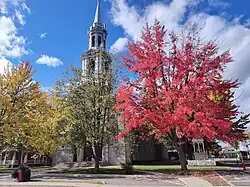 Église Saint-Joseph de Lanoraie, 9 Oct 2022 | |
 Coat of arms | |
| Motto: Ferme est ma foy (French for "Firm is my faith") | |
 Location within D'Autray RCM | |
  Lanoraie Location in central Quebec | |
| Coordinates: 45°58′N 73°13′W / 45.967°N 73.217°W[1] | |
| Country | Canada |
| Province | Quebec |
| Region | Lanaudière |
| RCM | D'Autray |
| Settled | 1732 |
| Constituted | December 6, 2000 |
| Government | |
| • Mayor | André Villeneuve |
| • Federal riding | Berthier—Maskinongé |
| • Prov. riding | Berthier |
| Area | |
• Total | 115.47 km2 (44.58 sq mi) |
| • Land | 102.74 km2 (39.67 sq mi) |
| Population (2021)[3] | |
• Total | 5,134 |
| • Density | 50/km2 (130/sq mi) |
| • Change 2016-21 |  7.2% |
| • Dwellings | 2,199 |
| Time zone | UTC−5 (EST) |
| • Summer (DST) | UTC−4 (EDT) |
| Postal code(s) | |
| Area codes | 450, 579 |
Highways  A-40 |  R-138 |
| Website | www |
Lanoraie (French pronunciation: [lanɔʁɛ]) is a town in the D'Autray Regional County Municipality in the Lanaudière region of Quebec, Canada.
History
When Jacques Cartier passed through in the 16th century, the Iroquois had already established themselves in the area, calling it Agochanda or Agouchonda, meaning "place where one stops to eat and rest". It was also in this area in 1642 that Isaac Jogues was abducted by the Mohawks along with Guillaume Couture and René Goupil, and taken into captivity and tortured.[1]
In 1672, the Intendant of New France Jean Talon granted the territory as a seignory to Louis de Niort de La Noraye (1639-1708). In 1688, the Seignory of La Noraye (also spelled as: Lanauraie, Lanoraie, Noraye) was united with the Autray Seignory, granted in 1637 to Jean Bourdon who passed it on to his son Jacques Bourdon d'Autray in 1653.[1]
Although the Parish of Saint-Joseph-de-Lanoraie was founded in 1732, it did not really begin to develop until 1831. In 1845, this parish was incorporated as the Parish Municipality of Lanoraie, but abolished two years later in 1847, when it became part of the Berthier County Municipality. In 1855, it was reestablished as the Parish Municipality of Saint-Joseph-de-Lanoraie. In 1848, the Municipality of Lanoraie-d'Autray was formed.[1]
On December 6, 2000, the Parish Municipality of Saint-Joseph-de-Lanoraie and the Municipality of Lanoraie-d'Autray were merged to form the new Municipality of Lanoraie.[1]
Demographics
| Year | Pop. | ±% |
|---|---|---|
| 2001 | 3,869 | — |
| 2006 | 4,067 | +5.1% |
| 2011 | 4,447 | +9.3% |
| 2016 | 4,787 | +7.6% |
| 2021 | 5,134 | +7.2% |
| Source: Statistics Canada[3] | ||
Private dwellings occupied by usual residents (2021): 2,123 (total dwellings: 2,199)[3]
Mother tongue (2021):[3]
- English as first language: 1.2%
- French as first language: 95.5%
- English and French as first languages: 1.1%
- Other as first language: 2.1%
Education
The Commission scolaire des Samares operates francophone public schools.
- École de la Source d'Autray[4]
See also

References
- 1 2 3 4 5 "Lanoraie (Municipalité)" (in French). Commission de toponymie du Québec. Retrieved 2009-11-02.
- 1 2 "Répertoire des municipalités: Geographic code 52017". www.quebec.ca (in French). Gouvernement du Québec.
- 1 2 3 4 5 "Lanoraie (Code 2452017) Census Profile". 2021 census. Government of Canada - Statistics Canada. Retrieved 2026-07-15.
- ↑ "de la Source d'Autray Archived 2017-09-23 at the Wayback Machine." Commission scolaire des Samares. Retrieved on September 23, 2017.
External links
 Media related to Lanoraie at Wikimedia Commons
- Official website
Adjacent Municipal Subdivisions | |
|---|---|


| Cities & towns | |
|---|---|
| Municipalities | |
| Parishes | |
| |
