Krishna Raja Sagara
| Krishna Raja Sagara (KRS Dam) | |
|---|---|
 | |
Interactive map of Krishna Raja Sagara (KRS Dam) | |
| Country | India |
| Location | Mandya, Karnataka |
| Coordinates | 12°25′29″N 76°34′20″E / 12.42472°N 76.57222°E |
| Purpose | Water supply, irrigation |
| Status | Operational |
| Construction began | 1911 |
| Opening date | 1932 |
| Construction cost | ₹10.34 million (US$110,000)[1] |
| Operator | Cauvery Neeravari Nigam Limited |
| Dam and spillways | |
| Type of dam | Gravity dam |
| Impounds | Kaveri River |
| Height | 39.8 m (131 ft) |
| Length | 2,620 m (8,600 ft) |
| Reservoir | |
| Creates | Krishna Raja Sagara |
| Total capacity | 1,368,847,000 m3 (1,109,742 acre⋅ft) |
| Active capacity | 124,421,000 m3 (100,870 acre⋅ft) |
| Catchment area | 10,619 km2 (4,100 sq mi) |
| Surface area | 129 km2 (50 sq mi) |
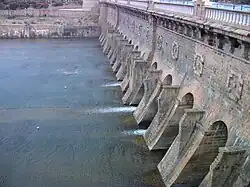
Krishna Raja Sagara, also known as KRS and, locally, as Kannambadi Katte, is a lake and the dam that forms it. Both sit near the settlement of Krishna Raja Sagara in the Indian State of Karnataka. The gravity dam, built of surki mortar, stands just below where the river Kaveri meets its tributaries Hemavati and Lakshmana Tirtha, in Mandya district.[2]
Krishna Raja Wadiyar IV, Maharaja of Mysore, sanctioned the dam's construction during a period of famine, when the state treasury was already under strain, and it was named after him.[3] Getting the dam built, and agreeing on the terms under which it could be built, took decades of negotiation between the Kingdom of Mysore and the Madras Presidency over rights to the Kaveri's water. In a modified form, that dispute still runs between the successor states of Karnataka and Tamil Nadu today. An ornamental garden, Brindavan Gardens, adjoins the dam.[4]
Background
Mysore, and Mandya in particular, had always been dry country, and summers regularly pushed people to migrate to wetter areas nearby. A severe drought in 1875–76 killed off a fifth of the population of the Kingdom of Mysore, and crop failures kept recurring for want of irrigation water.[5] The Kaveri was the obvious candidate to change that. An earlier attempt already existed as a model: the Marikanive project, begun in 1897 under Diwan K. Seshadri Iyer and Queen-Regent Kempananjammanni Devi, had shown that the state could fund and build a reservoir of its own.[6]
But any major new works on the Kaveri needed the consent of the downstream Madras Presidency, under an agreement signed in 1892 (see below), and getting that consent turned out to be the real obstacle standing between Mysore and its dam.
Survey and plan
Mysore's first chief engineer for the project, Captain Dawes, drowned in the Kaveri in 1909 while surveying the proposed site near Kannambadi village.[7] The Diwan at the time, T. Ananda Rao, then brought in Sir M. Visvesvaraya as Chief Engineer and Secretary to the Government; Visvesvaraya took up the post on 15 November 1909.[8] Drawing on his earlier work surveying large dams, including the Aswan Dam in Egypt, and on reservoir designs he'd done in the Bombay Presidency and Hyderabad, Visvesvaraya drew up the design for the Kannambadi reservoir.[9] He ran into resistance from Mysore's own finance ministry, who argued the project would "serve no purpose" and that any electricity it generated would go largely unused for lack of demand. He took his case to Ananda Rao and to the Maharaja, Krishna Raja Wadiyar IV.[10] The Maharaja agreed, and on 11 October 1911 issued the order to begin, setting aside ₹81 lakh (a sum that later grew to about ₹1.03 crore).[11]
Visvesvaraya's promotion to Diwan, and his successor as Chief Engineer
Ananda Rao served as Diwan of Mysore from 1909 to 1912. When his term ended, Visvesvaraya moved up from Chief Engineer to become the 19th Diwan, a post he held until 1918.[12][13] That left the Chief Engineer's chair empty, right in the middle of the still-unresolved Kaveri Reservoir Project. Visvesvaraya's choice to fill it was Karpur Srinivasa Rao, at the time a Superintending Engineer in the Bombay Presidency's Public Works Department and an old colleague of his there. Visvesvaraya later wrote about the decision himself: "I moved the Mysore Government to obtain the services of Mr. Karpur Srinivasa Rao, then a Superintending Engineer in the Bombay Service, as Chief Engineer of the State. He was a senior colleague of mine in the Bombay P.W.D. and a man of transparent sincerity."[14] A separate account from the time puts it more plainly still: "when Sir M. Visweswarayya was made Dewan, Karpur Srinivasa Rao was appointed Chief Engineer in Mysore."[15] Srinivasa Rao took charge as Chief Engineer in November 1912. His appointment was formally gazetted the following year, in Mysore Gazette Notification No. 412 (July 1913), which states it came "at the instance of the Dewan, Sir M. Visvesvaraya, for the execution of the Kaveri Reservoir Project."[16] The two men went on working together as Diwan and Chief Engineer through the Griffin arbitration and the construction years that followed. When Visvesvaraya pushed to have the Kannambadi dam's budget raised at a 1913–14 conference of the Mysore Representative Assembly, it was Srinivasa Rao, as the kingdom's chief engineer, who supplied the figures behind that push.[17]
The Madras Presidency objected to the scale of the project. It had its own plans for a much larger dam at Mettur, and it refused to consent to the reservoir Mysore initially proposed: about 41.5 TMC ft, held behind a dam roughly 194 feet high. Referred to the Government of India, Mysore ended up with permission for a far smaller first stage of about 11 TMC ft.[18][19] Construction went ahead anyway on foundations built for the larger design, which reopened Madras's objections and pushed both sides toward arbitration.[18] The Government of India appointed H. D. Griffin, a judge of the Allahabad High Court, to arbitrate. Proceedings in what became known as the Kannambadi Arbitration Case opened in July 1913, and Griffin's award, delivered on 12 May 1914, let Mysore build the dam to its full designed height of 124 feet, holding roughly 41.5 to 44.8 TMC ft.[19][18]
It was in this same period — the gazetted appointment came "at the instance of the Dewan, Sir M. Visvesvaraya, for the execution of the Kaveri Reservoir Project" — that Karpur Srinivasa Rao became Chief Engineer of Mysore State, holding the post from November 1912 to June 1917.[16] Srinivasa Rao's own Promotion Recommendation Roll, kept at the Karnataka State Archives, records that in 1913 he was placed on special duty "to represent the Mysore Government before the Court of Arbitration appointed by the Government of India" — that is, the Griffin arbitration just described — in the dispute between Mysore and Madras over the Kaveri.[20] The arbitration didn't fully settle things, and after he retired in 1923 Srinivasa Rao was pulled back in, leading the Mysore technical team, alongside Chief Engineer Cadambi, through further talks with Madras officials at Fort St. George between 1921 and 1924. Those talks fed directly into the 1924 Agreement.[21] A separate biographical sketch credits him, too, with "conducting important negotiations with the Madras Government" over the dam.[22] He stayed on to run the department through the years the dam's foundations and lower courses went up, including the wartime cement shortage described below.
Funding: the royal family's personal contribution
Popular and heritage-tourism accounts often repeat a story that members of the Mysore royal family sold their own jewelry to help pay for the dam when state finances came under pressure, though the sources don't agree on exactly who did it. Several credit Maharani Kempananjammani, the queen-regent, who by the time construction began in 1911 had already stepped down from the regency but remained an influential figure at court.[23] A 2025 news report quotes a Mysore royal-family member attributing the sale jointly to "the Maharaja's mother Rajmata Kempa Nanjammanni and his wife Pratap Kumari," prompted by the finance ministry's objections to the project's cost.[7] Yet another heritage account credits the Maharaja himself with selling jewelry from the royal treasury to cover a shortfall.[24] [a]
Cauvery water-sharing agreements
The dam's construction, its height, and how it's operated have all been shaped by a long sequence of agreements, and later tribunal and court rulings, between Mysore (later Karnataka) and Madras (later Tamil Nadu).
- 1892 Agreement
Signed between the Madras Presidency and the Kingdom of Mysore. It established that Mysore, as the upstream state, needed Madras's consent before it could undertake any major new irrigation works on the Kaveri.[25]
- 1913–1914 Griffin Arbitration
As described above, H. D. Griffin's award of 12 May 1914 let Mysore build the KRS dam to its full planned height and capacity, over Madras's continuing objections.[19]
- 1924 Agreement
A more thorough, fifty-year agreement between Mysore and Madras. It formally permitted construction of the KRS dam, by this point largely built, alongside the Madras government's Mettur dam, and it laid out detailed water-sharing and irrigated-acreage terms for both sides.[25][26] A supplementary agreement in 1929 pinned down the exact quantities of water to be released to Madras.[27]
- Karpur Srinivasa Rao's role in the 1924 negotiations
Karpur Srinivasa Rao had already represented Mysore before the 1913–14 Griffin arbitration as Chief Engineer. After he retired in 1923, he was called back to lead the Mysore Government's technical delegation for the negotiations that produced the 1924 Agreement. Together with the sitting Chief Engineer, Cadambi, he led the Mysore team through meetings at Fort St. George, Madras, between 1921 and 1924, facing a Madras delegation led by W. J. Howley, K. Srinivas Iyengar (later Vice-Chancellor of Madras University), and C. P. Ramaswami Iyer. T. Ramakrishnan's 2024 history of the dispute, published by The Hindu Group, confirms his presence at these talks independently: "apart from Cadambi, Mysore was represented by Karpur Srinivasa Rao, former Chief Engineer."[21] What the agreement actually produced was technically sophisticated: a set of "Rules of Regulation" and Gauging Tables that fixed the Full Reservoir Level at 124.80 feet and storage capacity at 44.827 TMC ft, while guaranteeing flow rights to the lower Cauvery delta. S. Guhan's standard scholarly history of the dispute calls this a genuine achievement of inter-state water diplomacy, and its principles still shape Cauvery water-sharing calculations today.[28]
A family memoir by Srinivasa Rao's grand-nephew, Hari Rao R. Chaturvedi, goes further. Written from direct family knowledge though never independently published or peer-reviewed, it says Srinivasa Rao was chosen to lead the delegation specifically for his mathematical and statistical ability, and for his detailed grasp of the Cauvery basin's flow patterns, its seasonal swings between flood and lean months, and Mysore's irrigation and power needs. It also says Visvesvaraya relied on data and analysis Srinivasa Rao had prepared for earlier technical submissions.[29] [b]
In recognition of his service, Srinivasa Rao received the honorific title Rajasabhabhushana from Maharaja Krishna Raja Wadiyar IV. An independent biographical sketch describes this as recognition for his "meritorious service to the State in constructing the Kannambadi Dam and in conducting important negotiations with the Madras Government" generally, rather than tying it specifically to the 1924 settlement.[30] The Chaturvedi family memoir adds that Cadambi received the same title alongside Srinivasa Rao, specifically for the successful 1924 Cauvery Agreement.[31] [c]
- 1974
- lapse of the 1924 Agreement
The 1924 agreement's fifty-year term ran out in 1974. Karnataka, as Mysore state had by then been renamed and reorganised, treated the agreement as lapsed and began new irrigation and reservoir projects on the Kaveri. Tamil Nadu held that the agreement's terms still defined its entitlement. That disagreement became the modern Cauvery water dispute.[32]
- 1990–2007
- Cauvery Water Disputes Tribunal
In 1990 the Government of India set up the Cauvery Water Disputes Tribunal (CWDT) under the Interstate River Water Disputes Act, 1956. Its 1991 interim award, directing Karnataka to release specified quantities of water to Tamil Nadu, set off widespread protests in both states.[32] Seventeen years of hearings later, the CWDT handed down its final award on 5 February 2007. It upheld the 1892 and 1924 agreements as valid and put the basin's total usable water at 740 TMC ft.[33]
- 2018
- Supreme Court verdict and the Cauvery Water Management Authority
On 16 February 2018, the Supreme Court of India partly revised the CWDT's final award and declared the Kaveri a "national asset." Citing, among other things, Bengaluru's growing need for drinking water, the Court raised Karnataka's allocation by 14.75 TMC ft, while lowering the amount Karnataka had to guarantee at the Biligundlu gauging point from 192 to 177.25 TMC ft in a normal year.[34] The Central Government then set up the Cauvery Water Management Authority (CWMA) in June 2018 to carry out the verdict, keep track of reservoir levels across the basin, and coordinate monthly releases among Karnataka, Tamil Nadu, Kerala, and Puducherry, working alongside the Cauvery Water Regulation Committee (CWRC).[32]
- Ongoing implementation disputes
Even with the legal framework settled in 2018, month-to-month disputes over how it's carried out have kept coming, especially in years of poor monsoon rainfall, and KRS releases remain the flashpoint. In 2023 the CWMA repeatedly ordered Karnataka to release several thousand cusecs a day to Tamil Nadu, and farmers protested around the dam.[35][36] In July and August 2026, with the monsoon running weak, the CWRC and CWMA again ordered Karnataka to release water, first 3,500 and later 12,000 cusecs a day, to Tamil Nadu. Karnataka argued it couldn't fully comply given shortfalls in its own command area, farmer and Kannada organisations protested at the dam site, and the Supreme Court told Karnataka to comply with the CWMA's order. Separately, in November 2025, the Court dismissed a Tamil Nadu attempt to stop the Authority from even discussing Karnataka's proposed Mekedatu project.[37][38]
Construction
Construction began in November 1911. Ten thousand workers were employed.[10]
The wartime cement crisis and Srinivasa Rao's improvisation
When the First World War broke out in 1914, it hit the dam's construction in a very specific way. India's own Portland cement industry barely existed at the time: total domestic output in 1914 came to only about 945 tonnes, all of it from a single factory in Madras, so builders across the country still depended almost entirely on cement shipped in from Britain.[39] Wartime shipping shortages made those imports "rapidly dwindle" right as domestic wartime demand for cement, much of it for military use, was climbing. Major civil projects like the Kannambadi reservoir suddenly found themselves cut off from their usual supply of binder, just as work on the dam's main masonry was getting underway.[40][41]
As Chief Engineer, Karpur Srinivasa Rao had to find a way around it. Rather than stop or slow construction, the Mysore PWD switched to surki mortar, a mix of hydrated lime and finely ground burnt-brick powder, as a wholesale substitute for Portland cement in the dam's masonry.[42][10] Surki wasn't just filler standing in for sand. Ground burnt brick is rich in reactive silica and alumina, so mixed with lime it triggers a genuine pozzolanic reaction, producing cementitious calcium-silicate compounds in much the same chemical family that gives ordinary cement its strength. Modern materials-science testing bears this out: the pozzolanic reaction adds strength, cuts shrinkage, and improves resistance to water penetration compared with plain lime mortar, though the mortar's final strength depends heavily on how finely the brick is ground and how well, not over- or under-, it was fired to begin with.[43] The technique wasn't new to Mysore: Visvesvaraya had already used surki masonry at the Vani Vilasa Sagara (Marikanive) dam a decade before. But its use at KRS was on a much bigger scale, and most of what stands today as the world's largest all-surki gravity dam went up with almost no imported Portland cement at all.[44] More than a century on, the dam's surki masonry is still structurally sound and in continuous service, a working demonstration that a properly proportioned, well-cured lime-pozzolan mortar can hold up over the long term about as well as Portland-cement concrete in a mass gravity dam. Engineering writers still point to KRS as an early-20th-century landmark of large-scale surki construction.[45][d]
By the time construction wrapped up in 1931, somewhere between 5,000 and 10,000 people had lost their homes to the project. The government rehabilitated them and gave them agricultural land nearby.[10]
Operation
Instead of the spillways that most dams use to stop water topping the dam, Visvesvaraya fitted 48 automatic gates, in six sets of eight, that open and close on their own as the reservoir rises and falls. Each gate is made up of a sill, lintel, side grooves and plates, a balance weight, a float, chains and pulleys, and inlet and outlet pipes. The gates themselves are cast iron, manufactured at the Visvesvaraya Iron and Steel Plant in Bhadravati.[46]
Each set of eight gates connects, via chains and pulleys, to a dead weight, which in turn connects to a float; together they form the "balance weight," working inside a masonry well at the rear of the dam. The deadweight and float sit one behind the other, four gates to each side. When all eight gates close the sluice, the balance weight rises to the top of its swing and the float sinks to the bottom of the well. An inlet pipe, 1 ft (0.30 m) across, lets water into the well from the reservoir once it reaches the maximum permissible level; that raises the float, drops the balance weight, and pulls the gates open to let water out. The same well empties out through an exit pipe once the reservoir level falls again.[46]
Today the dam's outflow is measured downstream at the Biligundlu gauging station on the Karnataka–Tamil Nadu border, which is what the CWMA and CWRC use to check compliance with the Supreme Court's 2018 water-sharing formula. Officials say water released from KRS takes roughly 48 hours to reach Biligundlu.[47]
Dam
The foundation stone was laid on 11 November 1911, and construction proper began that same month.[10] Sources don't fully agree on when it was finished. Most, including a 2025 report citing Mysuru historians, say the dam itself was built by 1931,[7][10] while the formal inauguration came in 1932[48] — the year usually given as its "opening" — and the adjoining Brindavan Gardens, begun in 1927, weren't finished until 1932 either.[49] This article's infobox and categories go with the more commonly cited 1932 inauguration date, though readers should know the underlying masonry was largely finished a year earlier.[e] The dam sits across the Kaveri near Kannambadi village; construction ran through the 1910s and 1920s alongside the water-sharing negotiations described above.[10] It's the main water source for Mysore and Mandya districts, and it's the principal source of drinking water for Mysore, Mandya, and nearly all of Bengaluru; roughly 2.1 TMC ft goes out from KRS each month to Bengaluru, Mysuru, Mandya, and other districts.[50][51] Water released from the dam flows on into Tamil Nadu and is stored at the Mettur dam in Salem district.[52]
The dam irrigates more than 100,000 acres in the Mysore and Mandya region, and it also underpinned the growth of the Mysore sugar industry.[53]
Brindavan Gardens
Brindavan Gardens is a show garden below the dam, with a botanical park, fountains, and boat rides. Maharaja Jayachamarajendra Wadiyar had it built, and the German botanist Gustav Hermann Krumbiegel designed it.[54]
Diwan Sir Mirza Ismail of Mysore planned and built the gardens alongside the dam. KRS was among the first dams anywhere to install automated crest gates, in 1920, under British chief engineer Sir Erwin. Its attractions include a musical fountain, and various biological research departments are based there too.
Significance today: why the 1913–14 height decision still matters
Winning the fight for the dam's full designed height, 124.80 feet and roughly 49.45 TMC ft of gross storage, rather than settling for the 11 TMC ft first allowed, wasn't just a historical footnote to the Griffin arbitration and the 1924 Agreement. That extra storage is what lets the reservoir do everything it does today for irrigation, drinking water, power generation, and flood control. A dam built to the smaller original allowance would hold only a fraction of today's water, nowhere near enough for the uses below.
- Irrigation
The KRS project irrigates roughly 339,136 acres across Mysuru and Mandya districts today, on a seasonal rotation, an "18 days on, 12 days off" cycle for sugarcane, for example, coordinated by the Irrigation Consultative Committee.[55]
- Drinking water
Together with the Kabini reservoir, KRS supplies drinking water to Bengaluru city, Mysuru city, and a reported 47 towns and 625 villages across the Cauvery basin.[56] Officials put the region's combined drinking-water need at roughly 3 TMC ft a month, around 300 cusecs a day for Bengaluru and 150 cusecs a day for Mysuru, which works out to something like 9 TMC ft of stored water needed to get through a typical three-month dry spell.[57][58] A reservoir capped at the original 11 TMC ft would leave almost no cushion for that demand once irrigation and power needs were also drawn from it.
- Hydroelectric power
Water released from KRS flows on down into the Shivanasamudra hydroelectric station, commissioned in 1902 as Asia's first hydroelectric power plant. It once supplied the Kolar Gold Fields and, in 1905, made Bengaluru the first Indian city with electric street lighting. Its ten turbines add up to 42 MW of installed capacity and a yearly generation target of around 225 million units, though what it actually produces depends heavily on how much water is left over from KRS and Kabini after drinking-water and irrigation needs are met. In drought years, generation has fallen to as little as 20 million units in a bad summer, which shows just how directly the reservoir's storage limits power output downstream.[59]
- Flood moderation
The reservoir's storage also gives operators some room to catch monsoon peak flows and release them in stages, instead of letting a whole flood pass downstream at once. That role has real limits, though: in years of very heavy inflow, the dam has still had to open its gates and release tens of thousands of cusecs, and the Central Water Commission and Cauvery Neeravari Nigam Limited have had to issue downstream flood alerts and close riverside areas around Srirangapatna when inflow got close to or exceeded what the dam could release.[60][61] Still, the larger, 124.80-foot design gives Cauvery Neeravari Nigam a good deal more room to absorb and stagger a flood pulse than the 11 TMC ft design ever would have, even if it can't rule out downstream flooding in an extreme year.
Transformation of the land and rural prosperity
Both contemporary and present-day accounts describe the dam's completion as a turning point for the Mandya–Mysuru region's farm economy, though the sourcing here is qualitative and institutional rather than a rigorous statistical record. No pre-1932-versus-post-1932 series on acreage, yield, or income turned up in this research, and readers should weigh the claims below with that in mind.
Before the dam, farming in the region was almost entirely rain-fed. Villagers interviewed by the long-form journalism outlet Fifty Two in 2019 recalled that their ancestors could only grow drought-tolerant, low-value rain-fed crops such as ragi (finger millet) and maize, and that families switched to higher-value irrigated crops, rice and sugarcane, only once canal water from the KRS project reached their fields.[62] That matches the severity of the pre-dam drought conditions described earlier: the 1875–76 famine alone reportedly killed off a fifth of the kingdom's population, and crop failures kept recurring into 1900.[63]
The Karnataka government's own tourism and district-administration material describes irrigation from the KRS reservoir "during the 1930s" as producing a "substantially marked transformation in cropping pattern" and "better grown yield level, ultimately leading to better economic conditions of the people," and says the district's main cash crop became sugarcane, giving Mandya its lasting nickname "Sakkare Nagara," Sugar City, in Kannada.[64][65] There's a concrete marker of that shift: the Mysore Sugar Company, the state's first sugar factory, opened at Mandya on 30 January 1933, within a year of the dam's completion, built directly on the strength of the cane-growing capacity the reservoir now made possible. The district is still widely known by the "Sugar City" name today.[66]
A 2020s academic overview of early-20th-century agricultural development in Mysore State likewise credits the KRS Dam with making reliable irrigation possible for paddy, sugarcane, and other cash crops in Mandya, with crop diversification away from rain-fed farming, and with "economic growth in the region, improving the livelihoods of farmers."[67] Present-day government figures show how far that's gone: of Mandya district's roughly 248,825 hectares of sown land, about 116,901 hectares are irrigated, and about 88,000 of those hectares draw directly from the KRS reservoir, with most of the rest coming from the Hemavathi reservoir and local tanks, wells, and borewells.[64]
Current status
As of 2026, the KRS reservoir runs under the framework the Supreme Court set in 2018, administered by the CWMA and CWRC. Water levels rise and fall through the year against a full reservoir level of 124.80 feet, and monthly releases get split among drinking water, irrigation, and Tamil Nadu's downstream share.[68] Karnataka's proposal for a new balancing reservoir downstream at Mekedatu, meant partly to shore up Bengaluru's drinking-water supply, remains contested by Tamil Nadu; as of late 2025 it sits before the CWMA and the Supreme Court, unresolved.[69]
Gallery
The images below, all on Wikimedia Commons, show the dam, the gardens, and the main historical figures behind its construction. Where no verified photograph of a figure could be found on Commons, that's noted below rather than guessing at a file.
 Maharaja Krishna Raja Wadiyar IV of Mysore, circa 1902, who sanctioned the dam
 Sir M. Visvesvaraya, Chief Engineer of Mysore (1909–1912) and later Diwan, who designed the dam
 Karpur Srinivasa Rao, Chief Engineer of Mysore (1912–1917), who oversaw much of the dam's construction
 The principal officers' plaque at the KRS Dam entrance gate, recording the chief engineers and other officers who oversaw the dam's design and construction
 Maharani Kempananjammanni Devi (Vani Vilasa Sannidhana), the queen-regent and dowager credited in several sources with helping fund the dam through the sale of personal jewelry (see above)
 Maharani Lakshmivilasa Sannidhana Sri Pratapa Kumari Ammani, consort of Krishna Raja Wadiyar IV, the other royal woman named in some accounts of the jewelry-funding tradition (see above); photographed by Barton, Son & Co., Bangalore, 1900
 Brindavan Gardens by day, adjoining the dam
 Brindavan Gardens' illuminated musical fountains at night
Flora and fauna

The area around the dam mixes farmland, villages, scattered trees, and pockets of original vegetation near the Ranganathittu Bird Sanctuary, which draws large numbers of both local and migratory birds. Close to 220 species[70] have been recorded here.
See also
Notes
- ↑ This episode turns up again and again across independent heritage and tourism sources, but no early-twentieth-century archival source or scholarly history has yet turned up to confirm who exactly was involved, how much was raised, or when. It's treated here as popular tradition, not documented fact, which is how most of the sources that repeat it treat it too.
- ↑ This specific claim — that Srinivasa Rao personally worked out the flow and storage figures used to justify the dam's final height and capacity to Madras — comes only from this family memoir. The independently published sources used in this research (Ramakrishnan 2024, Guhan 1993) confirm he led the Mysore delegation and that the resulting technical framework was hydrologically sophisticated, but neither one credits him by name with the underlying calculations. The flow-computation story should be read as a family account, not an independently confirmed historical fact, unless an independent published source turns up to back it.
- ↑ The only independently published source found for the Rajasabhabhushana title (Dakshini MarathiAdda) confirms Srinivasa Rao's award alone, and frames it around his overall service record rather than the 1924 Agreement specifically. That Cadambi received the same title, and that both awards were tied to the 1924 negotiations specifically, comes only from the Chaturvedi family memoir. A search was made for the Mysore Gazette's July–December 1924 volume (reportedly Notification No. 112), which would settle the question with an independent primary source, but no digitised copy could be found online — the same gap noted in earlier research toward the Karpur Srinivasa Rao Wikipedia article, where this claim was likewise kept but sourced only to the Chaturvedi manuscript. The Cadambi/1924 detail should be read as family-sourced until the Gazette notification, or some other independent record, surfaces.
- ↑ The claim that KRS is the "largest" surki-mortar structure of its kind turns up repeatedly in tourism and heritage sources, but it hasn't been checked here against an actual engineering survey; it's included as a commonly repeated description rather than a rigorously sourced superlative.
- ↑ An earlier version of this article carried the categories "Dams completed in 1938" and "1938 establishments in India." Nothing turned up in this research to support a 1938 date; every source found gives either 1931 (construction complete) or 1932 (formal inauguration). The 1938 date looks like an error and has been corrected to 1932, matching the infobox's "opening" field and most secondary sources.
- ↑ This image is identified as Maharani Kempananjammanni Devi (Vani Vilasa Sannidhana) based on the Wikimedia Commons filename and the corresponding Wikidata entry (Q6387033), which links the image to her Wikipedia article and names the child pictured as her grandson Jayachamarajendra Wadiyar.
References
- ↑ K. R., Rajendrakumar (12 October 2011). "Centenary milestone for KRS dam". The Times of India. Archived from the original on 9 March 2017. Retrieved 9 March 2017.
- ↑ Jain, Sharad K.; Agarwal, Pushpendra K.; Singh, Vijay P. (16 May 2007). Hydrology and Water Resources of India. Springer Science & Business Media. p. 715. ISBN 978-1402051807. Retrieved 9 March 2017.
- ↑ "Watch: KRS dam lights up in tricolour as Karnataka releases 80,000 cusecs of water to Tamil Nadu". 19 July 2018.
- ↑ "Brindavan Garden (KRS-Krishna Raja Sagar)".
- ↑ Misra, Rameshwar Prasad (1985). Development Issues of Our Time. Concept Publishing Company. p. 145. Retrieved 9 March 2017.
- ↑ "This Mysuru Queen Sold Jewellery to Supply Water to Millions". The Better India. 21 December 2020. Retrieved 19 August 2026.
- 1 2 3 Nandakumar, Prathima (5 August 2025). "Who built Krishna Raja Sagara dam? Congress minister's Tipu Sultan claim on KRS dam draws flak". The Week. Retrieved 19 August 2026.
- ↑ Visvesvaraya, M. (1951). "Work as Chief Engineer, Mysore — excerpts from Chapter VI, Memoirs of My Working Life". Indian Academy of Sciences. Retrieved 19 August 2026.
- ↑ Visvesvaraya, M. (1951). "Work as Chief Engineer, Mysore — excerpts from Chapter VI, Memoirs of My Working Life". Indian Academy of Sciences. Retrieved 19 August 2026.
- 1 2 3 4 5 6 7 Bharathi, C. (2012). M. Visvesvaraya. Sapna Book House Pvt. Ltd. ISBN 9788128017810. Retrieved 9 March 2017.
- ↑ "Sir M Visveshwaraya: Engineer and the foremost Diwan of Mysore" (PDF). International Journal of Creative Research Thoughts (IJCRT). Retrieved 19 August 2026.
- ↑ "Dewan with a difference". Deccan Herald. Retrieved 19 August 2026.
- ↑ "Sir M Visveshwaraya: Engineer and the foremost Diwan of Mysore" (PDF). International Journal of Creative Research Thoughts (IJCRT). Retrieved 19 August 2026.
- ↑ Visvesvaraya, M. (1951). Memoirs of My Working Life. Delhi: Publications Division, Ministry of Information and Broadcasting.
- ↑ "Rajabhasha Bhushana Karpur Srinivasa". Dakshini MarathiAdda. Retrieved 19 August 2026.
- 1 2 "Notification No. 412". Mysore Gazette. Bangalore: Government of Mysore. July 1913.
- ↑ "Karpura Srinivasa Rao (Part 1)". Prekshaa. Retrieved 19 August 2026.
- 1 2 3 "Unraveling the century-old Cauvery river dispute: A saga of water sharing and legal battles". The South First. 25 August 2023. Retrieved 19 August 2026.
- 1 2 3 "Cauvery river dispute UPSC note". Learnerz IAS. 21 February 2024. Retrieved 19 August 2026.
- ↑ "Promotion Recommendation Roll". General and Revenue Secretariat. Bangalore: Government of Mysore. 1913–1914. G.M. File No. 249.
- 1 2 Ramakrishnan, T. (2024). Cauvery: A Long-Winded Dispute. Chennai: The Hindu Group. p. 33. ISBN 9789393875969.
- ↑ "Rajabhasha Bhushana Karpur Srinivasa". Dakshini MarathiAdda. Retrieved 19 August 2026.
- ↑ "This Mysuru Queen Sold Jewellery to Supply Water to Millions". The Better India. 21 December 2020. Retrieved 19 August 2026.
- ↑ "Krishnarajasagara Dam: A Maharaja's Gift to his People". Live History India. 15 September 2022. Retrieved 19 August 2026.
- 1 2 "Cauvery Water Dispute: Tribunal, 2018 SC Verdict, CWMA". Anantam IAS. Retrieved 19 August 2026.
- ↑ "Cauvery Water Dispute: All You Need To Know About Supreme Court Verdicts". Outlook India. 18 January 2024. Retrieved 19 August 2026.
- ↑ "Cauvery Water Policy Plan for Sustainable Agricultural and Domestic Usage". International Journal of Engineering Research & Technology (IJERT). 12 May 2021. Retrieved 19 August 2026.
- ↑ Guhan, S. (1993). The Cauvery River Dispute: Towards Conciliation. Madras: Frontline Publications.
- ↑ Hari Rao R. Chaturvedi, unpublished family memoir on Karpur Srinivasa Rao (c. 2020), cited by family descendants as a primary source for this and related biographical detail; not independently published or peer-reviewed.
- ↑ "Rajabhasha Bhushana Karpur Srinivasa". Dakshini MarathiAdda. Retrieved 19 August 2026.
- ↑ Chaturvedi, Hari Rao R. (2020). Rajasabhabhushana Sri Karpur Srinivasa Rao: To My Knowledge (Unpublished manuscript).
- 1 2 3 "Cauvery Water Dispute, History, SC Verdict & Latest News". Vajiram & Ravi. Retrieved 19 August 2026.
- ↑ "Cauvery Water Dispute: All You Need To Know About Supreme Court Verdicts". Outlook India. 18 January 2024. Retrieved 19 August 2026.
- ↑ "From 1892 to 2026: The complete timeline of the Cauvery water dispute". Retrieved 19 August 2026.
- ↑ "Cauvery Water Dispute: Supreme Court Refuses To Intervene With Orders Directing Karnataka To Release Water To Tamil Nadu". Outlook India. Retrieved 19 August 2026.
- ↑ "Let the govt give us water or give us poison: Karnataka farmers protest releasing Cauvery waters to Tamil Nadu". Deccan Herald. Retrieved 19 August 2026.
- ↑ "Kaveri River Dispute 2026: Politics, Mekedatu & Water Crises Explained". India Water Portal. Retrieved 19 August 2026.
- ↑ "Cauvery row: Karnataka says no KRS water was released to Tamil Nadu". PTI. 15 August 2026. Retrieved 19 August 2026.
- ↑ "Cement Industry in India". Economics Discussion. Retrieved 19 August 2026.
- ↑ "Cement Industry in India". Economics Discussion. Retrieved 19 August 2026.
- ↑ "Cement: A Brief History" (PDF). IJARSCT. Retrieved 19 August 2026.
- ↑ History of the Mysore Public Works Department (1856–1956). Bangalore: Government Press. 1956. p. 115. OCLC 569234854.
- ↑ "Experimental Investigation of Compressive and Flexural Strength of Lime-Surkhi Mortar". Retrieved 19 August 2026.
- ↑ "Introduction to Sand, Lime and Surkhi on Construction". Retrieved 19 August 2026.
- ↑ "KRS Dam: History, Facts, Architecture & Importance". Retrieved 19 August 2026.
- 1 2 Rao, A. V. Shankara (May 2002). "Mokshagundam Visvesvaraya: Engineer, Statesman Planner". Indian Academy of Sciences. Retrieved 9 March 2017.
- ↑ "Cauvery Water Row: Supreme Court Directs Karnataka To Comply With CWMA Water Release Order for Tamil Nadu". Dynamite News. Retrieved 19 August 2026.
- ↑ "Krishna Raja Sagara (KRS) Dam History, Entry Fee, Storage Capacity and Flow Data". Oneindia. Retrieved 19 August 2026.
- ↑ "Krishna Raja Sagara Dam, Karnataka: Location, Timings, Best Time to Visit & Nearby Places". Journal Column. 20 May 2026. Retrieved 19 August 2026.
- ↑ "Watch: KRS dam lights up in tricolour as Karnataka releases 80,000 cusecs of water to Tamil Nadu". The Financial Express. 19 July 2018. Retrieved 29 August 2018.
- ↑ "Cauvery water reserved only for drinking water needs: Minister N Chaluvarayaswamy". Deccan Herald. Retrieved 19 August 2026.
- ↑ "Mettur dam hits full level". Deccan Herald. 11 August 2018. Retrieved 29 August 2018.
- ↑ "Krishnarajasagara Dam: A Maharaja's Gift to his People". Live History India. 15 September 2022. Retrieved 19 August 2026.
- ↑ Star of Mysore. "Brindavan Gardens' designer Krumbiegel's great-granddaughter in Mysuru".
- ↑ "Water release for sugarcane crops from May 12 in Mysuru region". Newskarnataka. 4 May 2026. Retrieved 19 August 2026.
- ↑ "KRS, Kabini levels can meet summer demand". Deccan Herald. Retrieved 19 August 2026.
- ↑ "KRS dam: Water level depletes to below 100-ft". Crystal Green India. 17 April 2026. Retrieved 19 August 2026.
- ↑ "KRS, Kabini levels can meet summer demand". Deccan Herald. Retrieved 19 August 2026.
- ↑ "Turbine overhaul at Shivanasamudra". Star of Mysore. Retrieved 19 August 2026.
- ↑ "Roads connecting River Cauvery closed due to flood-like situation". Deccan Herald. Retrieved 19 August 2026.
- ↑ "Heavy discharge from KRS; flood alert issued". Deccan Herald. Retrieved 19 August 2026.
- ↑ "Reservoir Gods". Fifty Two. Retrieved 19 August 2026.
- ↑ "Krishnarajasagara Dam: A Maharaja's Gift to his People". Live History India. 15 September 2022. Retrieved 19 August 2026.
- 1 2 "Agriculture". Mandya District, Government of Karnataka. Retrieved 19 August 2026.
- ↑ "Best Places to visit in Mandya District". Karnataka Tourism. Retrieved 19 August 2026.
- ↑ "Mysore Sugar Company Limited". The Company Check. Retrieved 19 August 2026.
- ↑ Mallaiah, N. (2023). "Agricultural Development In Mysore State: Early 20th Century". Educational Administration: Theory and Practice. 29 (4): 2441–2447. doi:10.53555/kuey.v29i4.7155. Retrieved 19 August 2026.
- ↑ "Water released from KRS dam, farmers continue protests in Karnataka". Deccan Herald. Retrieved 19 August 2026.
- ↑ "Kaveri River Dispute 2026: Politics, Mekedatu & Water Crises Explained". India Water Portal. Retrieved 19 August 2026.
- ↑ "Mysore Nature - Bird Checklist".
External links

- Krishnarajasagara Reservoir Project at Karnataka Water Resources Department
- Mysore Nature|KRS for birders
- Kaveri
- Dams in Karnataka
- Kingdom of Mysore
- Hydroelectric power stations in Karnataka
- Reservoirs in Karnataka
- Dams on the Kaveri
- Buildings and structures in Mandya district
- Tourist attractions in Mandya district
- Geography of Mandya district
- Dams completed in 1932
- 1932 establishments in India
- 20th-century architecture in India