Kellas cat
| Kellas cat | |
|---|---|
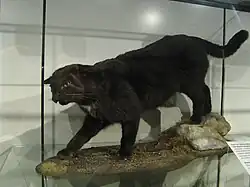 | |
| Mounted zoological specimen of a Kellas cat | |
Scientific classification  | |
| Kingdom: | Animalia |
| Phylum: | Chordata |
| Class: | Mammalia |
| Infraclass: | Placentalia |
| Order: | Carnivora |
| Family: | Felidae |
| Subfamily: | Felinae |
| Genus: | Felis |
| Species: | |
The Kellas cat is a large black cat found in Scotland. It is an interspecific hybrid between the Scottish wildcat (Felis silvestris silvestris syn. Felis silvestris grampia) and a feral housecat (Felis catus). Once thought to be a mythological wild cat, with its few sightings dismissed as hoaxes, a specimen was killed in a snare by a gamekeeper in 1984.[1][2][3] It is not a formal cat breed, but a population of felid hybrids. It is named after the village of Kellas, Moray, where it was first found.
Specimens, examination, and captive breeding
The "dog-size" animal snared in 1984 was 38 centimetres (15 inches) to shoulder height and measured 110 cm (43 in) from nose to tail.[1] When this find was reported, "[f]armers and gamekeepers responded immediately with claims that they had been shooting large black cats on Highland estates for years."[4] Skeptics initially dismissed the animal as "a very large feral domestic cat".[5]
A researcher at the National Museum of Scotland, Charles Thomas, examined eight Kellas cat specimens.[6] One carcass was already in the museum's collection; the remaining seven were supplied by Di Francis,[7] who was described by Thomas as a "writer, researcher and practical naturalist".[6] Thomas identified one of the animals as a melanistic wildcat;[6] this juvenile male was the first wildcat ever documented as melanistic in Scotland.[8] Most of the other specimens examined were concluded to be hybrids but more closely aligned to the Scottish wildcat; only one hybrid leaned more towards a domestic cat.[9]
The purported first live Kellas cat, a female, was caught at the Kellas estate by the Tomorrow's World team and featured in the 1986 episode "On the Trail of the Big Cat".[10] A second, male, was captured in 1988 in Inverness-shire. Both were kept for a time in the Highland Wildlife Park at Kincraig, then eventually taken on by Francis; she found them untameable but successfully bred them, producing the first litter of captive-born Kellas kittens.[11]
The Zoology Museum of the University of Aberdeen also holds a mounted specimen that was found during 2002 in the Insch area of Aberdeenshire.[12] Another specimen is kept in a museum in Elgin.[13]
Distinction from other alleged cats in Britain
In 1988, in Dufftown, Moray, another wildcat-sized black animal was trapped and killed, and upon examination has been suggested to be a different species entirely, for having a very different skull structure, which is narrower and elongated, with a notably smaller brainpan, and unusual dentition.[14]
Media reports about the Kellas cat in the 1980s often confused it, despite it being not much larger than a house cat, with purported sightings throughout Britain of leopard-sized or larger creatures, sometimes said to be black, tawny, or striped, and blamed for various livestock killings.[15] While a single puma, that had escaped or been released from captivity as an exotic pet, was captured humanely in 1980 in Cannich, Inverness-shire,[16] the remainder of such alleged great cats in Britain have proved to be elusive and dubious cryptids, generally regarded as urban legend.
Cat-sìth legend
The folklore of the cat-sìth ('fairy cat') may have been inspired by the Kellas cat.[17] The cat-sìth is a fairy creature from Celtic mythology, said to resemble a large black cat with a white spot on its chest. Legend has it that the ghostly cat haunts the Scottish Highlands. The legends surrounding this creature are more common in Scottish mythology, but a few occur in Irish mythology.
The historian Charles Thomas speculated that the Pictish stone at Golspie may depict a Kellas cat.[18] The Golspie stone, now held at the Dunrobin Castle Museum, shows a cat-like creature standing on top of a salmon, which may allude to the characteristics ascribed to a Kellas cat of catching fish while swimming in the river.[6]
See also
References
- 1 2 Bowers (2006).
- ↑ Francis (1996), pp. 5–7.
- ↑ Nowak, Ronald M. (2005). Walker's Carnivores of the World. Johns Hopkins University Press. p. 237. ISBN 978-0-8018-8033-9 – via Internet Archive.
- ↑ Francis (1993), p. 140.
- ↑ Francis (1993), p. 141.
- 1 2 3 4 Thomas (2013), p. 174.
- ↑ Kitchener (1996), p. 395.
- ↑ Kitchener (1996), p. 213.
- ↑ Kitchener (1996), pp. 397–399.
- ↑ Hann, Judith (22 May 1986). "On the Trail of the Big Cat". Tomorrow's World at Large. Series 23. Episode 35. BBC 1 – via YouTube.
- ↑ Francis (1993), p. 142.
- ↑ "Catalogue record: ABDUZ:CLD07". University of Aberdeen. Archived from the original on 7 October 2016. Retrieved 4 October 2015.
- ↑ "Kellas Cat". Engole: The Elven for Knowledge. 2020. Retrieved 4 February 2024.
- ↑ Francis (1993), pp. 143–144.
- ↑ Francis (1993), pp. 141–142, et passim.
- ↑ Francis (1993), pp. 127–128.
- ↑ Matthews, John; Matthews, Caitlín (2005). The Element Encyclopedia of Magical Creatures. HarperElement. p. 91. ISBN 978-1-4351-1086-1.
- ↑ Thomas (2013), p. 175.
Bibliography
- Bowers, Aron (2006). "Kellas Cats, Scotching the Myth". ScotCats.online.fr. Scottish Big Cat Trust. Archived from the original on 14 September 2015.
- Francis, Di (1993). The Beast of Exmoor: And Other Mystery Predators of Britain. London: Jonathan Cape. ISBN 9780224036658 – via Internet Archive.
- Francis, Di (1996) [1993]. My Highland Kellas Cats: The discovery and origin of a ferocious new black wild cat (Large-print ed.). Leicester: Ulverscroft. ISBN 9780708935392 – via Internet Archive.
- Kitchener, Andrew (1996) [1993]. "Appendix: Investigating the Identity of the Kellas Cats". In Francis, Di (ed.). My Highland Kellas Cats. Ulverscroft. ISBN 978-0-7089-3539-2. (Op. cit.)
- Thomas, Charles (2013). Gathering the Fragments: The Selected Essays of a Groundbreaking Historian. Sheffield: Cornovia Press. ISBN 978-1-908878-02-1.

