Karay-a language
| Kinaray-a | |
|---|---|
| Harayan[1] | |
| Karay-a, Hiniraya | |
| Native to | Philippines |
| Region | Antique, southern and central Iloilo, southern part of Guimaras, southern Aklan, Occidental Mindoro particularly in Ilin Island, western Capiz, some parts of Palawan, and a few parts of Soccsksargen |
| Ethnicity | Karay-a |
Native speakers | 1.1 million (2023)[2] |
Austronesian
| |
| Latin | |
| Official status | |
Official language in | Regional language in the Philippines |
| Regulated by | Komisyon sa Wikang Filipino |
| Language codes | |
| ISO 639-3 | krj |
| Glottolog | kina1250 |
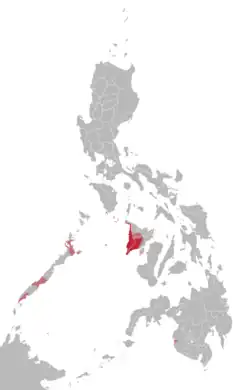 Area where Kinaray-a is spoken | |
The Karay-a language (Kinaray-a, Binisayâ nga Kinaray-a or Hinaraya; English: Harayan)[1] is an Austronesian regional language in the Philippines spoken by the Karay-a people, mainly in Antique.
It is one of the few languages spoken in Antique, along with Inakeanon, Cebuano, Hiligaynon, Inati/Inete, Hamtikanen, and Kaluyanon.
History
Etymology and Origins
The names Kinaray-a and Hiniraya are derived from the word iraya, meaning "upland" or "upstream." This contrasts with the neighboring language of Hiligaynon, which traces its name to the words ilig or ilawod, meaning "downstream" or "river flow."[3][4]

Prior to the Spanish conquest, an older form of Kinaray-a, which is well-preserved today in the epic chants of the Panay-Bukidnon, was the primary language spoken across the island of Panay and its settlements. [5]Linguistically, Kinaray-a is categorized as a Western Bisayan language, whereas Hiligaynon is a Central Bisayan language. They are sister languages that descended from a common Proto-Bisayan root.[6]
According to the linguistic research of David Zorc, it was not until the late pre-colonial period that immigrants from Eastern Visayas migrated to eastern Panay, bringing with them a language that would eventually evolve into Hiligaynon. [6]This is corroborated by 17th-century documentations by Fray Ignacio Alcina, which noted that the inhabitants of eastern Panay, such as Oton, traced their ancestral roots back to Leyte.[7]
Colonial Era and Socio-Economic Shift
When early Spanish colonizers arrived and settled in Ogtong (now Oton, Iloilo) between the late 16th and early 17th centuries, Kinaray-a was the primary language of the Panay majority. Spanish friars documented the Kinaray-a (then referred to as Haraya) language as early as the 1600s. [7]These early clerical records preserved the oldest known transcription of the language, a translation of the Ave Maria prayer:
"Maliag cao Maria, Nabota cao can gracia. An atun guinoon Dios dian canimo. Capin icao sa manga babai nga tanan, ig capin naman ang imon bata nga si Iesus. Santa Maria inang can Dios, igampo mo cami nga macasasala caraon, ig cum mamatai cami. Amen Iesus."[8]
Despite these early documentation efforts, clerical authority eventually favored Hiligaynon for evangelization and liturgy.[9]

Then, a socio-economic shift transformed a geographic linguistic difference into a class-based hierarchy. While early settlements along the Malandog River were once bustling trading ports, the region's economic center of gravity eventually shifted eastward. [10]The opening of the Port of Iloilo in 1855 spurred an economic boom tied to the sugar trade, establishing Hiligaynon as the language of commerce and the urban elite. [11]By the 1860s, early secular literature produced by high-society chroniclers in San Jose de Buenavista demonstrated that the Antiqueño elite were already adapting Hiligaynon linguistic markers into their written vocabulary (using sang and sia instead of the Kinaray-a kang and tana).[12]
Marginalization and Renaissance
During the late 19th-century sugar boom, many Antiqueños migrated to the neighboring island of Negros to serve as manual laborers (sacadas). [10]This mass migration of cheap labor further entrenched a colonial-era social stigma against Kinaray-a, characterizing it unfairly as an unrefined language.

Consequently, while Kinaray-a remained the primary daily language of Antique and western Iloilo, it currently faces until this day a slow erasure in formal settings and institutional literature. In recent decades, however, the language has seen a 'Kinaray-a Renaissance.' Spearheaded by local writers such as Alex Delos Santos and scholars in the late 20th to early 21st century, this ongoing cultural movement seeks to dismantle the historical stigma and promote authentic Kinaray-a literature.[13]
Geographical distribution
Kinaray-a is spoken mainly in Antique. It is also spoken in Iloilo province as a primary language in the city of Passi, in the municipalities of Alimodian, San Joaquin, Lambunao, Calinog, Leon, Miag-ao, Pavia, Badiangan, San Miguel, Guimbal, San Enrique, Tigbauan, Igbaras, Leganes, Pototan, Bingawan, San Rafael, Mina, Zarraga, Oton, Santa Barbara, Cabatuan, Janiuay, Maasin, New Lucena, Dueñas, Dingle, and Tubungan, and certain villages in Palawan and Mindanao – especially in the Soccsksargen region (particularly the province of Sultan Kudarat) by citizens who trace their roots to Antique or to Karay-a-speaking areas of Panay island. Inhabitants of most towns across the latter areas speak Kinaray-a while Hiligaynon is predominant around coastal areas particularly in Iloilo. It is also spoken in Iloilo City by a minority, particularly in the Arevalo district and few parts of southern Mindoro and parts Capiz and Aklan provinces, as well as Guimaras and some parts of Negros Occidental.[14]
Dialects

Historically, there had not been much formal linguistic study on the dialects of Kinaray-a, though speakers of both Kinaray-a and Hiligaynon readily observed differences in pronunciation and vocabulary between towns. However, recent lexicophonetic research has established well-defined dialectal groupings, noting that while Antique shares substantial linguistic connections with Iloilo due to sustained historical contact, it contains highly distinct internal varieties.
Based on these studies, mainland Antique can be divided into five specific dialect areas under the "Antique Kinaray-a Zone", categorized from north to south:
- Pandan Kinaray-a: Spoken in the northernmost towns of Pandan and Libertad. Due to their geographical isolation from Antique's commercial centers and closer proximity to Aklan, this dialect is sharply divergent and heavily associated with Akeanon. It uses unique vocabulary not found in the rest of Antique, such as /ʔuŋaʔ/ (child; standard KRJ: /bataʔ/), /pajuk/ (coconut milk; standard KRJ: /gataʔ/), and /ʔasawʔasaw/ (drizzle; standard KRJ: /tarithiʔ/).
- North Antique Kinaray-a: A transitional zone covering Sebaste and Culasi. While it shares a huge proportion of features with the southern towns, its accent is reported to be more similar to Pandan.
- Cangaranan-Tibiao Kinaray-a: A transitional zone in the middle of Antique, bridging the northern and southern towns around Laua-an, Barbaza, and Tibiao. It is characterized by the distinct use of the ngan and kan emphatic particles.
- San Jose-Sibalom Kinaray-a: Assumed as the basis for standard Antique Kinaray-a, radiating from the Sibalom River. This core dialect covers San Jose de Buenavista and the satellite towns of Sibalom, Belison, Hamtic, Patnongon, and parts of Bugasong and Valderrama.
- South Antique Kinaray-a: Spoken in the rugged, bypassed southernmost towns of Tobias Fornier and Anini-y. It is described as having a soft, rising-falling rhythm and is closely associated with the speech of neighboring San Joaquin in Iloilo. (There are also reports of a distinct mountain dialect in Hamtic called Hamtikanon that may relate to this southern grouping).
Separate from the mainland is the Caluyanon Zone. Because of the Caluya archipelago's extreme isolation and a mining-driven economy that draws laborers from across the Philippines, Caluyanon is considered extremely distinct. It exhibits a high level of spoken unintelligibility, heavily mixing Kinaray-a with Tagalog and Cebuano-Bisaya, to the extent that locals sometimes consider it an entirely separate language.[9]
Outside of Antique, the differences and degrees to which the dialects differ depend largely on an area's proximity to other language-speaking regions. A distinct dialect of Karay-a is spoken in central Iloilo where many Hiligaynon loanwords are utilized, and some Kinaray-a words are pronounced harder, such as using giya ('here') in Janiuay and Santa Barbara compared to rigya or ja in southern Iloilo and San Jose de Buenavista. Two highly accented dialects of Kinaray-a can also be heard in the Iloilo towns of San Joaquin, Leon, and Tubungan.[9]
Across all regions, some dialects differ only in consonant preference, such as alternating y and h (e.g., bayi vs. bahi for 'girl') or l and r (e.g., wala vs. wara). Other areas feature entirely distinct vocabulary differences, such as using sayëd vs. kadë ('ugly') or rangga vs. gëba ('defective').
Intelligibility with Hiligaynon
Due to geographic proximity and mass media, Kinaray-a-speakers can understand Hiligaynon (also erroneously known as Ilonggo) speakers. However, only Hiligaynon speakers who reside in Kinaray-a-speaking areas can understand the language. Those who come from other areas, like Iloilo City and Negros Island, have difficulty in understanding the language, if they can at all. [9]
Most Karay-a also know Hiligaynon as their second language. To some extent, an intermediate dialect of Hiligaynon and Kinaray-a is spoken in Mindanao, mainly in Sultan Kudarat province.
Phonology and Orthography
Alphabet
The Kinaray-a alphabet (Katigbatohan Kinaray-a) consists of 29 letters. It includes 20 native symbols and 9 borrowed letters.[15]
Vowels
| Front | Central | Back | |
|---|---|---|---|
| Close | i | ə ~ ɨ | u |
| Mid | e ~ ɛ | o | |
| Open | a |
Kinaray-a features five primary vowels (palimug): A, E, I, O, and U. A distinguishing feature of Kinaray-a phonology is the presence of the schwa sound [ə]. [15]The phonemes /e/ and /o/ are used mostly in non-Karay-a words and were formerly allophonic with /i/ and /u/, respectively. The phonemes /i/ and /u/ may also be pronounced as [ɪ] and [ʊ].[16] Among some speakers, /u/ may be pronounced as [ə], such as when subâ is uttered as [səˈbaʔ] instead of as /suˈbaʔ/.
| English | Karay-a | Hiligaynon | Tagalog |
| mine | akën | akon | akin |
| dark | madëlëm | madulom | madilim |
| food | pagkaën | pagkaon | pagkain |
| head | ulo | ulo | ulo |
| ball | bola | bola | bola |
| animal | sapat, hayëp | sapat | hayop |
| plant | tanëm | tanom | pananim, halaman |
| six | anëm | anom | anim |
Consonants
The language has 20 consonants (kalimug) which represent sounds formed by blocking, restricting, or altering the normal flow of breath.[15]
| Labial | Alveolar | Palatal | Velar | Glottal | ||
|---|---|---|---|---|---|---|
| Nasal | m | n | ŋ | |||
| Plosive | voiceless | p | t | k | ʔ | |
| voiced | b | d | ɡ | |||
| Fricative | s | h | ||||
| Tap/Flap | ɾ | |||||
| Approximant | l | j | w | |||
Orthography
There are two official orthographic conventions currently in use: a four-vowel-grapheme system released by the Komisyon sa Polong Kinaray·a in 2016 in coordination with the Komisyon sa Wikang Filipino (KWF),[17] and a six-vowel-grapheme system recommended by the KWF in 2018.[18] The latter builds on Brigadier General Vicente Pangantihon's introduction of a separate letter ⟨ə⟩ for /ɨ/ through the publication of Karay-a Rice Tradition Revisited,[19] but using ⟨ë⟩ in ⟨ə⟩'s place. Karay-a writings predating Pangantihon's innovation had not graphemically distinguished between /ɨ/ and /u/.[20] In 2018, the KWF elaborated,[18]
Harmonization is not compulsory for older users of the language or individual organizations; it is specifically aimed at helping the Department of Education and teachers to teach any of the native languages. Other organizations are free to adopt their own stylebook in their own publications.
Vowels
The 2018 Pangantihon–KWF orthography provides for six vowel letters: ⟨a⟩, ⟨e⟩, ⟨ë⟩ (previously ⟨ə⟩), ⟨i⟩, ⟨o⟩ and ⟨u⟩.[a] They do not form diphthongs with each other and always indicate a separate syllable: there are as many vowels as there are syllables. Informal writing, however, contravenes this orthographic rule such as, for example, when words such as balunggay, kambiyo, lanaw, puwede, ruweda and tuáw are written as *balunggai, *kambio, *lanao, *puede, *rueda and *tuao.
⟨Ë⟩, referred to as malëm·ëk nga ⟨i⟩ and which Pangantihon had originally written as ⟨ə⟩, represents /ɨ/, a phoneme that occurs natively in Karay-a and in some other languages spoken in the Philippines such as Ivadoy, Maranao and Pangasinan. ⟨Ë⟩ is also used for integrated words of relatively recent foreign origin.
Separate glyphs for /e/ and /u/ were introduced with the arrival of the Spaniards; namely ⟨e⟩ and ⟨u⟩.
Consonants
In line with the KWF's 2018 recommendation,[17] the alphabet has 23 consonant letters: ⟨b⟩, ⟨c⟩, ⟨d⟩, ⟨f⟩, ⟨g⟩, ⟨h⟩, ⟨j⟩, ⟨k⟩, ⟨l⟩, ⟨m⟩, ⟨n⟩, ⟨ñ⟩, ⟨ng⟩, ⟨p⟩, ⟨q⟩, ⟨r⟩, ⟨s⟩, ⟨t⟩, ⟨v⟩, ⟨w⟩, ⟨x⟩, ⟨y⟩ and ⟨z⟩. Of the above, ⟨c⟩, ⟨ñ⟩, ⟨q⟩ and ⟨x⟩ are used only in names and unintegrated loan words.[17]
The digraph ⟨ng⟩ constitutes a single letter and represents the phoneme /ŋ/. In the old orthography, which followed the Spanish norms set forth by the Real Academia Española, this phoneme was represented by ⟨n͠g⟩, the tilde stretching over both letters in order to distinguish it from ⟨ng⟩ and ⟨ñ⟩, which represented the Spanish /ŋɡ/ and /ɲ/, respectively.
In contrast to ⟨ng⟩, the digraph ⟨ts⟩, which represents /t͡ʃ/, is not counted as a distinct letter.
Grammar
Nouns
Nouns (Pangngaran) in Kinaray-a are categorized into Proper Nouns (Pat-ud), which are capitalized, and Common Nouns (Di pat-ud), which are written in lowercase.[15]
Pluralization of nouns can be achieved in three different ways; by adding the word mga before a singular noun (e.g., mga libro); by adding the prefix ka- and the suffix -an or -han to the noun, which eliminates the need for mga (e.g., kabulakan for flowers); by preceding the noun with a number or quantitative adjective (e.g., tatlo ka bisikleta).[15]
| Karay-a | English meaning | Malay | English meaning | Tagalog | English meaning |
|---|---|---|---|---|---|
| ayam | dog | ayam/anjing | chicken/dog | manok/aso | chicken/dog |
| bayi, bahi | female, woman | wanita | female, woman | babae | female, woman |
| bosong | abdomen | pusar/pusat | navel/central | puson/pusod | stomach/navel, core |
| kutî | cat | kucing | cat | kuting | kitten |
| damog | fodder | umpan/(pa)dang | fodder/pasture | kumpay/damo | fodder/pasture, grass |
| yawâ | demon | setan/awa | demon/accusation | demonyo/awa | demon/pity |
| makəl/uhong | mushroom | jamur | mushroom | kabuti | mushroom |
| kahig | foot | kaki | foot | paa | to scrape (ground) |
Pronouns
| Absolutive₁ (emphatic) |
Absolutive₂ (non-emphatic) |
Ergative₁ (postposed) |
Ergative₂ (preposed) |
Oblique | |
|---|---|---|---|---|---|
| 1st person singular | ako | takən | nakən, ko | akən | kanakən |
| 2nd person singular | ikaw, kaw | timo | nimo, mo | imo | kanimo |
| 3rd person singular | - | tana | nana, na | ana | kanana, kana |
| 1st person plural inclusive | kita | tatən | natən, ta | atən | kanatən |
| 1st person plural exclusive | kami | tamən | namən | amən | kanamən |
| 2nd person plural | kamo | tinyo | ninyo, nyo | inyo | kaninyo |
| 3rd person plural | sanda | tanda | nanda | anda | kananda |
Numbers
| Number | Kinaray-a | Malay | Tagalog |
|---|---|---|---|
| 1 | isará/sará | satu | isa |
| 2 | darwa | dua | dalawa |
| 3 | tatlo | tiga | tatlo |
| 4 | apat | empat | apat |
| 5 | limá | lima | lima |
| 6 | anəm | enam | anim |
| 7 | pitó | tujuh | pito |
| 8 | waló | lapan | walo |
| 9 | siyam | sembilan | siyam |
| 10 | pulù | (se)puluh | sampu |
| 11 | napulù kag sará / unsi (from Spanish) | (se)belas | labing-isa/onse (from Spanish) |
| 50 | kalim-an/singkwenta (from Spanish) | lima puluh | limampu/singkwenta (from Spanish) |
| 100 | sangkagatos/sanggatos | se ratus | isang daan |
| 1,000 | sangkalibo/sanglibo | se ribu | isang libo |
| 100,000 | sangka gatos ka libo | se ratus ribu | isang daang libo |
| 500,000 | lima ka gatos ka libo | lima ratus ribu | lima daang libo |
| 1,000,000 | sangka milyon | satu juta | isang milyon |
Common expressions
Saying Diin kaw maagto? (literally 'Where are you going?') is a common way to greet people. The question does not need to be answered directly. The usual answer is an action like Maninda (literally 'to buy something on the market') instead of Sa tinda (literally, 'to the market'.)
- Are you eating well? – Mayad man pangaën mo?
- Good. – Mayad.
- How are you feeling? – Musta bay pamatyagan mo? or: Ano bay pamatyag mo? (What do you feel?)
- I don't know. – Wara takën kamaan. / Waay takën kamaan (or simply: Maan a. / Ambay a. / Ilam a. – informal, usually an annoyed expression)
- Let's go! – Panaw ta / Halin ta ron! / Dali ron! (usually for hurrying up companions)
- Come together. – Iririmaw kita. / imaw kita. / Iribhanay kita./ Iririmaw tatən
- Why? – Manhaw/Wanhaw? (or: Andët haw/aw?)/ Insa haw? / Insaw? (informal)
- I love you. – Ginagugma ta (i)kaw. / palangga ta (i)kaw.
- My love/sweetheart. – Palangga ko.
- What is your name? – Ano ngaran mo?
- Good morning! – Mayad nga aga!
- Good afternoon! – Mayad nga hapon!
- Good evening! – Mayad nga gabiʔi!
- That one. – Amo kara. (Or simply: Ra/Ra ay.)(or: Amo ran)/ Amo ka di-a.
- How much? – Tag pira?
- Yes. – hə-əd. (Ho-ud)/ (h)ə-əd
- No. – Bukut./Bëkët. (Bëkën)/Indi
- Because. – Bangëd.
- Because of you. – Bangëd kanimo or Tëngëd kanimo.
- About you. – Nahanungëd kanimo or Parti kanimo.
- You know. – Man-an mo (or: Man-an mo man.)
- Hurry! – Dasiga! (lit. 'Fast!') or Dali-a! (lit. 'Hurry!')
- Again. – Liwan/Liwat/Riwan/Liwan (or: Uman ('again') / Umana (command to repeat).)
- Do you speak English? – Kamaan kaw maghambal kang Inglis? or Kama-an kaw mag-Inglis?
- It is fun to live. – Sadya mabuhi / Sadya ang mabuhi.
- Happy – Sadya
- Thank you – Salamat
Kinaray-a Writers
- Alex Delos Santos
- John Iremil Teodoro
- Russell Tordesillas
See also
Notes
- ↑ The vowel "u" is called matig-a nga "o" (the hard "o"). Hence, when a syllable with a vowel is pronounced lightly, the vowel "i" is substituted with the vowel "e". The opposite rule applies to the vowel "u". The practice however, is not the norm. What is more controlling for using either the vowels "i" and "o" or the introduced vowels "e" and "u" is what appears to the Karay-as pleasing to their eyes and ears. When in doubt on what vowel to use, it is always safe to use the indigenous vowels. The introduced "ë" vowel has no substitute. It will always be used since many Kinaray-a words have a schwa vowel sound.
References
- 1 2 Reid, Lawrence A. (2017). "Revisiting the Position of Philippine Languages in the Austronesian Family" (PDF). De La Salle University, Manila.
- ↑ "The Philippines' Language Report: What Language Is Spoken in the Philippines?". 2023-12-05. Retrieved 2024-06-22.
- ↑ "Meaning of ílig - Hiligaynon Dictionary". Retrieved 2026-08-16.
- ↑ "Ang Pinili, Volume 2". heyzine.com. Retrieved 2026-08-16.
- ↑ Sugidanon Epics of Panay: Tikum kadlum. University of the Philippines Press. 2014. ISBN 978-971-542-759-3.
- 1 2 Zorc, R.David (1977-01-01). The Bisayan dialects of the Philippines: Subgrouping and reconstruction.
- 1 2 Alcina, Francisco Ignacio (2002). History of the Bisayan people in the Philippine Islands : evangelization and culture at the contact period. Internet Archive. Manila, Philippines : UST Pub. House. ISBN 978-971-506-199-5.
- ↑ Cummins, J.S., ed. (2017-05-15). Sucesos de las Islas Filipinas, 1609, by Antonio de Morga. Hakluyt Society. ISBN 978-1-315-61126-6.
- 1 2 3 4 Rentillo, Philip (2025-01-01). "Lexicophonetic Dialectology of Panay". Dialectologia. doi:10.1344/Dialectologia.34.10.
- 1 2 Fornier, Joselito N. (2012-05-15). "Economic Developments in Antique Province: 1800-1850 Joselito N.". Philippine Studies: Historical and Ethnographic Viewpoints. 46 (4). doi:10.13185/2244-1638.4689. ISSN 2244-1638.
- ↑ "Iloilo History Part 5". Retrieved 2026-08-16.
- ↑ "NLP Digital Collection HD01. p4.m11". nlpdl.nlp.gov.ph. Retrieved 2026-08-16.
- ↑ "Ugsad kang Kinaray-a". DUNGUG KINARAY-A INC. Retrieved 2026-08-16.
- ↑ "Kinaray-a". yumpu.com. Retrieved 2022-08-11.
- 1 2 3 4 5 Tondares, Jose (2015). Taramdan sa Lantipulong Kinaray-a (in Kinaray-a). Antique, Philippines: St. Anthony’s College. ISBN 978-621-95295-3-2.
- ↑ Limpiada, Aimee (2015). The Phonology of Kinaray-a as Spoken in Antique. Philippine Normal University.
- 1 2 3 R. Pefianco, Anna Cecilia; S. Tabuyan, Danny; M. Flores, Felicia; V. Ysúlat, Cornelio; D. Pagunsan, Ritchie (2016). Ortograpiya Kinaray-a. New York: Innobril. ISBN 978-1540619891.
- 1 2 Paa, Saúl (2018-10-30). "Filipino-Language Commission Clarifies Harmonization of Orthographies". Philippine News Agency.
- ↑ P. Rendón, Jennifer (2012-08-14). "Retired Army General Authors Kinaray·a Dictionary". Philippine Star.
- ↑ Caláwag Pangantihon, Vicente (2011). Kinaray·a–English Dictionary.
External links


- Taramdan sa Lantipulong Kinaray·a, guide to grammar (Antiqueño Language)
- Marayum Dictionary Archived 2023-06-06 at the Wayback Machine