KAMU-TV
 | |
| |
| City | College Station, Texas |
|---|---|
| Channels | |
| Branding | KAMU PBS |
| Programming | |
| Affiliations | |
| Ownership | |
| Owner | Texas A&M University |
| History | |
First air date | February 15, 1970 |
Former channel numbers | Analog: 15 (UHF, 1970–2009) |
| NET (February–October 1970) | |
Call sign meaning | For owner Texas A&M University |
| Technical information[1] | |
Licensing authority | FCC |
| 65301 | |
| ERP | 3.2 kW |
| HAAT | 105 m (344 ft) |
Transmitter coordinates | 30°37′48″N 96°20′34″W / 30.63000°N 96.34278°W |
| Links | |
Public license information | |
| Website | kamu |
KAMU-TV (channel 12) is the public television station of Texas A&M University in College Station, Texas, United States, airing programming from PBS. KAMU-TV and KAMU-FM 90.9, the university's NPR station, broadcast from studios on the third floor of the Innovative Learning Classroom Building on the university's campus on Lamar Street; KAMU-TV's transmitter is located nearby in Hensel Park.
In the 1960s, Texas A&M operated an educational television program with broadcast studios on the campus, but it did not have a transmitter until receiving a construction permit to build on channel 15 in 1969. KAMU-TV began broadcasting on February 15, 1970, as Texas A&M's first public broadcasting service. It aired national programming, first from National Educational Television and later PBS, as well as local programming for the Bryan–College Station area including Texas A&M sports programming and, from 1970 to 1985, a local newscast. Operating initially from Bagley Hall, KAMU-TV moved in 1972 to the Joe Hiram Moore Communications Center near Kyle Field, where it was joined by KAMU-FM in 1977. The division encompassing the KAMU stations, Educational Broadcast Services, served as the nucleus of A&M's television production operation, including for athletics, and of A&M's campus connectivity services.
KAMU began digital broadcasting in 2003 on channel 12 and continued to use that as its major channel number when it ceased analog broadcasting in 2009. In 2023, the KAMU stations moved to the Innovative Learning Classroom Building to make way for new facilities near Kyle Field. As one of PBS's smaller stations, KAMU-TV's local programming largely has focused on the Bryan–College Station community and Texas A&M. Similarly, the station is only available in the Waco–Temple portion of the market on satellite television providers.
History
In January 1968, Texas A&M University (A&M) president James Earl Rudder authorized the university's Educational Television Program to prepare an application to the Department of Health, Education, and Welfare for federal funding to build and activate an educational television station on channel 15 in College Station, Texas. Though it had no transmitter, the A&M educational TV program already had all the necessary studio equipment for broadcasting, including a studio in Bagley Hall, and in 1967 had produced 123 hours of local programming[2] that was distributed to six campus buildings.[3] A&M set up an organizational committee to lead the establishment of the new station that June[4] and in November applied to the Federal Communications Commission (FCC) for a construction permit.[5] The FCC application was contingent on receiving federal funding.[6] The funds and construction permit were awarded to A&M on August 1, 1969,[5][7] days after the university announced it had purchased an outside broadcasting van from KTRK-TV in Houston and added color capability.[3]
With only the installation of a transmitter facility necessary to go on the air, A&M set a launch date for KAMU-TV of December 15, 1969. Planned daily educational telecasts for public schools had been ruled out due to a fund timing issue, but the station was planned to start with National Educational Television (NET) programs and local programs from the Bagley Hall studio.[8] However, a lengthy strike at General Electric (GE), which was manufacturing the transmitter, forced a 60-day delay in the station's debut.[9] Instead, KAMU-TV made its first telecast on February 15, 1970, in the form of a 90-minute preview of station programs.[10] The antenna was mounted atop the water tower on campus.[11] It offered three regular local programs: the daily local news roundup Campus and Community Today, Viewpoint, and This Week.[12] In its first year on air, the station suffered from reliability issues with the transmitter. The used GE transmitter failed 74 times on 24 different days—including on the first broadcast of Campus and Community Today—from the station's startup to March 27, when channel 15 left the air. Station director Mel Chastain declared, "KAMU-TV and Texas A&M will not operate an inferior facility."[13][14] KAMU-TV was not back on the air until June 15,[15] operating more reliably from that point onward.[16] NET was supplanted as the public television network by PBS in late 1970.[17] Aside from the debut, KAMU-TV operated on weekdays only until it made its first Sunday evening broadcasts in October 1971.[18] One of every five programs on the station's air was a local production—a proportion more than double the national average for a PBS station.[11]
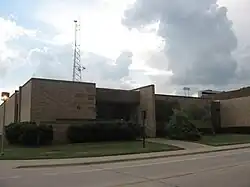
In 1972, A&M completed a new educational television center located southeast of Kyle Field. It replaced the old Bagley Hall with 17,000 square feet (1,600 m2) of space and features such as equipment to air PBS programming live, two studios, and provision for a future FM radio station. A&M also built a new, 375-foot (114 m) tower at an off-campus location to expand KAMU-TV's reach. KAMU-TV was off the air from March 15[19] to December 23, 1972, to accommodate the new studio and transmitter facilities. When it returned, the station had regular hours on Saturdays.[20] The new tower earned the station an FCC reprimand. A&M had asked for permission to paint the tower maroon and white instead of the standard orange and white, the colors of the rival University of Texas at Austin, which was denied by the Federal Aviation Administration. Nevertheless, the tower went up and was painted maroon and white. In January 1974, an FCC inspector visited the tower and issued a notice of violation; A&M repainted the tower that June and was chastised by the commission for its "irresponsible, casual attitude toward matters involving the safety of air traffic, toward representations to the FCC and toward compliance with the rules".[21]
KAMU-FM began broadcasting on March 30, 1977, with programming from NPR.[22] Later that year, KAMU-TV presented to public television stations nationwide a series of six half-hour programs in conjunction with Jacques Cousteau and the Cousteau Society. The series was KAMU's first national production[23] and came about after people at Texas A&M University at Galveston met Cousteau, whose ship was in dry dock there.[24] The building in which the KAMU stations operated was named for Joe Hiram Moore, an oil producer and 1938 A&M graduate and former president of the Association of Former Students.[25] In 1978, Friends of KAMU was formed to raise funds for the television and radio stations.[26] In 1981, KAMU produced another program for national distribution, the gardening series The Plant Kingdom.[27]
Local news had been on the station's schedule since 1970, retitled by 1975 as 15 News. The half-hour newscast covered local news and utilized the resources of Texas A&M journalism students.[28] It was canceled in 1985 amid budget cuts at KAMU-TV.[29] The station had in the preceding years dropped Nova and American Playhouse to save costs[30] and came close to removing The MacNeil/Lehrer NewsHour, which was kept after support from the annual on-air auction.[31] In 1986, KAMU was connected to the Texas Video Network, enabling Texas A&M to originate interviews with faculty for national media by way of microwave transmission and satellite uplink. Previously, programs used a rented uplink, as was the case when Phil Gramm and Lloyd Doggett held a U.S. Senate debate at KAMU in 1984.[32]
Much of KAMU's local programming gave the station an Aggie flavor. It annually telecast the 1943 film We've Never Been Licked, which was filmed on the A&M campus,[33] and originated telecasts of Aggie Bonfire.[34] When the bonfire collapsed in 1999, the event was live streamed—but not recorded—by KAMU.[35] KAMU also handled production for the Texas A&M athletic department, including the football coaches' show aired by commercial stations statewide,[36] and aired replays of football games.[37] It also annually aired a broadcast of Bryan's Christmas parade.[38]
KAMU's founding director, Mel Chastain, departed in 1987 to take a new role at Kansas State University.[39] In the years that followed, KAMU received two federal matching grants for new equipment, to which A&M's contribution represented the first capital expenditure by the university in the stations since their launch.[40] In 1991, EBS set up the Trans-Texas Videoconference Network, which used digital video compression and telephone circuits to connect the Texas A&M University System's far-flung campuses.[41] This network evolved into the system's intranet.[42] KAMU was a smaller PBS station and for most of its early history did not buy all of PBS's programs, except for several years in the early 1980s.[43] KAMU later became a "limited-use" station with fewer PBS programs and lower dues, until PBS restructured its dues and eliminated this option in 1995. At the time, 28 percent of its funding came from the Corporation for Public Broadcasting (CPB).[44]
In March 2003, KAMU was the first local station to broadcast a digital signal, on channel 12. At about the same time, a new data network based in College Station entered service, connecting all of Texas's PBS member stations.[45] KAMU's first live high-definition program aired on April 22, 2004.[46] In 2009, KAMU-TV became digital-only; its digital signal continued on channel 12.[47]
Texas A&M's athletic department and the 12th Man Foundation launched the Centennial Campaign in 2022 to construct new athletic-related facilities in the area south of Kyle Field housing the KAMU studios.[48] The KAMU stations moved in 2023 to the third floor of the Innovative Learning Classroom Building,[49] making way for a plaza next to the new Adam Sinn Academic and Wellness Center.[50]
Market
Though Bryan–College Station shares a television market with Killeen and Waco for commercial stations, KAMU has generally only served the Bryan–College Station half. Central Texas College put KNCT (channel 46) on the air in 1970;[51] Waco was served via cable by KNCT and KERA-TV of Dallas,[52] with KCTF (channel 34, later KWBU-TV) beginning in Waco in 1989 as a local station.[53] KWBU-TV shut down in 2010,[54] with KNCT replacing it on cable.[55] When KNCT was sold to Gray Television in 2018, KAMU-TV was made available on satellite but not added as a replacement on cable in the Waco area, which instead received KLRU of Austin.[56]
Local programming
KAMU-TV airs several video podcast versions of radio shows and podcasts, some of which also air on KAMU-FM. These include the public affairs series Brazos Matters and politics podcast Inside Political Science, featuring experts from the Bush School of Government and Public Service. The Bookmark features interviews of authors with new books published by Texas A&M University Press.[57]
Funding
In fiscal year 2024, KAMU-TV reported to the CPB $2.798 million in revenue, of which $1.089 million (38.9%) came from the CPB and $646,605 came from Texas A&M University. The station had 1,399 members in that year.[58]
Subchannels
KAMU-TV's transmitter is located in Hensel Park in College Station.[1] The station's signal is multiplexed:
| Subchannel | Res. | Short name | Programming |
|---|---|---|---|
| 12.1 | 1080i | PBS | PBS |
| 12.2 | 720p | Create | Create |
| 12.3 | Kids | PBS Kids |
See also
References
- 1 2 "Facility Technical Data for KAMU-TV". Licensing and Management System. Federal Communications Commission.
- ↑ Chmelik, Lee (March 13, 1968). "Prospect Of ETV Nears For B-CS". The Bryan Daily Eagle. p. 1. Retrieved August 3, 2026.
- 1 2 "ETV Department at A&M Gets Color Mobile Unit". The Bryan Daily Eagle. July 29, 1969. p. 3. Retrieved August 3, 2026.
- ↑ Palumbo, Joyce (March 16, 1969). "Educational TV Awaits U.S. Action". The Bryan Daily Eagle. p. 3. Retrieved August 3, 2026.
- 1 2 "History Cards for KAMU-TV". Federal Communications Commission.
- ↑ "Decision Due On HEW Funds". The Bryan Daily Eagle. June 8, 1969. p. 13. Retrieved August 3, 2026.
- ↑ "A&M Gets ETV Station Funds: Broadcasting May Start This Year, Chastain Says". The Bryan Daily Eagle. August 1, 1969. p. 1. Retrieved August 3, 2026.
- ↑ Griffis, Frank (November 23, 1969). "KAMU Goes on Dec. 15". The Daily Eagle. pp. 1, 10. Retrieved August 3, 2026.
- ↑ "Strike The Cause: KAMU Sign-on Put Off 60 Days". The Daily Eagle. December 9, 1969. p. 1. Retrieved August 3, 2026.
- ↑ "New Local Station: KAMU-TV Premieres". The Daily Eagle. February 15, 1970. p. TV Weekly Log 1. Retrieved August 3, 2026.
- 1 2 "New Building, New Equipment: KAMU-TV Returns to the Airwaves". The Texas Aggie. December 1972. pp. 7–8.
- ↑ "KAMU-TV to Make Debut In 'Living Color' Sunday". The Daily Eagle. February 12, 1970. p. 1. Retrieved August 3, 2026.
- ↑ Robinson, Bob (April 1, 1970). "While Transmitter Overhauled: KAMU-TV Off the Air For Indefinite Period". The Battalion. p. 1.
- ↑ Howell, Jane (March 27, 1970). "Major Repairs to Delay Channel 15 Broadcast". The Daily Eagle. p. 1. Retrieved August 3, 2026.
- ↑ "KAMU to Begin Broadcasting Again Monday". The Daily Eagle. June 11, 1970. p. 2. Retrieved August 3, 2026.
- ↑ "KAMU-TV Goes Off The Air Once Again". The Daily Eagle. October 4, 1970. p. 3. Retrieved August 3, 2026.
- ↑ "Does ETV hold key to fairness?" (PDF). Broadcasting. October 5, 1970. p. 50. ProQuest 1016855219. Archived (PDF) from the original on November 8, 2021. Retrieved October 14, 2022 – via World Radio History.
- ↑ "KAMU-TV License Is Official". The Daily Eagle. October 14, 1971. p. 4. Retrieved August 3, 2026.
- ↑ "KAMU Making Its Move; Off the Air Until Aug. 15". The Eagle. March 17, 1972. p. 16. Retrieved August 3, 2026.
- ↑ "KAMU-TV Finally Back on Air". The Eagle. December 29, 1972. p. 18. Retrieved August 3, 2026.
- ↑ Hines, Cragg (June 20, 1975). "FCC Hadn't Heard One About Aggie Tower Paint". The Houston Chronicle. p. 4:3. Retrieved August 3, 2026.
- ↑ "President Williams flips switch for new university radio station". The Eagle. March 31, 1977. p. 3. Retrieved August 3, 2026.
- ↑ "Cousteau series to air". The Eagle. February 19, 1977. p. 6B. Retrieved August 3, 2026.
- ↑ Butler, Jim (February 14, 1985). "KAMU celebrates 15 years of quality". Bryan-College Station Eagle. p. 7E. Retrieved August 3, 2026.
- ↑ "A&M renames building for independent oilman". The Midland Reporter-Telegram. November 25, 1977. p. 1D. Retrieved August 3, 2026.
- ↑ "Brazos Valley Arts". Bryan-College Station Eagle. August 25, 1983. p. Almanac 68. Retrieved August 3, 2026.
- ↑ Feighl, Cathie (January 29, 1981). "KAMU gardening show goes national" (PDF). The Battalion. p. 19.
- ↑ "KAMU Expands News Coverage". The Eagle. July 6, 1975. p. This Week 1. Retrieved August 3, 2026.
- ↑ "'15 News' to say farewell on Friday". Bryan-College Station Eagle. July 4, 1985. p. 7D. Retrieved August 3, 2026.
- ↑ Butler, Jim (April 5, 1984). "Is local community ready for PBS?". Bryan-College Station Eagle. p. 8C. Retrieved August 3, 2026.
- ↑ Butler, Jim (April 19, 1984). "KAMU-TV to keep McNeil/Lehrer [sic]". Bryan-College Station Eagle. p. 10C. Retrieved August 3, 2026.
- ↑ Owens, Brad (May 21, 1986). "Satellite hookup puts A&M in touch with the world". Bryan-College Station Eagle. pp. 1A, 8A. Retrieved August 3, 2026.
- ↑ Puckett, Daniel (September 2, 1985). "First, Labor Day, and then... what?". Bryan-College Station Eagle. p. 10A. Retrieved August 3, 2026.
- ↑ "A&M bonfire to be aired on cable network". Bryan-College Station Eagle. November 22, 1986. p. 4A. Retrieved August 3, 2026.
- ↑ Timms, Ed (November 19, 1999). "Web surfers get glimpse of scene". Bryan-College Station Eagle. The Dallas Morning News. p. A8. Retrieved August 3, 2026.
- ↑ Tagliabue, Tom (November 22, 1985). "Ag football games keep KAMU-TV personnel busy". The Battalion. p. 13.
- ↑ "KAMU provides entertainment, services for A&M community". The Battalion. September 26, 1988. p. 9.
- ↑ Fannin, Blair (February 27, 1998). "Christmas parade still afloat: The Eagle, KAMU will sponsor event". Bryan-College Station Eagle. pp. A1, A8. Retrieved August 3, 2026.
- ↑ Williams, Scott (August 8, 1987). "Educational broadcast director leaves A&M". Bryan-College Station Eagle. p. A2. Retrieved August 3, 2026.
- ↑ Warrenburg, Andrea (September 14, 1989). "KAMU recieves [sic] $72,500 grant; will replace obsolete equipment". The Battalion. p. 1.
- ↑ "University chiefs hookup to meet". Laredo Morning Times. June 2, 1991. p. 4D. Retrieved August 4, 2026.
- ↑ McLane, Paul (December 2, 2014). "This Educator Is an Aggie Over IP". Radio World. Retrieved August 4, 2026.
- ↑ Eades, Pamela (May 5, 1981). "May have to cancel news program: Budget cuts threaten KAMU-TV". The Battalion.
- ↑ Whitley, Chris (February 15, 1995). "Public television station celebrates 25th anniversary". Bryan-College Station Eagle. pp. A1, A4. Retrieved August 3, 2026.
- ↑ LeBas, John (March 30, 2003). "KAMU makes waves with digital upgrade". The Bryan-College Station Eagle. Archived from the original on July 4, 2011. Retrieved September 16, 2008.
- ↑ "KAMU has first live HD broadcast". The Battalion. April 24, 2004. Archived from the original on September 19, 2007. Retrieved September 16, 2008.
- ↑ "DTV Tentative Channel Designations for the First and Second Rounds" (PDF). Federal Communications Commission. May 23, 2006. Archived from the original (PDF) on August 29, 2013. Retrieved August 29, 2021.
- ↑ Ward, Jake (April 25, 2022). "Big changes in store for A&M Athletics with announcement of 'Centennial Campaign'". The Battalion. Retrieved August 3, 2026.
- ↑ "Our History KAMU TV FM". KAMU. Retrieved August 3, 2026.
- ↑ Tarpley, Jeff (May 22, 2023). "A&M AD says the Football Indoor Performance Center will be done by fall camp". 247Sports. Retrieved August 3, 2026.
- ↑ "College Station On the Air". The Austin American. November 24, 1970. p. 2. Retrieved August 3, 2026.
- ↑ "This TV Log Is In Cable Form". The Waco Citizen. March 11, 1977. p. 5. Retrieved July 30, 2026.
- ↑ "Public TV station debuts". Waco Tribune-Herald. May 23, 1989. pp. 1B. Retrieved July 30, 2026.
- ↑ Hoover, Carl (May 15, 2010). "Some KWBU programming to continue through June". Waco Tribune-Herald. pp. 1B, 3B. Retrieved July 30, 2026.
- ↑ Teeter, Bill (June 30, 2010). "Killeen station to expand in Waco: Public television programs will continue without KWBU". Waco Tribune-Herald. pp. 1B, 3B. Retrieved July 30, 2026.
- ↑ Carroll, John (August 28, 2018). "CTC Approves sale of KNCT-TV to Gray Television and KWTX-TV". KWTX.com. Gray Television. Archived from the original on August 29, 2018. Retrieved August 29, 2018.
- ↑ "2024 Local Content and Service Report to the Community" (PDF). KAMU. September 2024.
- ↑ "Annual Financial Report, Fiscal Year 2024" (PDF). KAMU.
- ↑ "Digital TV Market Listing for KAMU-TV". RabbitEars. Retrieved May 4, 2026.