John Milton (Florida politician)
John Milton | |
|---|---|
 | |
| 5th Governor of Florida | |
| In office October 7, 1861 – April 1, 1865 | |
| Preceded by | Madison S. Perry |
| Succeeded by | Abraham K. Allison |
| Member of the Florida House of Representatives | |
| In office 1850 | |
| Personal details | |
| Born | April 20, 1807 near Louisville, Georgia, U.S. |
| Died | April 1, 1865 (aged 57) Marianna, Florida, U.S. |
| Party | Democratic |
| Spouse(s) | Susan Amanda Cobb Caroline Howze |
| Alma mater | University of Georgia |
| Profession | Lawyer |
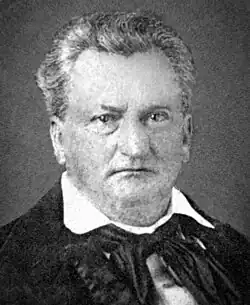
John Milton (April 20, 1807 – April 1, 1865) was governor of Florida through most of the American Civil War. A lawyer who served in the Florida Legislature, he supported the secession of Florida from the Union and became governor in October 1861. In that post, he turned the state into a major supplier of food for the Confederacy. In his final message to the state legislature as the war was ending, he declared that death would be preferable to reunion with the North, and killed himself shortly thereafter.
Early and personal life
Milton descended from a prominent Southern family and was a relative of the famed English poet of the same name.
He was the son of Homer Virgil Milton, an officer who fought in the War of 1812,[1] and the grandson of Revolutionary War veteran, United States presidential candidate of 1789, and former Georgia Secretary of State, John Milton.[2] Born near Louisville, Georgia, Milton graduated from the University of Georgia and later studied law.[3]
He married Susan Cobb in 1826,[3] and they had three children. Following Susan's death, Milton remarried Caroline Howze from Alabama in 1844; they had two sons and seven daughters.[4]
John and Caroline lived in Alabama and New Orleans,[5] before establishing a plantation worked by slave labor in Marianna, Jackson County, Florida in 1845.[3][6]
Milton's youngest son, Jefferson Davis Milton (1861–1947) moved to Texas, later Arizona.[7] He distinguished himself as a Texas Ranger, police chief of El Paso, and served for over 25 years as America's first border agent. William Hall Milton (1864–1942), grandson of the governor, was a U.S. Senator from Florida from 1908 to 1909.[7]
Political career
In Georgia, Milton ran for Congress in 1833 as a Nullifier candidate, but lost.[3] In 1848, he served as a presidential elector from Florida, then in 1850 was elected to the Florida House of Representatives.[3]
As a supporter and practitioner of slavery, he was an early advocate for secession of Florida from the Union. He was a delegate to the 1860 Democratic National Convention from Florida and was elected Governor in the 1860 election.[3] Milton took the oath of office on October 7, 1861, nine months after Florida had seceded from the Union and joined the Confederacy.
During the Civil War, Milton stressed the importance of Florida as a supplier of goods, rather than manpower, with Florida being a large provider of food and salt for the Confederate Army.[3] However the hardships of war still affected Florida, and by April 1864 many families were on the verge of starvation.[3]
Milton's predecessor, Madison S. Perry had been a strong supporter of the Davis administration's policies, and had sent most of Florida's volunteer forces to join the Confederate States Army. As such, Florida had limited manpower left to defend its extensive coastline when Milton came into office.[3] While other Confederate governors resisted the central government's conscription policies, Milton generally complied and did not seek wide-ranging exemptions to reserve men for service in local militia forces.[3]
Florida was never a strategic priority for either side, but as the war drew to a close and the Confederacy was close to defeat, Milton became worn down by the stress of his office. Governor Milton left Tallahassee for his plantation, Sylvania, in Marianna, Florida. In his final message to the state legislature, he said that the Northern Army leaders "have developed a character so odious that death would be preferable to reunion with them".[8]
On April 1, 1865, his son, William Henry Milton, found the governor dead of a gunshot wound to the head. The president of the Florida Senate, Abraham K. Allison, was sworn in as governor of Florida later that day. Governor John Milton is buried at Saint Luke's Episcopal Cemetery in Marianna.
References
- ↑ Johnson, Rossiter; Brown, John Howard (1 September 2018). "The Twentieth Century Biographical Dictionary of Notable Americans ..." Biographical Society – via Google Books.
- ↑ "Presidential Election of 1789: A Resource Guide". Presidential Elections, Library of Congress. The Library of Congress. Retrieved 24 September 2021.
- 1 2 3 4 5 6 7 8 9 10 Yearns, W. Buck, ed. (1985). The Confederate Governors. University of Georgia Press. p. 61—68.
- ↑ Gene M. Burnett: Florida's Past (Band 1: People and Events That Shaped the State), 1986, page 197
- ↑ "John Milton". Florida Department of State. Retrieved 20 July 2022.
- ↑ Cox, Dale (2010). The History of Jackson County, Florida: The Civil War Years. Two Egg, FL: CreateSpace Independent Publishing Platform. p. 191. ISBN 978-1448685141.
- 1 2 Dutton, Robin (2010-06-15). "Milton, Jefferson Davis". tshaonline.org. Retrieved 2019-01-13.
- ↑ "Suicide of Gov. Milton, of Florida". The New York Times. 1865-05-01. ISSN 0362-4331. Retrieved 2019-01-13.
- "The Hatcher-Harris Family Tree," Our Genealogy/History Directory, by Beverly & Bob Whitaker, https://web.archive.org/web/20070416082056/http://home.kc.rr.com/gentutor/
- The John Milton Letter Book, Florida Historical Society, Cocoa, Florida
External links
- Official Governor's portrait and biography from the State of Florida
- John Milton at Find a Grave
- Boyd (Florida Memory, Florida Department of State) (November 20, 2012). "Florida and the Civil War (November 1862)".
| Military (1821) |  | |
|---|---|---|
| Territorial (1822–1845) | ||
| State (since 1845) |
| |
- 1807 births
- 1865 deaths
- 1865 suicides
- 1848 United States presidential electors
- 19th-century American Episcopalians
- 19th-century American lawyers
- Confederate States of America state governors
- Democratic Party governors of Florida
- Georgia (U.S. state) lawyers
- Democratic Party members of the Florida House of Representatives
- People from Jefferson County, Georgia
- People from Marianna, Florida
- People of Florida in the American Civil War
- 19th-century members of the Florida Legislature
- People killed in the American Civil War
- Suicides by firearm in Florida
- State governors of the United States who owned slaves
- U.S. state legislators who owned slaves
- American people of English descent
- Male suicides