Ili-ishmani (𒉌𒉌𒅖𒈠𒉌 i3-li2-isz-ma-ni; fl.c. 2150 BC) was a ruler of Elam around 2150 BC. His name is purely Akkadian, and he was in charge of Elam at the time of Naram-Sin and/or Shar-Kali-Sharri, and probably their vassal.[3][4] His title of "Military Governor" (Shakkanakku in Akkadian, GIR.NITA in Sumerian) suggests that he was a dependent of the Akkadian kings, rather than an independent ruler.[5] Ili-ishmani rose from the position of scribe, already one of the top three positions in the land, to the position of Governor.[6]
His predecessor was probably Epirmupi.[7] After him, and the weakening of Akkad, rule in Elam probably reverted to local rulers of the Awan Dynasty.[8]
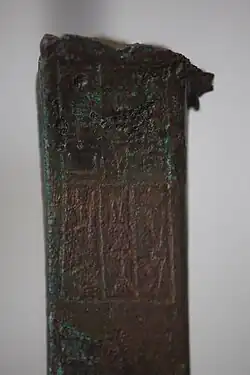
Axe fragment
The fragment of an axe is known, which was dedicated by Ili-ishmani.[9][10] It reads:
Axe blade with inscription Ilishmani, scribe and shakkanakku of Elam (with transcription)
𒉌𒉌𒅖𒈠𒉌 / 𒁾𒊬 / 𒄊𒀴 / 𒈠𒋾 / 𒉏𒆠
"i3-li2-isz-ma-ni / dub-sar / szagina / ma-ti / elam{ki}
"Ili-išmani, / scribe, / military governor (shakkanakku) / of the land / of Elam."
—Inscription of Ili-ishmani. Louvre Museum Sb 14243.[11][12][13]
Seal inscription
A seal found in Lagash also has the inscription "Ili-ishmani Governor (Ensi) of Susa" (𒉌𒉌𒅖𒈠𒉌 𒑐𒋼𒋛 𒈹𒂞𒆠Ili-ishmani ensi Shushanki).[14]
Seal found in Lagash, with the inscription "Ili-ishmani Governor of Susa" (𒉌𒉌𒅖𒈠𒉌 𒑐𒋼𒋛 𒈹𒂞𒆠Ili-ishmani ensi Shushanki) on the reverse (columns 2 and 3)
↑Transcription and drawing in Lambert, Maurice (1979). "Journal asiatique" (in French). Société asiatique.: 13. {{cite journal}}: Cite journal requires |journal= (help)
↑Transcription and drawing in Lambert, Maurice (1979). "Journal asiatique" (in French). Société asiatique.: 13. {{cite journal}}: Cite journal requires |journal= (help)
↑"Journal asiatique" (in French). Société asiatique. 1979: 12–13.{{cite journal}}: Cite journal requires |journal= (help)


 Seal found in Lagash, with the inscription "Ili-ishmani Governor of Susa" (𒉌𒉌𒅖𒈠𒉌 𒑐𒋼𒋛 𒈹𒂞𒆠 Ili-ishmani ensi Shushanki) on the reverse (columns 2 and 3)