Hurricane Lee (2023)
 Lee at peak intensity east of the Leeward Islands on September 8 | |
| Meteorological history | |
|---|---|
| Formed | September 5, 2023 |
| Extratropical | September 16, 2023 |
| Dissipated | September 18, 2023 |
| Category 5 major hurricane | |
| 1-minute sustained (SSHWS/NWS) | |
| Highest winds | 165 mph (270 km/h) |
| Lowest pressure | 926 mbar (hPa); 27.34 inHg |
| Overall effects | |
| Fatalities | 4 direct |
| Damage | $80 million (2023 USD) |
| Areas affected | Bermuda, Northeastern United States, Eastern Canada |
| [1] | |
Part of the 2023 Atlantic hurricane season | |
Hurricane Lee was a long-lived and intense tropical cyclone which impacted Bermuda, the Northeastern United States, and Eastern Canada in September 2023. Lee formed on September 5 from a tropical wave that had moved offshore from West Africa into the tropical Atlantic a few days earlier. A strong steering current caused the storm to track northwestward, far from the northern Leeward Islands. Highly favorable conditions enabled Lee to rapidly intensify to a Category 5 hurricane on September 7, its winds increased by 80 mph (130 km/h) in 24 hours. This makes it the fifth‑fastest rapid intensification on record in the Atlantic, only behind Hurricane Wilma in 2005, Hurricane Felix in 2007, Hurricane Milton in 2024, and Hurricane Matthew in 2016. Just as quickly however, Lee's strength waned, and it fluctuated in intensity for several days on account of strong wind shear and multiple eyewall replacement cycles.
On September 13, the system rounded the southwest side of a large ridge of high pressure over the central Atlantic, turned, and accelerated northward. Lee soon entered into an environment of increasing wind shear and moved into increasingly cooler water, causing the system to slowly weaken as it passed near Bermuda and New England. As a result, Lee transitioned into an extratropical cyclone. The cyclone then made landfalls in Nova Scotia, New Brunswick, Prince Edward Island, and in Newfoundland and Labrador, before moving out into the far northern Atlantic on September 18, where it merged with another extratropical low.
Rip currents caused one fatality in Puerto Rico when a 66-year-old man drowned at Poza del Obispo. Additionally, Lee generated dangerous surf and rip currents along the entire Atlantic coast of the United States. Lee produced hurricane-force winds gusts, along with flooding rains, mostly in Maine and Atlantic Canada. Consequently, approximately 200,000 power outages occurred in the United States, mostly in Maine, and a similar number in the Canadian provinces of New Brunswick and Nova Scotia. Maine and Atlantic Canada also reported many downed trees and power lines, as well as flash flooding, leading to road closures. Additionally, abnormally high tides and storm surge destroyed some roadways and a boardwalk in the Halifax area of Nova Scotia. Three storm-related fatalities occurred in the mainland of the United States: a 15-year-old boy drowned in Fernandina Beach, Florida; a 50-year-old man died in Searsport, Maine, when a tree fell onto the car he was in; and a 21-year-old man who was killed in Manasquan Inlet, New Jersey when the boat he was in capsized and sunk due to a tall wave. Total damage from the storm is estimated at $80 million, with $50 million in the United States and $30 million in Bermuda and Canada.
Meteorological history
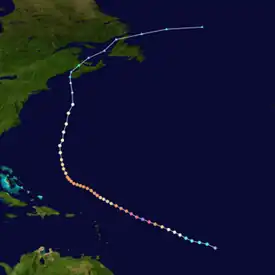
Tropical storm (39–73 mph, 63–118 km/h)
Category 1 (74–95 mph, 119–153 km/h)
Category 2 (96–110 mph, 154–177 km/h)
Category 3 (111–129 mph, 178–208 km/h)
Category 4 (130–156 mph, 209–251 km/h)
Category 5 (≥157 mph, ≥252 km/h)
Unknown


 Extratropical cyclone, remnant low, tropical disturbance, or monsoon depression
On September 1, a tropical wave emerged into the tropical Atlantic from the west coast of Africa producing disorganized shower and thunderstorm activity, and began to gradually organize.[1][2] A broad surface low formed by September 4, which acquired multiple low-level bands developing and a well-defined center on September 5. Consequently, Tropical Depression Thirteen developed at 12:00 UTC that day about halfway between the west coast of Africa and the Lesser Antilles.[1]
Amid favorable conditions for intensification, the depression quickly strengthened into Tropical Storm Lee six hours later and then a hurricane by late on September 6.[1] Lee tracked west-northwestward, steered by a mid-level ridge located to its north, and continued to intensify as it became better organized, with increased convective banding, development of a central dense overcast, and formation of a ragged eye, evident in visible satellite imagery by the following afternoon. By 21:00 UTC on September 6, the system strengthened into a Category 1 hurricane on the Saffir–Simpson scale while located far to the east of the Northern Leeward Islands.[3][4] Explosive intensification began the next day, with Lee reaching Category 2 strength at 15:00 UTC,[5][1] then reaching Category 4 strength at 21:00 UTC, as its eye cleared.[6] A few hours later, a hurricane hunters mission into the storm found that it had reached Category 5 strength, and possessed a clear 17 mi-wide (28 km) eye surrounded by convective cloud tops with temperatures as low as −105 °F (−76 °C).[7] By 06:00 UTC on September 8, Lee's maximum sustained winds reached 165 mph (270 km/h), an increase of 80 mph (130 km/h) in 24 hours, making it the fifth‑fastest intensifying Atlantic hurricane on record, surpassed by Matthew in 2016, Milton in 2024, Felix in 2007, and Wilma in 2005.[8][9] During this same time period, the hurricane's minimum barometric pressure fell to 926 mbar (27.34 inHg).[10] However, increasing southwesterly wind shear quickly caused Lee's eye to become cloud filled and the storm became more asymmetric, weakening it back to a high-end Category 4 hurricane.[11] The pace of weakening quickened as the day progressed, and Lee fell below major hurricane status by late on September 9.[1] Data from an evening hurricane hunters mission indicated that the storm was undergoing an eyewall replacement cycle and was still being adversely affected by wind shear.[12]
By September 10, wind shear abated, and the eyewall replacement cycle was completed, permitting the new, larger-diameter eye to contract and to grow more symmetric.[13] As a result, Lee intensified to a Category 3 major hurricane strength on the Saffir–Simpson scale once again that same day. Another series of eyewall replacement cycles led to fluctuations in its size and intensity, but Lee remained a major hurricane throughout. After tracking west-northwestward to northwestward for much of its trans‑Atlantic journey, Lee turned northward on September 13, moving around the western side of the steering subtropical ridge. That same day, it also weakened to Category 2 strength.[1] Then, on the morning of September 14, Lee became a Category 1 hurricane while approaching Bermuda,[14] passing to the west by 185 mi (300 km) later in the day.[15] As the hurricane pushed northward, continued drier air entrainment and increasingly strong southerly wind shear displaced Lee's convection to the northern side of the system, weakening it further. These factors caused the hurricane to commence its extratropical transition,[16] which was completed by 06:00 UTC on September 16. The cyclone then made landfalls in Nova Scotia, New Brunswick, Prince Edward Island, and in Newfoundland and Labrador, before moving into the northern Atlantic and merging with another extratropical low late on September 18.[1]
Preparations

Bermuda
Bermuda received tropical storm watches on September 12, which were later upgraded to warnings on September 13.[17][18] The House of Assembly moved their September 15 meeting date to September 22.[19]
United States
A hurricane watch and a tropical storm watch were issued for the New England coastline from Rhode Island to Maine, including Block Island, Martha's Vineyard and Nantucket, on September 13. A storm surge watch was also issued for Cape Cod Bay and Nantucket, although this alert was cancelled when the storm veered further to the east.[20]
New York State Governor Kathy Hochul deployed fifty National Guard members to Long Island in preparation of the storm's possible arrival.[21] The New York City Emergency Management Department advised coastal communities in the city to review their emergency plans.[22] On September 15, the town of Southampton declared a state of emergency, shutting down coastal roads.[23] The same day, the town of East Hampton prohibited swimming at all beaches.[24]
In Massachusetts, boats on Nantucket were pulled from the water or were sheltered in protected harbors.[25] All Hy-Line Cruises service was canceled between Martha's Vineyard and Hyannis, and from Martha's Vineyard to Nantucket.[26] The Steamship Authority waived change and cancellation fees for ferries between September 15 and 17.[26] On September 14, Boston Mayor Michelle Wu announced the opening of an emergency operations center.[27] Preparations to place sand bags and flood walls if necessary were also made. The Boston Police and Fire Departments were put on standby.[28] On September 15, Massachusetts Governor Maura Healey announced a state of emergency in response to the cyclone. Healey also announced that 50 members of the Massachusetts National Guard capable of operating high-water vehicles were being activated in anticipation of any potential rescues.[29]
The Rhode Island Department of Transportation cleaned out storm drains and cut down at risk trees to mitigate flood and wind risk. The Independent Man statue atop the Rhode Island State House in Providence was being taken down for repairs due to damage to the dome of the statue before any potential impacts by Lee could put it at risk.[30]
Maine Governor Janet Mills declared a state of emergency and requested President Joe Biden to issue an emergency disaster declaration for the state, and he did so later that evening.[31] Utility workers from as far as Tennessee were brought into the state to help quickly restore power in case of outages. Boat owners were advised to secure their boats by the Maine Harbor Master's Association.[32] The White Mountains in Maine were also put under wind advisory.[33] On September 16, about half of all flights to and from Portland International Jetport were canceled, while most flights were canceled to and from Bangor International Airport due to high winds.[34][35] The National Park Service also shut down certain areas of Acadia National Park.[36]
Canada
Environment Canada issued hurricane watches for parts of Charlotte County, particularly its coast and Grand Manan Island in New Brunswick, as well as Nova Scotia's Digby, Yarmouth, Shelburne, and Queens counties. Further tropical storm watches were issued for southeastern New Brunswick as well as several parts of Nova Scotia.[37] On September 15, Prime Minister Justin Trudeau announced that he had convened the Incident Response Group to discuss potential impacts from the cyclone and warned Canadians to take precautions and listen to their local officials.[38]
Cancellations were made for cruise ships scheduled to stop at the Port of Saint John.[39] On September 15, New Brunswick Emergency Measures Organization director Kyle Leavitt warned of hazardous driving conditions and urged residents to stay home. NB Power vice-president Nicole Poirier also announced that crews were put into position to respond to potential power outages.[40] Many flights were canceled or delayed to and from Greater Moncton Roméo LeBlanc International Airport and Fredericton International Airport due to hazardous conditions on September 16 and 17.[41][42] A senior director for energy delivery for Nova Scotia Power, Matt Drover, announced that utility crews were being mobilized throughout the province. Bay Ferries also canceled sailings of the MV Fundy Rose between September 16 and 17.[43] Most flights to and from Halifax Stanfield International Airport were canceled.[44]
Northumberland Ferries Limited canceled ferry crossings between Nova Scotia and Prince Edward Island on Saturday. Maritime Electric stationed utility crews throughout the province to respond to any potential power outages.[45] Flights were also cancelled to and from Charlottetown Airport.[46]
Elsewhere
A tropical cyclone alert was in effect for the Leeward Islands and the British Virgin Islands on September 7–8.[47][48] Additionally, a 5‑day high surf warning was issued for the British Virgin Islands on September 8.[49]
On September 7, the United States federal government deployed food, water, and rapid response teams to Puerto Rico and the United States Virgin Islands.[50]
Impact
Bermuda
Bermuda experienced tropical storm conditions. L.F. Wade International Airport reported peak winds of 51 mph (82 km/h) and was closed until September 16. 11,342 people lost power as a result of the storm. The Devonshire and St. George's bus depots had significant power failures, causing them to be closed until September 16. The Royal Naval Dockyard also suffered damage, causing ferry delays between the Dockyard and St. George's.[51]
United States
During the afternoon on September 14, a boat was capsized during a small craft advisory after being hit by a tall wave in New Jersey's Manasquan Inlet, requiring first responders to rescue two people. A 21-year-old man who was also on the boat was killed and his body washed ashore on Point Pleasant Beach on September 24.[52][53] Rough surf and dangerous rip currents were present along all of the east coast of the United States as Lee passed off the coast, and on September 15, a 15-year-old boy drowned due to rough surf off of Fernandina Beach, Florida.[54][55] Total damage in the US is estimated at USD$50 million. [56]
In New York, eastern Long Island experienced beach erosion and gusty winds from the storm.[57][58]
In Massachusetts, numerous flights were canceled or delayed at Logan International Airport, with some routes being canceled entirely due to high winds.[59] The majority of damage was caused by trees being felled due to a combination of gusty winds and highly saturated ground. In Cohasset, a Cohasset police officer's cruiser was crushed by a falling tree while the officer was outside his cruiser.[60] Damage in the state totaled to $11,700.[61]
A wind advisory was put into effect for New Hampshire's White Mountains, where wind would be stronger due to elevation.[62] On Mount Washington, gusts reached 96 mph (154 km/h).[63]
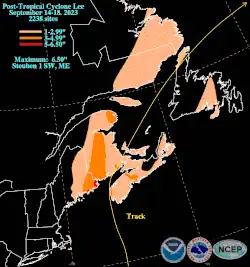
On September 16, wind damage occurred across southeastern portions of Maine, where trees were down, including some that fell over a portion of SR 11 in Aroostook County, forcing a closure. More than 92,000 power outages occurred.[64][65] Maine House Republican leader Billy Bob Faulkingham, along with one other person, were rescued after their boat overturned off of Winter Harbor while they clung to the hull of the vessel until rescue arrived.[66] A 66-year-old man was killed after his vehicle was struck by a falling tree in Searsport.[55][1] A man was also injured while driving on SR 11 in Moro Plantation after a downed tree went through his windshield. In Bar Harbor, a whale watching vessel broke free and crashed ashore, forcing authorities to offload 1,800 U.S. gallons (6,800 L) of diesel fuel to prevent it from spilling into the ocean. On the afternoon of September 16, about 94,000 customers in Maine were without power.[67] Heavy rain also fell throughout Maine, peaking at 6.50 in (165 mm) in Steuben.[68]
Canada
Strong winds with hurricane‑force gusts caused widespread, but minimal damage in Nova Scotia and in New Brunswick as Lee passed through, mostly in the form of downed trees and power lines. Power outages associated with the cyclone rose to around 140,000 in Nova Scotia, and 37,000 in New Brunswick, on the afternoon of September 16.[67] Total damages in Canada are estimated at $30 million.[56]
In New Brunswick, trees were felled throughout the province, sometimes taking utility poles and wires with them. Low-lying areas in Saint John and Fredericton suffered from flooding.[69]

In Nova Scotia, nearly 200,000 customers lost electricity.[70] A utility pole caught fire in Stoney Island. Coastal roads were inundated by storm surge, with several roads in the Eastern Shore region being destroyed by storm surge. The majority of damage was caused by trees being knocked over by wind gusts. Rissers Beach Provincial Park suffered significant storm surge, with extensive damage to the boardwalk and several trees being knocked over throughout the park.[71] The highest wind gust caused by the cyclone in Canada, 73 mph (117 km/h), was recorded at Halifax Stanfield International Airport.[69]
See also
References
- 1 2 3 4 5 6 7 8 9 Blake, Eric; Nepaul, Heather (March 21, 2024). Tropical Cyclone Report: Hurricane Lee (PDF) (Report). Miami, Florida: National Hurricane Center. Retrieved March 24, 2024.
- ↑ Blake, Eric (September 4, 2023). Tropical Weather Outlook (Report). Miami, Florida: National Hurricane Center. Retrieved September 4, 2023.
- ↑ Brown, Daniel (September 6, 2023). Hurricane Lee Discussion Number 6 (Report). Miami, Florida: National Hurricane Center. Retrieved September 6, 2023.
- ↑ Brown, Daniel (September 6, 2023). Hurricane Lee Advisory Number 6 (Report). Miami, Florida: National Hurricane Center. Retrieved September 6, 2023.
- ↑ Zelinsky, David (September 7, 2023). Hurricane Lee Advisory Number 9 (Report). Miami, Florida: National Hurricane Center. Retrieved September 7, 2023.
- ↑ Zelinsky, David (September 7, 2023). Hurricane Lee Advisory Number 10 (Report). Miami, Florida: National Hurricane Center. Retrieved September 7, 2023.
- ↑ Berg, Robbie (September 7, 2023). Hurricane Lee Discussion Number 11 (Report). Miami, Florida: National Hurricane Center. Retrieved September 7, 2023.
- ↑ Masters, Jeff; Henson, Bob (September 8, 2023). "Hurricane Lee peaks as a Cat 5 with 165-mph winds". New Haven, Connecticut: Yale Climate Connections. Retrieved September 8, 2023.
- ↑ Gilbert, Mary (October 7, 2024). "Hurricane Milton could bring life-threatening surge, winds to Florida Gulf Coast". CNN. Retrieved October 7, 2024.
- ↑ Cangialosi, John (September 8, 2023). Hurricane Lee Advisory Number 12 (Report). Miami, Florida: National Hurricane Center. Retrieved September 8, 2023.
- ↑ Brown, Daniel (September 8, 2023). "Hurricane Lee Discussion Number 13". Miami, Florida: National Hurricane Center. Archived from the original on September 8, 2023. Retrieved September 8, 2023.
- ↑ Papin, Philippe (September 9, 2023). Hurricane Lee Discussion Number 19 (Report). Miami, Florida: National Hurricane Center. Archived from the original on September 14, 2023. Retrieved September 10, 2023.
- ↑ Brown, Daniel (September 10, 2023). Hurricane Lee Discussion Number 22 (Report). Miami, Florida: National Hurricane Center. Archived from the original on September 14, 2023. Retrieved September 10, 2023.
- ↑ Brown, Daniel (September 14, 2023). Hurricane Lee Advisory Number 37 (Report). Miami, Florida: National Hurricane Center. Archived from the original on September 14, 2023. Retrieved September 14, 2023.
- ↑ Pasch, Richard (September 14, 2023). Hurricane Lee Intermediate Advisory Number 38A (Report). Miami, Florida: National Hurricane Center. Archived from the original on September 18, 2023. Retrieved September 14, 2023.
- ↑ Kelly, Larry; Brown, Daniel (September 15, 2023). Hurricane Lee Discussion Number 43 (Report). Miami, Florida: National Hurricane Center. Archived from the original on September 18, 2023. Retrieved September 16, 2023.
- ↑ Salam, Erum (September 12, 2023). "Hurricane Lee heads north with landfall expected in Nova Scotia or Maine". The Guardian. ISSN 0261-3077. Retrieved September 13, 2023.
- ↑ Shackelford, Robert; Elamroussi, Aya; Gilbert, Mary (September 13, 2023). "Massive Hurricane Lee prompts tropical storm and hurricane watches for coastal New England as threat grows". CNN. Retrieved September 13, 2023.
- ↑ "House Of Assembly Meeting Cancelled On Friday". Bernews. September 14, 2023. Retrieved September 15, 2023.
- ↑ Cangialosi, John (September 13, 2023). Hurricane Lee Advisory Number 34 (Report). Miami, Florida: National Hurricane Center. Retrieved September 14, 2023.
- ↑ "National Guard Deployed To Long Island In Preparation For Hurricane Lee". Long Island Press. September 12, 2023. Retrieved September 19, 2023.
- ↑ "New Yorkers urged to prepare for possible impact of Hurricane Lee". abc7. September 12, 2023. Retrieved September 19, 2023.
- ↑ "Town of Southampton declares state of emergency due to effects of Hurricane Lee". PIX 11. Retrieved September 19, 2023.
- ↑ East End preps for effects of Hurricane Lee; Town of East Hampton prohibits swimming, News 12 Long Island, September 15, 2023
- ↑ Bushard, Brian. "Hurricane Lee Poses Rare New England Threat—Here's Where Forecasters Say It Will Land". Forbes. Retrieved September 14, 2023.
- 1 2 Gresci, Lisa; Silva, Sabrina; Hausle, Dan (September 14, 2023). "Coastal communities eye Hurricane Lee's expected impacts". WHDH. Retrieved September 15, 2023.
- ↑ Kwangwari, Munashe; Fortin, Matt (September 14, 2023). "New England communities prepare for Lee impacts". NBC Boston. Retrieved September 15, 2023.
- ↑ Tenser, Phil (September 15, 2023). "Boston bracing for winds, storm surge expected from Hurricane Lee". WCVB-TV. Retrieved September 15, 2023.
- ↑ Eagan, Jennifer (September 15, 2023). "State of Emergency declared in Massachusetts as Hurricane Lee moves north". WCVB-TV. Retrieved September 15, 2023.
- ↑ DaSilva, Melanie (September 15, 2023). "Independent Man to be taken down for repairs". WPRI-TV. Retrieved September 15, 2023.
- ↑ "Governor Mills Applauds President's Approval of Presidential Emergency Disaster Declaration in Anticipation of Hurricane Lee". Maine.gov. September 15, 2023. Retrieved September 15, 2023.
- ↑ Terhune, John; Ohm, Rachael (September 15, 2023). "Preparations underway as Maine coast braces for impact of Hurricane Lee". Portland Press Herald. Retrieved September 15, 2023.
- ↑ "Gray - Portland, ME Weather Forecast Office NWS Forecast Office Gray/Portland, ME". National Weather Service Gray/Portland, Maine. Archived from the original on September 15, 2023. Retrieved September 15, 2023.
- ↑ "Flight Information | Portland International Jetport". Portland International Jetport. Archived from the original on September 16, 2023. Retrieved September 16, 2023.
- ↑ "Flight Status | Bangor International Airport". Bangor International Airport. August 2, 2019. Archived from the original on September 16, 2023. Retrieved September 16, 2023.
- ↑ Acadia closes several park areas in anticipation of Hurricane Lee, MD Islander, September 15, 2023
- ↑ "Hurricane, tropical storm watches issued in Nova Scotia and New Brunswick". Atlantic. September 14, 2023. Retrieved September 14, 2023.
- ↑ Trudeau, Justin [@JustinTrudeau] (September 15, 2023). "I convened the Incident Response Group today to discuss Hurricane Lee's imminent landfall. Federal agencies are engaged and working with provincial partners. If you're in the affected areas: Please take proper precautions and listen to local authorities. Stay safe, everyone" (Tweet). Retrieved September 15, 2023 – via X (formerly Twitter).
- ↑ "'Very wet and windy weekend': Saint John port, officials gearing up for Hurricane Lee - New Brunswick | Globalnews.ca". Global News. Retrieved September 14, 2023.
- ↑ "No matter where Lee hits, New Brunswickers need to be ready and indoors, EMO says". CBC News. September 15, 2023. Retrieved September 15, 2023.
- ↑ "Arrivals/Departures — Greater Moncton Roméo LeBlanc International Airport". Greater Moncton Roméo LeBlanc International Airport. Archived from the original on September 16, 2023. Retrieved September 16, 2023.
- ↑ "Home - YFC - Fredericton International Airport". Fredericton International Airport. Archived from the original on September 16, 2023. Retrieved September 16, 2023.
- ↑ "N.S. prepares as Hurricane Lee looks set to make landfall this weekend". CBC News. September 15, 2023. Retrieved September 15, 2023.
- ↑ "Departures - Halifax Stanfield International Airport". Halifax Stanfield International Airport. Archived from the original on September 16, 2023. Retrieved September 16, 2023.
- ↑ Ryan, Carolyn; Yarr, Kevin (September 15, 2023). "Tropical storm watch issued for P.E.I. as 'big, big storm' Lee approaches". CBC News. Retrieved September 15, 2023.
- ↑ Ross, Shane (September 17, 2023). "No major incidents reported as Lee leaves P.E.I. relatively intact". CBC News. Retrieved September 18, 2023.
- ↑ "Tropical Cyclone Alert". Tortola, British Virgin Islands: BVI Department of Disaster Management. September 7, 2023. Retrieved September 11, 2023.
- ↑ "Tropical Cyclone Alert Discontinued". Tortola, British Virgin Islands: BVI Department of Disaster Management. September 8, 2023. Retrieved September 11, 2023.
- ↑ "High Surf Warning for the Virgin Islands". Tortola, British Virgin Islands: BVI Department of Disaster Management. September 8, 2023. Retrieved September 11, 2023.
- ↑ Pulver, Dinah Voyles; Rice, Doyle; Santucci, Jeanine (September 8, 2023). "Hurricane Lee to pose 'extreme' risk at East Coast beaches; NHC says too soon to know path". USA Today. Retrieved September 8, 2023.
- ↑ "Live Updates & Videos: Hurricane Lee". Bernews. September 15, 2023. Retrieved September 15, 2023.
- ↑ "2 rescued, 23-year-old man missing after boat capsizes in New Jersey". WABC-TV. September 15, 2023. Retrieved September 18, 2023.
- ↑ Larsen, Erik (September 26, 2023). "Remains of missing boater in Manasquan Inlet, Derek Narby, 'positively identified'". Asbury Park Press. Retrieved September 26, 2023.
- ↑ Gilbert, Mary; Wolfe, Elizabeth (September 14, 2023). "Hurricane Lee lashing Bermuda before striking coastal New England and Atlantic Canada". CNN. Retrieved September 16, 2023.
- 1 2 Wulfeck, Andrew (September 14, 2023). "Florida, Maine report first fatalities connected to Hurricane Lee". FOX Weather. Retrieved September 16, 2023.
- 1 2 Čejka, Tomáš; Elizondo, Antonio; Hotový, Ondřej; Lörinc, Michal (2024). "2024 Climate and Catastrophe Insight" (PDF). aon.com. Retrieved August 8, 2024.
- ↑ Impacts from Hurricane Lee on Long Island, NBC New York, September 15, 2023
- ↑ "Post-Tropical Cyclone Lee passes Long Island's South Shore". FOX 5 NY. September 17, 2023. Retrieved September 19, 2023.
- ↑ Cote, Jackson (September 16, 2023). "Amid Lee, dozens of flights cancelled from Boston Logan Airport". The Republican. Retrieved September 16, 2023.
- ↑ Reed, Russ (September 17, 2023). "Falling tree crushes Cohasset police cruiser with winds gusting from Lee". WCVB-TV. Retrieved September 18, 2023.
- ↑ "Massachusetts Event Reports: September 14-16, 2023". Retrieved January 1, 2026.
- ↑ Skarupa, Kevin; Thomas, Jacqueline (September 15, 2023). "Hurricane Lee impacts likely at New Hampshire coast". WMUR-TV. Retrieved September 15, 2023.
- ↑ "Second US death reported as Lee lashes New England with high winds, dangerous waves". Fox Weather. September 16, 2023. Retrieved September 18, 2023.
- ↑ "Wind damage reports (mostly trees and powerlines down) are really piling up Downeast, though we also just got a report up in Aroostook County of trees over Route 11, closing the road. Around 85,000 customers are without power over the state. #MEwx". X (formerly Twitter). September 16, 2023. Retrieved September 16, 2023.
- ↑ Bousquet, Carol; Carpenter, Murray; Catalina, Andrew (September 16, 2023). "Power out for over 92,000 Maine customers as Lee re-categorized to a post-tropical cyclone". Maine Public. Retrieved September 16, 2023.
- ↑ Sharp, David; Bukaty, Robert F. (September 16, 2023). "Enormous storm Lee lashes New England and Canada with wind, heavy rain, pounding surf". AP News. Retrieved September 16, 2023.
- 1 2 Henson, Bob; Masters, Jeff (September 12, 2023). "Lee goes post-tropical before reaching Nova Scotia". New Haven, Connecticut: Yale Climate Connections. Retrieved September 18, 2023.
- ↑ Washington County sees highest wind, rain totals during Lee, NewsCenterMaine, September 18, 2023
- 1 2 "Post-tropical storm Lee hits the Maritimes with flooding, high waves and power outages". CTV News. September 16, 2023. Archived from the original on September 16, 2023. Retrieved September 18, 2023.
- ↑ "Lee makes landfall with near-hurricane strength in Canada after moving up Atlantic Ocean - CBS News". www.cbsnews.com. September 16, 2023. Retrieved September 17, 2023.
- ↑ "Cleanup from Lee continues as thousands remain without power in Nova Scotia". CBC News. September 18, 2023. Retrieved September 18, 2023.
External links

Tropical cyclones of the 2023 Atlantic hurricane season | ||
|---|---|---|
 | ||

| 1920s |
|
|---|---|
| 1930s |
|
| 1940s |
|
| 1950s | |
| 1960s | |
| 1970s | |
| 1980s | |
| 1990s | |
| 2000s | |
| 2010s | |
| 2020s | |
