Hurricane Celia (2010)
 Celia at peak intensity on June 25 | |
| Meteorological history | |
|---|---|
| Formed | June 18, 2010 |
| Remnant low | June 28, 2010 |
| Dissipated | June 30, 2010 |
| Category 5 major hurricane | |
| 1-minute sustained (SSHWS/NWS) | |
| Highest winds | 160 mph (260 km/h) |
| Lowest pressure | 921 mbar (hPa); 27.20 inHg |
| Overall effects | |
| Fatalities | None |
| Damage | None |
| Areas affected | Oaxaca, Guerrero and Clipperton Island |
| IBTrACS / [1] | |
Part of the 2010 Pacific hurricane season | |
Hurricane Celia was the second-earliest forming Category 5 hurricane in the Eastern Pacific on record, after 1973's Hurricane Ava. The fourth tropical cyclone, third named storm, first hurricane, and first major hurricane of the very inactive 2010 Pacific hurricane season, Celia formed from a tropical wave about 370 mi (595 km) southeast of Acapulco, Mexico on June 18, Celia quickly organized as deep convection consolidated around the center, attaining hurricane status by June 20. Over the following days, the hurricane's winds fluctuated as wind shear impeded significant development hindering it from becoming potentially dangerous. Once this shear lightened on June 24, the storm rapidly intensified to attain its peak strength with winds of 160 mph (255 km/h) and an estimated barometric pressure of 921 mbar (hPa; 27.20 inHg). Not long after reaching this strength, wind shear increased and the system entered a dry, stable environment. Over the following 42 hours, Hurricane Celia's sustained winds decreased to tropical storm force and the system began to stall over the open ocean by June 27. Despite highly unfavorable conditions, the storm managed to retain tropical storm status through June 28 and degenerated into a non-convective remnant low that evening. The remnants of Celia drifted northward, completing a counter-clockwise loop, and dissipated on June 30, 2010.
Although Celia remained far away from any populated landmasses, waves from the storm prompted storm advisories along the southern coastline of Mexico. Additionally, its outer bands brought moderate rainfall to parts of Oaxaca and Guerrero. Due to the high intensity and longevity of the hurricane, it significantly contributed to the record-high accumulated cyclone energy value for June 2010 in the eastern Pacific basin.
Meteorological history
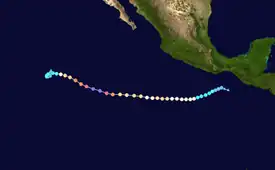
Tropical storm (39–73 mph, 63–118 km/h)
Category 1 (74–95 mph, 119–153 km/h)
Category 2 (96–110 mph, 154–177 km/h)
Category 3 (111–129 mph, 178–208 km/h)
Category 4 (130–156 mph, 209–251 km/h)
Category 5 (≥157 mph, ≥252 km/h)
Unknown


 Extratropical cyclone, remnant low, tropical disturbance, or monsoon depression
On June 5, 2010, a tropical wave exited western Africa and traversed westward across the Atlantic Ocean. The system eventually crossed Central America and entered the Pacific Ocean on June 17. Thereafter, the thunderstorms increased along the wave axis as the system moved toward the west-northwest, steered by a ridge to the north. A low-pressure area formed on June 18, which continued to organize. Around 18:00 UTC that day, Tropical Depression Four-E developed about 370 mi (590 km) southeast of Acapulco, Mexico. The thunderstorms diminished before redeveloping and becoming better organized. Around 12:00 UTC on June 19, the National Hurricane Center (NHC) to upgrade the depression to Tropical Storm Celia. Around that time, the storm had an eye-like feature, consisting of a ring of convection around the circulation. which continued to organize within the central dense overcast. Celia moved generally to the west to west-southwest and continued to intensify despite northeasterly wind shear. At 18:00 UTC on June 20, Celia attained hurricane status, with maximum sustained winds of 75 mph (120 km/h).[1][2]
Wind shear displaced the circulation and restricted outflow.[3] On June 22, Celia strengthened to a Category 2 on the Saffir-Simpson scale. It weakened slightly the next day, and the eye became no longer visible on satellite imagery.[1][4] The following morning, the eye reformed and the storm became more vertically aligned, allowing Celia to re-attain Category 2 status on June 23. The hurricane briefly weakened again as the eye dissipated. On June 24, the wind shear decreased, allowing Celia to restrengthen again as the eye reformed and became symmetrical. At 00:00 UTC on June 25, Celia attained maximum sustained winds of 160 mph (255 km/h) and a barometric pressure estimated at 921 mbar (hPa; 27.20 inHg). This made it a Category 5 on the Saffir-Simpson scale, the first Pacific hurricane of that intensity since Hurricane Ava in 1973. At its peak, Celia had a well-defined eye estimated to be 17 to 23 mi (27 to 37 km) in diameter. After maintaining peak winds for about 12 hours, Celia began weakening due to cooler waters and higher wind shear. On June 27, it fell to tropical storm status as the track slowed and shifted to the west-southwest, after the ridge weakened that was previously guiding Celia. The storm lost all convection on June 28, and degenerated into a remnant low. The remnants of Celia executed a small loop before drifting to the north and dissipating on June 30, located about 990 mi (1,590 km) southwest of the southern tip of Baja California Sur.[1][5]
Impact
During Celia's early development stages, it brought moderate rainfall to parts of Oaxaca and Guerrero.[6] Beaches in both states increased the number of lifeguards on duty due to the threat of rip currents.[7] The Sistema Nacional de Protección Civil (National System of Civil Protection) raised the alert level to stage two for coastal areas of Jalisco, Michoacán, and Colima.[8][9] A precautionary alert was issued for Socorro Island.[10] Between June 22 and 23, the outer bands of the storm brought unsettled weather to France's Clipperton Island.[11]
See also
References
- 1 2 3 4 Todd B. Kimberlain (October 6, 2010). "Hurricane Celia Tropical Cyclone Report" (PDF). National Hurricane Center. Retrieved October 8, 2010.
- ↑
- Daniel Brown; Eric S. Blake (June 17, 2010). "Tropical Weather Outlook". National Hurricane Center. Retrieved August 1, 2026.
- Jack Beven (June 18, 2010). "Tropical Weather Outlook". National Hurricane Center. Retrieved August 1, 2026.
- Stacy Stewart and Michael Brennan (June 19, 2010). "Tropical Storm Celia Discussion Two". National Hurricane Center. Archived from the original on October 24, 2012. Retrieved July 3, 2010.
- Jack L. Beven (June 19, 2010). "Tropical Storm Celia Discussion Four". National Hurricane Center. Archived from the original on October 24, 2012. Retrieved July 3, 2010.
- ↑ Daniel Brown (June 21, 2010). "Hurricane Celia Discussion Eleven". National Hurricane Center. Archived from the original on October 24, 2012. Retrieved July 3, 2010.
- ↑ David Roberts and Lixion A. Avila (June 22, 2010). "Hurricane Celia Discussion Sixteen". National Hurricane Center. Archived from the original on August 19, 2014. Retrieved July 8, 2010.
- ↑
- John Cangialosi and Stacy Stewart (June 23, 2010). "Hurricane Celia Discussion Eighteen". National Hurricane Center. Archived from the original on August 19, 2014. Retrieved July 8, 2010.
- Todd Kimberlain (June 23, 2010). "Hurricane Celia Discussion Twenty". National Hurricane Center. Archived from the original on October 24, 2012. Retrieved July 8, 2010.
- John Cangialosi and Richard J. Pasch (June 24, 2010). "Hurricane Celia Discussion Twenty-Two". National Hurricane Center. Archived from the original on October 24, 2012. Retrieved July 8, 2010.
- Jack L. Beven (June 25, 2010). "Hurricane Celia Discussion Twenty-Five". National Hurricane Center. Archived from the original on October 24, 2012. Retrieved July 8, 2010.
- David Roberts and Lixion A. Avila (June 25, 2010). "Hurricane Celia Discussion Twenty-Six". National Hurricane Center. Archived from the original on October 24, 2012. Retrieved July 8, 2010.
- ↑ "Aviso 6 de la Tormenta Tropical Celia 20/jun/2010 10:30 h." (in Spanish). Comisión Federal de Electricidad. June 20, 2010. Archived from the original on August 30, 2010. Retrieved June 25, 2010.
- ↑ Pablo Martín Obregón (June 21, 2010). "Huracán 'Celia' pasa por Guerrero sin dejar daños" (in Spanish). Noticieros Televisa. Archived from the original on March 14, 2012. Retrieved June 25, 2010.
- ↑ NTX and BNP (June 22, 2010). "Jalisco alerta por huracán Celia" (in Spanish). Informador. Archived from the original on March 10, 2012. Retrieved June 25, 2010.
- ↑ Notimex (June 22, 2010). "Emite PC alerta azul en costas michoacanas debido al huracán Celia" (in Spanish). Cambio de Michoacán. Archived from the original on February 24, 2012. Retrieved June 25, 2010.
- ↑ J.Manuel Muñoz and MI Héctor Eslava Morales (June 22, 2010). "Huracán "Celia" Categoría 2 Del Oceano Pacifico" (in Spanish). CENAPRED. Archived from the original on March 9, 2012. Retrieved June 25, 2010.
- ↑ Giuseppe Tito (June 25, 2010). "Uragano Celia tocca la categoria 5, la massima" (in Italian). Meteo Live. Archived from the original on July 22, 2011. Retrieved June 25, 2010.
External links

- The National Hurricane Center's Eastern Pacific Main Page
- The National Hurricane Center's Advisory Archive for Hurricane Celia
| 1950s | |
|---|---|
| 1970s | |
| 1990s | |
| 2000s | |
| 2010s | |
| 2020s | |


Tropical cyclones of the 2010 Pacific hurricane season | ||
|---|---|---|
 | ||