Horní Bříza
Horní Bříza | |
|---|---|
 Aerial view | |
 Flag  Coat of arms | |
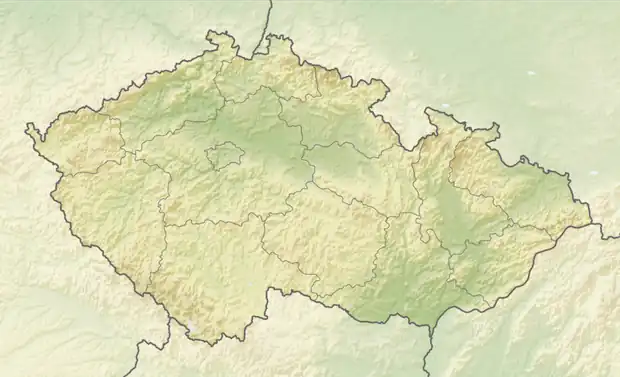  Horní Bříza Location in the Czech Republic | |
| Coordinates: 49°50′39″N 13°21′48″E / 49.84417°N 13.36333°E | |
| Country |  Czech Republic |
| Region | Plzeň |
| District | Plzeň-North |
| First mentioned | 1180 |
| Government | |
| • Mayor | David Kapr |
| Area | |
• Total | 14.55 km2 (5.62 sq mi) |
| Elevation | 367 m (1,204 ft) |
| Population (2026-01-01)[1] | |
• Total | 4,041 |
| • Density | 277.7/km2 (719.3/sq mi) |
| Time zone | UTC+1 (CET) |
| • Summer (DST) | UTC+2 (CEST) |
| Postal code | 330 12 |
| Website | www |
Horní Bříza (German: Ober Birken) is a town in Plzeň-North District in the Plzeň Region of the Czech Republic. It has about 4,000 inhabitants.
Etymology
The name Bříza means 'birch' in Czech. The settlement was founded near some notable birch tree. The prefix Horní ('upper') served to distinguish it from nearby Dolní Bříza ('lower Bříza'; today known as Břízsko, part of Kozojedy) and Německá Bříza (today known as Česká Bříza).[2]
Geography
Horní Bříza is located about 8 kilometres (5 mi) north of Plzeň. It lies in the Plasy Uplands. The highest point is at 492 m (1,614 ft) above sea level. The Bělá Stream flows through the town.
History
The first written mention of Horní Bříza is from 1180. Around 1220, the village was donated to the monastery in Plasy.[3]
The appearance of Horní Bříza changed after the great fire in 1865 and also with the construction of the railway line in the years 1871–1873. However, a significant turning point did not occur until the 1880s, when kaolin was discovered here. In 1882, Johann Fitz, a prominent businessman and mining expert from Rokycany, began with its mining. In 1886, he introduced the production of ceramic goods and founded a company which maintained dominant position in the ceramics industry for hundred years.[3]
World War II
During World War II, some death trains taking Jews, outspoken people, gypsies, intellectuals, communists and Russian prisoners travelled through Horní Bříza. It was on the route to Mauthausen concentration camp, further south on the Danube River. On 21 April 1945, a death train stopped here as the line was blocked. The station master Antonín Pavlíček intervened and organised the townspeople to cook food and bread for the about 1,000 women being taken to Mauthausen. He asked the SS to leave the people there so the town could care for them, but they refused.[4]
Demographics
Historical population | ||||||||||||||||||||||||||||||||||||||||||||||||||||||||
|
|
| ||||||||||||||||||||||||||||||||||||||||||||||||||||||
| Source: Censuses[5][6] | ||||||||||||||||||||||||||||||||||||||||||||||||||||||||
Transport

Sights
The only protected cultural monuments in Horní Bříza are the Chapel of Saint Peter, built in the pseudo-Baroque style in 1840, and the Memorial to the Victims of World War II.[8]
Notable people
- Zdeněk Bláha (1929–2025), composer, editor and bagpiper
Twin towns – sister cities
Horní Bříza is twinned with:[9]
 Villeneuve-sur-Yonne, France
References
- ↑ "Population in municipalities as at 1. 1". DataStat. Czech Statistical Office. 2026-05-18.
- ↑ Profous, Antonín (1947). Místní jména v Čechách I: A–H (in Czech). pp. 195–196.
- 1 2 "Krátce z historie" (in Czech). Město Horní Bříza. Retrieved 2022-09-22.
- ↑ Holden, Wendy (2015). Born Survivors: Three Young Mothers and Their Extraordinary Story of Courage, Defiance, and Hope. Brown Book Group Limited. ISBN 9780751557398.
- ↑ "Historický lexikon obcí České republiky 1869–2011" (in Czech). Czech Statistical Office. 2015-12-21.
- ↑ "Population Census 2021: Population by sex". Public Database. Czech Statistical Office. 2021-03-27.
- ↑ "Station details Horní Bříza". České dráhy. Retrieved 2026-08-04.
- ↑ "Výsledky vyhledávání: Kulturní památky, obec Horní Bříza". Ústřední seznam kulturních památek (in Czech). National Heritage Institute. Retrieved 2026-08-04.
- ↑ "Partnerství mezi městy Horní Bříza a Villeneuve sur Yonne" (in Czech). Město Horní Bříza. Retrieved 2026-08-04.
External links
