History of capoeira

The history of capoeira explores the origins and development of capoeira, a Brazilian martial art and game that combines elements of dance, acrobatics, combat, and music.
Capoeira developed among Africans in Brazil during the colonial period. The origins of capoeira remain debated among historians and researchers, including whether it developed primarily in Brazil from African traditions or preserved elements from specific African combat practices. According to the oral tradition of old capoeira mestres and many practitioners, capoeira has origins connected to Angola, particularly among Bantu-speaking peoples such as the Mbundu people of the former Kingdom of Ndongo.
Some studies have identified engolo, an Angolan combat game practiced in the Cunene region, as a possible ancestral influence on capoeira. Researchers have pointed to similarities between engolo and capoeira movements, including crescent kicks, push kicks, sweeps, handstands, cartwheels, evasions, and techniques such as meia lua de compasso, scorpion kick, and L-kick. However, the extent of the historical relationship between engolo and capoeira remains debated, and some authors argue that other African and Brazilian influences also contributed to the formation of capoeira.
Rio de Janeiro became an important center of capoeira during the 19th century, where the urban practice known as capoeira carioca developed in association with groups known as maltas. This form of capoeira was often linked to violent confrontations and incorporated techniques such as headbutts, kicking, punching, and knife-fighting. This historical style gradually disappeared during the 20th century.
In the early 1930s, Mestre Bimba developed and codified the Regional style of capoeira in Salvador, Bahia, helping to transform capoeira into a more socially accepted practice. In 1941, Mestre Pastinha founded the Capoeira Angola school, organizing and preserving traditional forms of capoeira while distinguishing them from Mestre Bimba's reforms and the sport-oriented approach. Despite their differences, both masters introduced major innovations — they moved training and rodas from the streets into organized schools, established teaching methods, adopted uniforms, began teaching women, and presented capoeira to broader audiences.
From the 1970s onward, capoeira gained wider acceptance throughout Brazil and expanded internationally, including to the United States and other countries. During the 1980s, there was also renewed interest among practitioners and researchers in the African origins and cultural heritage of capoeira.
16th and 17th centuries: Enslavement of Africans in Brazil

From the 16th century, Portuguese colonists transported enslaved Africans from different regions of Africa to Brazil, including significant numbers from West Central Africa, particularly from areas corresponding to present-day Angola and the Kingdom of Kongo. Angola and the Kongo region became major sources of enslaved Africans within the Portuguese Atlantic trade. During the 17th century, Portuguese colonial expansion intensified in parts of Central Africa, including the establishment of Benguela in 1617.[2]
Some researchers have suggested that combat traditions associated with engolo, practiced in southwestern Angola, may have influenced the development of capoeira in Brazil. However, enslaved Africans brought to Brazil came from diverse regions and cultural backgrounds, and the extent of engolo's contribution to the formation of capoeira remains debated.[3]
The main economic activity in colonial Brazil was sugar production. Portuguese colonists established large plantations known as engenhos, which relied heavily on enslaved labor. Enslaved people lived under harsh conditions, performing forced labor and facing physical punishment and other forms of violence.[4]
However, enslaved people who escaped captivity established settlements in remote areas known as kilombo, a term of Kimbundu Bantu origin associated with military and social organizations.[5] Portuguese sources described the difficulty of capturing people from quilombos, mentioning that they defended themselves with a "strangely moving fighting technique".[6]
Some quilombos developed into autonomous communities, with Quilombo dos Palmares becoming the largest and lasting for nearly a century (1605–1694).[6] Quilombos attracted enslaved people who escaped captivity, Indigenous peoples, and Europeans fleeing colonial authorities.[6]
Life in quilombos provided greater autonomy compared to plantation slavery. Anibal Burlamaqui proposed that capoeira originated in the quilombos of Palmares, developing from the need of Africans to defend themselves. However, historical sources indicate that Palmares fighters also relied on weapons, including firearms.[7] Some researchers, including T. J. Desch-Obi, have discussed the possibility that combat traditions within quilombo communities contributed to the development of capoeira, although direct evidence that capoeira or a specific precursor was practiced at Palmares remains debated.[8]
African origins and the engolo hypothesis
Oral tradition
Capoeira originated among Africans in Brazil and for a long time was transmitted primarily through oral tradition within Afro-Brazilian communities. There is a long-standing debate over whether capoeira originated principally in Africa or whether it developed into a distinct martial art in Brazil through the interaction of multiple African traditions and local historical circumstances.
Capoeira came from Africa brought by the African. We all know this.[9]
Well, there is one thing that nobody doubts: the ones to teach capoeira to us were the negro slaves that were brought from Angola.[10]

As with other Afro-Brazilian traditions, oral communication formed the basis for the transmission of knowledge in capoeira.[11] According to the old capoeira mestres and the oral tradition within the community, capoeira originated in Angola.[10][12] This tradition has been widely documented by masters and scholars, although its historical interpretation remains debated. While many researchers regard it as evidence supporting an Angolan origin, others argue that capoeira took shape primarily in Brazil through the interaction of multiple African traditions brought by enslaved Africans from different regions of the continent.[13]
The very name Capoeira de Angola (Angolan capoeira), together with older names such as jogo de Angola (Angolan game) and brincar de angola (playing angola), reflects this oral tradition.[14] Several traditional capoeira rhythms refer to Angola, including Angola, Benguela and São Bento (the patron saint of Angola), while African references in capoeira songs frequently mention Angola.[8] The capoeira drum and the musical bow, together with its style of performance, have also been identified by scholars as having Angolan provenance.[8]
In the 19th century, Pires de Almeida, João do Rio and Manuel Raimundo Querino all stated that capoeira was brought from Angola to Rio ("from the lands of Congo").[15] Mestre Pastinha, who learned capoeira from a teacher born in Angola, often stated that the original art came from Angola: "Capoeira undoubtedly came to Brazil with the African slaves. It was a form of battle with unique characteristics that have been preserved to this day."[16]
Contemporary research, interpretation, and historical reconstruction

Several researchers have identified close similarities between many core capoeira techniques and those found in the African martial art engolo, including rasteira, rabo de arraia, chapa de frente, chapa de costas, meia lua de frente, scorpion kick, cartwheel kick, and others.[17][18]
In the mid-20th century, the painter Neves e Sousa brought detailed drawings of n'golo from Angola to Brazil, documenting a martial art with notable similarities to capoeira.[19] His work renewed scholarly interest in the relationship between engolo and capoeira. Since then, several studies have supported the oral tradition by identifying engolo as one of the principal African martial traditions associated with capoeira and locating the Cunene region as the area where engolo was documented.[20][21][22]
According to T. J. Desch-Obi, no documented martial art shares a closer technical repertoire of kicking techniques with capoeira than engolo.[15]
18th century: Spread of capoeira to cities and repression

One of the earliest descriptions of inverted movements in Brazil comes from an 18th-century Bahia Inquisition record involving a free African man named João, who was described as becoming "possessed" and communicating with ancestors. One reported practice involved him having to "walk on one foot, throwing the other one violently over his shoulder."[23]
During the second half of the 18th century, practices associated with African-derived combat traditions were present among Black communities in Brazilian cities. Some researchers have proposed connections between these traditions and engolo, an Angolan combat art documented in the Cunene region, although the extent of its influence on the development of capoeira remains debated.[3]
The term playing angola was also associated with African-derived practices, and both angola and engolo have been linked linguistically to Bantu origins.[24] Within capoeira traditions, names such as jogo de Angola were later used to emphasize connections with African ancestry and memory.[9]
Displays of martial practices and even acrobatics among Black people were often viewed with suspicion and subject to repression by colonial authorities.[25] During the 1780s, a free African man in Rio was reported to the Inquisition for "witchcraft." One element cited in the accusation was his ability to perform hand walking, which was interpreted within a religious and ritual context.[23]
By the end of the 18th century, the term capoeira began to appear in Brazilian records to describe practices associated with Black communities, particularly fighting and physical skills performed in urban and rural settings.[26] The origin of the name remains debated, although one explanation connects it to forest clearings where enslaved and formerly enslaved Africans practiced their skills.[27]
The term "capoeira" appears in a judicial record from 1789, which describes the punishment of a young man named Adão for being identified as a capoeira:
A fight had occurred between capoeiras, and one of them had been murdered. According to the law of the kingdom, the gravest of crimes was the practice of capoeiragem [...] Adão was innocent regarding the murder charge, but his status as a capoeira was confirmed. As punishment he was to receive five hundred lashes and two years in public works.[23]
— A judicial record from 1789.
Capoeira was practiced in senzalas (slave quarters), rural plantations, and urban Black communities. By the late 18th century, police and judicial records documented capoeira-related activities in cities such as Rio de Janeiro, Salvador, and Recife. Colonial authorities attempted to suppress these practices through punishments, arrests, and other forms of repression.[28]
Debate on the Origins, Development, and Influences of Capoeira
The origins and development of capoeira remain a subject of academic debate. Many authors argue that its exact origins cannot be attributed to a single source, viewing capoeira as a synthesis of fighting practices, dances, music, and cultural traditions that developed among African-descendant communities in Brazil during the colonial period. While some practitioners historically referred to the activity as angola or brincar de angola ("playing angola"), formal records from the late 18th century used the term capoeiragem, with practitioners being known as capoeiras. Over time, the practice became widely known as capoeira, and its practitioners as capoeiristas.[29]
By the late 19th century, some authors began to question theories of African origins. In 1886, Plácido de Abreu rejected the oral tradition, arguing that no similar practice was known in Africa at the time.[30] During the early 20th century, capoeira was promoted as a Brazilian national practice and reinterpreted as a national martial art.[31][32] Some writers and politicians presented capoeira as a uniquely Brazilian creation, while others continued to emphasize African influences. Inezil Penna Marinho, for example, argued in 1936 that capoeira had been brought to Brazil by enslaved Bantu peoples.[33]
The oral tradition preserved among older capoeira masters frequently associates the art with Africa, particularly with Angola and the broader West Central African region. Names such as Capoeira Angola, jogo de Angola and brincar de Angola reflect this historical memory. However, these references do not necessarily indicate that capoeira was transferred unchanged from a single African location. Enslaved Africans brought to Brazil came from diverse regions of Africa, including areas corresponding to present-day Angola, the Kingdom of Kongo, and other parts of West and Central Africa.
Nestor Capoeira describes capoeira as "a synthesis of dances, fights and musical instruments from different cultures, from different African regions, created on Brazilian soil", especially during the 19th century.[34] He argues that capoeira should not be attributed to a single place or tradition, but understood as a complex cultural formation shaped by multiple influences. African cultural elements were transformed within Brazil, producing a distinct practice that developed through the rodas and broader social experiences.[35][36]
Some researchers, including T. J. Desch-Obi, have argued that the Angolan martial art engolo contributed significantly to the development of capoeira. Based on similarities in movements such as kicks, sweeps, inverted positions, and evasive techniques, Desch-Obi proposes that elements associated with engolo were transformed within the Brazilian context through the experiences of enslaved Africans and their descendants.[37] He argues that martial arts can spread through the migration of even a small number of practitioners introduced into a new region.[38] According to his interpretation, many characteristic capoeira movements, including crescent and pushing kicks, inverted positions, sweeps, and acrobatic evasions, show strong similarities with techniques found in engolo.[39] He also identifies headbutting, associated with the African practice jogo de cabeçadas, as one of the additional elements incorporated into capoeira.[40]
However, Matthias Röhrig Assunção questions whether engolo alone can explain the origins of capoeira. He notes that available ethnographic evidence identifies engolo primarily among the Nkhumbi people of southern Angola and questions how a practice associated with a relatively limited ethnic group could have become a major influence on a Brazilian tradition formed among diverse African-descendant communities. He proposes that capoeira may have developed from a wider range of Central African combat traditions brought across the Atlantic, or that elements of engolo may have contributed to its formation while being transformed through interaction with other African traditions in Brazil. Assunção emphasizes that there is currently no conclusive evidence demonstrating that engolo alone was the direct ancestor of capoeira.[13]
For Assunção, "capoeira is much more than engolo."[13] He suggests that other African traditions may also have contributed to its formation, including Moraingy, a combat game from Madagascar.[41]
I propose that the jogo de capoeira is both derived from an Angolan tradition and also a uniquely Brazilian expression of this tradition. Just as the version of jiujitsu developed in Brazil can be accurately termed Brazilian Jiu Jitsu without the need to deny its direct evolution from Japanese Jiu Jitsu.[42]
— M. Thomas J. Desch-Obi
Similarly, Maya Talmon-Chvaicer argues that fighting techniques, games, and dances from West Central Africa likely influenced the development of capoeira through the Atlantic slave trade, particularly through connections with the Congo-Angola region.[43]
Thus, contemporary research generally does not describe capoeira either as an unchanged survival of a single African martial art or as an entirely independent Brazilian invention. Instead, it is understood as a cultural expression formed in Brazil through the transformation of African traditions, social experiences under slavery, and historical developments within the Atlantic slave diaspora.
19th century: Capoeira gangs of Rio de Janeiro
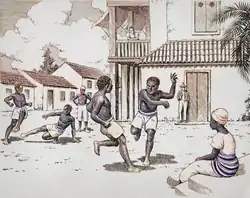
At the beginning of the 19th century, prince Dom João VI, along with the royal court, moved to Rio de Janeiro. Due to city growth, more slaves were brought to manufactures.[44] More slaves were sent from Southern Angola to Rio de Janeiro than from any other region of Africa.[15] Urban slaves usually worked without direct supervision, looking for employment and paid a portion to their master. That fostered the common practice of capoeira among them during and after work.
A violent slave game
In March 1814 the police chef saw violent capoeiras in the street, in the time where prince was passing by. They were "with knives and sticks and with the ribbons they sometimes use to come out, causing great mayhem and shouting".[45] The police depicted capoeiragem as a well-organized network of territorial groups with their symbols and slang. According to a police report from 1815, the red hat was the symbol of the capoeristas. Some arrested capoeiras wore colored ribbons, especially yellow and red, associated with Kongo/Angola religions. They also commonly wear hats or caps, and on occasion, feathers. These items may have signified their ethnic identity, but it is unclear if they indicated gang affiliation. Some even were arrested for "walking as capoeiras."[46]

Whistling was the way capoeiristas signaled each other.[47] In 1817, the police declared strict penalties for possession of knives, and the same for those "whistling and with sticks", including 300 lashes (for slaves only) and three months of forced labor:
The same penalty will apply to all those who roam around the city, whistling and with sticks, committing disorder most of the times with no aim, and which are well known by the name of capoeiras, even if they do not provoke any injuries or death or any other crime […] [45]
In 1817 one officer required the arrest of "all the negros and mulattos" that "entertain themselves in capoeiragem games" in seven different locations in the city.[48] In 1821, the Military Commission of Rio de Janeiro wrote to the Minister of War about the "urgent necessity of punishing, without delay and in public, the negros capoeiras caught by the military school while provoking disorders". The letter also reported "six deaths and many knife wounds have been caused by these capoeiristas".[49] On 6 February 1822, Emperor Pedro I pledged four days leave to any soldier who caught a capoeirista.[50]
Between 1822 and 1825, the Bavarian painter Johann Moritz Rugendas describes capoeira as a headbutting game:
The Negroes also have another war game, much more violent, the jogar capoera: two champions charge against each other, and seek to hit with their head the chest of the opponent they want to throw to the ground. By jumps on the side, or equally skilful parries they escape from the attack; but by throwing themselves against each other, more or less like he-goats, they sometimes get badly hurt at the head: therefore one sees often the jesting being displaced by fury, to the point that blows and even knives stain the game with blood.[51]

In 1829, law limited the number of lashes for a slave to fifty per day. But exceptions were made for two major threats to the system: quilombolas and capoeiras, who were publicly whipped at pillars in Campo de Santana squares as a deterrent.[52] In July 1831, a police patrol encountered a group of over 200 "blacks and mulattoes" engaged in a battle in the Catete suburb. They paused their fight and threw stones at the patrol, injuring its leader. When the patrol charged, they split into their distinct factions and dispersed in opposite directions. This incident implies a level of organization within the capoeira groups, during that period.[47] This street-fighting capoeira was mix of various fighting techniques: foot kicks, head butts, hand blows, knife fight and stick-fighting.[53] Only the kicks arguably originated from the Angolan art.[40]
Mid-19th century: Increase in capoeira violence
Reverend James Fletcher, who visited Rio during the 1850s, characterized capoeira leaders as those with the most people killed.[54] In a police report from February 1854, it was noted in only one afternoon "capoeiras committed seven murders in the parish of Santa Anna".[55] The folklorist Mello Moraes describes how capoeiras violently interrupted public events in the mid-19th century Rio:
Sometimes, interrupting the course of a procession, or the pace of a parade, one could hear, jointly with screams of the ladies fleeing in terror, of negras carrying the young master in their arms, of fathers seeking refuge for their wife and children, the horrendous ‘Shut down! Shut down’. The caxinguelés [capoeira apprentices] flew at the front, capoeiragem exploded without restraints, and the mayhem resulted in broken heads, shattered light posts, stabbings and deaths.[56]
Police data from the mid-19th century shows that capoeira was the main reason for the arrests:

"From 288 slaves that entered the Calabouço jail during the years 1857 and 1858, 80 (31%) were arrested for capoeira, and only 28 (10.7%) for running away. Out of 4,303 arrests in Rio police jail in 1862, 404 detainees—nearly 10%—had been arrested for capoeira."[57]
Standard punishment for imprisoned capoeiras were whipping (for slaves only) and forced labour in the dockyards.[47]
On rural estates capoeira was played as a form of entertainment. In 1859, French journalist Charles Ribeyrolles described Afro-Brazilian free practices on a fazenda in Rio de Janeiro province:
Saturday evening, after the last working task of the week, and on holidays that give idleness and rest, the blacks have an hour or two of the evening for dancing. They assemble in their terreiro, calling, gathering and inciting each other, and the celebration starts. Here it is the capoeira, a kind of Pyrrhic dance, with daring combat evolutions, regulated by the Congo drum; there it is the batuque, with its cold or indecent postures which the urucungo, viola with thin cords, accelerates or contains; further away it is a frenzied dance where the gaze, the breasts and the hips provoke. It is a kind of inebriated convulsion one calls the lundu.[56]
During the 1860s the capoeira gangs suffered severe disruption due to the draft for Paraguayan War. The police chief had made clear he wanted to use recruitment to clean the city of its capoeiras.[48] However, in Rio alone 2900 slaves were freed because of their participation in the war, among them numerous capoeiras.[48]
1870s-1880s: The war of Nagoas and Guaiamos
By the 1870s the capoeira gangs formed two main maltas: Nagoas and Guaiamos, organized by city parishes.[30] Guaiamú has parties such as Saint Francis, Saint Rita, Ouro Preto, Marinha, and Saint Domingos de Gusmão. Their color was red. Nagoa has parties like Saint Lucia, Saint Joseph, Lapa, Saint Anne, and Moura. They color was white. Many workers wearing these colors were often targeted with violence.[30] These parties had leaders, assistants, policemen and rank-and-file soldiers,[30] which indicates military principles in gang culture.[58] Moreover, many capoeiras served as policemen, National Guards or soldiers.[59]
Both gangs held regular Sunday exercises, with knife and razor blows:

The most famous capoeiras served as instructors for the newcomers. At first, the blows were rehearsed, making use of the clean hand; when the disciple took advantage of the lessons, they began to be rehearsed with wooden weapons and finally they made use of their very blades, and the place of the exercises often became bloody.[30]
Street battles among maltas were exceptionally brutal, marked by the use of all available weapons like clubs and knives, frequently resulting in a high number of casualties.
The Nagoas and Guaiamuns were used, respectively, as a hitforce by the Conservative and Liberal party.[60] Republican party, founded in 1870, party was among the rare political entities consistently opposed the maltas. The major political incident occurred in 1873, when capoeira gangs violently broke republican meeting, inspired by the declaration of a republic in Spain.
In 1881 the majority of the arrested capoeiras (60%) were free citizens (usually workers), against 40% slaves.[56] In 1885, whites represented at least 22% of the arrested capoeiras, increasing to 33% in 1890, blacks counted for 36% and 30% respectively, while others not being qualified in terms of colour.[61]
1880s-1890s: Political violence and the ban on capoeira
On 13 May 1888 slavery ended in Brazil with the Golden Law, signed by Princess Isabel.[62] Immediately after, the Brazilian Imperial regime formed the Black Guard (Guarda Negra), secret paramilitary organization composed of freed African slaves and capueristas.[63] The purpose was to ensure the Princess Isabel's accession to the throne, in opposition to the rising Republican movement.[64] The Guarda Negra capoeiristas did horrible crimes, violently disrupting both private and public gatherings of republicans. The greatest assault occurred on 30 December 1888, during the republicans’ gathering at the French Gymnastic Society. When Silva Jardim began his speech, the room became a battleground, with many dead and wounded.[65]
On 15 November 1889, the First Brazilian Republic was proclaimed. Following the coup, the Republicans implemented strict measures against gangs. In merely a week, 111 capoeiras were arrested.[59] In 1890, new Republic decreed the prohibition of capoeira in the whole country.[66]

To engage in exercises of agility and physical dexterity known as capoeiragem in public streets and squares; to engage in running with weapons or instruments capable of causing bodily harm, inciting riots or disorders, threatening specific or unspecified individuals, or instilling fear of harm: Penalty – imprisonment for two to six months. For leaders or heads, the penalty shall be doubled.[67]
— Penal Code of the United States of Brazil (1890), On Vagrants and Capoeira
During the prohibition, any individual caught practicing capoeira would be arrested. Street rodas seemingly vanished, although remnants might have endured in certain shantytowns or working-class neighborhoods.[68] The capoeira was slowly extinguished in Rio and Recife, preserved only in Bahia.
It was during this period that legendary capoeira fighters, such as Besouro in Bahia, Nascimento Grande in Recife and Manduca da Praia in Rio, made their fame.[69]
20th century

Early 20th century, 1910s, and 1920s
At the beginning of the 20th century, some capoeira teachers attempted to bypass the ban by incorporating elements from gymnastics and other legal martial arts, such as judo. Professor Mario Aleixo was the first in showing a capoeira "revised, made bigger and better", which he mixed with judo, wrestling, jogo do pau and other arts to create Defesa Pessoal (Personal Defense).[70][71] In 1928, Anibal "Zuma" Burlamaqui published the first capoeira manual, Ginástica nacional, Capoeiragem metodizada e regrada, where he also introduced boxing-like rules for capoeira competition. It was greatly influential, being even taught at academies.[71] Inezil Penha Marinho published a similar book.[70] Felix Peligrini founded a capoeira school in the 1920s, intending to practice it scientifically.[71]
1930s: Legalization and birth of capoeira regional
Mestre Sinhozinho from Rio de Janeiro created a training method in 1930 that divested capoeira from all its music and traditions in the process of making it a complete martial art.[72] While those efforts helped to keep capoeira alive,[72] they also led the traditional form of capoeira to decline.[70]
State repression of capoeira was reduced when Getúlio Vargas took power in 1930.[73] In the early 1930s Mestre Bimba, a traditional capoeirista with both legal and illegal fights in his records, founded his school in Salvador, Bahia. He developed systematic training method for capoeira, including traditional elements of music and dance, as well as new elements from other martial arts.[74] Advised by Cisnando, Bimba called his style luta regional raiana (regional Bahian fight), because capoeira was still illegal.[75] In 1937, Bimba founded Centro de Cultura Física e Luta Regional, with permission from Salvador's Secretary of Education. His work was very well received, and he taught capoeira to the cultural elite of the city.[75] This style of capoeira teaching has been called an academy, based on specialized public classes. As anthropologist Greg Downey writes, "With the advent of the academy, capoeira became legal: what had been a crime was transformed into physical education."[76]
Mid-20th century: Birth of Capoeira Angola and national popularity
Reacting to a series of reforms, which changed capoeira almost beyond recognition, Mestre Pastinha decided to preserve and popularize the traditional African style known as capoeira de Angola,[77][78] from which the reformers distanced themselves. In the 1941, he founded his Centro Esportivo de Capoeira Angola (CECA), in the Salvador neighborhood of Pelourinho, which attracted many traditional capoeiristas. The term capoeira Angola was derived from brincar de angola ("playing angola"), the term used in the earlier days.[14] The name was used by other masters too, including those not part of Pastinha's school.[14] Other icons of the capoeira Angola at that time include Waldemar, Cobrinha Verde and Gato Preto.[79]

It was through the academia system that capoeira spread throughout Brazil.[80] From the 1950s onward, Bahian capoeira styles, Regional and Angola, gained nationwide popularity in Brazil. Many Bahian migrants in Rio de Janeiro began teaching capoeira.[81] In 1953, President Vargas called capoeira Brazil's "one true national sport."[82]
In the 1950s and 1960s, the city of Salvador's Tourism Office sponsored capoeira shows. However, these were meant to be amusing and lacked authenticity.[83] Ethnographer Waldeloir Rego reports that in the 1960s capoeira practitioners frequently performed in front of bars in return for money or beer.[84] However, over the course of the 1960s Bimba's more combative regional style spread through the country and became the dominant form of capoeira practice.[85]
1970s and 1980s
On 26 December 1972, the Brazilian government recognized capoeira as an official sport.[86] During the early 1970s, the military regime tried to regulate capoeira, aiming to turn it into a national gymnastics. In 1972, the Confedederação Brasileira de Pugilismo (CBP) (Brazilian Boxing Confederation) introduced Technical rules of capoeira, regulating kicks, ethics, uniforms, competitions, and standardizing student levels.[87] Belts in the colors of the Brazilian flag were used for student identification. Initially allowing most movements, head butts were banned due to accidents, and games became more regulated. Salve! before or after classes and displaying a Brazilian flag became mandatory. Spontaneous rodas after tournaments were forbidden.[81] In 1974, the Boxing Confederation promoted the first national capoeira competition in Rio de Janeiro.[88]
All these attempts to control capoeira by the state were far from successful.[89] Capoeira's practice spread nationwide in the 1970s and 1980s, with the growth of groups like Muzenza. This made the profession of capoeira teachers more attractive, particularly for black and poor males without formal education.[81] Beginning in the early 1970s, there was increasing participation by women in the game.[90]
In the mid-1970s, the Senzala Group of Rio became particularly influential. As Nestor Capoeira characterizes them, these were young men primarily of the white middle class who trained intensively. This group was also in conversation with the larger Brazilian martial arts scene, which included leaders and innovators in karate and jiu-jitsu.[91] There was some debate about capoeira losing its roots in the Black community and its history. In 1979, capoeira was the theme of a Brazilian film titled Cordão de Ouro.[92]
In the 1980s, there was a turn toward investigating the authentic roots of capoeira and resisting systematic athleticism in its culture.[93] Capoeira angola became more popular, linked to a broader movement to revive Afro-Bahian popular culture.[94] The capoeira organization Grupo de Capoeira Angola Pelourinho (GCAP) criticized a perceived "whitening" of capoeira and emphasized musicality over self-defense or athletic display.[95] This was linked to the Bahian Carnival movement.[96] Capoeira also appeared in the 1984 film Quilombo, about the Palmares community of escaped slaves in the 17th century.[97]
1990s
In the mid-1990s, some capoeira practitioners integrated kicks and grappling from other martial arts, leading to a more aggressive style. There was national controversy in 1996 when one man died after suffering a punctured lung in a roda.[98]
At the same time, capoeira became more professionalized and more common in health clubs and gymnasiums.[99]
International spread of capoeira
Artur Emídio is likely the first capoeirista to perform abroad, traveling to Americas and Europe during the 1950s and early 1960s. Nestor Capoeira likely became the first to teach capoeira in Europe. After receiving his red belt, he ventured abroad, teaching in London in 1971 and touring European cities for three years.[100] Since the 1970s, Mestre Lucídio taught capoeira in Japan. Jelon Vieira began teaching capoeira in New York City in 1975. He founded the Capoeira Foundation in the U.S. in 1976.[101] Demonstrations by Vieira may have inspired the incorporation of some capoeira movements into breakdancing.[102] Bira Almeida, Mestre Bimba's student, settled on the West Coast of the United States in 1979.[103] Afterward, numerous Brazilian groups toured Europe, the United States, and other countries, showcasing capoeira alongside other Brazilian rhythms and dances. Almeida reported that in 1984 there were about 300 capoeira students in California, 60 in New York, and about 100 scattered elsewhere.[104]
In 1987 Senzala teachers Mestre Peixinho, Sorriso, Garrincha, and Toni Vargas spent six months in Europe, organizing workshops and the first European Capoeira Encounter. In 1992, João Grande, a highly respected capoeira mestre, established his academy in New York.[100] Since 1988, Mestre Paulo Siqueira has organized the annual summer meeting in Hamburg, which became one of Europe's largest capoeira events. In 1994, capoeira appeared in an American martial arts film, Only the Strong.[105] In 2001, Europe saw its first native mestre, Edgardo Sananiello.[100]

In April 2002 the First International Capoeira Championship of Asia and the Pacific took place in Sydney, featuring 60 groups. In 2002, a Brazilian capoeira group also traveled to Angola to connect with the roots of the art form.[106]
In 2004, capoeira appeared in a variety of American movies, TV shows, and video games and became a fitness trend. Anthropologist Katya Wesolowski notes that "capoeira had become an 'exotic' dance-fitness fad stripped of contextual signifiers and packaged for global consumption."[107] As of 2006, Nestor Capoeira estimated about 7,000 capoeira students in the United States.[108]
Capoeira today is an active exporter of Afro-Brazilian culture all over the world. Present on every continent, every year capoeira attracts thousands of foreign students and tourists to Brazil. Foreign capoeiristas work hard to learn Portuguese to better understand and become part of the art. Skilled capoeira mestres often teach abroad and establish their own schools. Capoeira presentations, normally theatrical, acrobatic and with little martiality, are common sights around the world.[109]
Generally, globalized capoeira tends to be highly inclusive. The capoeira school has become a space where "class, ethnic, gender and cultural differences are played out and renegotiated".[110] Moreover, Wesolowski suggests that it has become increasingly globalized: "Early capoeira migration from the 1970s to 1990s was predominantly to North America, Europe, Australia, and Japan--places where Brazilian instructors hoped to improve their quality of life. Starting in the early 2000s, capoeira groups were popping up in African, South American, and Caribbean locales."[111]
In 2014 the capoeira circle was added to UNESCO's Representative List of the Intangible Cultural Heritage of Humanity, the convention recognised that the "capoeira circle is a place where knowledge and skills are learned by observation and imitation" and that it "promotes social integration and the memory of resistance to historical oppression".[109][112]
Literature
- Almeida, Bira (1986). Capoeira: A Brazilian Art Form. North Atlantic Books. ISBN 978-0938190295.
- Assunção, Matthias Röhrig (2002). Capoeira: The History of an Afro-Brazilian Martial Art. Routledge. ISBN 978-0-7146-8086-6.
- Capoeira, Nestor (2002). Capoeira: Roots of the Dance-Fight-Game. Blue Snake Books. ISBN 978-1-58394-637-4.
- Capoeira, Nestor (2006). A Street-Smart Song: Capoeira Philosophy and Inner Life. Blue Snake Books. ISBN 978-1-58394-155-3.
- Capoeira, Nestor (2007). The Little Capoeira Book. Blue Snake Books. ISBN 9781583941980.
- Talmon-Chvaicer, Maya (2008). The Hidden History of Capoeira: A Collision of Cultures in the Brazilian Battle Dance. University of Texas Press. ISBN 978-0-292-71723-7.
- Desch-Obi, Thomas J. (2008). Fighting for Honor: The History of African Martial Art Traditions in the Atlantic World. University of South Carolina Press. ISBN 978-1-57003-718-4.
- Downey, Greg (2005). Learning Capoeira: Lessons in Cunning from an Afro-Brazilian Art. Oxford University Press. ISBN 978-0-19-517697-1.
- Miranda, Clícea Maria Augusto (2011). Memórias e Histórias da Guarda Negra: verso e reverso de uma combativa organização de libertos. São Paulo, Brazil.
{{cite book}}: CS1 maint: location missing publisher (link) - Wesolowski, Katya (2023). Capoeira Connections: A Memoir in Motion. University of Florida Press. ISBN 978-1-68340-320-3.
See also

References
- ↑ Assunção, 2002, pp 98.
- ↑ Desch-Obi 2008, pp. 17.
- 1 2 Desch-Obi 2008, pp. 153–154.
- ↑ "O Brasil no quadro do Antigo Sistema Colonial" (in Portuguese). Culturabrasil.pro.br. Archived from the original on 18 May 2013. Retrieved 18 November 2013.
- ↑ A. de Assis Junior, "Kilómbo", Dicionário kimbundu-português, Luanda Argente, Santos, p. 127
- 1 2 3 Gomes, Flávio (2010). Mocambos de Palmares; histórias e fontes (séculos XVI–XIX) (in Portuguese). Editora 7 Letras. ISBN 978-85-7577-641-4.
- ↑ Assunção 2002, pp. 44.
- 1 2 3 Desch-Obi 2008, pp. 290.
- 1 2 The Manuscripts of Mestre Noronha
- 1 2 "It's a fight, it's a dance, it's Capoeira". Realidade. February 1967 – via velhosmestres.com.
- ↑ There are women in the roda: Female empowerment in capoeira
- ↑ Assunção 2002, pp. 156.
- 1 2 3 Assunção 2002, pp. 52–55.
- 1 2 3 "O ABC da Capoeira Angola – Os Manuscritos de Mestre Noronha | Publicaçþes e Artigos – Capoeira". Portalcapoeira.com. Archived from the original on 20 July 2013. Retrieved 18 November 2013.
- 1 2 3 Desch-Obi 2008, pp. 291.
- ↑ Talmon-Chvaicer 2008, pp. 154.
- ↑ Desch-Obi 2008, pp. 219–224.
- ↑ The documentary Jogo de Corpo. Capoeira e Ancestralidade (2013) by Matthias Assunção and Mestre Cobra Mansa provides insights into this development.
- ↑ THE VISIT OF ALBANO NEVES E SOUSA
- ↑ Da minha África e do Brasil que eu vi, Albano Neves e Sousa. Angola: Ed. Luanda.
- ↑ Matthias Röhrig Assunção, Engolo and Capoeira. From Ethnic to Diasporic Combat Games in the Southern Atlantic
- ↑ Desch-Obi 2008, pp. 206–207.
- 1 2 3 Desch-Obi 2008, pp. 163.
- ↑ https://en.wiktionary.org/wiki/ngolo
- ↑ Desch-Obi, T. J. "Capoeira." Encyclopedia of African-American Culture and History, edited by Colin A. Palmer, 2nd ed., vol. 2, Macmillan Reference USA, 2006, pp. 395–398.
- ↑ Its first known mention dates back to 1789 [Cavalcanti 2004: 201–2]
- ↑ https://en.wiktionary.org/wiki/capoeira#Etymology_2_2
- ↑ "Gangues do Rio: Capoeira era reprimida no Brasil" (in Portuguese). Guiadoestudante.abril.com.br. Archived from the original on 24 October 2012. Retrieved 18 November 2013.
- ↑ Roberto Pedreira, Choque: The Untold Story of Jiu-Jitsu in Brazil 1856–1949
- 1 2 3 4 5 Classic sources of capoeira history: Plácido de Abreu, 1886
- ↑ Anibal Burlamaqui, Gymnástica Nacional (capoeiragem), 1928.
- ↑ O.D.C., Guia do capoeira ou Ginástica Brasileira, 1907.
- ↑ Talmon-Chvaicer 2008, pp. 113.
- ↑ Capoeira 2002, pp. 4.
- ↑ Capoeira 2002, pp. 19.
- ↑ Capoeira 2002, pp. 150–151.
- ↑ Desch-Obi 2008, pp. 154–209.
- ↑ Desch-Obi 2008, pp. 78.
- ↑ Desch-Obi 2008, pp. 154.
- 1 2 Desch-Obi 2008, pp. 209.
- ↑ Assunção 2002, pp. 55.
- ↑ Desch-Obi 2008, pp. 288.
- ↑ Talmon-Chvaicer 2008, pp. 19.
- ↑ Gomes, Laurentino (2007). 1808; Como uma rainha louca, um príncipe medroso e uma corte corrupta enganaram Napoleão e mudaram a História de Portugal e do Brasil (in Portuguese). Editora Planeta. ISBN 978-85-7665-320-2.
- 1 2 Assunção 2002, pp. 70.
- ↑ Desch-Obi 2008, pp. 164.
- 1 2 3 Assunção 2002, pp. 74.
- 1 2 3 Assunção 2002, pp. 83–84.
- ↑ Capoeira 2002, pp. 160.
- ↑ Desch-Obi 2008, pp. 167.
- ↑ Assunção 2002, pp. 72.
- ↑ Desch-Obi 2008, pp. 168.
- ↑ Assunção 2002, pp. 83.
- ↑ Desch-Obi 2008, pp. 162.
- ↑ Desch-Obi 2008, pp. 186.
- 1 2 3 Assunção 2002, pp. 78.
- ↑ Assunção 2002
- ↑ Assunção 2002, pp. 86.
- 1 2 Assunção 2002, pp. 86–87.
- ↑ a-capoeira-na-politica-as-maltaswww.vermelho.org.br Archived 12 February 2018 at the Wayback Machine
- ↑ Assunção 2002, pp. 80–82.
- ↑ Cardoso, Fernando Henrique (1962). Capitalismo e Escravidão no Brasil Meridional (in Portuguese). Editora Civilização Brasileira. ISBN 978-85-200-0635-1.
{{cite book}}: ISBN / Date incompatibility (help) - ↑ Capoeira 2002, pp. 165.
- ↑ Miranda 2011, p. 1.
- ↑ Capoeira 2002, pp. 166.
- ↑ "Código penal brasileiro – proibição da capoeira – 1890 – Wikisource" (in Portuguese). Pt.wikisource.org. Retrieved 18 November 2013.
- ↑ "Código penal brasileiro – proibição da capoeira – 1890 – Wikisource" (in Portuguese). Pt.wikisource.org. Retrieved 18 November 2013.
- ↑ Assunção 2002, pp. 90–92.
- ↑ Capoeira 2007, pp. 11.
- 1 2 3 Capoeira, Nestor (2012). Capoeira: Roots of the Dance-Fight-Game. North Atlantic Books. ISBN 978-1-58394-637-4.
- 1 2 3 Gerard Taylor, Capoeira: The Jogo de Angola from Luanda to Cyberspace, vol. 2 (Berkeley CA: Blue Snake Books, 2007), ISBN 1583941835, 9781583941836
- 1 2 André Luiz Lacé Lopes (2015). A capoeiragem no Rio de Janeiro, primeiro ensaio: Sinhozinho e Rudolf Hermanny. Editorial Europa. ISBN 978-85-900795-2-1.
- ↑ Almeida, p. 31.
- ↑ Kingsford-Smith, Andrew. "Disguised In Dance: The Secret History Of Capoeira". Culture Trip. Retrieved 3 October 2017.
- 1 2 Sodre, Muniz (2002). Mestre Bimba: Corpo de Mandiga (in Portuguese). Livraria da Travessa. ISBN 978-85-86218-13-2.
- ↑ Downey, p. 38.
- ↑ Assunção 2002, pp. 129.
- ↑ 11th – 20th January 1937 II AFRO-BRAZILIAN CONGRESS, Capoeira de Angola
- ↑ Assunção 2002, pp. 154–155.
- ↑ Capoeira 2002, pp. 182.
- 1 2 3 Assunção 2002, pp. 167–177.
- ↑ Wesolowski, p. 64.
- ↑ Capoeira 2006, p. 227.
- ↑ Wesolowski, p. 50.
- ↑ Downey, p. 9.
- ↑ Almeida, p. 52.
- ↑ Almeida, p. 52.
- ↑ Almeida, p. 54.
- ↑ Assunção 2002, pp. 178.
- ↑ Capoeira 2006, p. 179, 254.
- ↑ Capoeira 2006, p. 148-149.
- ↑ Capoeira 2006, p. 182.
- ↑ Capoeira 2006, p. 254-265.
- ↑ Downey, p. 9.
- ↑ Downey, p. 10.
- ↑ Downey, p. 14.
- ↑
- ↑ Wesolowski, p. 93-94.
- ↑ Wesolowski, p. 94.
- 1 2 3 Assunção 2002, pp. 186–189.
- ↑ Almeida, p. 56.
- ↑ Almeida, p. 56-57.
- ↑ Almeida, p. 57.
- ↑ Capoeira 2006, p. 240.
- ↑ Capoeira 2006, p. 182.
- ↑ Wesolowski, p. 158.
- ↑ Wesolowski, p. 182.
- ↑ Capoeira 2006, p. 240.
- 1 2 "Brazil's capoeira gets Unesco status". BBC News. 26 November 2014. Retrieved 23 September 2019.
- ↑ Assunção 2002, pp. 190.
- ↑ Wesolowski, p. 196.
- ↑ "UNESCO – Capoeira circle". Convention for the Safeguarding of the Intangible Cultural Heritage. 2014.
| History | |
|---|---|
| Music | |
| Mestres |
|
| Techniques | |
| Groups and foundations | |
| See also | |
