Hercules (crater)
 Mosaic of Lunar Orbiter 4 images | |
| Coordinates | 46°49′N 39°13′E / 46.82°N 39.21°E |
|---|---|
| Diameter | 68.32 km |
| Depth | 3.2 km |
| Colongitude | 322° at sunrise |
| Formation | Eratosthenian[1] |
| Eponym | Hercules |

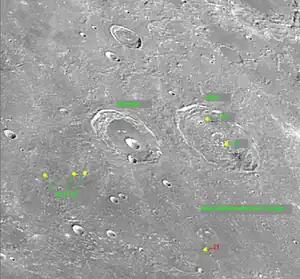
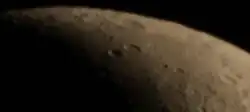
Hercules is a prominent crater located in the northeast part of the Moon, to the west of the crater Atlas.[2] It lies along the east edge of a southward extension in the Mare Frigoris. To the west across the mare is Bürg. To the south is the ruined crater Williams.
On the lunar geologic timescale, Hercules is a crater of Eratosthenian age.[1] The interior walls of Hercules have multiple terraces, and there is a small outer rampart. The crater floor has been flooded by lava in the past, and contains several areas of low albedo. The central peak has been buried, leaving only a low hill near the midpoint. The satellite crater Hercules G is located prominently just to the south of the center. The small crater Hercules E lies along the southern rim of Hercules.
The name Hercules was formally recognized by the IAU in 1935.[3]
Since 1900, this crater has been reported as the site of one instance of transient lunar phenomenon.[4]
Satellite craters
By convention these features are identified on lunar maps by placing the letter on the side of the crater midpoint that is closest to Hercules.
| Hercules | Latitude | Longitude | Diameter |
|---|---|---|---|
| B | 47.8° N | 36.6° E | 9 km |
| C | 42.7° N | 35.3° E | 9 km |
| D | 44.8° N | 39.7° E | 8 km |
| E | 45.7° N | 38.5° E | 9 km |
| F | 50.3° N | 41.7° E | 14 km |
| G | 46.4° N | 39.2° E | 14 km |
| H | 51.2° N | 40.9° E | 7 km |
| J | 44.1° N | 36.4° E | 8 km |
| K | 44.2° N | 36.9° E | 7 km |
The following craters have been renamed by the IAU.
References
- 1 2 Wilhelms, Don E.; McCauley, John F.; Trask, Newell J. (1987). The geologic history of the Moon. USGS Professional Paper 1348. Washington: U.S. Government Printing Office. doi:10.3133/pp1348. Table 12.2.
- ↑ Webb, Rev. T. W. (1962). Celestial Objects for Common Telescopes (6th revised ed.). Dover. pp. 108, 154–159. Reprint: ISBN 978-0-486-20917-3
- ↑ "Hercules". Gazetteer of Planetary Nomenclature. USGS Astrogeology Research Program.
- ↑ Crotts, Arlin P. S. (April 30, 2009). "Transient Lunar Phenomena: Regularity and Reality". The Astrophysical Journal. 697 (1): 4. doi:10.1088/0004-637X/697/1/1.
- ↑ Moore, Patrick; Rees, Robin (2014). Patrick Moore's Data Book of Astronomy (2 ed.). Cambridge University Press. p. 65. ISBN 978-1-139-49522-6.
Sources
- Andersson, L. E.; Whitaker, E. A. (1982). NASA Catalogue of Lunar Nomenclature. NASA RP-1097.
- Blue, Jennifer (July 25, 2007). "Gazetteer of Planetary Nomenclature". USGS. Retrieved 2007-08-05.
- Bussey, B.; Spudis, P. (2004). The Clementine Atlas of the Moon. New York: Cambridge University Press. ISBN 978-0-521-81528-4.
- Cocks, Elijah E.; Cocks, Josiah C. (1995). Who's Who on the Moon: A Biographical Dictionary of Lunar Nomenclature. Tudor Publishers. ISBN 978-0-936389-27-1.
- McDowell, Jonathan (July 15, 2007). "Lunar Nomenclature". Jonathan's Space Report. Archived from the original on 2012-02-08. Retrieved 2007-10-24.
- Menzel, D. H.; Minnaert, M.; Levin, B.; Dollfus, A.; Bell, B. (1971). "Report on Lunar Nomenclature by the Working Group of Commission 17 of the IAU". Space Science Reviews. 12 (2): 136–186. Bibcode:1971SSRv...12..136M. doi:10.1007/BF00171763. S2CID 122125855.
- Moore, Patrick (2001). On the Moon. Sterling Publishing Co. ISBN 978-0-304-35469-6.
- Price, Fred W. (1988). The Moon Observer's Handbook. Cambridge University Press. ISBN 978-0-521-33500-3.
- Rükl, Antonín (1990). Atlas of the Moon. Kalmbach Books. ISBN 978-0-913135-17-4.
- Whitaker, Ewen A. (1999). Mapping and Naming the Moon. Cambridge University Press. ISBN 978-0-521-62248-6.
- Wlasuk, Peter T. (2000). Observing the Moon. Springer. ISBN 978-1-85233-193-1.
| Physical properties |  | |
|---|---|---|
| Orbit | ||
| Surface and features | ||
| Science | ||
| Exploration | ||
| Time-telling and navigation | ||
| Phases and names | ||
| Daily phenomena | ||
| Related |
| |
