HN-5
| HN-5 | |
|---|---|
 HN-5A(M) of Thailand | |
| Type | MANPADS |
| Place of origin | China |
| Service history | |
| In service | HN-5: 1983–present (reserve only) HN-5A: 1984–present (reserve only) |
| Used by | See Operators |
| Production history | |
| Manufacturer | HN-5: Liaoning Defense Industry Office HN-5A: Shanghai Academy of Spaceflight Technology (SAST) |
| Produced | 1973–present |
| Specifications | |
| Mass | HN-5A: 10.2 kg (22 lb) |
| Length | HN-5A: 1.46 m (4.8 ft) |
| Diameter | 72 mm (2.8 in) |
Detonation mechanism | Impact |
| Engine | Rocket motor |
| Propellant | Solid fuel |
Operational range | HN-5A: 0.8–4.4 km (0.50–2.73 mi) |
| Flight altitude | HN-5A: 50–2,500 m (160–8,200 ft) |
| Maximum speed | 500 m/s (Mach 1.5) |
Guidance system | Infrared homing (IR) |
Launch platform | MANPADS & surface |
The HN-5 (Chinese: 红缨-5; pinyin: Hóng Yīng-Wǔ; lit. 'Red Tassel-5'; NATO reporting name: CH-SA-3[1]) is a family of first generation Chinese man-portable air-defense systems (MANPAD) based on Soviet technology. The HN abbreviation is used to avoid confusion with the HY (Hai Ying, or Sea Eagle) series anti-ship missiles of the Silkworm missile family. The HN-5 series was developed into HN-6 and QW-1 missiles.
Development
The HN-5 is a reverse-engineered version of the Soviet Strela 2 (SA-7).[2] The reverse-engineering and subsequent development took place between 1973 and 1982. The HN-5 was certified in 1983. The HN-5 was exported to Pakistan as Anza-1 and Afghanistan during the Soviet–Afghan War. The HN-5 was co-developed by the Liaoning Defense Industry Office, Third Ministry of Machine Building (aka Aviation Industry Corporation of China; AVIC), Fifth Ministry of Machine Building (aka Norinco), Seventh Ministry of Machine Building (aka China Aerospace Science and Technology Corporation; CASC and China Aerospace Science and Industry Corporation; CASIC) under designers Zhu Yuchi (Chinese: 朱玉池) and Xiao Lin (Chinese: 肖林).[3]
The HN-5A (Chinese: 红缨-5甲; pinyin: Hóng Yīng-Wǔ jiǎ) was neither an improved variant nor a modification of the HN-5, but a parallel development began a few years later under the Shanghai Municipality Second Bureau of Electromechanical Industry, later known as the Shanghai Academy of Spaceflight Technology (SAST). The lead designers were Fan Conghui (Chinese: 范崇惠) and Ye Xiaoqing (Chinese: 叶尧卿). The HN-5A was tested between 1979 and 1981, with certification in 1984. Compared to the HN-5, the HN-5A has a larger warhead, a higher flight velocity, a longer range, a thermal filter, and a thermoelectric cooler with increased seeker sensitivity.[3] The HN-5A largely correlates to Strela 2M.[4]
Later, CASIC developed the second-generation MANPADS based on the HN-5, called QW-1.[5][6] SAST also developed the next iteration of the HN-5 missile in parallel, called HN-6 (FN-6), which is a third-generation MANPADS.[3]
Variants
- HN-5
- The HN-5 is developed by Liaoning Defense Industry Office, Third Ministry of Machine Building (aka Aviation Industry Corporation of China; AVIC), Fifth Ministry of Machine Building (aka Norinco), Seventh Ministry of Machine Building (aka China Aerospace Science and Technology Corporation; CASC and China Aerospace Science and Industry Corporation; CASIC).[3]
- HN-5A
- The HN-5A features a performance largely correlates to Strela 2M.[4] A parallel development by the Shanghai Academy of Spaceflight Technology (SAST).[3]
- HN-5B
- Developed from HN-5A[4][7] with technology based on the Soviet 9K34 Strela-3. Although the missile had entered service with the Chinese army in the mid-1980s, it was not until 1990 that it was first publicly revealed in China.[8] According to many domestic Chinese media sources and some sources outside China, Chinese obtained the Soviet samples via Zaire from UNITA captured 9K34 Strela-3 from Angola governmental forces, the exact the same way China obtained the 9K310 Igla-1 a short time later. The missile entered service with the Pakistani army in January 1990.
- HN-5C
- Vehicle-mounted version of HN-5 missiles. It can mount all missiles in the HN-5 series.[4] It first entered production in 1986, but was not revealed to the public in China until the early 1990s. A total of eight missiles are configured into two groups of four missiles mounted on a 4x4 vehicle with an electro-optical fire control system.
- HQ-5C
- HQ stands for Hongqi, the Chinese designation for their surface-to-air missiles. The missile was specifically developed in the 1980s for export.[9] The missile is modified to be compatible with Western standards.[9]
Foreign derivatives
Pakistan has produced the HN-5 missile as the Anza Mk I,[3] based on tech from the HN-5B.[9] North Korea also produced HN-5 locally.[10]
Operators
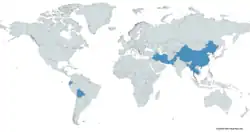
 Albania: 100 acquired in 1978.[11]
 Bangladesh: 50 HN-5As acquired in 1991–1992, 21 HN-5JA1 acquired in 2001.[11]
 Bolivia: 30 HN-5As acquired in 1994.[11]
 Cambodia: 1,000 acquired in 1992.[11]
 China[12]
 Ecuador: 72 HN-5As acquired in 1995.[11]
 Iran: 500 acquired from 1986 to 1988.[11]
 Iraq[12]
 Myanmar: 200 HN-5As acquired in 1992.[11]
 North Korea: 600 acquired unknown number from 1983 to 1994.[11]
 Pakistan: 100 acquired by 1987. An additional 1,000 were produced as Anza Mk-I from 1989 to 1998.[13][11]
 Thailand: 1,150 acquired from 1987 to 1988.[11]
Non-state actors


Specifications
| HN-5[3] | HN-5A | |
|---|---|---|
| Introduction | 1983 | 1984 |
| Missile length | 1.423 m (4.67 ft) | 1.463 m (4.80 ft) |
| System length | 1.508 m (4.95 ft) | |
| Missile weight | 9.8 kg (22 lb) | 10.2 kg (22 lb) |
| System weight | 15 kg (33 lb) | 16.5 kg (36 lb) |
| Missile diameter | 72 mm (2.8 in) | 72 mm (2.8 in) |
| Warhead | 1.17 kg (2.6 lb)[17] | |
| Warhead filling | 0.5 kg (1.1 lb) | |
| Fuze | Impact | |
| Flight speed | 500 m/s (Mach 1.5) | |
| Range | 0.5–4.2 km (0.31–2.61 mi) | 0.8–4.4 km (0.50–2.73 mi) |
| Altitude | 50–2,300 m (160–7,550 ft) | 50–2,500 m (160–8,200 ft) |
See also
References
- ↑ The International Institute for Strategic Studies (15 February 2023). "6 Asia". The Military Balance 2023. London: Routledge.
- ↑ "Multiplying the Sources: Licensed and Unlicensed Military Production" (PDF). Geneva: Small Arms Survey. 2007. Archived from the original (PDF) on 23 December 2016. Retrieved 21 September 2016.
- 1 2 3 4 5 6 7 "《士兵突击》罕见错误!我军单兵防空导弹射程4500千米,能从敦煌打到莫斯科?". Guancha. 22 June 2023. Archived from the original on 1 August 2025.
- 1 2 3 4 "强强联手:中国神弓防空武器系统". Sohu News. 21 May 2005.
- ↑ "从2002年珠海航展看中国便携式防空导弹". 兵器知识. 23 September 2021 – via WeChat Official Account.
- ↑ 兵工科技. ""前卫":国产单兵 防空导弹"引领者"". Changsha Evening News. Archived from the original on 6 June 2026.
- ↑ "资料:中国"红缨五号"便携式防空导弹". Sina News. 25 July 2003.
- ↑ "Archived copy". www.sinodefence.com. Archived from the original on 1 December 2008. Retrieved 12 January 2022.
{{cite web}}: CS1 maint: archived copy as title (link) - 1 2 3 "HY-5 / HN-5 / HQ-5". www.globalsecurity.org.
- ↑ Kirkham, Elizabeth; Okechukwu, Nneka (2010). Controlling the Transfer of Man-Portable Air Defence Systems (PDF) (Report). Saferworld.
- 1 2 3 4 5 6 7 8 9 10 Dr. Michael Ashkenazi; Princess Mawuena Amuzu; Jan Grebe; Christof Kögler; Marc Kösling (February 2013). brief 47: MANPADS A Terrorist Threat to Civilian Aviation? (PDF) (Report). Bonn International Center for Conversion. pp. 132–152. ISSN 0947-7322. Retrieved 18 February 2021.
- 1 2 Zeigler, Sean M.; Hou, Alexander C.; Martini, Jeffrey; Norton, Daniel M.; Phillips, Brian; Schwille, Michael; Strong, Aaron; Vest, Nathan (2019). Acquisition and use of MANPADS against commercial aviation: Risks, proliferation, mitigation, and cost of an attack (PDF). Santa Monica, CA: RAND Corporation. ISBN 978-1-9774-0418-3.
- ↑ SIPRI Arms Transfers Database. "Transfers and licensed production of major conventional weapons". Retrieved 16 April 2024.
- ↑ Khan, Shirley A. (2009). U. S.-China Counterterrorism Cooperation. DIANE Publishing Company. ISBN 978-1-4379-1936-3. Retrieved 15 July 2026 – via Google Books.
- ↑ "United Wa State Army military parade showcases ongoing modernisation". Janes. 23 April 2019. Retrieved 15 February 2021.
{{cite web}}: CS1 maint: deprecated archival service (link) - ↑ "红缨5号防空导弹". Xilu. Archived from the original on 24 November 2020.
- ↑ "HN-5(A)". weaponsystems.