Gyrolepis
| Gyrolepis Temporal range: | |
|---|---|
 | |
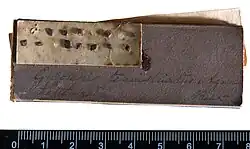
| Gyrolepis albertii fossil | |
Scientific classification  | |
| Kingdom: | Animalia |
| Phylum: | Chordata |
| Class: | Actinopterygii |
| Order: | †Palaeonisciformes |
| Family: | †Palaeoniscidae |
| Genus: | †Gyrolepis Agassiz, 1835 |
| Type species | |
| Gyrolepis albertii Agassiz, 1835 | |
| Other species | |
Gyrolepis is an extinct genus of prehistoric marine ray-finned fish from the Middle-Late Triassic epochs in what is now Europe. It is known both from complete specimens and isolated skeletal elements, such as scales or teeth.
Taxonomy
The following species are placed in this genus:[1][2][3]
- G. agassizi (Münster, 1835) - Anisian of Germany (Muschelkalk), Ladinian of France
- G. albertii Agassiz, 1835 (type species) - Anisian of the Netherlands (Vossenveld Formation of Muschelkalk)[4], Poland (Wellenkalk Formation), late Anisian/early Ladinian of Germany (Muschelkalk), Norian of Austria (Seefelder Formation) & Belgium (Grès de Mortinsart Formation), Rhaetian of England (Westbury Formation) and France,[5] potentially Anisian of Spain (Muschelkalk)
- G. angulisulcatus Oertle, 1927 - Ladinian of Germany (Muschelkalk)
- G. ornatus Giebel in Dames, 1888 - Anisian of Germany (Muschelkalk)
- G. quenstedti Dames, 1888 - Ladinian of Germany (Muschelkalk)
- G. parcisquamosus Oertle, 1927 - Ladinian of Germany (Muschelkalk)
- G. pompeckji Oertle, 1927 - Ladinian of Germany (Muschelkalk)
- G. tenuidentatus Oertle, 1928 - late Anisian/early Ladinian of Germany (Muschelkalk)
An indeterminate species is known from the Besano Formation of Italy & Switzerland.[2] A potential species is also known from the Rhaetian of China.[1]
Distribution
Gyrolepis fossils have been found across much of the Northern Hemisphere, but the genus was by far most common in Europe.[6] G. albertii, the type species of the genus, is a ubiquitous component of Rhaetian biotas in Europe.[7]
See also
References
- 1 2 Romano, Carlo; Koot, Martha B.; Kogan, Ilja; Brayard, Arnaud; Minikh, Alla V.; Brinkmann, Winand; Bucher, Hugo; Kriwet, Jürgen (2016). "Permian-Triassic Osteichthyes (bony fishes): diversity dynamics and body size evolution". Biological Reviews. 91 (1): 106–147. doi:10.1111/brv.12161. PMID 25431138. S2CID 5332637.
- 1 2 "†Gyrolepis Agassiz 1833 (ray-finned fish)". The Paleobiology Database.
- ↑ Geology, British Museum (Natural History) Department of; Woodward, Arthur Smith (1891). Catalogue of the Fossil Fishes in the British Museum (Natural History): Elasmobranchii (Acanthodii), Holocephali, ichthyodorulites, Ostracodermi, Dipnoi, and Teleostomi (Crossopterygii and chondrostean Actinopterygii). order of the Trustees.
- ↑ Haarhuis, Adam; J. Diependaal, Henk (2019-01-01). "The fish fauna of the Winterswijk Vossenveld Formation". Staringia. 16 (1): 198–207. ISSN 0165-2354.
- ↑ Cavicchini, Iacopo; Heyworth, H. Cecilia; Duffin, Christopher J.; Hildebrandt, Claudia; Benton, Michael J. (2018-04-01). "A Rhaetian microvertebrate fauna from Stowey Quarry, Somerset, U.K." Proceedings of the Geologists' Association. 129 (2): 144–158. doi:10.1016/j.pgeola.2018.02.001. hdl:1983/84fa3358-c8a1-4feb-81f6-ea403885b21d. ISSN 0016-7878.
- ↑ "Gyrolepis". Paleobiology Database.
- ↑ Numberger-Thuy, Lea D.; Aiglstorfer, Manuela; Delsate, Dominique; Feist-Burkhardt, Susanne; Gräbenstein, Stefan; Havlik, Philipe; Régnier, Sylvie; Servais, Thomas; Thuy, Ben (1 July 2025). "An exceptional window into the Triassic-Jurassic boundary on the margins of the Ardenno-Rhenish Massif: stratigraphy and palaeontology of the Irrel section (Rhineland-Palatinate, Germany)". Swiss Journal of Palaeontology. 144 (1). doi:10.1186/s13358-025-00384-3. ISSN 1664-2376. Retrieved 26 March 2026 – via Springer Open.
External links
Actinopterygian genera | |||||||||||||||||||||||||||||||||||||||||||||||||||||||||||||||||||||||||||||||||
|---|---|---|---|---|---|---|---|---|---|---|---|---|---|---|---|---|---|---|---|---|---|---|---|---|---|---|---|---|---|---|---|---|---|---|---|---|---|---|---|---|---|---|---|---|---|---|---|---|---|---|---|---|---|---|---|---|---|---|---|---|---|---|---|---|---|---|---|---|---|---|---|---|---|---|---|---|---|---|---|---|---|
| |||||||||||||||||||||||||||||||||||||||||||||||||||||||||||||||||||||||||||||||||
| |||||||||||||||||||||||||||||||||||||||||||||||||||||||||||||||||||||||||||||||||
| |||||||||||||||||||||||||||||||||||||||||||||||||||||||||||||||||||||||||||||||||


Categories:
- Prehistoric ray-finned fish genera
- Palaeonisciformes
- Fossils of Belgium
- Fossils of France
- Fossils of Germany
- Fossils of the Netherlands
- Fossils of Poland
- Fossils of Spain
- Fossils of Switzerland
- Fossils of Italy
- Fossils of Austria
- Fossils of England
- Anisian genus first appearances
- Ladinian genera
- Norian genera
- Rhaetian genus extinctions
- Triassic fish of Europe
- Triassic bony fish
- Fossil taxa described in 1835
- Taxa named by Louis Agassiz
- Triassic fish stubs
- Prehistoric Osteichthyes stubs