Gyroelongated cupola
| Set of gyroelongated cupolae | |
|---|---|
 Example of a pentagonal form | |
| Faces | 5n triangles n squares 1 n-gon 1 2n-gon |
| Edges | 11n |
| Vertices | 5n |
| Symmetry group | Cnv, [n], (*nn) |
| Rotational group | Cn, [n]+, (nn) |
| Dual polyhedron | |
| Properties | convex |
In geometry, the gyroelongated cupolae are an infinite set of polyhedra, constructed by adjoining an n-gonal cupola to a 2n-gonal antiprism.
There are three gyroelongated cupolae that are Johnson solids made from regular triangles, squares, and pentagons. Higher forms can be constructed with isosceles triangles. Adjoining a triangular prism to a square antiprism also generates a polyhedron, but has adjacent parallel faces, so is not a Johnson solid. The hexagonal form can be constructed from regular polygons, but the cupola faces are all in the same plane. Topologically other forms can be constructed without regular faces.
Forms
| name | faces | |
|---|---|---|
 | gyroelongated digonal cupola | 10 triangles, 2+1 squares |
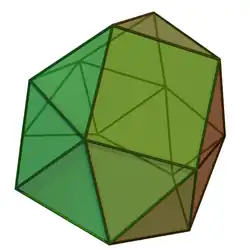 | gyroelongated triangular cupola (J22) | 15+1 triangles, 3 squares, 1 hexagon |
 | gyroelongated square cupola (J23) | 20 triangles, 4+1 squares, 1 octagon |
| gyroelongated pentagonal cupola (J24) | 25 triangles, 5 squares, 1 pentagon, 1 decagon |
| gyroelongated hexagonal cupola | 30 triangles, 6 squares, 1 hexagon, 1 dodecagon |
See also
References
- Norman W. Johnson, "Convex Solids with Regular Faces", Canadian Journal of Mathematics, 18, 1966, pages 169–200. Contains the original enumeration of the 92 solids and the conjecture that there are no others.
- Victor A. Zalgaller (1969). Convex Polyhedra with Regular Faces. Consultants Bureau. No ISBN. The first proof that there are only 92 Johnson solids.
Categories: