Girl of the Uchter Moor
Girl of the Uchter Moor | |
|---|---|
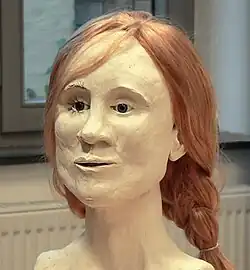 Facial reconstruction with red hair | |
| Born | c. 7th century BC Unknown |
| Died | Between 764 and 515 BC Near present-day Uchte, Lower Saxony, Germany |
Body discovered | 6 September 2000 Near Uchte, Lower Saxony, Germany 52°30′56″N 8°51′12″E / 52.51556°N 8.85333°E |
| Other name | Moora (nickname) |
| Known for | Iron Age bog body with multiple facial reconstructions |
The Girl of the Uchter Moor, also known as Moora, is a female Iron Age bog body discovered in 2000[1] in marshland near Uchte, Germany. The remains include vertebrae, hair, and skull pieces. The studies of the body began in 2005. The radiocarbon dating performed at the University of Kiel showed that she had died between 764 and 515 BC. Despite common Iron Age burial practices,[2] the body was not cremated. All the body parts are estimated to have been found except for one scapula.[3]
Before DNA analysis and radiocarbon dating, the body was initially believed to be that of a sixteen-year-old girl,[4] Elke Kerll, who had disappeared in 1969 after going to a dance club.[2][5]
Discovery
On 6 September 2000, peat cutters working in the Uchter Moor near Uchte, Lower Saxony, Germany, uncovered human skeletal remains while extracting peat. The discovery was reported to archaeologists, who found nearly her entire skeleton, together with fragments of her skull bearing scalp and hair, her naturally mummified right hand, pieces of skin, numerous teeth, and both fingernails and toenails. Only one scapula was not recovered.[1][6]
Condition
During approximately 2,700 years in the bog, Moora's bones lost much of their original mineral content. They shrank, became dark brown and, in some cases, changed shape, although their underlying collagen structure remained well preserved.[6]
Moora's soft tissues survived unevenly. Fragments of her scalp retained hair up to approximately 14 centimetres (5.5 in) long. Her naturally mummified right hand retained its skin, tendons, joints and fingerprint ridges despite considerable shrinkage.[6]
Chemical reactions within the peat turned Moora's hair a reddish colour after burial. Its surviving colour therefore does not necessarily reflect her natural hair colour during life.[6][7]
Initial analysis
Following the discovery of the remains on 6 September 2000, investigators initially believed they belonged to a recent death. Their first theory was that the remains might be those of the victim of a United States fighter-bomber crash that had occurred in the area at the end of the Second World War, approximately 55 years earlier.[1][6] Anthropological and odontological examinations carried out at the University Medical Center Hamburg-Eppendorf instead identified the remains as those of a young woman between 17 and 20 years of age.[6]
Investigators then considered whether the remains belonged to Elke Kerll, a sixteen-year-old local girl who had disappeared after visiting a dance club in 1969.[2][5][4] The site was treated as a crime scene while police and forensic specialists investigated the possibility. Mitochondrial DNA testing later excluded Kerll as a match, but without further evidence the case remained unresolved for the next three years.[6]
The investigation resumed in 2005, when archaeologists recovered a naturally mummified hand from the same area.[1][6] The renewed excavation uncovered additional bones, fragments of skin and fingernails, although no clothing or associated artefacts were found.[6] Radiocarbon dating carried out at the University of Kiel subsequently showed that the remains dated to between 764 and 515 BCE, more than 2,500 years before Kerll disappeared, identifying them as those of an Iron Age bog body.[2]
Scientific study

Moora was estimated to be between 17 and 19 years old at the time of her death.[2] Osteological analysis indicates she was left-handed.[5]
Analysis of Moora's skeleton revealed that she had likely experienced intense physical labour during her lifetime,[8] such as repeatedly carrying heavy loads such as water jugs, while roaming through the marshland.[2]
According to Saring Dennis from the University Hospital Hamburg-Eppendorf, Moora had sustained at least two partial skull fractures in her lifetime, both of which had gradually healed in time.[5]
Bone growth lines indicate periods of physiological stress consistent with chronic malnutrition during childhood and adolescence, as well as extended illness, possibly associated with harsh winter conditions.[5]
Moora was also diagnosed to have a benign tumour at the base of her skull, which may have contributed to the spine curvature and chronic inflammation in the leg bones.[5]
Chemical analysis

More than 2,500 years after Moora's death, researchers used chemical analysis to investigate both her remains and the effects of their long burial in peat. X-ray fluorescence spectroscopy (XRF) showed that the chemical composition of her bones and teeth had been substantially altered by the bog environment. Strontium measurements were consistent with the surrounding region and were interpreted as supporting a possible local origin, although they could not establish where she had lived.[9]
Researchers also found that both burial conditions and conservation after discovery had changed the concentrations of elements in her remains. These changes make it difficult to distinguish chemical traces originating during Moora's life from those introduced or altered after her death.[9]
Analysis of Moora's hair produced similar cautions. Researchers compared its trace elements with samples from other bog bodies, modern individuals and peat from her find site. They concluded that prolonged burial in peat can substantially alter the chemical composition of hair, limiting what its trace elements can reveal about Moora's health or diet during life. The reddish colour of her surviving hair was also attributed to chemical changes in the bog and does not establish her original hair colour.[10]
Cause of death
For all that scientific examination has revealed about Moora's life, it has not established how she died. Her two skull fractures had healed before her death, and researchers identified no cause of death from the surviving skeleton.[11] A later review similarly reported that no evidence of an injury associated with her death had been found and that the manner of her deposition could not be determined.[12]
No clothing or associated objects were recovered with her. Early investigators interpreted the absence of clothing fasteners as possible evidence that she had been unclothed, but subsequent investigation did not establish whether she was clothed when she died.[13] The surviving evidence also cannot establish whether her deposition in the bog was accidental or deliberate. Her cause and circumstances of death remain unknown.[12]
Facial reconstructions

Moora's face has been reconstructed a number of times. The two that were created in the traditional way were built by moulding material over a plastic replica of the skull. The artist had to estimate the shape of the girl's lips, hair colour and skin tones, similar to the process of the Yde Girl.[14]
References
- 1 2 3 4 "The Girl of Uchter Moor - Archaeology Magazine Archive". Archaeology Magazine. Retrieved 2026-07-21.
- 1 2 3 4 5 6 "Scientists model ancient bog woman's face". The Local. 21 January 2011. Archived from the original on 24 January 2011. Retrieved 24 January 2011.
- ↑ "Ancient 'Bog Body' Unearthed in Germany". All Voices. 24 January 2011. Retrieved 24 January 2011.
- 1 2 Archaeology, Current World (2005-09-06). "Germany, Iron Age Bog Body". World Archaeology. Retrieved 2026-07-21.
- 1 2 3 4 5 6 "Identify the remains of Iron Age woman". All Voices. 24 January 2011. Retrieved 24 January 2011.
- 1 2 3 4 5 6 7 8 9 Moora – Das Mädchen aus dem Uchter Moor. Naturwissenschaftliche Ergebnisse. 2018.
- ↑ "Pictures: Ancient Bog Girl's Face Reconstructed". National Geographic. 4 February 2011. Archived from the original on 4 February 2011. Retrieved 17 January 2014.
- ↑ Eisenbeiss, Sabine (September 2016). "Preserved in Peat: Decoding Bog Bodies from Lower Saxony, Germany" (PDF). Expedition. Vol. 58, no. 2. Penn Museum. Retrieved 2026-07-21.
- 1 2 Granite, Guinevere; Bauerochse, Andreas (2018). "Analysis of the Girl from the Uchter Moor using portable X-ray fluorescence spectroscopy". „Moora“ – Das Mädchen aus dem Uchter Moor: Eine Moorleiche der Eisenzeit aus Niedersachsen II: Naturwissenschaftliche Ergebnisse. Materialhefte zur Ur- und Frühgeschichte Niedersachsens. Vol. 47. Niedersächsisches Landesamt für Denkmalpflege. Retrieved 2026-08-11.
- ↑ "Spurenelementanalysen an Haaren von Moorleichen und Torfproben aus dem Uchter Moor". „Moora“ – Das Mädchen aus dem Uchter Moor: Eine Moorleiche der Eisenzeit aus Niedersachsen II: Naturwissenschaftliche Ergebnisse. Materialhefte zur Ur- und Frühgeschichte Niedersachsens (in German). Vol. 47. Niedersächsisches Landesamt für Denkmalpflege. 2018. Retrieved 2026-08-11.
- ↑ "Paläopathologische Untersuchungen am Schädel von „Moora"". „Moora“ – Das Mädchen aus dem Uchter Moor: Eine Moorleiche der Eisenzeit aus Niedersachsen II: Naturwissenschaftliche Ergebnisse. Materialhefte zur Ur- und Frühgeschichte Niedersachsens (in German). Vol. 47. Niedersächsisches Landesamt für Denkmalpflege. 2018. Retrieved 2026-08-11.
- 1 2 Eisenbeiss, Sabine (September 2016). "Preserved in Peat: Decoding Bog Bodies from Lower Saxony, Germany". Expedition. Vol. 58, no. 2. Penn Museum. Retrieved 2026-08-11.
- ↑ "Eine Hand weist den Weg in die Jungsteinzeit". Die Welt (in German). Retrieved 2026-08-11.
- ↑ "Pictures: Ancient Bog Girl's Face Reconstructed". National Geographic. 4 February 2011. Archived from the original on February 4, 2011. Retrieved 17 January 2014.
External links
