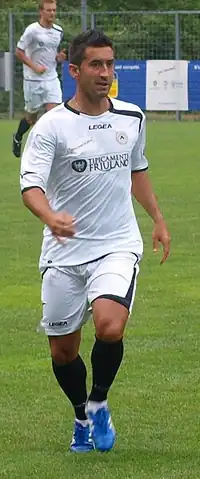
Giampiero PinziCavaliere OMRI (Italian pronunciation:[dʒamˈpjɛːroˈpintsi]; born 11 March 1981) is an Italian former professional footballer who played as a midfielder.
Club career
Lazio
Pinzi came through Lazio's youth system, joining from Almas Roma, and was promoted to Lazio's first team in 1999. He made his senior debut in the UEFA Champions League on 2 November 1999, coming on in the match against Dynamo Kyiv.[1] During the 1999–2000 season, he also made three appearances in the Coppa Italia for Lazio, winning both the Serie A title and Coppa Italia, although he did not feature in the league.[2]
Udinese
After one-year with [Lazio in the Serie A Pinzi signed with league rivals Udinese.
Chievo
On 17 July 2009, Chievo announced that they would be keeping Pinzi on loan for another season.[3]
Return to Udinese
Pinzi returned to Udinese for the 2010–11 Serie A season, after the departure of Gaetano D'Agostino and Simone Pepe. Pinzi formed the club's central midfield trio with the energetic Gökhan Inler and Kwadwo Asamoah in Udinese's new 3–5–2 (or 5–3–2 formation); he provided six assists.
After the departure of Alexis Sánchez, Pinzi changed to play attacking midfielder role, partnered with forward Antonio Di Natale in new 4–1–4–1 (or 4–4–1–1) formation, with Asamoah and Emmanuel Agyemang-Badu as cover against Arsenal. With the new signing Gabriel Torje and Diego Fabbrini arrived, Pinzi again formed a new partnership role with either or both players. After the departure of Torje and arrival of Maicosuel, Pinzi was still able to secure a place in starting XI.
In October 2012, he signed a new contract which lasted until 30 June 2016.[4]
Return to Chievo
After 15 years played for Udinese, on 31 August 2015, the last day of transfer market, Pinzi returned to Chievo, where he had played between 2008 and 2010.[5]
Brescia
On 10 August 2016, Pinzi signed for Serie B club Brescia on a free transfer.[6]
Padova
On 8 January 2019, he was released from his contract by Padova by mutual consent.[7]
Pinzi was a versatile, hard-working, and physical right-footed midfielder, who primarily operated as a central midfielder in the mezzala role, although could also play in front of the defence as a defensive midfielder, or even behind the forwards as an attacking midfielder. He was known for his ability to read the game and provide balance to his teams by supporting the attack with his runs or by building attacking plays from deep, but also by providing defensive cover.[9][10][11][12][13] He was also capable of playing on the right flank, a position in which he was deployed on occasion in his early career.[14]