General Oliver Otis Howard House
General Oliver Otis Howard House | |
 | |
  Location within Washington, D.C. | |
| Location | 607 Howard Pl., NW (campus of Howard University), Washington, D.C. |
|---|---|
| Coordinates | 38°55′23″N 77°01′19″W / 38.92295°N 77.02183°W |
| Area | less than one acre |
| Built | 1867 |
| Architectural style | Second Empire |
| NRHP reference No. | 74002163[1] |
| Significant dates | |
| Added to NRHP | February 12, 1974 |
| Designated NHL | May 30, 1974[2] |
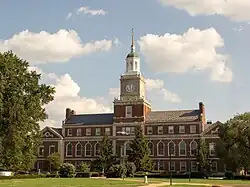
The General Oliver Otis Howard House, also known as Howard Hall, is a historic house, and the oldest surviving building on the campus of Howard University, in Washington, D.C. Built in 1867, it was the home of General Oliver Otis Howard, the university founder and its third president. The house was declared a National Historic Landmark in 1974.[2][3] It faces Georgia Avenue NW, just north of Howard Place.
Description and history
The General Oliver Otis Howard House is located on the west side of the Howard University Campus. It is separated from Georgia Avenue to the west by a parking lot, and from 6th Street by the Johnson Administration Building, which forms an L around its north side. It is a 2+1⁄2-story painted brick building, with a mansard roof providing a full third floor, and a fieldstone foundation that is exposed on the west and south due to the sloping terrain. A three-story tower projects from the southwest corner, rising to a low balustrade surrounding a mansard roof, which is crowned by iron cresting. Windows are set in segmented-arch windows, and dormers in the roof face have elaborate carved surrounds. The interior retains some original features, but has in parts been altered to provide modern office space.[3]
The house was built in 1867 as the home of General Oliver Otis Howard. Of four buildings erected during the founding phase of Howard University, it is the only one still standing. The university was chartered in 1867, when General Howard was serving as commissioner of the federal Freedmen's Bureau. In that role, Howard was a major supporter of improved educational opportunities for newly freed African Americans. As a member of the First Congregational Church of Washington, he was instrumental in that congregation's support for creating of the institution as a seminary and normal school.[3]
Beyond its architectural significance, the General Oliver Otis Howard House represents a tangible link to the Reconstruction-era mission of expanding educational access for formerly enslaved African Americans. As the residence of General Oliver Otis Howard during his leadership of the Freedmen’s Bureau and early involvement with Howard University, the house functioned as both a domestic and symbolic center of federal efforts to promote Black education and civil rights. Following Howard’s death, the university repurposed the building for institutional use, and it remains a key ceremonial and administrative space, reflecting the continuity of the university’s founding vision.[4]
Howard's house was purchased by the university in 1909.[5]
The Howard House at Howard University transitioned from a private residence into an institutional space in the early twentieth century. After the university acquired the property in 1909, the building was repurposed for administrative and office functions, reflecting the university’s expanding bureaucratic structure. Over time, its role evolved further into a ceremonial and symbolic site used for official university events and functions, illustrating how a once-private domestic space became integrated into the institutional and cultural identity of the university rather than preserved solely as a historic museum (National Park Service, n.d.).[6]
After Howard University acquired the Howard House in 1909, the building was repurposed for administrative and office use as the institution expanded. Over time, it also came to serve ceremonial and representational functions for the university, reflecting its evolving role beyond its original use as a private residence.[7][8]
See also
References
- ↑ "National Register Information System". National Register of Historic Places. National Park Service. July 9, 2010.
- 1 2 "General Oliver Otis Howard House". National Historic Landmark summary listing. National Park Service. Archived from the original on June 6, 2011. Retrieved May 10, 2008.
- 1 2 3 Carol Ann Poh (January 3, 1974). "National Register of Historic Places Inventory-Nomination: Howard Hall / General Oliver Otis Howard House" (pdf). National Park Service.
{{cite journal}}: Cite journal requires|journal=(help) and Accompanying two photos, exterior, from 1973 (32 KB) - ↑ "National Park Service. (n.d.). General Oliver Otis Howard House. U.S. Department of the Interior".
- ↑ Weeks, Christopher (c. 1994). AIA guide to the architecture of Washington, D.C.. Johns Hopkins University Press. pp. 287. ISBN 0801847125.
- ↑ "National Park Service. (n.d.). General Oliver Otis Howard House. U.S. Department of the Interior".
- ↑ "General Oliver Otis Howard House". National Park Service, U.S. Department of the Interior. Retrieved April 29, 2026.
- ↑ Williams, Heather Andrea (2005). Self-Taught: African American Education in Slavery and Freedom. Chapel Hill: University of North Carolina Press. ISBN 978-0807855986.
{{cite book}}: Check|isbn=value: checksum (help)
External links

- General Oliver Otis Howard House, NRHP 'travel itinerary' listing at the National Park Service
- Historic American Buildings Survey (HABS) No. DC-284, "General Oliver O. Howard House, 607 Howard Place Northwest, Washington, District of Columbia, DC", 2 photos, 2 data pages, 1 photo caption page
| ||||||||
| Academics |
|  | ||||||
| Athletics |
| |||||||
| Broadcasting | ||||||||
| Campus | ||||||||
| Student life | ||||||||

| Topics | |
|---|---|
| Lists by state |
|
| Lists by insular areas | |
| Lists by associated state | |
| Other areas | |
| Lists of specific structure types | |
| Related | |
