Florida Park Service
| Division of Recreation and Parks | |
 Logo of the Florida Parks Service, a division of the Florida Department of Environmental Protection | |
| Agency overview | |
|---|---|
| Formed | 1935 |
Preceding agency |
|
| Jurisdiction | Florida |
| Headquarters |
|
| Employees | 1041 (2024) |
| Annual budget | US$450 million (FY26–27) |
Agency executive |
|
Parent agency | Florida Department of Environmental Protection |
| Website | www |
The Florida Park Service, officially the Division of Recreation and Parks, is the Florida state government agency that manages the Florida State Parks system. It is a division of the Florida Department of Environmental Protection (DEP) and administers roughly 176 state parks, trails, and historic sites covering nearly 815,000 acres.[1] Annual attendance regularly exceeds 25 million visitors, and the division has estimated the direct economic impact of the system at more than $3 billion annually.[1]
The division was formally established in 1935 under the Florida Board of Forestry.[2] The introduction of the federal Civilian Conservation Corps (CCC) gave Florida its first practical means to develop a park system.[2] An independent Board of Parks and Historic Memorials managed the agency from 1949 to 1969, after which it was folded into the Department of Natural Resources (DNR) as the Division of Recreation and Parks (DRP).[3] In 1993, the DNR was merged with the Department of Environmental Regulation to form the Department of Environmental Protection, placing the Division of Recreation and Parks under its supervision.[4]
Florida is the only state park system to have received the National Recreation and Park Association's National Gold Medal Award four times, in 1999, 2005, 2013, and 2019.[5] The agency has been the subject of periodic controversy over commercial and recreational development inside state parks, most notably a 2011 proposal to build golf courses at four parks and the 2024 "Great Outdoors Initiative," both of which were withdrawn after bipartisan opposition.[6][7]
History
Early preservation efforts

Florida's involvement in the preservation of public sites for recreation and commemoration precedes the creation of any formal park agency. The state legislature created the Olustee Battle Memorial in 1909 to mark the site of the Battle of Olustee, and comparable stone plaque memorials were established at the Dade Massacre site and at several of the state's Civil War battlefields in the following decades. These memorials consisted of nothing more than a plaque and a stone monument, cared for by the state legislature and organizations such as the United Daughters of the Confederacy, and did not become full state parks until the 1950s.[8]
Separate preservation efforts began in 1915, when the Florida Federation of Women's Clubs, led by May Mann Jennings, persuaded the legislature to transfer 960 acres of state land on Paradise Key in the Everglades to the federation for park purposes; the transfer was matched by a comparable donation from the estate of Henry Flagler.[9][10] The federation formally dedicated Royal Palm State Park on November 23, 1916, with a motorcade of 168 cars carrying more than 1,000 guests.[11][12] Although never operated by the state, Royal Palm functioned as Florida's first state park in all but name until 1947, when it was turned over to the United States federal government to become part of Everglades National Park.[13][14]

The first attempt at a statewide park system came in 1925, when the state legislature enacted a law establishing a "Florida State Park System" under the Trustees of the Internal Improvement Fund. The law failed to produce an organized park system.[3] Two years later, the Florida Board of Forestry was created in 1927, becoming the eventual home for park activities.[15]
By the 1930s, public interest in state parks had become apparent. Highlands Hammock, a 500-acre tract of virgin subtropical forest near Sebring, was assembled by the Roebling family of New Jersey; working with the local Tropical Florida Parks Association, they opened the land to the public in 1933. The following year, in 1934, it was accepted by the state, becoming Florida's first state park upon the Park Service's formal creation in 1935.[16]
The CCC era
The federal Civilian Conservation Corps, created in 1933 as part of the New Deal, provided the labor and capital that helped establish the Florida state park system. State officials, led by Governor David Sholtz, moved to obtain federal camps and to identify suitable landholdings for their work.[17] In 1935 the legislature enacted Chapter 17025, formally creating the Florida Park Service under the Board of Forestry, authorizing it to "establish, develop and maintain a system of state parks" and appropriating $25,000 annually for the purpose.[a][2]

Charles H. Schaeffer served as the first director of the Florida Park Service from 1935 to 1937, followed by former state procurement officer Henry J. Malsberger from 1937 to 1940.[18][3] By the end of 1935 the agency had established the first seven original state parks: Gold Head Branch, Hillsborough River, Myakka River, Florida Caverns, Fort Clinch, Torreya, and Highlands Hammock.[19] The first FPS employee was Mr. Pantzer, a CCC enrollee at Highlands Hammock, who in May 1935 began offering guide services to visitors.[19] At these parks, CCC workers under National Park Service supervision built the roads, cabins, bathhouses, picnic shelters, and other visitor infrastructure that allowed the state to open them to the public over the following seven years.[20][b] At Royal Palm, work was carried out by CCC Company 262, Camp SP-1, based in Homestead beginning in October 1933 under the supervision of landscape architect William Lyman Phillips of the Olmsted Brothers firm.[22] Historian David J. Nelson has argued that the CCC era built the tourism image of modern Florida as it is today.[23]
In 1941, the Board of Forestry was renamed the Board of Forestry and Parks, and in 1945 the Florida Park Service was placed under the reorganized board.[3]
Segregation and race

From their inception until the mid-1960s, Florida's state parks were racially segregated.[24] African-American CCC enrollees were placed in segregated companies and worked on many of the earliest parks in the state.[25] Company #5480 built parts of Myakka River State Park, while other companies were sent to Torreya State Park and Florida Caverns State Park.[25] Local white communities often opposed the placement of African-American CCC camps near their towns.[26]
Despite this work, African-American visitors were excluded from most Florida state parks until Little Talbot Island State Park opened in 1951 as a separate, segregated facility for African Americans, part of a broader pattern of parallel park provision under Jim Crow.[27]
Postwar expansion
The Florida Legislature, sponsored by state senator and later governor LeRoy Collins, separated parks from the Board of Forestry in 1949, creating the Board of Parks and Historic Memorials. The now-independent agency was governed by a citizen board of five people appointed by the governor.[3] The board oversaw the Park Service and merged the management of the state's historic and archaeological sites with natural parks management.
Operating budgets grew during the 1950s. Lewis G. Scoggin, who had served as director since 1940, was succeeded in 1952 by Walter Coldwell, whose brief first tenure was followed by Emmet L. Hill (1953 to 1960).[3] Under Hill, an appropriation of $465,405 in 1953 enabled the Park Service to pave roads in 13 state parks.[3]
The Outdoor Recreation and Conservation Act of 1963 established the Land Acquisition Trust Fund to acquire park land on a systematic basis; N. E. "Bill" Miller served as director throughout the fund's early years, from 1963 to 1970.[3] Between the fund's creation and mid-1969, the state purchased 13 properties for approximately $28 million, more than doubling the value of the previous three decades of acquisition.[3]
The Division of Recreation and Parks
A statewide executive reorganization in 1969 merged the Board of Parks and Historic Memorials and the Outdoor Recreation Development Council into the Division of Recreation and Parks housed within the newly created Department of Natural Resources (DNR).[3] As a result of this reorganization, the Park Service ceased to be an independent agency; the "Florida Park Service" name remained in use only for the division's field operations.

Ney C. Landrum, who became director in 1970 and served until 1989, helped establish nationwide recognition of the Florida Park Service.[28] During his tenure, the number of parks in the system nearly doubled, staff training and interpretive programs were expanded, and the agency adopted the unit classification framework in 1972.[29] This new framework separated state parks, state preserves, state recreation areas, and other categories.[29] After Landrum's retirement, Governor Bob Martinez and the Florida Cabinet designated him as Director Emeritus of Florida State Parks, and he later received the United States Department of the Interior Conservation Service Award.[28] Landrum went on to serve as executive director of the National Association of State Park Directors from 1989 until his second retirement in 1997.[30]
Two major acquisition programs added significantly to the park system during Landrum's tenure. Governor Reubin Askew's 1972 environmental package, which included the Environmental Land and Water Management Act, the Water Resources Act, the Land Conservation Act, and the State Comprehensive Planning Act, established the borrowing mechanism for endangered lands and recreation lands; voters approved the $240 million general obligation bond authorization in November 1972.[31][3] The Conservation and Recreation Lands (CARL) Trust Fund was established in 1979.[3] Under Governor Bob Graham, the state launched the Save Our Coasts (1981), Save Our Rivers (1982), and Save Our Everglades (1983) programs; during Graham's two terms, Florida brought more environmentally endangered lands into public ownership than any other state.[32] The Preservation 2000 program, proposed by Governor Bob Martinez in response to a 1990 blue-ribbon commission report and enacted in the same year, issued $300 million in general obligation bonds annually for a decade, backed by the documentary stamp tax.[33] By the year 2000, the program had funded the acquisition of 1.25 million acres of Florida land.[33]
The Department of Environmental Protection
The Florida Environmental Reorganization Act of 1993 merged the Department of Natural Resources with the Department of Environmental Regulation to form the Florida Department of Environmental Protection, effective July 1, 1993.[4] The Division of Recreation and Parks was unaffected by the change and was placed under the new department, where it remains as of 2026.

Fran Mainella led the division from 1990 to 2001, a period during which additional land acquisition programs, notably Florida Forever, enacted 1999 as a successor to Preservation 2000, continued to expand the system.[34] In June 2001 President George W. Bush nominated Mainella to lead the National Park Service, and on her confirmation the following month she became the 16th Director of the NPS and the first woman to hold that post.[35]
After Mainella's move to the National Park Service, the Division went through several directors including Wendy Spencer (2001 to 2003), Mike Bullock (2003 to 2010), Donald Forgione (2010 to 2016), Lisa Edgar in an interim capacity in 2017, Eric Draper (2017 to 2021), and Chuck Hatcher (2021 to present).[3][36][37] Draper had previously spent more than two decades at Audubon Florida, the last eight as its executive director. His time there was framed around climate change adaptation as a threat to coastal parks.[36][38]
The Florida State Parks system was designated the nation's first four-time recipient of the National Gold Medal Award for Excellence in Park and Recreation Management by the National Recreation and Park Association in 2019, after previous wins in 1999, 2005, and 2013.[5]
Organization
The Florida Park Service is one of several divisions of the Florida Department of Environmental Protection and is headquartered in Tallahassee.[39] It is led by a division director appointed by the Secretary of Environmental Protection; Chuck Hatcher has held the position since 2021.[37]
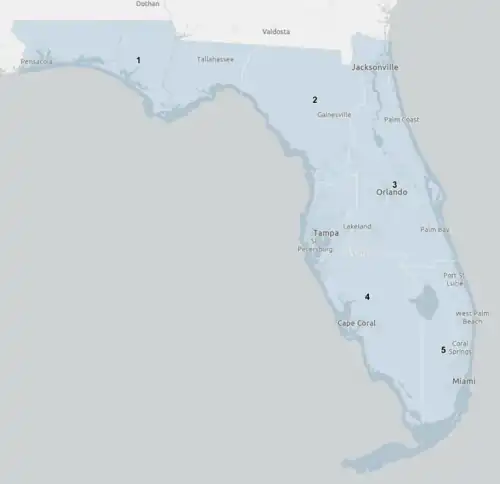
For field administration, the state is divided into five park districts:
- District 1, Northwest
- District 2, Northeast
- District 3, Central
- District 4, Southwest
- District 5, Southeast[39]
Park system
As of the mid-2020s the Florida Park Service manages roughly 176 units on approximately 815,000 acres, including state parks, state preserves, state recreation areas, state trails, and archaeological and historic sites.[1] Reported annual attendance regularly exceeds 25 million visitors, and the division has estimated the direct economic impact of the system at more than $3 billion annually.[1]
The division's unit classification system, adopted in 1972, distinguishes among:
- State parks, which balance resource protection with public recreation;
- State preserves, which prioritize protection of ecologically or archaeologically sensitive resources;
- State recreation areas, which emphasize outdoor recreation in less sensitive settings;
- State ornamental gardens and specialized historical or geological sites; and
- State trails, linear corridors managed for hiking, bicycling, and equestrian use.[3][29]
Land acquisition for the system continues to be funded primarily through the Florida Forever program and its predecessor Preservation 2000, together with the general and Land Acquisition Trust Fund appropriations.[34] Reservations for camping and cabins are administered through a statewide central reservation system, and visitor entrance fees make the park system, in most years, substantially self-supporting from operating revenue.[1]
Directors
Directors of the Florida Park Service and its predecessors have included:[3]
| # | Director | Tenure |
|---|---|---|
| 1 | Charles H. Schaeffer | 1935 to 1937 |
| 2 | Henry J. Malsberger | 1937 to 1940 |
| 3 | Lewis G. Scoggin | 1940 to 1952 |
| 4 | Walter Coldwell | 1952 to 1953; 1960 to 1963 |
| 5 | Emmet L. Hill | 1953 to 1960 |
| 6 | N. E. "Bill" Miller | 1963 to 1970 |
| 7 | Ney C. Landrum | 1970 to 1989 |
| Joseph F. Knoll (acting) | 1990 | |
| 8 | Fran P. Mainella | 1990 to 2001 |
| 9 | Wendy Spencer | 2001 to 2003 |
| 10 | Mike Bullock | 2003 to 2010 |
| 11 | Donald Forgione | 2010 to 2016 |
| Lisa Edgar (interim) | 2017 | |
| 12 | Eric Draper | 2017 to 2021 |
| 13 | Chuck Hatcher | 2021 to present |
Volunteers

Volunteers contribute a substantial portion of the Florida Park Service's workforce, providing more than one million volunteer hours annually across the system.[40] The service's volunteer program includes individual park volunteers, campground hosts, and organized Citizen Support Organizations (CSOs) that operate at both individual parks and statewide. All volunteers regardless of program are eligible for volunteer awards, defined by service hour milestones, which include pins, certificates, and park passes.[40]
Individuals and campground hosts
Individual volunteers assist rangers with visitor services, interpretive programming, resource management, and campground operations. The Park Service maintains a statewide volunteer portal that lets volunteers apply, log hours, and coordinate with park staff.[41] Long-term "campground host" volunteers can live on-site at their assigned park for extended stays in exchange for site fees and utilities, providing an evening staff presence at parks after regular ranger hours.[40]
Citizen Support Organizations
Citizen Support Organizations (CSOs), also known as "Friends" groups, are independent 501(c)(3) nonprofit corporations authorized to raise funds and coordinate volunteer activity on behalf of state parks. Most Florida state parks are supported by an affiliated CSO. Each CSO operates under a written partnership agreement with the Department of Environmental Protection and is required to submit an annual report describing its activities and finances to the department, which are compiled into a system-wide report.[42] The DEP sets standards for CSOs through the Citizen Support Organization Handbook for CSOs operating at Florida state parks.[43]
Florida State Parks Foundation
The Florida State Parks Foundation serves as the statewide CSO for the entire park system. Established on November 12, 1993, at Wekiwa Springs State Park as the Friends of Florida State Parks, it was renamed the Florida State Parks Foundation in 2018.[44] The organization provides fundraising, advocacy, and support services to individual park-level CSOs, and administers a Park Impact Grants program that distributes funding to local Friends groups.[45][44] The foundation reports supporting more than 20,000 park volunteers across the system.[45]
Recognition
The Florida State Parks system received the National Recreation and Park Association's National Gold Medal Award for Excellence in Park and Recreation Management in 1999, 2005, 2013, and 2019. The 2019 award made Florida the first state park system in the United States to receive the honor four times.[5][46]
Controversies
2011 golf course proposal
In early 2011, former Governor Rick Scott's administration promoted a proposal, developed with input from professional golfer Jack Nicklaus, to build private golf courses and associated hotels at Jonathan Dickinson State Park and several other units, modeled after the Robert Trent Jones Golf Trail in Alabama.[7] Legislation to authorize the project was introduced by state representative Patrick Rooney but withdrawn within a week after broad public opposition; Rooney told reporters that "Floridians spoke very clearly" against the plan.[7]
2024 Great Outdoors Initiative
On August 19, 2024, the Department of Environmental Protection announced the "2024–25 Great Outdoors Initiative," a proposal to add golf courses, pickleball courts, disc golf courses, and lodging at nine state parks, including Anastasia, Honeymoon Island, Topsail Hill Preserve, and Jonathan Dickinson.[47] The plan generated bipartisan opposition, including from Republican U.S. senators Marco Rubio and Rick Scott, and prompted protests at multiple parks.[6][48] Reporting later showed that Park Service staff and the public had not been consulted before the announcement.[49]
On August 28, 2024, Governor Ron DeSantis announced that the initiative was "going back to the drawing board" and stated, "We're not getting into the golf course business in the state of Florida."[6] The department subsequently withdrew all remaining proposals.[50] Following the episode, legislators from both parties filed measures intended to restrict future non-conservation development inside state parks.[51]
References
Notes
- ↑ Chapter 17025, Laws of Florida (1935). The citation is found in Blythe 2017, p. 60 n. 98.
- ↑ O'Leno State Park is usually listed among the original CCC-built Florida state parks, but it was originally developed jointly by the local Works Progress Administration and a Forestry CCC camp based out of Olustee. The park was not transferred to the FPS until 1941.[21]
Bibliography
- Blythe, Robert W. (2017). Wilderness on the Edge: A History of Everglades National Park. Chicago: National Park Service / Organization of American Historians.
- Vance, Linda D. (1976). "May Mann Jennings and Royal Palm State Park". Florida Historical Quarterly. 55 (1): 1–17.
- Vinten, C. R. (1944). "The Conservation of Historic Sites in Florida". Florida Historical Quarterly. 23 (2): 121–127.
- Colburn, David R. (2013). From Yellow Dog Democrats to Red State Republicans: Florida and Its Politics since 1940 (2nd ed.). Gainesville: University Press of Florida. ISBN 978-0-8130-4485-9.
- Landrum, Ney C. (2004). The State Park Movement in America: A Critical Review. Columbia: University of Missouri Press. ISBN 978-0-8262-2018-9.
- Nelson, David J. (2019). How the New Deal Built Florida Tourism: The Civilian Conservation Corps and State Parks. Gainesville: University Press of Florida. ISBN 978-0-8130-5631-9.
Citations
- 1 2 3 4 5 "About Florida State Parks". Florida Department of Environmental Protection, Division of Recreation and Parks. Retrieved July 31, 2026.
- 1 2 3 Nelson 2019, pp. 63–65.
- 1 2 3 4 5 6 7 8 9 10 11 12 13 14 15 "Florida State Park History". Florida Park Service Ranger Association. Retrieved July 31, 2026.
- 1 2 "History of State Lands". Florida Department of Environmental Protection. Retrieved July 31, 2026.
- 1 2 3 "2019 National Gold Medal Winner". Florida Department of Environmental Protection, Division of Recreation and Parks. Retrieved July 31, 2026.
- 1 2 3 "Following protests, DeSantis says a plan to develop state parks is 'going back to the drawing board'". WUSF. August 28, 2024. Retrieved July 31, 2026.
- 1 2 3 "Marco Rubio, Rick Scott lead elected official slam of Dickinson Park golfing plan". Florida Politics. August 21, 2024. Retrieved July 31, 2026.
- ↑ Nelson 2019, p. 215.
- ↑ Vance 1976, pp. 9–11.
- ↑ Blythe 2017, pp. 48–49.
- ↑ Vance 1976, pp. 13–14.
- ↑ Blythe 2017, p. 51.
- ↑ Landrum 2004, pp. 68–69.
- ↑ Vance 1976, pp. 16–17.
- ↑ Nelson 2019, p. 57.
- ↑ Nelson 2019, pp. 34–36.
- ↑ Nelson 2019, pp. 62–64.
- ↑ Nelson 2019, p. 95.
- 1 2 Nelson 2019, p. 69.
- ↑ Nelson 2019, pp. 113–136.
- ↑ Nelson 2019, pp. 91–92.
- ↑ Blythe 2017, pp. 56–57.
- ↑ Nelson 2019, pp. 1–3.
- ↑ Nelson 2019, pp. 203–204.
- 1 2 Nelson 2019, pp. 134–136.
- ↑ Nelson 2019, pp. 134–135.
- ↑ Nelson 2019, p. 96.
- 1 2 "Ney Landrum". Florida Park Service Ranger Association. Retrieved July 31, 2026.
- 1 2 3 Landrum 2004, pp. 176–177.
- ↑ Landrum 2004, pp. 207–208.
- ↑ Colburn 2013, pp. 88–90.
- ↑ Colburn 2013, pp. 117–119.
- 1 2 Colburn 2013, pp. 139–140.
- 1 2 "Florida Forever". Florida Department of Environmental Protection. Retrieved July 31, 2026.
- ↑ "16th National Park Service Director Fran P. Mainella". National Park Service, U.S. Department of the Interior. Retrieved July 31, 2026.
- 1 2 Klas, Mary Ellen (November 3, 2017). "Audubon executive director is tapped to run state park system, but not everyone is a fan". Tampa Bay Times. Retrieved July 31, 2026.
- 1 2 "DEP Names Chuck Hatcher Director of Division of Recreation and Parks". Florida Department of Environmental Protection. Retrieved July 31, 2026.
- ↑ "Retiring Florida parks director Eric Draper ranks climate change as a major threat". Florida Phoenix. December 30, 2021. Retrieved July 31, 2026.
- 1 2 "Parks and Recreation Topics". Florida Department of Environmental Protection. Retrieved July 31, 2026.
- 1 2 3 "Volunteer at a Florida State Park". Florida Department of Environmental Protection, Division of Recreation and Parks. Retrieved August 26, 2026.
- ↑ "Florida State Parks Volunteer Portal". Florida Department of Environmental Protection, Division of Recreation and Parks. Retrieved August 26, 2026.
- ↑ "Citizen Support Organizations Reports". Florida Department of Environmental Protection. Retrieved August 26, 2026.
- ↑ "Florida Park Service Citizen Support Organization Handbook" (PDF). Florida Department of Environmental Protection, Division of Recreation and Parks. January 15, 2015. Retrieved August 26, 2026.
- 1 2 "30th Anniversary Timeline". Florida State Parks Foundation. Retrieved August 26, 2026.
- 1 2 "About the Florida State Parks Foundation". Florida State Parks Foundation. Retrieved August 26, 2026.
- ↑ "NRPA Gold Medal Awards, Park and Recreation Management Excellence". National Recreation and Park Association. Retrieved July 31, 2026.
- ↑ "Ron DeSantis announces plan to build golf courses, pickleball courts at nine Florida state parks". The Architect's Newspaper. August 22, 2024. Retrieved July 31, 2026.
- ↑ "DeSantis blames 'left-wing group' for Great Outdoors Initiative". WLRN. August 28, 2024. Retrieved July 31, 2026.
- ↑ "PolitiFact FL: State parks proposal was further along than DeSantis let on". Jax Today. September 5, 2024. Retrieved July 31, 2026.
- ↑ "DeSantis disavows controversial state parks plan". Central Florida Public Media. August 28, 2024. Retrieved July 31, 2026.
- ↑ "To block another golf course debacle, Florida lawmakers try protecting state parks". Riverland News. Retrieved July 31, 2026.
Further reading
External links
- Official website
- Division of Recreation and Parks at Florida DEP
- Florida Park Service Ranger Association
- Florida State Parks Foundation
