Fast Life (1929 film)
| Fast Life | |
|---|---|
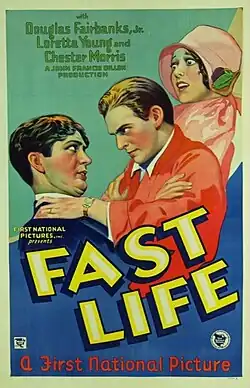 Theatrical release poster | |
| Directed by | John Francis Dillon |
| Screenplay by | John F. Goodrich |
| Based on | |
| Produced by | Richard A. Rowland |
| Starring | Douglas Fairbanks Jr. Loretta Young William Holden Frank Sheridan Chester Morris Ray Hallor |
| Cinematography | Faxon M. Dean |
| Edited by | Ralph Holt |
Production company | |
| Distributed by | Warner Bros. Pictures |
Release date |
|
Running time | 80 minutes |
| Country | United States |
| Language | English |
Fast Life is a 1929 American pre-Code drama film directed by John Francis Dillon and written by John F. Goodrich. It is based on the 1928 play Fast Life by Samuel Shipman and John B. Hymer. The film stars Douglas Fairbanks Jr., Loretta Young, William Holden, Frank Sheridan, Chester Morris, and Ray Hallor. The film was released by Warner Bros. Pictures on September 1, 1929.[1][2][3]
Plot
Douglas Stratton and Patricia “Pat” Mason Stratton have secretly married, concealing their union from friends and family due to social pressures and parental opposition. Despite their marriage, they continue living the fast, carefree social life that defines their circle, attending lively late-night parties filled with alcohol, flirtation, and jealousy.
The film begins during one of their late-night parties with two songs, a jazzy one ("A Fast Life And A Hot One") followed by a plaintive rendition of the theme song ("Since I Found You") sung by entertainers. As the party continues tensions rise as Pat is pursued by two persistent admirers: Rodney Hall, a jealous and volatile suitor, and Paul Palmer, the son of the State Governor. Both men are deeply in love with Pat, and their rivalry fuels constant friction. Douglas, though devoted to Pat, becomes increasingly distressed by their attention toward her, especially Rodney’s aggressive and drunken flirtations.
As the evening escalates, arguments repeatedly erupt between Douglas, Rodney, and Paul, with Pat forced to intervene multiple times to prevent violence. Eventually, as most of the guests have left and dawn approaches, Pat attempts to defuse the situation by accepting both Rodney’s and Paul’s offer to escort her home. However, she secretly intends to return to Douglas afterward, which she does—slipping away from both men and rejoining her husband in their apartment.
For a brief moment, Douglas and Pat enjoy a peaceful and intimate reunion. That peace is shattered when Rodney suddenly appears, drunk, enraged, and consumed by jealousy. He hurls insults at Pat and Douglas, provoking a violent confrontation. A brutal fight ensues between Douglas and Rodney inside the apartment.
At one point, Rodney suddenly collapses, pretending to suffer from a severe illness. Douglas, believing him to be genuinely stricken, leaves to call a doctor. But when Douglas returns, he discovers Rodney fully recovered and attempting to forcibly drag Pat away. The two men immediately clash again in a renewed and more violent struggle.
During the chaos, Paul Palmer appears and secretly picks up a dropped revolver. Without being seen, Paul fires a shot intended for Douglas but instead fatally wounds Rodney. In the confusion, Douglas is left holding the smoking gun and, unable to explain the situation clearly, is arrested. Despite his protestations of innocence, the evidence appears overwhelming, and he is convicted of Rodney’s death.
Douglas is sentenced to death and placed on death row. Governor Palmer grants two stays of execution, but refuses to pardon him without proof of another culprit. Meanwhile, Douglas sinks into despair, believing his fate sealed.
Behind the scenes, it is revealed that Paul Palmer is the true killer. Paul had been driven by obsessive love for Pat and believed that Douglas’s removal would allow him to win her. However, when Pat firmly and unequivocally affirms her devotion to Douglas, Paul is overcome with guilt and emotional collapse. He confesses the truth to Warden Palmer, his uncle.
The Warden, however, is torn. He understands that exposing Paul would devastate the Governor and destroy the family, placing him in a moral conflict between duty and loyalty. He initially decides to remain silent, even if it means Douglas’s execution proceeds.
At the final moment—just as Douglas is being prepared for execution—the Warden’s conscience finally breaks through. He intervenes, halting the execution and revealing Paul’s guilt. Douglas is saved and released.
In the aftermath, Paul, unable to bear the shame, the guilt, and the consequences of his actions, takes his own life at the Governor’s mansion. His death resolves the moral crisis but leaves lasting emotional devastation.
With the truth exposed and the ordeal behind them, Douglas Stratton and Patricia Mason Stratton are finally reunited, their love proven through betrayal, violence, and injustice. Having survived the nightmare, they are able to begin a new life together, free from the chaos that nearly destroyed them.
Cast
- Douglas Fairbanks Jr. as Douglas Stratton
- Loretta Young as Patricia Mason Stratton
- William Holden as Governor
- Frank Sheridan as Warden
- Chester Morris as Paul Palmer
- Ray Hallor as Rodney Hall
- John St. Polis as Andrew Stratton
- Purnell Pratt as Berton Hall
Music
The film featured a theme song entitled "Since I Found You" which was composed by Ray Perkins (music) and Herman Ruby (lyrics). Also featured on the soundtrack is a song entitled "A Fast Life And A Hot One" by the same composers.
Censorship
When Fast Life was released, many states and cities in the United States had censor boards that could require cuts or other eliminations before the film could be shown. While the Chicago Board of Censors may not have required any cuts, it passed the film with a pink ticket, or "adults only", while showing at the Oriental Theatre.[4] The restricted film, however, gave the theatre then highest gross for the week for those on the Chicago Loop, taking in $48,500.[5]
Preservation
This film is now lost.[6] Its Vitaphone soundtrack survives.
See also
References
- ↑ "Fast Life (1929) - Overview". Turner Classic Movies. Archived from the original on May 23, 2018. Retrieved May 22, 2018.
- ↑ Sandra Brennan. "Fast Life (1929) - John Francis Dillon". AllMovie. Retrieved May 22, 2018.
- ↑ "Fast Life". Catalog.afi.com. Retrieved May 22, 2018.
- ↑ "Fast Life and Modern Maidens Pinked for Chi". Variety. 96 (9). New York City: Variety, Inc.: 5 September 11, 1929. Retrieved January 6, 2026.
- ↑ "Pinked Fast Life Gave Oriental Loop Lead at $48,500". Variety. 96 (13). New York City: Variety, Inc.: 10 October 9, 1929. Retrieved January 21, 2026.
- ↑ Progressive Silent Film List: Fast Life at silentera.com
External links

- Fast Life at IMDb
- Fast Life at the TCM Movie Database (archived)
- Fast Life at the AFI Catalog of Feature Films