Executive Council of the Province of Canada
The Executive Council of the Province of Canada was the cabinet of the colonial government of the United Province of Canada, the polity in existence between 1841 and 1867. The council was not initially accountable to the Legislative Assembly of the Province of Canada, the legislature of the colony, but answered only to the Governor-General of the Province of Canada. Responsible government was not firmly established until 1848 under Lord Elgin. The council was the successor body of the Executive Council of Upper Canada and the Executive Council of Lower Canada and was dissolved in 1867 and was replaced by the Canadian Cabinet, the Executive Council of Ontario and the Executive Council of Quebec upon Canadian Confederation.
Members of the Executive Council functioned as portfolio ministers and advisers to the colonial governor, and later to the Joint Premier of the Province of Canada. They were generally members of the elected Legislative Assembly, but there were also some members from the appointed Legislative Council of the Province of Canada. Due to the frequent move of the colony's capital during this period, the council sat in five different cities during its short lifespan: Kingston (1841–43), Montreal (1843–49), Toronto (1849–52 and 1856–58), Quebec City (1852–1856 and 1859–66) and Ottawa (1866–67).
Partisanship
While political partisanship was certainly present during this era, it was neither formal nor clearly defined.[1] There was no contemporary political maps or listing of members (of the assembly or the executive council) by "political party" per se.[2] Partisan affiliations was not the sole, and sometimes not even the primary, determining factor of politicians' political allegiances, and how much their affiliation influenced their allegiances varied over time. Accordingly, the political affiliation classifications below serve only as general references to the broad political groupings the joint-premiers most likely belonged to, and the broad groupings the supporters of their governments most likely considered themselves as parts of. Varying classification systems/approaches and partisanship labels have been used by differing authors depending on the focus of their analysis. There were sub-groupings with membership that straddled multiple groupings with fluctuating degrees of cohesion and formality from session to session.[2] There were moderate and radical or "ultra" members within each grouping.[2] The ministry often could not count on the support of all members of the joint-premiers' political groupings and some counted on support from different rival fractions on different issues/voting divisions. The political deadlock and instability was the primary driver that led to the Great Coalition ministry, which eventually produced the Canadian Confederation.
Ministries and Premiers of the Province of Canada
- Conservative
- Reform
- Liberal-Conservative
- Liberal/Grits
- Coalition
- Governor driven / loyalist
| Ministry (Political party) |
Tenure | Joint-premiers | № | Governor General | ||||||
|---|---|---|---|---|---|---|---|---|---|---|
| Canada West | Canada East | |||||||||
| Governor Sydenham (Multi-partisan) |
February 13, 1841 – January 12, 1842 | Samuel Harrison
co-leading Executive Councillor |
[a] | 1st | Baron Sydenham
(1841) | |||||
| William Henry Draper co-leading Executive Councillor | ||||||||||
| Governor Bagot (Multi-partisan) |
January 12, 1842 – Sep 15, 1842 | Charles Richard Ogden co-leading Executive Councillor |
Sir Charles Bagot (1842–43) | |||||||
| Lafontaine-Baldwin I (Reform) |
Sep 16, 1842 – Nov 27, 1843 | Robert Baldwin Co-premier |
Louis-Hippolyte Lafontaine Premier | |||||||
| Draper (Pro-Governor; Tory/Conservative) |
Nov 27, 1843 – December 12, 1843 | vacant | Dominick Daly[b] de facto government leader[c] |
Sir Charles Metcalfe (1843–45) | ||||||
| December 12, 1843 – June 17, 1846 | William Henry Draper Premier |
Denis-Benjamin Viger Co-premier |
2nd | |||||||
| June 18, 1846 – May 28, 1847 | Denis-Benjamin Papineau Co-premier |
Earl Cathcart (1846–47) | ||||||||
| Earl of Elgin (1847–54) | ||||||||||
| Sherwood (Pro-Governor; Tory/Conservative) |
May 29, 1847 – December 7, 1847 | Henry Sherwood Premier | ||||||||
| December 8, 1847 – March 10, 1848 | vacant | 3rd | ||||||||
| Responsible government instituted | ||||||||||
| Lafontaine-Baldwin II (Reform) |
March 10, 1848 – October 27, 1851 | Robert Baldwin Co-premier |
Louis-Hippolyte Lafontaine, Premier | |||||||
| Hincks-Morin (Reform) |
October 28, 1851 – Sep 10, 1854 | Francis Hincks Premier |
Augustin-Norbert Morin Co-premier |
4th | ||||||
| MacNab-Morin/Taché (Coalition: Conservative, Bleu & moderate Reformers) |
Sep 11, 1854 – January 26, 1855 | Sir Allan N. MacNab Premier |
5th | Sir Edmund Walker Head (1854–61) | ||||||
| January 27, 1855 – May 23, 1856 | Étienne-Paschal Taché[b] Co-premier (until May 24, 1856) Premier | |||||||||
| Taché-Macdonald (Liberal-Conservative) |
May 24, 1856 – Nov 25, 1857 | John A. Macdonald Co-premier (until Nov. 26, 1857) Premier[b] |
||||||||
| Macdonald–Cartier I (Liberal-Conservative) |
Nov 26, 1857 – July 29, 1858 | George-Étienne Cartier Co-premier[b] |
6th | |||||||
| Interregnum | July 30, 1858 – August 1, 1858 | vacant | vacant | |||||||
| Brown–Dorion (Reform) (Clear Grits/Rouges) |
August 2, 1858 – August 4, 1858 | George Brown Premier |
Antoine-Aimé Dorion Co-premier | |||||||
| Interregnum | August 5, 1858 | vacant | vacant | |||||||
| Macdonald–Cartier II (Liberal-Conservative) |
August 6, 1858[d] – May 23, 1862 | John A. Macdonald Co-premier |
George-Étienne Cartier Premier | |||||||
| 7th | The Viscount Monck (1854–61) | |||||||||
| Sandfield Macdonald–Sicotte (Moderate Reform) |
May 24, 1862 – May 15, 1863 | John Sandfield Macdonald Premier |
Louis-Victor Sicotte Co-premier | |||||||
| Sandfield Macdonald–Dorion (Reform/Liberal) |
May 16, 1863 – March 29, 1864 | Antoine-Aimé Dorion Co-premier | ||||||||
| 8th | ||||||||||
| Great Coalition (coalition: Conservatives; Blues; most Liberals)[e] |
March 30, 1864 – July 30, 1865 | John A. Macdonald Co-premier |
Sir[3] Étienne-Paschal Taché†[f] Premier | |||||||
| July 31, 1865 – August 6, 1865 | vacant | |||||||||
| August 7, 1865 – June 30, 1867 | Sir Narcisse-Fortunat Belleau Premier[g] | |||||||||
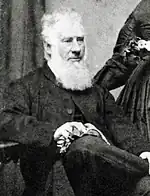


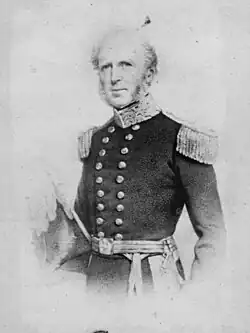
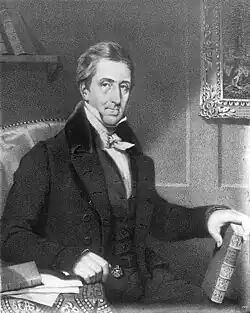




Offices held by executive councillors
The following offices were held by members of the executive council, thought not always:
- President of the Executive Council
- Attorney General, Lower Canada
- Attorney General, Upper Canada
- Provincial Secretary and Registrar (existed prior to 1842 as two separate offices, one each for Upper and Lower Canadas)
- Inspector General (after 1859 renamed Ministers of Finance) (sub-cabinet 1841–42)
- Receiver General
- Ministers of Agriculture (from 1852)[h]
- Commissioner of Public Works (in commission by members of the Board of Works 1841–46)[6]
- Commissioner of Crown Lands (sub-cabinet 1841–42)
- Solicitor General, Lower Canada (sub-cabinet 1845–47, 1848–58)
- Solicitor General, Upper Canada (sub-cabinet 1848–60)
- Postmaster General (sub-cabinet 1841–51)
- Superintendent General of Indian Affairs[i]
Presidents of the Executive Council
The title president of the council were usually not held by the actual leader of the government during this period. Allen MacNab was the only person who held the title while premier. George Brown held the title in Great Coalition years after his two day-tenure as Premier. Most, but not all, joint premiers held the office of Attorney General for the portion of the colony they hailed from.
- William Morris 1846–1848
- James Leslie 1848
- Philip Michael Matthew Scott VanKoughnet 1856
- Isidore Thibaudeau, May 16, 1863 – March 29, 1864
- George Brown June 30, 1864 – December 1865
- Adam Johnston Fergusson Blair 1866
Ministries
Sydenham-Bagot Ministry (February 1841 – September 1842)
In the months immediately following the reunion of the two Canadas, the ministry was led by the Governor General, the recently raised Baron Sydenham, himself. In his despatch to his direct superior, Colonial Secretary the Lord Russell on February 16, he reported having made only three appointments formally, appointing Dominick Daly, Samuel Harrison, and John Henry Dunn, to continue in their roles as provincial secretary for Lower Canada, for Upper Canada, and as Receiver General, and submitted additional names seeking approval from the Crown: Robert Baldwin Sullivan, William Henry Draper, and Robert Baldwin from Canada West and Charles Richard Ogden, Charles Dewey Day from Canada East, all to executive portfolios they held prior to the union.[7] [8] The line up was not well received in Lower Canada. The press noted that there was only one Catholic (Mr. Daly) in the administration, and not a single French Canadian.[9]
There was no premier identified in either Sydenham's despatch or in contemporary press reports. The mentions of Draper-Ogden cabinet or Harrison-Draper administration appeared half a century later in Senate debates[j] but mentions of the cabinet or individual executive councillors in news report of the day invariably portrayed them as advisors subservient to the Governor. In the debate to move the writ of election for the newly appointed Attorney General LaFontaine that took place in late 1842 Sir Allen MacNab, then in opposition, drew attention to the uncertain of status, and was met with uniform responses from executive councillors that it was not the right time to discuss the subject.[10]
Sydenham took an active role in lining up candidates that would be supportive of his administration in the lead up to the 1841 legislative election. The primary political dividing line during this brief period was the issue of the union. Political alignment could be generalized into the following four main groupings:[11]
- Upper Canada Tories, the all power elite who had wielded power former known as the Family Compact, saw the union as a threat of their power
- Upper Canada Reformers, who had been systematically prevented from power despite their large numbers, favoured the union as a means to divert power away from the Tories
- Lower Canada English Tories, a tiny minority of the population with an increasingly tenuous grip on power, supported the union to gain greater number of English speaking votes
- French Canadians, made up of nearly half the united province's population at the time but was excluded from political participation for two years due to the suspension of the constitution in Lower Canada, most strongly opposed to the union due to their exclusion in the process
Accordingly, the governor found himself relying on the support of reformers on one side and the Tories on the other. Elections were to take place in April and Sydenham had grand plans in mind. His low regard and misgiving for the Tory local leaders, those in Lower Canada in particular, motivated his aggressive drive to preserve the township form of municipal government in Upper Canada and to extend it to Lower Canada, believing that the provincial assemblies neither had the capacity nor the credibility to manage matters centrally.[12] Having made the command of a majority in the assembly a requirement of the future governments of the province, he set out on a tour of more than 40 towns for the purpose of handpicking candidates for the forthcoming elections to the united parliament in the months leading up to the reunion.[13]
Sydenham's engagement and interest in ministry building was not all that surprising. He was not yet forty when he was appointed to the post, and was considered a rising star with jilted ambition in Westminster just a year earlier, having previously entered cabinet at age 34 as the President of the Board of Trade (essentially trade minister) in the short-lived Whig Melbourne ministry. A ruthless veteran of consequential electoral politics back home, Sydenham did not refrain from high-handed tactics like gerrymandering and bribery with patronage. He also largely turned a blind eye to riots, election related violence instigated by the Orange Order and blatant electoral fraud.[14] His simultaneous aggressive intervention and non intervention resulted in electoral divisions such as Chambly, Rouville, Vaudreuil, Terrebonne, Beauharnois, all with overwhelming majority of French Canadians oppose to the union, returning the governors preferred candidates. For this Sydenham was severely criticized not just by local press but by newspapers back in London.[15] He was unapologetic however, having been quoted with this retort "If he means that I personally interfere he is quite misinformed, but the Govt. officials must try to get seats in Parliament… and they surely have a right to look after their elections."
Sydenham's supporters won thirteen of the forty-two seats in Canada East and an overwhelming twenty-six of the forty-two in Canada West, a total of thirty-nine firm supporters of the union against thirty-three opposed, and the ten remaining with uncertain allegiances. The group of supporters Sydenham assembled was shaky at best, however. While he controlled a good portion with government offices, his ministry was dependent on many independent minded reformers. Many new politician hand picked by him, including Hamilton Hartley Killaly who he quickly installed into the ministry, lacked political experience and wielded little influence in the legislature. After his ministry failed to get a bill passed to establish a single bank, according to his civil secretary Thomas Murdoch, Sydenham took control of not only policy making but also legislative strategy.
The ministry's most serious adversaries ultimately came from within. Robert Baldwin and Francis Hincks, two leading Reformers supportive of the ministry members of the ministry, parted ways with Sydenham over the clergy reserves bill, and sought to construct a united Reform Party in alliance with French speaking Reformers. They moved for an expression of non-confidence in four executive councillors, and demanded that the council be reconstituted on a party basis. While Sydenham's ministry survived the initial attack, the ministers conceded to the assembly that they would resign if they lost the confidence of the house. Sydenham, too, also acknowledged he could not perpetually set aside the democratic principles he practiced back home. He did not live to see the ministry he built collapse. An infection from a riding accident claimed his life on September 19, 1841, at age 42, a day after the first session of the legislative assembly prorogued.
Sydenham was succeeded by Sir Charles Bagot, who arrived in Kingston in January the following year and inherited Sydenham's ministry. Bagot spoke fluent French and swiftly took a number of actions that demonstrated his willingness to work with the French speaking community in Canada East, such as appointing French-speakers to government positions and suspending selected decrees of the notorious Special Council.[16] Bagot also took meaningful steps toward responsible government, despite maintaining an official position against any demand toward it.
Executive councillors of the Sydenham-Bagot Ministries
- Conservative
- Reform
- Governor loyalist
Officeholder was not a member of the Executive Council at the time.
| Office | Start | End | Holder | Constituency | Note | ||
|---|---|---|---|---|---|---|---|
| President of the Council | 1841-02-10 | 1943-11-27 | Robert Baldwin Sullivan | West | Leg. Co. (appointed) | later Reform | |
| Attorneys General, LC | 1841-02-10 | 1842-09-15 | Charles Richard Ogden | East | Three Rivers | ||
| Attorneys General, UC | 1841-02-10 | 1842-09-15 | William Henry Draper | West | Russell | ||
| Provincial Secretary, LC[k] | 1841-02-10 | 1848-03-10 | Dominick Daly | East | Megantick | ||
| Provincial Secretary, UC | 1841-02-10 | 1843-09-30 | Samuel Bealey Harrison | West | Kingston | ||
| Solicitor General, LC | 1841-02-10 | 1842-06-20 | Charles Dewey Day | East | Ottawa County | ||
| Solicitor General, UC | 1841-02-10 | 1841-06-13 | Robert Baldwin | West | Hastings | resigned | |
| 1842-07-23 | 1842-09-15 | Henry Sherwood | West | Toronto | |||
| Inspector General | 1841-02-10 | 1841-12-31 | James Cary (for LC) | n/a | sub-cabinet | ||
| 1841-02-10 | 1842-06-08 | J. Macaulay (for UC) | n/a | sub-cabinet | |||
| 1842-06-09 | 1843-12-11 | Francis Hincks | West | Oxford | |||
| Receiver General | 1841-02-10 | 1843-12-31 | John Henry Dunn | West | Toronto | ||
| Commissioner of Crown Lands | 1841-02-10 | 1841-06-30 | Robert Baldwin Sullivan | West | Leg. Co. (appointed) | ||
| 1841-07-23 | 1842-10-12 | John Davidson | n/a | sub-cabinet | |||
| Chair, Board of Works | 1841-12-21 | 1846-06-08 | Hamilton Hartley Killaly | West | London | ||
| Postmasters General | 1841-02-10 | 1851-02-21 | Thomas Allen Stayner | n/a | sub-cabinet |
First Lafontaine-Baldwin ministry (September 1842 – November 1843)
Strictly speaking, the first Reform ministry led by Robert Baldwin and Louis-Hippolyte Lafontaine was just part of Governor Bagot's ministry. On accepting the appointment as Governor General, Bagot was instructed to uphold existing policy of accommodation of the will of the local legislature without submitting to demands for responsible government. Bagot nonetheless took the advice of William Henry Draper and Samuel Harrison, his two leading moderate executive councillors, and negotiated with LaFontaine toward ending the exclusion of French speakers in government. In recognition of the sizable block of Reformers in the legislature, Bagot invited Louis-Hippolyte Lafontaine to nominate certain number of executive councillors in exchange for their support. Recognizing the likely danger of the continual exclusion of half of the colony's population, Draper offered his resignation along with those of other councillors to give the governor any required room for negotiation.
The result was the entry of Lafontaine and Robert Baldwin along with three of their nominees, Augustin-Norbert Morin and Thomas Cushing Aylwin from Canada East and James Edward Small from Canada West, into council. The incumbent councillors who were Reformers or primarily loyalist to the administration remained while Draper and two other Conservatives took their leave. Bagot also appointed Baldwin and Lafontaine as Attorney General of Upper and Lower Canada respectively, firmly establishing them as co-premiers of the his government. The continual presence of Sydenham's appointees who were not Reformers allowed Bagot to maintain the appearance of having starved off responsible government. But as Bagot admitted in his despatch to Colonial Secretary Edward Stanley, "whether the doctrine of responsible government is openly acknowledged, or is only tacitly acquiesced in, virtually it exists."[17]
Executive councillors in the first Lafontaine-Baldwin ministry
- Reform
- Governor loyalist
Officeholder was not a member of the Executive Council at the time.
| Office | Start | End | Holder | Constituency | Note | ||
|---|---|---|---|---|---|---|---|
| President of the Council | 1841-02-10 | 1943-11-27 | Robert Baldwin Sullivan | West | Leg. Co. (appointed) | later a Reformer | |
| Attorneys General, LC | 1842-09-17 | 1843-12-11 | Robert Baldwin | West | Rimouski* | ||
| Attorneys General, UC | 1842-09-16 | 1843-12-11 | Louis-Hippolyte Lafontaine | East | 4th York* | ||
| Provincial Secretary, LC[k] | 1841-02-10 | 1848-03-10 | Dominick Daly | East | Megantick | ||
| Provincial Secretary, UC | 1841-02-10 | 1843-09-30 | Samuel Bealey Harrison | West | Kingston | ||
| Inspector General | 1842-06-09 | 1843-12-11 | Francis Hincks | West | Oxford | ||
| Receiver General | 1841-02-10 | 1843-12-31 | John Henry Dunn | West | Toronto | ||
| Solicitor General, LC | 1842-09-24 | 1843-12-11 | Thomas Cushing Aylwin | East | Portneuf | ||
| Solicitor General, UC | 1842-09-26 | 1843-12-11 | James Edward Small | West | 3rd York | ||
| Commissioner of Crown Lands | 1842-10-13 | 1843-12-11 | Augustin-Norbert Morin | East | Saguenay | ||
| Chair, Board of Works | 1841-12-21 | 1846-06-08 | Hamilton Hartley Killaly | West | London | ||
| Postmasters General. | 1841-02-10 | 1851-02-21 | Thomas Allen Stayner | n/a | sub-cabinet |
As Bagot became ill in 1843, he handed off more of his authorities to his co-premiers. He died in May 1843, and the brief experiment of responsible came quickly to a halt under his successor.
Draper-Sherwood ministry (December 1843 – March 1848)
Executive councillors of the Draper-Sherwood Ministry
- Conservative
- Governor loyalist
Officeholder was not a member of the Executive Council at the time.
| Office | Start | End | Holder | Constituency | Note | ||
|---|---|---|---|---|---|---|---|
| Attorneys General, UC | 1843-12-12 | 1847-05-28 | William Henry Draper | West | Leg. Co. (appointed) | ||
| 1847-05-29 | 1848-03-10 | Henry Sherwood | West | Toronto | |||
| Attorneys General, LC | 1844-09-02 | 1847-04-22 | James Smith | East | Missiskoui | ||
| 1847-04-23 | 1848-03-10 | William Badgley | East | Missiskoui | |||
| President of the Council | 1843-12-12 | 1846-06-17 | Denis-Benjamin Viger | East | Richelieu | ||
| 1847-05-22 | 1848-03-10 | William Morris | West | Leg. Co. (appointed) | |||
| Provincial Secretary | 1841-02-13 | 1848-03-10 | Dominick Daly | East | Megantick | ||
| Inspector General | 1844-12-20 | 1845-04-30 | William Benjamin Robinson | West | Simcoe | ||
| 1845-08-06 | 1848-03-10 | William Cayley | West | Huron | |||
| Receiver General | 1844-09-02 | 1847-05-20 | William Morris | West | Leg. Co. (appointed) | ||
| 1847-05-11 | 1847-12-07 | John A. Macdonald | West | Kingston | |||
| 1847-12-08 | 1848-03-10 | François-Pierre Bruneau | East | Leg. Co. (appointed) | |||
| Commissioner of Crown Lands | 1844-09-02 | 1847-12-07 | Denis-Benjamin Papineau | East | Ottawa County | ||
| 1847-12-08 | 1848-03-10 | John A. Macdonald | West | Kingston | |||
| Solicitor General, UC | 1846-07-01 | 1848-03-10 | John Hillyard Cameron | West | Cornwall | sub-cabinet prior to 1847-05-22 | |
| Speaker of the Legislative Council | 1847-05-31 | 1848-03-10 | Peter McGill | East | Leg. Co. (appointed) | ||
| Chair, Board of Works | 1841-12-21 | 1846-06-08 | Hamilton Hartley Killaly | West | London | sub-cabinet | |
| Commissioner of Public Works | 1846-06-22 | 1848-03-10 | William Benjamin Robinson | West | Simcoe | sub-cabinet | |
| Solicitor General, UC | 1844-10-07 | 1846-06-30 | Henry Sherwood | West | Toronto | sub-cabinet | |
| Solicitor General, LC | 1845-08-21 | 1847-05-21 | J. A. Taschereau | n/a | sub-cabinet | ||
| 1847-12-08 | 1848-03-10 | J.E. Tarcotte | n/a | sub-cabinet | |||
| Postmasters General | 1841-02-10 | 1851-02-21 | Thomas Allen Stayner | n/a | sub-cabinet |
References
Notes
- ↑ Practice of government being headed jointly by a minister from Canada West and a minister from Canada East had not yet be formally established.
- 1 2 3 4 The honours associated with entitlement of being addressed as "sir" were conferred upon Daly/Taché/Macdonald /Cartier after this period in office. Daley was knighted in 1856; Taché in 1858;[3] Macdonald on Dominion Day in 1867; Cartier was created a Baronet in 1868[4]
- ↑ Daly was he only member remaining in the Executive Council following resignation of all Reform members
- ↑ See Double Shuffle
- ↑ 7 Liberals (Sandfield Macdonald faction) from Canada West and 21 Rouges were in opposition 31 Liberals from Canada West and 4 Liberals from Canada East support the coalition until 1866; in 1866 Brown and 8 others rejoined the Liberals in opposition.
- ↑ Died in office
- ↑ Belleau's partisan affiliation at this time is subject to debate. His selection was not opposed by Brown and Dorion who were in council at the time, likely a compromise choice.
- ↑ Office established by statue in 1852, but not held as a standalone office until 1862[5]
- ↑ Not a cabinet post prior to 1860 but a role commissioned to one of the secretaries of the Governor. From 1860 to 1867 ex officio of the Commissioner of Crown Lands
- ↑ for examples, seeJoseph-Hyacinthe Bellerose, Senator (April 7, 1897). "Debate on the Address". Parliamentary Debates (Hansard). Canada: Senate. p. 150-171.
- 1 2 from 1844 onward in later ministries, Provincial Secretary for the entire province
Cited work
- Côté, Joseph Olivier (1866). Political Appointments and Elections in the Province of Canada, 1841 to 1865 (2nd ed.). Quebec: St. Michel and Darveau.
- Cornell, Paul G. (1962). Alignment of Political Groups in Canada, 1841–67. Toronto: University of Toronto Press.
- Parliament of Great Britain (1841). Correspondence Relative to the Affairs of Canada 1841. William Clowes and Sons. ISBN 9780665285677.
{{cite book}}: ISBN / Date incompatibility (help) - Moore, Christopher (2011). 1867 How the Fathers Made a Deal. McClelland & Stewart. ISBN 978-1-55199-483-3.
- Scobie, H (1841). "Monthly Summary". The Monthly Review Devoted to the Civil Government of Canada. 1.
Additional citations and references
- ↑ Moore 2011.
- 1 2 3 Cornell 1962.
- 1 2 "No. 22201". The London Gazette. November 16, 1858. p. 4854.
- ↑ "No. 23411". The London Gazette. August 11, 1868. p. 4453.
- ↑ Côté 1866, p. 4.
- ↑ Côté 1866, p. 9.
- ↑ Parliament 1841, p. 28, No.12.
- ↑ Civil 1841, p. 207.
- ↑ Collection de documents inédits sur le Canada et l'Amérique. Vol. 2. L.-J. Demers. 1889. p. 29.
- ↑ "Provincial Parliament, Friday 16th Sept 1842". Western Herald. Vol. 5, no. 25. Sandwich, Canada. October 6, 1842. p. 1.
- ↑ Cornell 1962, pp. 4–12, 93–94.
- ↑ Parliament 1841, No.4, Despatch from the Rt Hon. C. POULETT THOMSON to Lord JOHN RUSSELL, dated Toronto, 16th September, 1840..
- ↑ Phillip Buckner (2021) [1988]. "THOMSON, CHARLES EDWARD POULETT, 1st Baron SYDENHAM". In Halpenny, Francess G. (ed.). Dictionary of Canadian Biography. Vol. VII (1836–1850) (online ed.). University of Toronto Press.
- ↑ Parliament 1841, p. 30.
- ↑ Parliament 1841, p. 34.
- ↑ Halpenny, Francess G., ed. (1988). "BAGOT, Sir CHARLES". Dictionary of Canadian Biography. Vol. VII (1836–1850) (online ed.). University of Toronto Press.
- ↑ Jacques Monet (1988). "Bagot, Sir Charles". In Halpenny, Francess G. (ed.). Dictionary of Canadian Biography. Vol. VII (1836–1850) (online ed.). University of Toronto Press.