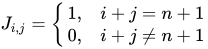
In mathematics, especially linear algebra, the exchange matrices (also called the reversal matrix, backward identity, or standard involutory permutation) are special cases of permutation matrices, where the 1 elements reside on the antidiagonal and all other elements are zero. In other words, they are 'row-reversed' or 'column-reversed' versions of the identity matrix.[1]

Definition
If J is an n × n exchange matrix, then the elements of J are
Properties
- Premultiplying a matrix by an exchange matrix flips vertically the positions of the former's rows, i.e.,

- Postmultiplying a matrix by an exchange matrix flips horizontally the positions of the former's columns, i.e.,

- Exchange matrices are symmetric; that is:

- For any integer k:
 In particular, Jn is an involutory matrix; that is,

- The trace of Jn is 1 if n is odd and 0 if n is even. In other words:

- The determinant of Jn is:
 As a function of n, it has period 4, giving 1, 1, −1, −1 when n is congruent modulo 4 to 0, 1, 2, and 3 respectively.
- The characteristic polynomial of Jn is:
^{\frac {n+1}{2}}(\lambda +1)^{\frac {n-1}{2}}&{\text{ if }}n{\text{ is odd,}}\end{cases}}}](./_assets_/eb734a37dd21ce173a46342d1cc64c92/923496ff9975512bbf3e4a9759190c53dacd94e1.svg)
its eigenvalues are 1 (with multiplicity  ) and -1 (with multiplicity
 ).
- The adjugate matrix of Jn is:
 (where sgn is the sign of the permutation πk of k elements).
Relationships
- An exchange matrix is the simplest anti-diagonal matrix.
- Any matrix A satisfying the condition AJ = JA is said to be centrosymmetric.
- Any matrix A satisfying the condition AJ = JAT is said to be persymmetric.
- Symmetric matrices A that satisfy the condition AJ = JA are called bisymmetric matrices. Bisymmetric matrices are both centrosymmetric and persymmetric.
