Eurovision Young Dancers 2003
| Eurovision Young Dancers 2003 | |
|---|---|
 | |
| Dates and venue | |
| Semi-final |
|
| Final |
|
| Venue | Stadsschouwburg Amsterdam, Netherlands |
| Organisation | |
| Organiser | European Broadcasting Union (EBU) |
| Executive supervisor | Sarah Yuen |
| Production | |
| Host broadcaster | Nederlandse Programma Stichting (NPS) |
| Director | Ross MacGibbon |
| Executive producer | Henk van der Meulen |
| Presenter | Aldith Hunkar |
| Participants | |
| Number of entries | 17 |
| Number of finalists | 10 |
| Debuting countries |
|
| Non-returning countries |
|
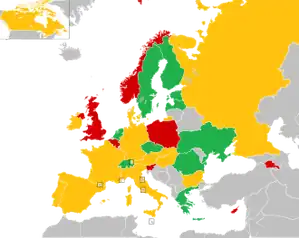
Participation map
| |
| Vote | |
| Voting system | A professional jury chose the finalists and gave points to each performance |
| Winning dancers |
|


The Eurovision Young Dancers 2003 was the 10th edition of the Eurovision Young Dancers. It consisted of a semi-final on 2 July and a final on 4 July 2003, held at the Stadsschouwburg Theatre in Amsterdam, Netherlands, and presented by Aldith Hunkar. It was organised by the European Broadcasting Union (EBU) and host broadcaster Nederlandse Programma Stichting (NPS).
Dancers representing seventeen countries took part in the competition, with ten of them participating in the televised final. Armenia and Romania made their début while Austria, Germany and Ireland decided not to participate.[1] This was the first EBU event to feature a representative from Armenia, who would subsequently debut at both the Eurovision Song Contest and Junior Eurovision Song Contest, three and four years later respectively.
Each participating broadcaster could send one or two dancers, male or female, not older than 20. All countries except the host (Netherlands) had to take part in the semi-final.
Duo Kristina Oom and Sebastian Michanek representing Sweden won the contemporary dance prize, with Jerlin Ndudi representing Ukraine winning the classical dance prize. Duo Monika Hejduková and Viktor Konvalinka representing Czech Republic won the 'Youth Jury Choice' award.[2]
Location

Stadsschouwburg Theatre in Amsterdam, Netherlands was the host venue for the 2003 edition of the Eurovision Young Dancers.[3] The building is in the neo-Renaissance style dating back to 1894, and is the former home of the National Ballet and Opera.[4]
Format
The format consists of dancers who are non-professional and between the ages of 16–21, competing in a performance of dance routines of their choice, which they have prepared in advance of the competition. All of the acts then take part in a choreographed group dance during 'Young Dancers Week'.[5]
Jury members of a professional aspect and representing the elements of ballet, contemporary, and modern dancing styles, score each of the competing individual and group dance routines. The overall winner upon completion of the final dances is chosen by the professional jury members.[5] All participants received a medal, designed by Dutch artist Dinie Besems.[1]
There was no interval act this year, with footage of previous contest winners and an offstage interview with Agnès Letestu, winner of the contemporary dance prize in 1989, broadcast instead.
Participants and results
Preliminary round
Broadcasters from seventeen countries took part in the preliminary round of the 2003 contest, of which ten qualified to the televised grand final. The following participants failed to qualify.[3][6]
| Country | Broadcaster | Dancer(s) | Dance | Choreographer |
|---|---|---|---|---|
 United Kingdom | BBC | Kate Lyons | The Girl | M. Baldwin |
 Belgium | RTBF | Sébastien Tassin | Coppélia | A. Saint-Léon |
 Cyprus | CyBC | Natalia Krekou | After | A. Hatjieftychiou |
 Slovenia | RTVSLO | Anže Škrube | Club Hoppin | D. Popovski |
 Armenia | ARMTV | Avetik Karapetyan | Rhythm of Spirit | H. Divanyan |
 Norway | NRK | Caroline Roca | Afraid of Beauty | P. Touzeau |
 Poland | TVP | Jakub Greda | Solo Hip-Hop | A. Grazul and R. Ziolkowski |
Final
There were two prizes given this year: one for contemporary dance (awarded to Sweden) and one for classical ballet dance (awarded to Ukraine). A special "young jury" award was given as well by a group of young viewers that were in the audience, this went to contemporary runner-up Czech Republic.[3][7]
Classical category
| Country | Broadcaster | Dancer(s) | Dance | Choreographer | Points | Place |
|---|---|---|---|---|---|---|
 Ukraine |
NTU | Jerlin Ndudi | Le Corsaire | M. Petipa | 938 | 1 |
 Estonia |
ETV | Maria Seletskaja | Swan Lake | M. Petipa | 800 | 3 |
 Finland |
Yle | Tiina Myllymäki | Paquita | Makarova and M. Petipa | 745 | 5 |
 Greece |
ERT | Elenina Nicolaou | M. Petipa | 716 | 6 | |
 Romania |
TVR | Ovidiu Matei Iancu | Swan Lake | 831 | 2 | |
 Switzerland |
SRG SSR | Sarah-Jane Brodbeck | Don Quixote | 793 | 4 |
Contemporary category
| Country | Broadcaster | Dancer(s) | Dance | Choreographer | Points | Place |
|---|---|---|---|---|---|---|
 Sweden |
SVT | Kristina Oom and Sebastian Michanek | Light Beings | M. Ek | 907 | 1 |
 Czech Republic |
ČT | Monika Hejduková and Viktor Konvalinka | The Twilight Of Innocence | Kodel and Vágnerová | 856 | 2 |
 Netherlands |
NOS | Joeri Dubbe | Perfect Skin | E. Wubbe | 781 | 3 |
 Latvia |
LTV | Linda Siliņa | La Primavera | I. Lapsiņa | 777 | 4 |
Jury members
The jury members consisted of the following:[3]
 Russia – Vladimir Vasiliev
 Germany – Susanne Linke
 Italy – Paola Cantalupo
- Netherlands – Derrick Brown
 United States – Liz Imperio
Broadcasting
26 national broadcasters[8] in 23 countries transmitted the 2003 event.[9] Albania, Croatia, Germany, Iceland, Puerto Rico, and Serbia and Montenegro all broadcast the contest in addition to the competing countries. Known details on the broadcasts in each country, including the specific broadcasting stations and commentators are shown in the tables below.
| Country | Broadcaster(s) | Channel(s) | Commentator(s) | Ref(s) |
|---|---|---|---|---|
| Armenia |
Armenia TV | [10] | ||
| Belgium |
RTBF | La Deux | [11] | |
| Cyprus |
CyBC | |||
| Czech Republic |
ČT | ČT2[b] | [12] | |
| Estonia |
ETV[c] | [13] | ||
| Finland |
Yle | TV1 | [14] | |
| Greece |
ERT | |||
| Latvia |
LTV | |||
| Netherlands |
NOS | Nederland 3 | [15] | |
| Norway |
NRK | NRK1[d] | [16] | |
| Poland |
TVP | TVP2 | ||
| Romania |
TVR | TVR 2 | ||
| Slovenia |
RTVSLO | |||
| Sweden |
SVT | SVT1, SVT2, SVT Europa | Agneta Bolme Börjefors | [17][18] |
| Switzerland |
DRS | SF 1[e] | [19] | |
| TSR | ||||
| TSI | ||||
| Ukraine |
NTU | Pershyi | Yuri Stanishevsky | |
| United Kingdom |
BBC | BBC Four[f] | Deborah Bull | [20] |
| Country | Broadcaster(s) | Ref(s) |
|---|---|---|
 Albania |
RTVSH | |
 Croatia |
HRT | |
| Germany |
3sat[g] | [21] |
 Iceland |
RÚV | |
 Kosovo |
RTK | |
 Puerto Rico |
||
 Serbia and Montenegro |
UJRT | |
See also
Notes and references
Notes
- ↑ Armenia took part for the first time in the semi-final since they did not reach the final. Their debut in a Final of the Young Dancers contest took place in 2013
- ↑ Delayed broadcast on 25 October[12]
- ↑ Deferred broadcast on 11 July at 22:30 EET[13]
- ↑ Deferred broadcast on 13 August at 19:30 CEST[16]
- ↑ Deferred broadcast on 6 July at 23:05 CEST[19]
- ↑ Deferred broadcast on 12 July at 19:00 UTC[20]
- ↑ Deferred broadcast on 2 August at 11:15 CET[21]
References
- 1 2 "10th Eurovision Young Dancers". EBU. 13 February 2013. Archived from the original on 13 February 2013. Retrieved 3 May 2018.
- ↑ "Eurovision Young Dancers 2003: Participants". youngmusicians.tv. European Broadcasting Union. Retrieved 5 October 2014.
- 1 2 3 4 "Eurovision Young Dancers 2003: About the show". European Broadcasting Union. Retrieved 5 October 2014.
- ↑ Martin Dunford (2010). The Rough Guide to The Netherlands. Penguin. p. 74. ISBN 978-1-84836-882-8.
- 1 2 "Eurovision Young Dancers - Format". youngdancers.tv. European Broadcasting Union. Archived from the original on 11 February 2015. Retrieved 8 March 2015.
- ↑ "Eurovision Young Dancers 2003". 10 October 2004. Archived from the original on 10 October 2004. Retrieved 5 May 2019.
- ↑ "Eurovision Young Dancers Awards Ukrainian and Swedish winners". 7 July 2003. Archived from the original on 24 December 2004. Retrieved 9 October 2019.
- ↑ "Eurovision Young Dancers 2003". 2 June 2011. Archived from the original on 2 June 2011. Retrieved 3 May 2018.
- ↑ "2003 Countries Broadcastrs" (PDF). young-dancers.com. 25 June 2003. Archived from the original (PDF) on 31 March 2004. Retrieved 3 May 2018.
- ↑ Rau, Oliver (19 July 2003). "'Armenia to participate in Song Contest 2004'". ESCToday. Archived from the original on 3 November 2013.
- ↑ "BnL Viewer". viewer.eluxemburgensia.lu. Retrieved Jun 1, 2026.
- 1 2 "Eurovizní soutěž mladých tanečníků 2003 - Eurovizní soutěž mladých tanečníků | Česká televize". www.ceskatelevize.cz. Retrieved Jun 1, 2026.
- 1 2 "Maria Seletskaja jõudis Tantsu-Eurovisiooni finaali". Kultuur. Jul 3, 2003. Retrieved Nov 7, 2025.
- ↑ "Tiina Myllymäki pääsi EBU:n tanssikilpailun finaaliin". Kaleva. Retrieved Nov 7, 2025.
- ↑ "Algemeen Dagblad". July 4, 2003 – via Delpher.
- 1 2 "Prestisjefylt dansekonkurranse". arkiv.nrk.no. Retrieved Jun 1, 2026.
- ↑ "Välkommen till SMDB". smdb.kb.se. Retrieved Jun 1, 2026.
- ↑ "Välkommen till SMDB". smdb.kb.se. Retrieved Jun 1, 2026.
- 1 2 https://www.e-newspaperarchives.ch/?a=d&d=FZG20030705-01.2.103
- 1 2 "Young Dancer". 10 July 2003. p. 56. Retrieved 1 May 2018 – via BBC Genome.
- 1 2 https://www.e-newspaperarchives.ch/?a=d&d=TGZ20030802-01.2.32
