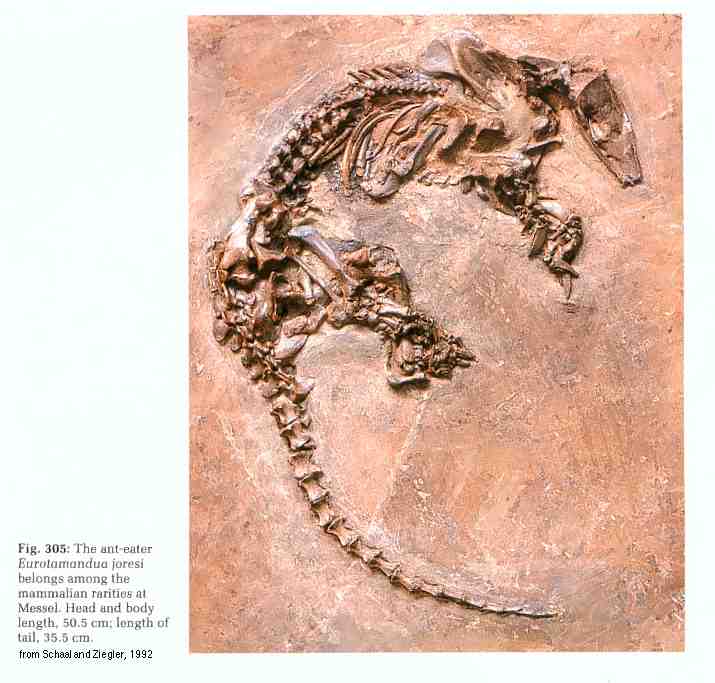
Eurotamandua
| Eurotamandua | |
|---|---|
 | |
| Fossil of Eurotamandua joresi | |
 | |
| Life reconstruction of Eurotamandua joresi | |
Scientific classification  | |
| Kingdom: | Animalia |
| Phylum: | Chordata |
| Class: | Mammalia |
| Infraclass: | Placentalia |
| Clade: | Pholidotamorpha |
| Order: | †Afredentata Szalay & Schrenk, 1994[1] |
| Family: | †Eurotamanduidae Szalay & Schrenk, 1994 |
| Genus: | †Eurotamandua Storch, 1981[2] |
| Type species | |
| †Eurotamandua joresi Storch, 1981 | |
Eurotamandua ("European Tamandua") or European anteater, is an extinct genus of placental mammals from extinct family Eurotamanduidae and extinct order Afredentata from clade Pholidotamorpha. It lived during the middle Eocene in Europe. Eurotamandua fossils found in the Messel Pit in southwestern Germany.[3]
Characteristics and paleobiology
A single fossil is known, coming from the Messel Pit in Germany. Eurotamandua was about 90 cm (35 in) long. Eurotamandua bears characteristics found in almost all ant-eating mammals: long claws, an elongated snout, and most likely the same long, sticky tongue. These features led Eurotamandua to be initially misclassified as a xenarthran anteater, which was common for many ant-eating mammals prior to the 20th century. Presumably it also fed on ants and termites.[4] The generic name comments on the strong, albeit possibly superficial resemblance to modern arboreal anteaters of the genus Tamandua, especially with its long, prehensile tail.
Classification and phylogeny
History of taxonomy
When its fossils were first discovered, Eurotamandua was originally thought to be an anteater related to genus Tamandua, and later as primitive member of Xenarthra. However, this classification was highly unlikely because all known fossil evidence indicates that xenarthrans existed exclusively in South America from the beginning of the Cenozoic era until the formation of the Panama land bridge (3 million years ago), after which they spread to North America, but never to Eurasia or Africa.[5] Another possibility that arised at time was that Eurotamandua belongs to Afrotheria.[6]
Later studies set Eurotamandua's placement within the pangolins was made primarily because of a lack of the characteristic "xenarthran" joints found in all xenarthrans, including tamanduas. It was thought to be a primitive member of order Pholidota as it lacked the characteristic fused-hair scales of other pangolins. It was closer to suborder Eupholidota more than genus Euromanis.[7][8]
However, a 2026 studies found that this extinct genus of mammals is not member of order Pholidota, and is more closely related to order Palaeanodonta along side genus Euromanis.[9][5][10]
Phylogeny
| Phylogenetic position of genus Eurotamandua based on Rose (2026.) study:[5] | |||||||||||||||||||||||||||||||||
|---|---|---|---|---|---|---|---|---|---|---|---|---|---|---|---|---|---|---|---|---|---|---|---|---|---|---|---|---|---|---|---|---|---|
|
See also
References
- ↑ "Abstracts of Papers". Journal of Vertebrate Paleontology. 14: 1–58. 1994. Bibcode:1994JVPal..14S...1.. doi:10.1080/02724634.1994.10011592.
- ↑ Gerhard Storch: "Eurotamandua joresi, ein Myrmecophagide aus dem Eozän der "Grube Messel" bei Darmstadt (Mammalia, Xenarthra)." Senckenbergiana lethaea 61 (3/6), (1981), S. 247–289
- ↑ Delsuc, Frédéric; Vizcaíno, Sergio F.; Douzery, Emmanuel J. P. (28 April 2004). "Influence of Tertiary paleoenvironmental changes on the diversification of South American mammals: a relaxed molecular clock study within xenarthrans". BMC Evolutionary Biology. 4 (1): 11. doi:10.1186/1471-2148-4-11. ISSN 1471-2148. PMC 419338. PMID 15115541.
- ↑ Palmer, D., ed. (1999). The Marshall Illustrated Encyclopedia of Dinosaurs and Prehistoric Animals. London: Marshall Editions. p. 209. ISBN 1-84028-152-9.
- 1 2 3 Rose, K. D.; Rabenstein, R.; Habersetzer, J.; Gaudin, T. J. (2026). "Anatomy of Eurotamandua joresi (Mammalia) from Grube Messel, Germany, based on computed tomography, and implications for its relationships. Part I: Background and forelimb". Palaeobiodiversity and Palaeoenvironments. doi:10.1007/s12549-025-00686-x.
- ↑ Hunter, John P. and Janis, Christine M. (2006.) "Spiny Norman in the Garden of Eden? Dispersal and early biogeography of Placentalia." J Mammal Evol 13:89–123
- ↑ Gaudin, Timothy (2009). "The Phylogeny of Living and Extinct Pangolins (Mammalia, Pholidota) and Associated Taxa: A Morphology Based Analysis" (PDF). Journal of Mammalian Evolution. 16 (4). Heidelberg, Germany: Springer Science+Business Media: 235–305. doi:10.1007/s10914-009-9119-9. S2CID 1773698. Archived from the original (PDF) on 25 September 2015. Retrieved 16 November 2020.
- ↑ Kondrashov, Peter; Agadjanian, Alexandre K. (2012). "A nearly complete skeleton of Ernanodon (Mammalia, Palaeanodonta) from Mongolia: morphofunctional analysis". Journal of Vertebrate Paleontology. 32 (5): 983–1001. Bibcode:2012JVPal..32..983K. doi:10.1080/02724634.2012.694319. ISSN 0272-4634. S2CID 86059673.
- ↑ Tumothy J. Gaudin, Kenneth D. Rose, Renate Rabenstein, Jörg Habersetzer (2023.) "New forelimb details of Eurotamandua, purpoted anteater from the middle Eocene of Messel, Germany, reveal extraordinary similarities to palaeanodonts (Pholidotamorpha), not to Xenarthra", in "The Society of Vertebrate Paleontology 83rd annual meeting"
- ↑ Rose, K. D.; Rabenstein, R.; Habersetzer, J.; Gaudin, T. J. (2026). "Micro-computed tomography indicates Eurotamandua, putative anteater from the Eocene of Messel, Germany, is related to pangolins, not xenarthrans". Scientific Reports. doi:10.1038/s41598-026-51713-6.
External links
- Online discussion of Eurotamandua relations Archived 8 June 2007 at the Wayback Machine
- Photo of fossil